


Quick Answer: What Are Chinese Folk Tales?
Chinese folk tales are stories transmitted and reshaped through telling, writing and performance. English collections often use the label broadly, bringing together love legends, magical adventures, animal stories and tales of clever or foolish people.
- Familiar entry points: Four celebrated legends offer stories of love, separation, grief and extraordinary reunion.
- A wider field: Creation myths, humorous tales, spirit encounters and stories drawn from novels circulate alongside them.
- Regional traditions: Language, community, performer and occasion can change both the story and the experience of hearing it.
There is no single book containing the definitive form of every Chinese tale, and a famous national selection does not represent every local tradition.
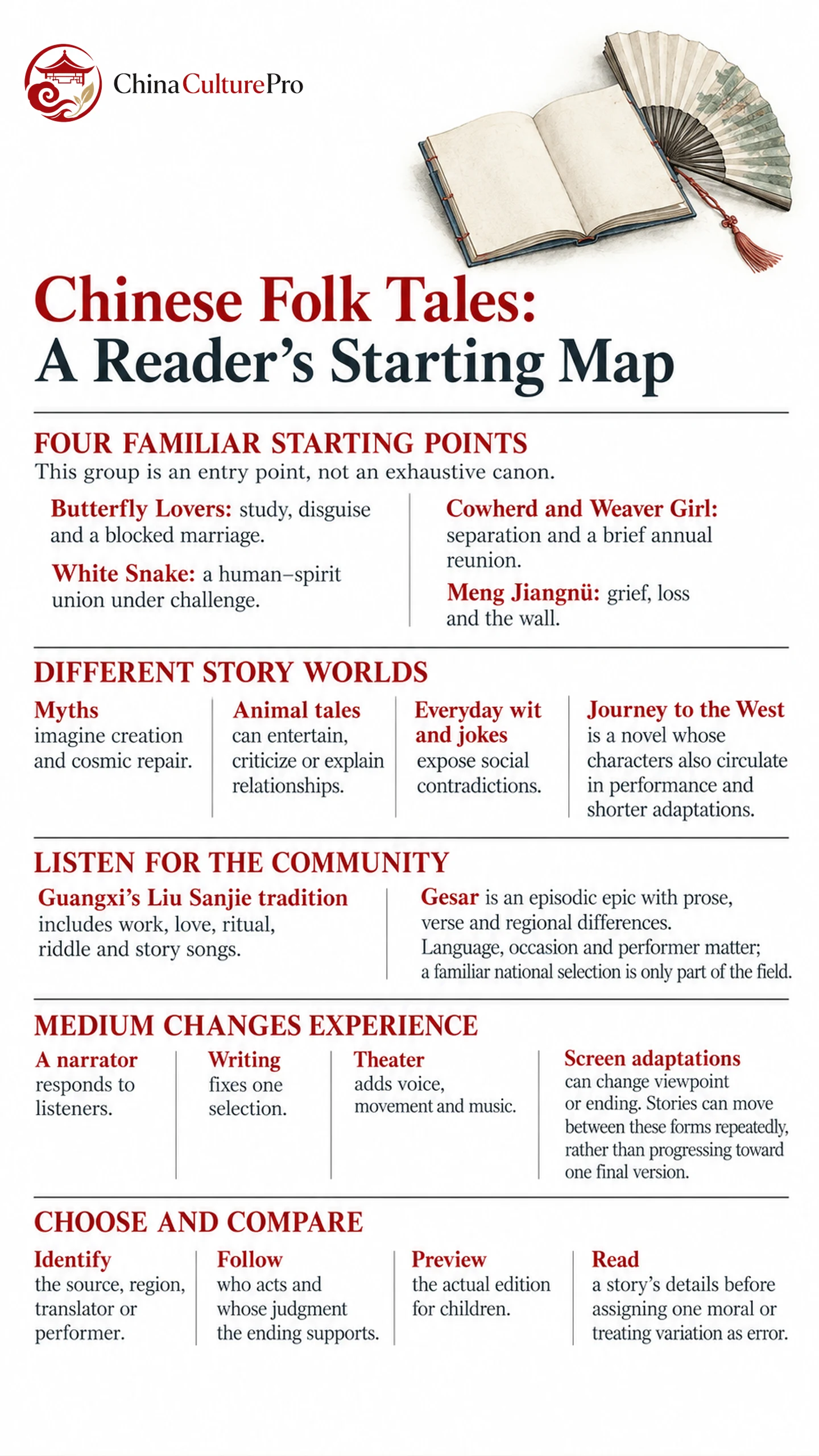
A story can be heard at home, sung onstage, printed in a schoolbook and retold on a screen. Each setting makes different choices about what to explain, emphasize or leave out. This guide offers recognizable starting points while keeping the wider world of regional storytelling in view, so readers can choose a tale and understand the version they encounter.
Four Great Folk Legends: Where to Start
The group commonly called China’s four great folk legends is a useful introduction, particularly for readers interested in human relationships. Their shared fame does not make their plots interchangeable. Each imagines a different response to separation or loss.
| Legend | Defining conflict and memorable image | A reason to start here |
|---|---|---|
| Butterfly Lovers (梁祝,Liáng Zhù) | A student disguise leads to friendship and love, but an existing marriage arrangement blocks the couple. The familiar ending transforms them into butterflies. [1] | Education, recognition and personal choice. |
| White Snake (白蛇传,Báishé Zhuàn) | A snake spirit marries a human; disclosure and a monk’s intervention threaten their life together. Confinement or later release changes the ending. [2] | A supernatural romance with changing moral perspectives. |
| Cowherd and Weaver Girl (牛郎织女,Niúláng Zhīnǚ) | A heavenly river divides the lovers. A magpie bridge permits a brief reunion associated with Qixi. [3] | Sky imagery and the meaning of limited reunion. |
| Meng Jiangnü (孟姜女,Mèng Jiāngnǚ) | A woman’s grief for her dead husband becomes linked with a collapsing wall and the suffering caused by war or forced labor. [4] | The force of lament and a legend’s changing historical setting. |
These summaries identify the tales rather than replacing them. A full telling lets an apparently small event—a missed hint, an umbrella, a departure or a lament—acquire its emotional weight. The linked stories examine the different versions more closely.
Myths, Animal Tales and Stories from Novels
The field is wider than tragic romance. One cultural classification distinguishes imaginary tales, stories of ordinary life, animal tales and folk jokes. Talking animals can entertain, expose a human weakness or explain a relationship: the feud between cats and dogs is one recorded example, while zodiac-animal stories offer another familiar route. Clever figures, foolish relatives and unequal encounters also provide material for humor and social criticism. [5]
Myths ask different kinds of questions. Nüwa(女娲,Nǚwā)repairs a damaged heaven, while Hou Yi(后羿,Hòu Yì)confronts a world threatened by too many suns. These accounts explain a habitable world through extraordinary acts; they are useful companions to folk legends without requiring identical genre labels. [6][7] Explore the broader Chinese mythology collection for that strand, or Chinese fables for shorter tales built around actions and consequences.
Written fiction enters popular circulation too. Journey to the West(西游记,Xīyóu Jì)is a novel whose Monkey King and pilgrimage episodes have acquired lives in performance, children’s adaptations and screen media. The received novel remains a distinct literary form even when its characters circulate in shorter tales. [8] The Journey to the West guide follows that literary context.
Regional Traditions Beyond a Single Canon
“Chinese” names a broad cultural field here, not one uniform voice. A local language can shape rhyme and humor; a community’s landscape can provide the bridge, mountain or shrine; an occasion can determine whether the story is spoken, sung or acted.
Liu Sanjie(刘三姐,Liú Sānjiě)offers a concrete example. The Guangxi tradition associated with this celebrated singer includes songs of work, love, ritual, riddles, stories and creation. Its national heritage entry locates an important center in Yizhou and describes its Zhuang setting. Reducing the tradition to the plot of one familiar film would leave out much of that repertoire. [9]
Gesar(格萨尔,Gésà’ěr)provides a different comparison. Tibetan, Mongolian and Tu communities transmit the epic tradition through episodes, with alternating prose and verse and substantial regional variation. It belongs to the wider world of oral narrative, but its scale and performance practice differ from a short fairy tale. [10]
These examples are reasons to ask which community and performance a collection represents. They are not additions to a new mandatory list. A regional account need not match the wording of a national schoolbook to have value.
How Stories Move Between Voice, Page and Stage
Oral telling gives a narrator room to respond to listeners, explain a local reference or dwell on a favored episode. Writing fixes one selection of words and scenes. Theater adds bodies, voices, music and a shared occasion. A screen adaptation can expand a secondary character or replace an ending.
The movement is not always one-way from an original oral tale to a final book. Written plots can return to performance; a famous production can influence how a family tells the story afterward. Chinese folk and popular literature includes intertwined traditions of songs, ritual, drama, epics and professional storytelling. Scholarly collections preserve those differences rather than treating every item as the same literary form. [11]
The medium therefore belongs to the evidence. A recorded performance preserves an event and an interpreter; an English translation preserves a translator’s choices; a local heritage entry documents a community’s transmission. None is automatically the last or only version. For a closer look at performance, see Chinese storytelling.
How to Read Different Versions
Begin with the title, but also notice the source. A retelling that identifies its text, region or performer gives you a stronger basis for comparison than one labeled only “an ancient Chinese story.” Look for a translator or adapter when reading in English.
Then follow the actual conflict. Who acts, who makes a judgment and who receives the ending’s sympathy? A White Snake retelling centered on danger asks a different question from one centered on the heroine’s loyalty. The difference may be its purpose rather than a copying error.
For children, preview the chosen edition. Familiar titles can contain death, punishment, frightening transformations or coercive situations; a gentle picture-book adaptation and an older full text may be very different reading experiences. Match the particular telling to the reader rather than assigning an age to the entire tradition.
Finally, resist extracting one compulsory moral. A story can entertain, criticize authority, express longing or explain a place at the same time. Begin with what happens and how it is told; interpretation becomes more useful when it stays connected to those details.
FAQs About Chinese Folk Tales
What are China’s four great folk legends?
The usual group is the Butterfly Lovers, White Snake, Cowherd and Weaver Girl, and Meng Jiangnü. It is a famous selection, not the whole of Chinese storytelling.
Are Chinese folk tales and Chinese mythology the same?
They overlap in collections and popular use, but the labels do different work. Creation and cosmic myths differ from everyday trickster tales or local legends.
Are all traditional tales suitable for children?
No. Content varies by text and adaptation. Preview the actual version for frightening scenes, death, punishment and other themes relevant to the reader.
Why do versions of the same story differ?
Region, language, performer, medium and intended audience can all change a telling. A useful comparison identifies those choices before deciding that a difference is an error.
Sources
[1] Zhejiang Provincial Department of Culture and Tourism, via Zhejiang International Communication Center. Butterfly Lovers
[2] CGTN, via Zhejiang government. White Snake legend
[3] Ministry of Culture and Tourism. Qixi and its associated legend
[4] China Intangible Cultural Heritage. Meng Jiangnü legend
[5] China Culture. Collection of Chinese folktales
[6] Huainanzi. Lanming chapter
[7] Huainanzi. Benjing chapter
[8] Columbia University, ExEAS. Teaching Journey to the West
[9] China Intangible Cultural Heritage. Liu Sanjie song tradition
[10] UNESCO Intangible Cultural Heritage. Gesar epic tradition
[11] Columbia University Press. The Columbia Anthology of Chinese Folk and Popular Literature