
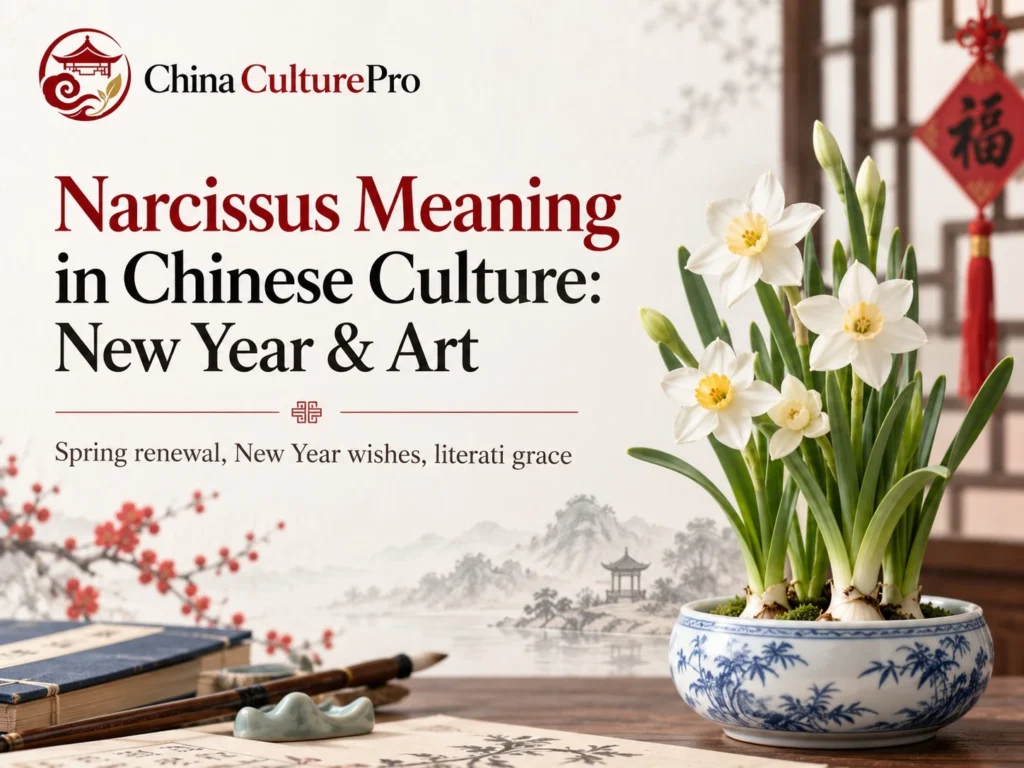

Quick Answer: What Does Narcissus Symbolize in Chinese Culture?
Chinese narcissus (水仙, shuǐxiān) can mark spring, New Year wishes or literati refinement, but none of these meanings applies in every setting.
- Winter renewal: Blooming around the turn of spring, narcissus can mark seasonal change, fresh growth and a new beginning.
- New Year wishes: In Spring Festival displays, it conveys hopes for household well-being, prosperity and a favorable year—not a promise of wealth.
- Refined character: In literati painting, its pale flowers, fragrance and poised leaves may suggest cultivated restraint, purity of conduct or integrity.
- Poetic grace: The names “water immortal” and “fairy above the waves” compare its water-grown form to an elegant figure moving over water.
- Regional craft: In Zhangzhou, Fujian, shaped narcissus bulbs and plants are part of a distinctive winter flower tradition.
Context is decisive. A narcissus in a New Year still life, an ink handscroll and a modern flower market does not necessarily carry the same message. These meanings are cultural interpretations, not claims that the plant can change luck, health or finances.
Narcissus occupies two especially important places in Chinese culture: it is a fragrant Spring Festival flower and a literati subject valued for elegant form and moral association. Those roles sometimes overlap, but they should not be collapsed into one “lucky flower” definition.
This distinction matters when reading Chinese flower symbols. Traditional meanings are normally created by season, medium, companion objects, inscriptions and historical context. The same method applies across the broader Chinese flower and plant symbolism system.
What Is Chinese Narcissus? Names, Species and Flower Form
The traditional plant is a cultivated form within the Narcissus tazetta complex. It is often published as Narcissus tazetta var. chinensis, although botanical databases do not always use the same rank or accepted name. Flora of China describes var. chinensis as a widely cultivated ornamental introduced to China roughly 1,300–1,400 years ago.[1] Kew places Chinese narcissus names within its wider records for N. tazetta and cultivated varieties.[2] Calling it the Chinese cultivated form of N. tazetta avoids presenting one disputed rank as universal.
The familiar form bears clusters of fragrant flowers with white tepals surrounding a short yellow cup. This appearance is traditionally called Jin Zhan Yin Tai (金盏银台, jīn zhǎn yín tái), “golden cups on silver stands.” Its bulbs can be grown indoors in shallow water, which helps explain both its winter popularity and its Chinese name.
| Name | Normal use | Interpretive limit |
|---|---|---|
| Shui Xian / Chinese narcissus | Chinese literature, painting and seasonal display | Usually refers to the traditional Chinese cultivated form, not every species of Narcissus |
| Chinese sacred lily | Historical English common name | It is in the amaryllis family, not a true lily in the genus Lilium |
| Daffodil | Broad English common name for plants in Narcissus | Chinese narcissus is a daffodil in this broad sense, but it is not the yellow trumpet flower many readers picture |
| Jin Zhan Yin Tai | Traditional description of the white-and-yellow flower | A visual name, not a separate cultural meaning or a guarantee of good fortune |
Narcissus is ornamental, not food. All parts can cause poisoning if swallowed, and the bulb is especially hazardous because it may be mistaken for an onion.[3] Its cultural history should not be used to justify eating it or making home remedies.
Why Narcissus Is a Chinese New Year Flower
Winter Blooming and the Arrival of Spring
Chinese narcissus flowers during the transition into spring. Bulbs are also prepared indoors to bloom near the Spring Festival. Its fresh leaves, white blossoms and fragrance make winter’s change especially visible.
That timing supports meanings such as renewal, fresh beginnings and “welcoming spring.” It does not create a rule that the flower must open on New Year’s Day. Temperature, bulb condition and cultivation all affect flowering, so an early or late bloom has no reliable cultural or practical connection to a household’s fortune.
Good Fortune and Prosperity as New Year Wishes
In a New Year setting, narcissus can express hopes for prosperity, domestic harmony and a smooth year ahead. The important phrase is “express hopes.” The plant acts like other festive flowers and objects: it gives visible form to an auspicious wish shared at the start of the year.
Seasonal freshness, clustered flowers, water culture and fragrance make it suitable for this role; none gives it an independent power to attract money. The flower belongs among the decorations and renewal customs explained in this guide to Chinese New Year.
Narcissus in New Year Paintings and Household Displays
A New Year painting (岁朝图, suìcháo tú) or “New Year’s morning picture” often assembles flowers, fruit, vessels and scholar’s objects into a seasonal still life. Narcissus can identify the winter-to-spring moment and contribute a wish for renewal. The rest of the composition determines whether the picture also suggests longevity, abundance, peace or another blessing.
The same rule applies to household displays. A bowl of narcissus near the Spring Festival may function as fragrant decoration and as an auspicious seasonal gesture. Outside that setting, a painted or potted narcissus does not automatically mean prosperity. Plum blossom can occupy a similar winter-to-spring role, but its established emphasis on endurance and flowering in the cold is explained separately in the plum blossom symbolism guide.
“Water Immortal” and “Fairy Above the Waves”
What Does Shui Xian Literally Mean?
Shui Xian literally joins “water” with “immortal” or “transcendent.” In English, it is variously rendered as “water immortal,” “water fairy” or “water goddess.” These translations describe an imaginative cultural name rather than a botanical definition.
The name suits a bulb displayed in a shallow dish, its green leaves and pale flowers rising above water. The word xian does not make narcissus a deity or give it a general symbolism of immortality, healing or supernatural protection.
Why Narcissus Is Called Lingbo Xianzi
Lingbo Xianzi (凌波仙子, língbō xiānzǐ) means “fairy above the waves” or “goddess who steps over the waves.” The epithet turns the flower’s upright, water-grown form into the image of a graceful figure moving over water. The Metropolitan Museum of Art records both this name and the flower’s promise of spring in its discussion of Zhao Mengjian’s narcissus handscroll.[4] This is an art-historical description, not a supernatural claim.
The phrase lingbo also recalls the celebrated description “lightly she steps upon the waves” in Cao Zhi’s Rhapsody on the Luo River Goddess. That work describes a goddess, not a narcissus. Later writers could borrow its graceful imagery when praising the flower, but the literary echo does not make narcissus an incarnation of the Luo River goddess or establish a single origin story for the plant’s name.
Narcissus in Chinese Literati Painting
Narcissus became much more than a festival flower in Southern Song painting. Zhao Mengjian, an imperial clansman, scholar and calligrapher, specialized in ink narcissi. His mid-13th-century handscroll now in the Metropolitan Museum of Art presents ranks of blossoms and arching leaves without a festive domestic setting. The museum describes his achievement as raising narcissus to the level of the orchid in scholarly esteem.[4] The comparison concerns scholarly taste, not a formal botanical rank.
Restrained ink, pale blossoms, controlled lines and fragrance that cannot literally be painted could suggest cultivated elegance and inward worth. In some works, narcissus may evoke integrity or loyalist feeling, but the reading depends on the artist, date and inscriptions. A poem added to Zhao’s scroll after the Mongol conquest connects its imagery with loss and Song loyalism.[4] That layer does not belong to every narcissus picture.
The National Museum of Asian Art preserves another narcissus handscroll traditionally attributed to Zhao Mengjian, showing how closely the subject became identified with his name and with Chinese flower painting.[5] Even so, an unsigned botanical study may simply explore brush line, rhythm and plant form. “Purity” or “high character” should be treated as a contextual literati reading, not a universal flower label.
Zhangzhou Narcissus and the Art of Bulb Carving
Zhangzhou in southern Fujian is closely associated with Chinese narcissus cultivation and display. Growers select and shape bulbs so that leaves and flower stalks develop into compact, curling or sculptural forms. The best-known “crab-claw” appearance is produced through skilled cutting and controlled growth rather than representing a separate symbolic species.
Bulb carving turns the living plant into seasonal craft: the maker anticipates how each cut will influence later growth, then arranges the result as a miniature winter display. Chinese heritage programming presents Zhangzhou narcissus carving as a distinctive Fujian practice.[6] Its regional identity matters more here than a generalized national symbolism.
The tradition should remain geographically specific. The craft is not evidence that every Chinese household historically carved bulbs, and claims of an unbroken Tang-dynasty carving tradition require dated records. Its strongest cultural meaning lies in regional skill, living form and New Year aesthetics.
How Companion Motifs Change the Meaning
Chinese decorative art often builds meaning through combinations. The narcissus contributes a seasonal or refined floral element, while an inscription or companion motif may supply the more specific wish.
| Composition | Context-sensitive reading | Do not assume |
|---|---|---|
| Narcissus alone | Winter-spring season, fragrance, graceful form or literati refinement | Automatic wealth, longevity or supernatural luck |
| Narcissus in a New Year still life | Welcoming spring and wishing for a flourishing year | The flower controls the year’s outcome |
| Narcissus with a longevity character, lingzhi or peaches | A combined birthday or longevity wish led by the explicit longevity motifs | Narcissus alone is a standard longevity emblem |
| Narcissus with rocks, orchid or bamboo | A scholar’s composition emphasizing form, restraint or cultivated character | A fixed formula with one mandatory translation |
| Narcissus with an inscription | The text may identify a recipient, occasion, pun or personal emotion | A generic symbolism list overrides the inscription |
This composition-first approach is central to reading Chinese symbols and meanings. A proposed pun such as “a gathering of immortals” is not established merely because the flower’s name contains xian; it needs a matching title, inscription or recognized visual program.
Chinese Narcissus vs Western Daffodil Symbolism
Chinese narcissus belongs to the genus Narcissus, so it is not botanically disconnected from daffodils. The cultural mistake occurs when a Western story attached to the genus name is treated as the meaning of a Chinese painting or New Year display.
| Question | Chinese cultural context | Common Western context |
|---|---|---|
| Typical image | Clusters of white flowers with yellow cups, often grown in a shallow bowl | Frequently a yellow trumpet daffodil, although Western narcissi are diverse |
| Main seasonal setting | Winter-to-spring transition and the Spring Festival | Early spring; settings vary by country and denomination |
| Literary framework | Shui Xian, Lingbo Xianzi and Chinese flower painting | The Greco-Roman story of Narcissus and his reflection |
| Vanity or self-absorption | Not a traditional Chinese narcissus meaning | Derived from the classical Narcissus story and later language |
| Death or mourning | Not a default Chinese meaning | Appears in some classical and later Western traditions, not all of them |
| Prosperity | A New Year wish in the appropriate Chinese setting | Not a universal Western daffodil meaning |
The traditions are independent, but neither “China” nor “the West” has only one unchanging interpretation. The safest reading identifies the actual object, culture, period and occasion before assigning meaning.
How to Interpret a Narcissus Motif Correctly
- Identify the flower: Look for the Chinese form’s clusters of white flowers, small yellow cups, strap-like leaves and frequent shallow-water display. Do not rely on an English label alone.
- Identify the setting: A New Year arrangement, literati handscroll, regional carved bulb and ordinary botanical image perform different cultural jobs.
- Check companion elements: Peaches, lingzhi, auspicious vessels, rocks or other plants may change the composition’s overall message.
- Read the text and date: Titles, inscriptions, colophons, recipients and museum records outrank a generic flower-symbolism list.
- Separate cultural systems: Keep Chinese seasonal and artistic readings apart from Greek mythology, modern commercial flower language and personal tattoo meanings.
When evidence is limited, the most responsible interpretation is modest: the flower marks winter or early spring, contributes fragrance and elegance, or serves as decoration. A deeper moral or auspicious claim needs supporting context.
Common Misreadings of Narcissus Symbolism
- Every narcissus means wealth: Prosperity is a Spring Festival wish, not the automatic meaning of every plant or painting.
- A New Year bloom guarantees luck: Flowering reflects biology and cultivation, not a household’s future.
- Chinese narcissus means vanity: That association comes from the Greco-Roman Narcissus story, not the Chinese tradition.
- “Immortal” means longevity: Xian is part of a poetic name; longevity requires clearer motifs or text.
- Chinese sacred lily is a true lily: It is a historical common name for a member of the amaryllis family.
- All daffodils carry the same symbolism: Species, appearance, region, medium and occasion all matter.
- Every old narcissus painting is auspicious: A literati painting may concern brushwork, integrity, loss or cultivated taste rather than New Year fortune.
- Bulb carving was a uniform national custom: It is especially associated with Zhangzhou and should be presented as a regional practice.
FAQs About Narcissus Meaning in Chinese Culture
What does narcissus symbolize in Chinese culture?
Narcissus can symbolize winter giving way to spring, New Year renewal and hopes for a flourishing household. In literati painting, it may instead suggest refined restraint, integrity or otherworldly grace. The artwork, occasion, companion motifs and inscriptions determine which reading is appropriate.
Why is narcissus used at Chinese New Year?
Chinese narcissus flowers during the winter-to-spring season and can be prepared indoors to bloom near the Spring Festival. Its fresh leaves, fragrant flowers and water-grown display make it an effective image of welcoming spring and expressing good wishes for the coming year.
Is Chinese narcissus the same as a daffodil?
Chinese narcissus is a cultivated form in the genus Narcissus, so “daffodil” can include it in broad botanical English. It is not, however, identical to the yellow trumpet daffodil many English speakers imagine, and its Chinese cultural meanings must be read in their own setting.
What does “water immortal” mean?
“Water immortal” is a literal-style translation of Shui Xian. The name poetically compares a fragrant flower rising from a shallow water dish to an elegant transcendent figure. It does not mean that narcissus grants immortality, healing or supernatural protection.
Is Chinese narcissus connected to the Greek myth of Narcissus?
No traditional interpretive connection is required. The Greek story explains Western associations with reflection, self-absorption and vanity. Chinese narcissus developed its own seasonal, literary and artistic meanings, so the Greek myth should not be imposed on a Chinese New Year display or painting.
Sources
[1] Flora of China. Narcissus tazetta var. chinensis
[2] Royal Botanic Gardens, Kew. Plants of the World Online: Narcissus tazetta records
[3] National Capital Poison Center. Daffodils: Beautiful but Potentially Toxic
[4] The Metropolitan Museum of Art. Zhao Mengjian: Narcissus
[5] Smithsonian National Museum of Asian Art. Narcissus, Traditionally Attributed to Zhao Mengjian
[6] China Media Group. Zhangzhou Narcissus Carving Tradition