
Quick Answer: What Are the Four Symbols of Chinese Mythology?
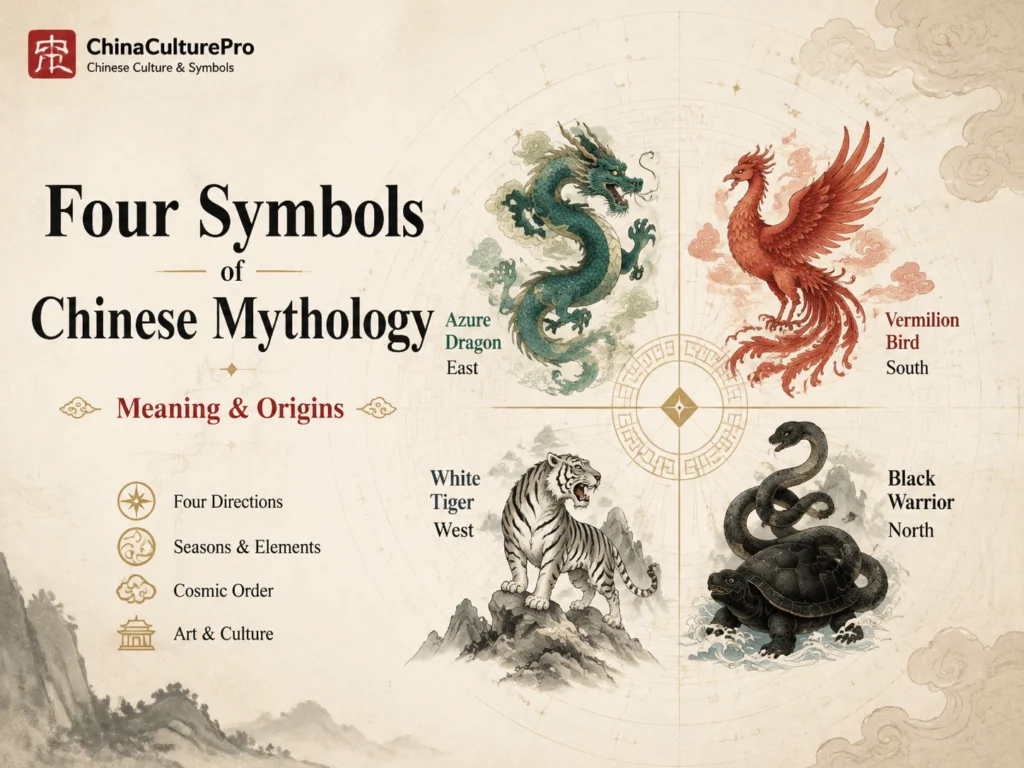
The Four Symbols (Sìxiàng, 四象) are four celestial creatures that organize the traditional Chinese sky into directional regions. Each governs one cardinal direction and a group of seven lunar mansions, while later systems connect it with a season, color, and phase of wuxing. They began as astronomical and spatial symbols—not simply as four lucky animals.
- Azure Dragon (青龙 / 青龍, Qīnglóng): East, spring, blue-green, and Wood; it represents the eastern celestial region and seasonal renewal.
- Vermilion Bird (朱雀, Zhūquè): South, summer, vermilion, and Fire; it represents the southern sky and the height of seasonal warmth.
- White Tiger (白虎, Báihǔ): West, autumn, white, and Metal; it represents the western region, seasonal contraction, and later martial authority.
- Black Warrior (玄武, Xuánwǔ): North, winter, dark or black, and Water; its mature form commonly combines a tortoise and snake.
For the wider taxonomy, see Chinese symbols and their meanings and the guide to Chinese mythical creatures.
On Han-dynasty mirrors and tomb walls, four extraordinary creatures do more than fill empty space. They turn an object or chamber into a model of an ordered cosmos: dragon in the east, bird in the south, tiger in the west, and tortoise-snake in the north.
This system connects constellations, direction, season, color, and ritual space. Its imagery developed gradually rather than appearing fully formed in remote prehistory. By reading the creatures as a coordinated map—and separating astronomy from later religion and popular symbolism—we can understand why the Four Symbols became one of the most durable structures in Chinese visual culture.
What Are the Four Symbols?
In this article, “Four Symbols” translates Sìxiàng (四象): the Azure Dragon, Vermilion Bird, White Tiger, and Black Warrior as the creatures of the four celestial directions. Here, xiang means an image, manifestation, or representational form. The animals visualize regions of the sky and the spatial order associated with them.
The same Chinese term also appears in a different philosophical context. The Yijing or Book of Changes states that the Two Modes produce the Four Images, which then produce the Eight Trigrams.[3] That passage does not name a dragon, bird, tiger, or tortoise. In later explanations, these Four Images are commonly understood as four configurations or stages of yin and yang. The shared wording does not make the abstract Yijing concept identical to the four directional creatures.
English names also depend on context. “Four Symbols” is the clearest general label for the historical system. “Four Directional Creatures” emphasizes spatial function. “Four Guardians” or “Four Gods” can describe later protective and religious roles, but those names should not be projected onto every early astronomical or Han-art object.
The Four Symbols at a Glance
The correspondences below summarize the mature system. They are a cultural map, not four independent personality profiles or guaranteed sources of fortune.
| Symbol | Typical visual form | Direction | Season | Color | Five Phase | Seven lunar mansions | Primary system role |
|---|---|---|---|---|---|---|---|
| Azure Dragon (青龙 / 青龍, Qīnglóng) | Long, scaled dragon; usually wingless, with form varying by period | East | Spring | Qing: azure or blue-green | Wood | Horn, Neck, Root, Room, Heart, Tail, Winnowing Basket | Eastern celestial region, seasonal emergence, and spatial orientation |
| Vermilion Bird (朱雀, Zhūquè) | Stylized sacred bird, often shown in flight | South | Summer | Vermilion or red | Fire | Well, Ghost, Willow, Star, Extended Net, Wings, Chariot Platform | Southern celestial region and the height of seasonal warmth |
| White Tiger (白虎, Báihǔ) | Powerful tiger, often striding or leaping | West | Autumn | White | Metal | Legs, Bond, Stomach, Hairy Head, Net, Turtle Beak, Three Stars | Western celestial region, seasonal contraction, and later martial order |
| Black Tortoise / Black Warrior (玄武, Xuánwǔ) | Typically a tortoise entwined with a snake in mature imagery | North | Winter | Dark or black | Water | Dipper, Ox, Girl, Emptiness, Rooftop, Encampment, Wall | Northern celestial region, winter concealment, stability, and protection |
Translations of the twenty-eight mansion names vary, so Chinese names are often more precise in specialist work. The color qing is equally difficult to reduce to one English swatch: it can cross blue, green, and blue-gray territory. The dedicated guide to qing in Chinese culture explains why “blue dragon” and “green dragon” are both incomplete in some contexts.
The table also shows why each creature should first be read relationally. The Azure Dragon means “east” most precisely when a composition also establishes the other directions; outside the quartet, a dragon may instead refer to rain, imperial authority, or another tradition. The same rule applies to the bird, tiger, and tortoise-snake. Membership is confirmed by placement, companions, inscriptions, and object type—not by species or color alone.
How the Four Symbols Organize the Chinese Sky
Four Celestial Quadrants and the Twenty-Eight Lunar Mansions
Traditional Chinese astronomy grouped twenty-eight lunar mansions (ershiba xiu, 二十八宿) into four sets of seven. Each set occupied a broad celestial region represented by one of the Four Symbols. The creature was therefore not one star or constellation in the modern Western sense. It was a large symbolic figure used to organize several star groups into a memorable quadrant.
This framework supported observation of the Moon, seasonal change, and celestial position. A Han mirror makes the logic visible: a square world aligned to the four directions is placed within circular heaven, accompanied by the twelve Earthly Branches, the four directional animals, cosmic waves, and other markings.[2] The image is a compact cosmogram rather than a decorative animal collection.
The Warring States lacquer chest from the tomb of Marquis Yi of Zeng records all twenty-eight mansion names and places a dragon and tiger around the celestial design.[6] It is important evidence for the early conjunction of star mapping and directional animals. Because the object does not show the complete later quartet, it should not be used to prove that every part of the mature Four Symbols system was already standardized in 433 BCE.
Directions, Seasons, Colors, and Five Phases
The four celestial regions were eventually integrated with a wider network of correspondences. East aligned with spring, qing, and Wood; south with summer, vermilion, and Fire; west with autumn, white, and Metal; north with winter, dark coloring, and Water. These are not separate dictionary meanings accidentally attached to the animals. Together they create a correlative model in which space, time, color, and natural process mirror one another.
The associations should still be dated and contextualized. The complete grid developed through the interaction of pre-imperial and Han cosmological systems; it was not necessarily present in every early animal image. Readers who need the wider chromatic framework can compare the five traditional Chinese colors.
Orientation can be confusing because traditional ceremonial layouts often assume a south-facing position. From that standpoint, south is in front, north behind, east to the left, and west to the right—the arrangement summarized in the Book of Rites.[4] A museum photograph, mirror surface, tomb plan, or architectural diagram may present the viewer from another angle or reverse the image through reflection. Before labeling a creature “misplaced,” identify whose viewpoint the design uses and whether the published image has been mirrored.
Why Is There No Fixed Fifth Symbol at the Center?
The Four Symbols divide four celestial directions, while a Five Phases or five-direction scheme also includes the center and Earth. Some later systems represent that center with a Yellow Dragon or another central figure, but no single fifth creature belongs universally to every Four Symbols tradition. Adding one can describe a particular five-direction model; it does not turn the historical Four Symbols into a permanently fixed “Five Symbols” set.
How the Four Symbols Developed Through History
Early Dragon–Tiger Pairings and Warring States Evidence
The system developed in stages. A Neolithic burial at Xishuipo in Henan contains shell-and-bone dragon and tiger forms placed on opposite sides of the deceased. Scholars have proposed that their positioning anticipates the later eastern dragon and western tiger. The identification remains cautious: the burial does not provide the names, twenty-eight mansions, Vermilion Bird, or Black Warrior needed to demonstrate the complete later system.[8]
By the Warring States period, the dragon–tiger pair appears in clearer astronomical settings. The Marquis Yi lacquer chest joins these animals with the twenty-eight mansion names and the Big Dipper.[6] Other evidence suggests that the four directional figures emerged unevenly rather than as one simultaneous invention. One artifact’s missing figures do not prove that an entire period knew only two animals; they show that early configurations were varied and not yet universally standardized.
Han Dynasty Standardization
The late Western Han and Eastern Han periods provide especially strong evidence for the quartet familiar today. A mid- to late-first-century BCE mirror in the Metropolitan Museum of Art uses animals of the four directions, but its northern figure is a curling, spiked beast rather than the later standard tortoise-snake. The museum dates the standardization of the directional-animal iconography to the end of the first century BCE.[1]
On first- and second-century CE mirrors, the complete set appears within elaborate cosmological diagrams. The Azure Dragon, White Tiger, Vermilion Bird, and entwined tortoise-snake occupy directional positions around a square-and-circle model of earth and heaven.[2] Han tomb reliefs, mural programs, and burial objects also adapted the figures to local materials and visual conventions.
Standardization did not eliminate variation. Dragons could curve, turn backward, or take hybrid forms; birds, tigers, and northern creatures also changed by region and medium. “Mature system” means that the members and directional logic became recognizable—not that every artist followed one anatomical template.
From Celestial Markers to Guardian Deities
Once the creatures marked the four directions, they could also guard those directions. In funerary art, they helped organize the tomb as a model cosmos and could protect its ordered boundaries. On objects and architectural plans, the same framework placed people within a structured universe.
Later religious traditions personified the creatures and gave them divine titles. Daoist sources identify the Azure Dragon as Mengzhang, the Vermilion Bird as Lingguang, the White Tiger as Jianbing, and the Black Warrior as Zhiming. These names belong to developed religious systems, not to the earliest astronomical evidence.
The National Palace Museum summarizes this layered change: four groups of seven constellations became symbols of the cardinal directions and were later treated as guardian beasts; names such as Vermilion Bird Avenue and Black Warrior Gate carried the same spatial language into cities and palaces.[7]
Where the Four Symbols Appear and What They Mean
Meaning changes with the carrier. The same creature can mark a constellation group on one object, a military direction on another, and a protective deity in a later religious image.
| Context | What the Four Symbols do there | Interpretation boundary |
|---|---|---|
| Star maps and calendrical systems | Divide the twenty-eight mansions into four celestial regions and connect sky position with seasonal order | Astronomical classification, not four personal horoscope signs |
| Ritual and military banners | Mark front, rear, left, and right according to a directional formation | The Book of Rites places the Red Bird in front, Dark Warrior behind, Azure Dragon left, and White Tiger right.[4] This is spatial and ritual order, not fantasy combat power |
| Han mirrors | Present a portable cosmological diagram combining directions, celestial animals, Earthly Branches, and square-circle imagery | Exact designs vary; not every mirror contains the same complete program |
| Tomb murals, coffins, and reliefs | Orient the burial space, model the cosmos, and protect its boundaries | Funerary use does not make every modern Four Symbols image a death symbol |
| Cities, palaces, and architecture | Name or position southern, northern, eastern, and western features | Orientation depends on the site and viewer’s perspective, not the printed page’s left and right |
| Daoist imagery | Appear as named directional deities or celestial generals | Later religious identities should not be read back into all pre-Han art |
| Modern games, film, logos, and tattoos | Supply four visual factions, seasons, elements, or directional identities | Creative powers and personalities may be modern inventions rather than historical meanings |
This context-first method prevents two opposite errors. It avoids reducing the creatures to decoration, but it also avoids claiming that every appearance performs a supernatural act. For a broader method of reading objects, see Chinese symbolism in art.
Funerary use deserves particular care. A Four Symbols image from a tomb can organize and guard that specific burial cosmos, but the quartet is not inherently a death omen. When the same directional structure appears on a mirror, gate, ritual banner, or contemporary design, its meaning follows that new carrier rather than automatically retaining a funerary message.
Four Symbols vs. Four Auspicious Creatures
The Four Symbols are often confused with the Four Numinous or Four Auspicious Creatures (Sìlíng, 四灵 / 四靈). The two systems overlap in their use of extraordinary animals, but their membership and primary cultural work differ.
| Comparison | Four Symbols (四象) | Four Auspicious Creatures (四灵 / 四靈) |
|---|---|---|
| Members | Azure Dragon, Vermilion Bird, White Tiger, Black Warrior | Lin or Qilin, Fenghuang, tortoise, dragon |
| Organizing principle | Four celestial regions, directions, seasons, and related correspondences | Ritual order, benevolent rule, numinous life, and auspicious governance |
| Classical anchor | Directional and celestial traditions, including the banner order in Qu Li | Li Yun explicitly names the lin, Fenghuang, tortoise, and dragon.[5] |
| Typical media | Star maps, mirrors, tomb art, banners, directional architecture | Ritual texts, court auspicious art, decorative patterns, and images of virtuous rule |
| Critical distinction | Includes the Vermilion Bird and White Tiger—not Qilin or Fenghuang | Includes Qilin and Fenghuang—not the Vermilion Bird or White Tiger |
In short, the Four Symbols primarily organize cosmic space; the Four Auspicious Creatures primarily express numinous and human-facing order. A generic dragon may participate in the Four Numinous Creatures, while the Azure Dragon is the specific eastern member of the Four Symbols. The categories are related parts of Chinese symbolic culture, not interchangeable lists.
Common Misidentifications and Translation Errors
| Common claim | More accurate interpretation |
|---|---|
| The Vermilion Bird is the Chinese phoenix | Zhuque is the southern celestial bird. The Chinese Fenghuang belongs to a different ritual and auspicious tradition |
| The Vermilion Bird dies and rises from fire | Fire and summer are correspondence fields; the Western phoenix’s death-and-rebirth story is not Zhuque’s defining Chinese narrative |
| Xuanwu is just a black turtle | “Black Warrior” is a closer translation of the name, while “tortoise-snake” describes the typical mature image. Historical forms can vary, so identify it through context rather than color alone |
| The Azure Dragon means every Chinese dragon | Qinglong is the eastern celestial dragon. The broader Chinese dragon also carries water, imperial, mythological, and modern cultural meanings outside this system |
| The White Tiger is the zodiac Tiger | Baihu is the western celestial creature. The zodiac animal and wider tiger symbolism in Chinese culture belong to different reader tasks |
| Every tortoise in Chinese art is Xuanwu | Ordinary turtle and tortoise symbolism can concern longevity, divination, or endurance without representing the northern symbol |
| All four are lucky animals | Their earliest shared function is cosmological and directional. Protection and auspiciousness depend on later setting and use |
No single English translation solves every problem. “Black Tortoise” is widely recognized but underplays the snake and the martial word wu. “Black Warrior” preserves the name’s meaning but does not show readers what the creature looks like. A clear first reference can therefore use “Black Warrior (Xuanwu), typically shown as a tortoise entwined with a snake,” then shorten it consistently.
How to Identify the Four Symbols in Chinese Art
Use the full composition rather than one color or body part:
- Establish the date and medium. A Warring States lacquer chest, Han mirror, tomb mural, Daoist print, and game illustration follow different conventions.
- Determine whether the set is complete. Dragon–tiger pairs and partial directional groups can be historically meaningful; missing members do not automatically signal an error.
- Reconstruct the orientation. East–west and north–south relationships matter more than where an animal happens to sit on a modern screen.
- Inspect the northern creature. A tortoise-snake combination strongly supports a Xuanwu identification, but date, inscription, and surrounding figures remain important.
- Separate Zhuque from Fenghuang. Look for a Four Symbols program, southern placement, or celestial companions instead of relying on a universal feather shape.
- Check supporting motifs. Lunar-mansion labels, Earthly Branches, the sun and moon, clouds, a square-circle diagram, or tomb orientation can reveal the system.
- Use authoritative object records. Museum titles, inscriptions, and archaeological context should outweigh modern fantasy art or an unsourced diagram.
This approach also applies to wider Chinese symbolic patterns and motifs, where meaning often comes from the complete arrangement rather than one isolated figure.
Final Takeaway
The Four Symbols are not merely four auspicious beasts. They are a visual system for organizing sky, direction, season, color, and ritual space. Their forms developed gradually, became widely recognizable in Han art, and later gained funerary, protective, religious, and modern creative roles. The most accurate reading begins with the complete composition and its historical context—not with a fixed list of personality traits or lucky effects.
FAQs About the Four Symbols of Chinese Mythology
Are the Four Symbols Part of the Chinese Zodiac?
No. The Four Symbols divide celestial space into four directional regions, while the Chinese zodiac uses twelve animals in a repeating calendrical cycle. The Azure Dragon is not a separate zodiac sign, and the White Tiger is not interchangeable with the zodiac Tiger.
Do the Four Symbols Predict Personality or Destiny?
Not by themselves. Their foundational roles concern celestial regions, direction, season, ritual, and visual order. Later divination systems may reuse some of the same correspondences, but a favorite symbol, birth season, or online Four Symbols quiz does not provide a historically complete or scientifically verified prediction of personality or destiny.
Do the Four Symbols Have the Same Meanings Across East Asia?
No. The system spread to Japan, Korea, Vietnam, and other regions, where names, religious roles, artistic forms, and local stories developed independently. Japanese Seiryū, Suzaku, Byakko, and Genbu reflect historical Chinese influence, but a Japanese artwork should be interpreted through its own period and cultural setting.
Can All Four Symbols Be Used Together in a Tattoo or Logo?
Yes, but the design should preserve recognizable membership and an intentional directional relationship. Avoid turning Zhuque into a Western rebirth phoenix or reducing Xuanwu to an unexplained turtle. Before finalizing a permanent or commercial design, follow the review guidance for Chinese tattoo symbols.
Is There a Fixed Order for Listing the Four Symbols?
There is no single mandatory writing order. Lists may begin with the east, south, west, or north depending on the source. Their correspondences are stable within the mature system, but visual left and right depend on whether the image faces south, follows a tomb plan, appears on a mirror, or is viewed from another orientation.
Why Do Some Ancient Artworks Show Only Two or Three Symbols?
Early imagery developed unevenly, and artists also selected figures to fit an object’s purpose and available space. A dragon–tiger pair can express east–west order without displaying the entire quartet. Date, provenance, inscriptions, and composition determine whether a partial set is historically appropriate rather than incomplete by mistake.
Sources
[1] The Metropolitan Museum of Art. Mirror with Animals of the Four Directions
[2] The Metropolitan Museum of Art. Mirror with Game Board Design and Animals of the Four Directions
[3] Chinese Text Project. Book of Changes: Xi Ci I
[4] Chinese Text Project. Book of Rites: Qu Li I
[5] Chinese Text Project. Book of Rites: Li Yun
[6] Hubei Provincial Museum. The Marquis Yi of Zeng: Lacquer Objects
[7] National Palace Museum. What Powers Do Mythical Creatures Possess?
[8] Marianna Lázár. Animating the Cosmos: The Azure Dragon, White Tiger, Vermilion Bird, and Dark Warrior in Han Tomb Art and Thought