

Quick Answer: What Does the Pine Tree Symbolize in Chinese Culture?
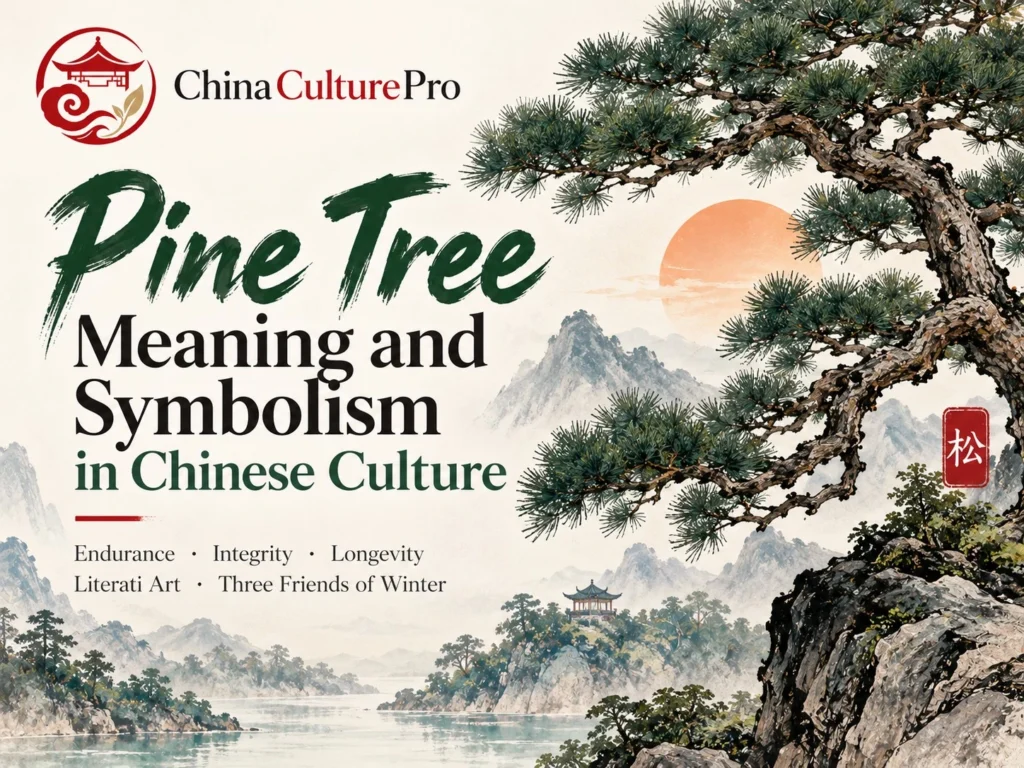
In Chinese culture, pine (松, sōng) can represent endurance, moral character, reclusion, longevity, or constancy—but each reading belongs to a particular textual or visual context.
- Endurance and fortitude: An evergreen pine in a winter landscape can suggest survival through hardship.
- Moral integrity: The classical pine-and-cypress pair (松柏, sōngbǎi) models the noble person (君子, jūnzǐ) whose principles become visible in adversity.[1]
- Reclusion and self-discipline: In literati painting, an old pine beside a scholar, studio, or poetic inscription may express withdrawal from office and an independent mind.
- Longevity: In birthday art and auspicious decoration, pine combined with cranes, deer, lingzhi, rocks, or the character shou expresses wishes for long life.[6][7]
- Constancy and shared character: In the complete Three Friends of Winter (岁寒三友, suìhán sānyǒu)—pine, bamboo, and plum—the pine contributes evergreen steadfastness to a broader image of character under pressure.[9]
A lone pine in an ordinary landscape may simply be scenery, a compositional anchor, or a subject for brushwork. These meanings are cultural metaphors and artistic wishes, not promises of wealth, protection, or longer life.
A pine (松, sōng) does not carry one permanent meaning in Chinese art. Wu Zhen’s 1335 Crooked Pine turns a winter tree into a Yuan-dynasty image of endurance and reclusion. By contrast, Song Tian’s sixteenth-century Squirrel on a Pine Branch concentrates on an alert animal, a tiny insect, and the painter’s control of ink; its warm-season activity does not require a longevity reading.[3][5] The difference captures a basic rule of Chinese symbolic art: date, medium, inscription, surrounding motifs, and intended use matter more than the tree alone.
Song, Songbai, Pine, and Cypress: What Is the Difference?
English summaries often treat “pine,” “cypress,” and the classical compound songbai as interchangeable. They are not. The distinction matters most when a work cites an early text.
| Term | Meaning and usual context | Interpretive limit |
|---|---|---|
| Pine (松, sōng) | A pine tree or pine imagery in painting, poetry, and decorative art | A stylized old painting may not permit identification of a modern species |
| Pine and cypress (松柏, sōngbǎi) | A fixed classical pairing of two evergreen tree groups | It is not another name for pine; a statement about songbai should not automatically be assigned to pine alone |
| Ancient pine (古松, gǔsōng) | A pictorial form with an aged, knotted, or twisting trunk | “Ancient” describes appearance; it does not prove loyalism, protest, or longevity |
| Three Friends of Winter | The complete pine-bamboo-plum motif | One pine, or even a pine-bamboo pair, is not the full Three Friends subject |
| Noble person (君子, jūnzǐ) | An ethical ideal of someone who maintains principle and proper conduct | It is a human moral model projected onto nature, not a botanical quality |
In The Analects, the famous line about trees remaining green in the cold names pine and cypress together. Translating it as a lesson taught by “the pine” erases half of the source image. Museum titles should likewise guide identification when a painted evergreen is too stylized for confident botanical classification.
This linguistic distinction does not mean pine and cypress never share associations. Their evergreen appearance made them useful together in poetry, moral comparison, and later memorial settings. It means the evidence must be quoted at the same level at which it was written. A passage that says songbai supports a claim about the pair; a painting titled Pine supports a claim about that identified tree. This small discipline prevents an ancient compound from becoming a modern one-word symbol dictionary.
Why Did the Pine Become a Symbol of Endurance, Integrity, and Long Life?
Three different processes turned an evergreen tree into a cultural image. They overlap, but they are not one universal code.
| Source of meaning | Cultural interpretation | Where the reading works |
|---|---|---|
| Evergreen foliage through winter | Endurance, survival, and steadiness under pressure | Winter landscapes, literati painting, and inscriptions about adversity |
| Moral comparison in classical texts | Integrity becomes visible when conditions grow harsh | Ethical writing and works that clearly invoke the pine-cypress tradition |
| Longevity and auspicious art | A long-lived evergreen expresses wishes for a long, flourishing life | Birthday gifts, court celebrations, family portraits, and explicit longevity compositions |
Confucius is recorded as saying, “When the year turns cold, we know that the pine and cypress are the last to wither.”[1] The line is not a biological claim that these trees never shed foliage. It is an ethical comparison: easy conditions do not reveal character as clearly as hardship does.
An earlier royal hymn in the Book of Poetry compares continuing prosperity to flourishing pine and cypress. Its sequence also invokes the waxing moon, rising sun, and enduring Southern Mountain, making the trees part of a courtly blessing for continuity.[2] Later decorative art developed a more recognizable long-life vocabulary. By the Ming and Qing dynasties, evergreen pines appeared among motifs suitable for birthdays and retirement celebrations.[6] None of these cultural associations gives a pine image supernatural power.
How Pine Symbolism Changed Across Chinese History
Early Texts: Blessing, Adversity, and the Pine-Cypress Pair
Early transmitted texts often present pine with cypress rather than as a fully independent emblem. In the Book of Poetry, flourishing pine and cypress help articulate dynastic continuity and an ongoing line of successors. In The Analects, their late withering becomes a test of moral constancy.[1][2]
These passages establish two durable ideas—continuity and character under pressure—but they do not contain the entire later symbolism of Chinese pine art. They do not yet define a standard Three Friends of Winter composition, a scholar beneath an ancient pine, or the mature birthday vocabulary of pine, crane, deer, fungus, and longevity characters. Applying every later meaning to an early textual reference would reverse the historical sequence.
Song–Yuan Literati Pines: Character, Reclusion, and Survival
By the Song and Yuan periods, scholar-painters could use old trees and calligraphic brushwork to express personal values. Zhao Mengfu’s Twin Pines, Level Distance, painted after he withdrew from government service under Mongol rule, has been read as both an image of survival and a double portrait of the painter and his friend. The reading depends on the subject, deliberately archaic style, inscription, recipient, and Zhao’s circumstances—not merely on the presence of two trees.[4]
Wu Zhen’s Crooked Pine offers an even clearer case. Its twisted trunk remains alive in winter, while the artist’s inscription records seeing a crooked ancient tree in December 1335 and “writing” the picture in ink. Wu lived in reclusion rather than pursuing an official career. Within the Yuan context, the pine could therefore serve as a metaphor for survival under political discrimination and for a scholar maintaining independence outside office.[3]
That does not make every crooked pine a coded protest. Without an inscription, known recipient, artist biography, or relevant historical setting, “may suggest endurance” is more responsible than “means political loyalty.”
Ming–Qing Decoration, Birthday Art, and Multiple Meanings
During the Ming and Qing dynasties, pine imagery spread across court painting, professional bird-and-flower painting, porcelain, lacquer, textiles, and domestic decoration. Several meanings now operated in parallel. A pine could continue the literati language of integrity; join cranes, deer, lingzhi, or shou characters in long-life art; appear with bamboo and plum as the Three Friends of Winter; or function as scenery and ornament.
The difference is visible in two museum works. The circa-1500 Crane and Pine is an ornamental reception-hall painting in which the pair carries long-life associations.[7] Song Tian’s Squirrel on a Pine Branch, however, emphasizes movement, fur, claws, and the exchange between squirrel and insect; the museum even notes that their activity suggests a warm season.[5] Dynasty alone therefore does not determine meaning. Genre and composition remain decisive.
What Does the Pine Mean in the Three Friends of Winter?
The Three Friends of Winter is a complete composition of pine, bamboo, and flowering plum. Because the pine and bamboo stay green through winter while plum blossoms announce renewal, the trio became an emblem of moral rectitude, survival in adversity, and renewal. A sixteenth- to early-seventeenth-century carved lacquer dish makes the identification visually explicit: pine needles, bamboo leaves, and plum blossoms fill its center.[9]
| Member | Contribution to the complete motif | What it does not mean alone |
|---|---|---|
| Pine | Evergreen steadiness and survival | One pine is not the Three Friends and need not mean longevity |
| Bamboo | Resilience, disciplined joints, and moral flexibility | A pine-bamboo pair is still incomplete |
| Plum | Blossoming in cold weather and the possibility of renewal | A pine-plum pair does not automatically encode the full trio |
Later gifts and decorative objects can extend the trio toward auspicious wishes or enduring fellowship, but the best-supported core is character tested by a harsh environment. The pine is not one of the Four Gentlemen—plum, orchid, bamboo, and chrysanthemum. The two systems overlap in bamboo and plum, yet their membership and organizing ideas remain different.
Common Pine Motifs and Their Meanings in Chinese Art
The smallest reliable unit of interpretation is usually the whole composition, not the pine by itself.
| Motif | First reading to test | Evidence needed | Do not assume |
|---|---|---|---|
| Solitary, ancient, or crooked pine | Landscape, brushwork, endurance, or literati self-image | Inscription, artist, recipient, season, and historical setting | Every twisted trunk is political protest |
| Pine with crane, deer, lingzhi, rock, or shou | Long-life wish in auspicious or ceremonial art | Birthday use, court context, inscription, or a recognized longevity ensemble | The object can extend life or protect its owner |
| Pine, bamboo, and plum | Three Friends of Winter | All three plants visibly present | One or two members make the full subject |
| Pine with chrysanthemum | Reclusion and Tao Yuanming’s return home | Chrysanthemums, retreat imagery, or textual allusion | Two longevity symbols have simply been added together |
| Scholar beneath a pine | Cultivation, retirement, or life apart from office | Human figure, studio objects, title, or poem | The figure is necessarily a Daoist immortal |
| Pine with ordinary birds or animals | Naturalistic bird-and-flower painting or decoration | Species, action, season, and museum description | Every animal produces a rebus or auspicious formula |
A Solitary, Ancient, or Crooked Pine
An aged trunk is visually powerful because it records pressure: bends, scars, and broken limbs coexist with living needles. Literati artists could turn that contrast into a self-image. Yet the same form also gave painters an ideal subject for dry brush, textured ink, and calligraphic line.
Read a solitary pine in layers. First ask whether the work is a natural study or part of a landscape. Then examine its title and inscription. Finally, consider whether the artist’s withdrawal, political position, or named recipient makes a personal reading plausible. Wu Zhen’s Crooked Pine passes those tests; an unsigned decorative panel may not.[3] The curved form alone never proves loyalism, hidden protest, or an auspicious wish.
Pine with Crane, Deer, Rock, Lingzhi, or Shou Characters
In a clearly auspicious setting, pine can participate in a vocabulary of long life. Its evergreen foliage contributes continuity; cranes and deer connect with immortals and longevity; lingzhi evokes the fungus of immortality; rocks add an image of durability; and the written character shou makes the wish explicit. Late imperial paintings, garments, and decorative objects used such motifs for birthdays, retirements, and other congratulatory occasions.[6]
Pine and crane is one of the most recognizable combinations. A circa-1500 reception-hall painting identifies the pair as a long-life motif and also notes that paired cranes and pines could convey wishes for a happy marriage.[7] The adjacent animal matters, so readers can continue with the dedicated guide to crane symbolism in Chinese culture.
Context still controls the result. A crane resting in an ordinary habitat can be naturalistic, while a pine on birthday ware can carry longevity even without every possible companion. These are ceremonial wishes, not medical claims or supernatural mechanisms.
Pine with Chrysanthemum or a Recluse
Pine and chrysanthemum often point to Tao Yuanming rather than merely doubling two long-life motifs. In his Return Home, overgrown garden paths frame the assurance that “the pines and chrysanthemums still remain.” The plants become witnesses to a life recovered after leaving office.
Wen Zhengming’s 1541 Chrysanthemums and Pine Tree makes that allusion specific. Its inscription and composition connect the painter’s own brief, unhappy government service with Tao’s return to reclusion, suggesting the moral value of a life outside official ambition.[8] A scholar, wine vessel, rustic garden, or quotation from Return Home can reinforce the reading. In a birthday object with explicit shou imagery, longevity may still be relevant, but it should not displace a clear literary allusion.
What Does the Pine Mean in Chinese Poetry and Language?
Literary meaning belongs first to the text that creates it. It may guide a painting with a matching inscription, but it should not automatically define unrelated porcelain or textiles.
| Expression | Original context | Main idea | Limit |
|---|---|---|---|
| “When the year turns cold…” | Analects, “Zi Han” | Adversity reveals the integrity of pine and cypress | It is about the pair, not a promise of longevity from one pine |
| “Like the flourishing pine and cypress…” | Book of Poetry, “Tian Bao” | Royal continuity and succeeding generations | It is an early court blessing, not a generic painting label |
| “The pines and chrysanthemums still remain” | Tao Yuanming, Return Home | Reclusion, return, and constancy after leaving office | A pine-chrysanthemum work needs textual or visual support for the allusion |
| “I stroke the solitary pine and linger” | Tao Yuanming, Return Home | Ease in nature and self-directed retirement | “Solitary” does not automatically mean loneliness or misfortune |
| Pine and cypress flourish after the cold | Later idiomatic usage | Steadfast character revealed by trial | Language does not assign one meaning to every pine image |
The same words can also change function across centuries. A court hymn, a moral maxim, a recluse’s poem, and a modern design statement do not produce interchangeable definitions simply because each mentions a pine.
What a Chinese Pine Symbol Does Not Automatically Mean
| Common claim | More accurate boundary |
|---|---|
| Every pine means longevity | Long life is strong in birthday, court, and auspicious contexts; literati and naturalistic pines may mean something else or nothing symbolic |
| Pine protects a home, repels evil, or attracts wealth | No historically consistent art rule gives a pine image those real-world powers |
| Branch direction, tree count, or color determines luck | Chinese art has no universal cross-dynastic code of this kind |
| Every ancient or crooked pine is a loyalist protest | Political meaning requires evidence from the artist, period, inscription, recipient, or documented interpretation |
| A pine alone is the Three Friends of Winter | Pine, bamboo, and plum must all be present for the complete motif |
| Pine is one of the Four Gentlemen | The Four Gentlemen are plum, orchid, bamboo, and chrysanthemum |
| Pine and chrysanthemum always double longevity | Their best-known paired reading often invokes Tao Yuanming and reclusion |
| Cemetery evergreens prove supernatural protection | Evergreen solemnity and continuity do not demonstrate protective power |
| Chinese and Japanese pine designs use one shared code | Related East Asian motifs developed in different artistic and ritual settings |
| A pine tattoo has ancient rules for luck | Its meaning is modern and personal unless the design deliberately quotes a documented historical composition |
The responsible alternative is not to deny that pine can be auspicious. It is to identify where that reading comes from and how strongly the specific object supports it.
This approach also improves modern design. Instead of attaching every favorable meaning to one tree, a designer can choose the layer that fits the project: a winter pine for resilience, a pine-and-crane composition for a birthday wish, or the full pine-bamboo-plum trio for character under pressure. Clear selection produces a more culturally legible image than a generic claim that pine “brings good luck.”
How to Interpret or Use a Chinese Pine Symbol Correctly
Use this sequence for a museum object, painting, tattoo reference, logo, textile, or decorative design:
- Identify the subject: Distinguish pine from cypress, a pine-cypress pair, and a generic stylized evergreen. Follow the museum’s title when the species is unclear.
- Date the work: Separate early textual traditions, Song–Yuan literati painting, Ming–Qing auspicious decoration, and modern design.
- Identify the medium and use: A scholar’s handscroll, reception-hall painting, birthday gift, porcelain vessel, and tattoo do different cultural work.
- Read the complete composition: Look for cranes, deer, lingzhi, rocks, bamboo, plum, chrysanthemums, a recluse, shou characters, and inscriptions.
- Choose the best-fitting system: Test naturalistic scenery, moral metaphor, reclusion, longevity art, the Three Friends, and pure decoration. Do not combine them without evidence.
- Separate history from modern intent: A contemporary designer may use pine for resilience or growth, but should label that choice as a modern interpretation rather than an ancient rule.
For example, Wu Zhen’s dated inscription, life in reclusion, and Yuan setting support an interpretation of endurance and independent character. A pine-and-crane birthday design supports a traditional long-life wish. A minimalist pine tattoo can express personal resilience, but it has no inherited rule about needle color, branch direction, or lucky placement. In every case, the symbol communicates an idea; it does not alter health, career, money, or fate.
FAQs About Pine Tree Symbolism in Chinese Culture
Does the Pine Tree Always Symbolize Longevity in China?
No. Pine signifies longevity most clearly in birthday art, ceremonial decoration, and auspicious compositions with cranes, deer, lingzhi, rocks, or shou characters. In a literati painting it may express endurance or reclusion, while an ordinary landscape pine may simply be scenery.
Is the Pine One of the Four Gentlemen?
No. The Four Gentlemen are plum, orchid, bamboo, and chrysanthemum. Pine belongs to the Three Friends of Winter with bamboo and plum. The two systems share some plants but have different membership and organizing themes.
What Is the Difference Between Pine and Cypress in Chinese Texts?
Pine and cypress are distinct trees, but early texts often join them as songbai. The Analects praises pine and cypress together as the last to wither in the cold, so its moral lesson should not be presented as a pine-only quotation.
What Do a Pine Tree and Crane Mean Together?
In Chinese birthday and auspicious art, pine and crane commonly express wishes for long life. Some paired compositions can also carry marital wishes. The reading depends on the object’s use and complete composition; the image has no power to extend life.
What Does a Chinese Pine Tree Tattoo Mean?
A modern pine tattoo can represent resilience, integrity, independence, or lasting vitality. A crane or complete Three Friends design can quote a traditional motif, but there is no ancient Chinese pine-tattoo canon or fixed rule for color, number, direction, protection, or luck.
Sources
[1] Chinese Text Project. The Analects: Zi Han
[2] Chinese Text Project. Book of Poetry: Tian Bao
[3] The Metropolitan Museum of Art. Crooked Pine by Wu Zhen
[4] The Metropolitan Museum of Art. Chinese Painting
[5] Cleveland Museum of Art. Squirrel on a Pine Branch
[6] The Metropolitan Museum of Art. Longevity in Chinese Art
[7] Smithsonian National Museum of Asian Art. Crane and Pine
[8] Smithsonian National Museum of Asian Art. Chrysanthemums and Pine Tree
[9] The Metropolitan Museum of Art. Dish with the Three Friends of Winter