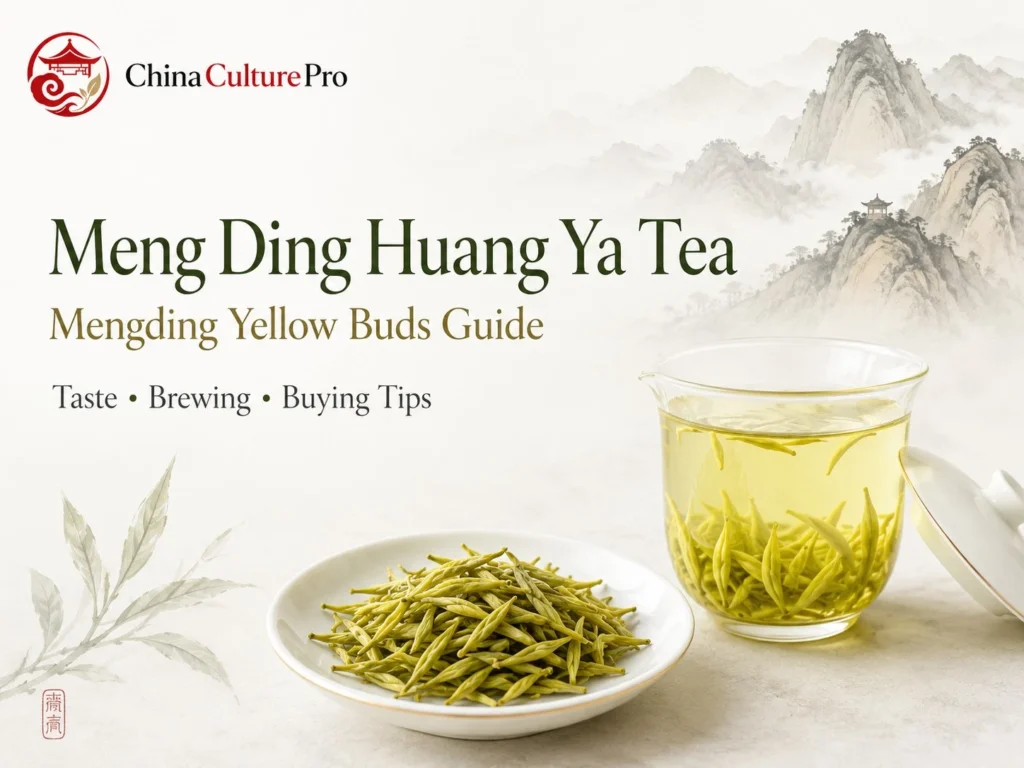

Quick Answer: What Is Meng Ding Huang Ya Tea?
Meng Ding Huang Ya Tea, also written as Mengding Huangya Tea and often translated as Mengding Yellow Buds Tea, is a classic Chinese yellow tea from Mengding Mountain in Ya’an, Sichuan Province. It is a specific yellow tea, not ordinary green tea and not a general name for all Mengding teas.
In Chinese tea classification, it belongs to Huang Cha, or yellow tea. Its identity depends on tender bud-leaf material and the Men Huang process, often translated as yellowing or smothering. This step gives the tea a softer, sweeter, lower-astringency character than a typical green tea.
The basic points are:
Tea Type: Chinese yellow tea, or Huang Cha.
Core Origin: Mengding Mountain, Ya’an, Sichuan.
Common English Names: Meng Ding Huang Ya Tea, Mengding Huangya Tea, Mengding Yellow Buds Tea, Meng Ding Yellow Buds.
Name Meaning: Meng Ding refers to Mengding Mountain; Huang Ya means yellow buds.
Tea Material: tender buds and young leaves, often early spring material.
Key Processing: Men Huang, or yellowing / smothering.
Dry Leaf: tender, even bud-leaf sets with a yellowish or yellow-green appearance.
Liquor: bright pale-yellow or yellow-green.
Core Aroma: tender aroma, clean sweetness, soft floral note, honey, dried apricot, sweet corn, green bean, light nutty note, or gentle creamy note.
Taste: fresh, mellow, sweet, smooth, velvety, delicate, clean, and low in bitterness.
Brewing: usually 75–85°C, using a glass cup, gaiwan, or porcelain teapot.
Key Point: Good Meng Ding Huang Ya is not simply greener or lighter. It should be judged by Mengding Mountain origin, tender and even bud-leaf material, naturally yellowish or yellow-green color, proper Men Huang yellowing, clean tender aroma with gentle cooked sweetness, bright pale-yellow or yellow-green liquor, sweet mellow freshness, velvety mouthfeel, low bitterness, and tender yellow leaf base.
Meng Ding Huang Ya, Mengding Huangya, and Yellow Buds: Are They the Same?
Meng Ding Huang Ya Tea, Mengding Huangya Tea, and Mengding Yellow Buds Tea usually refer to the same tea. The differences are mainly spelling and translation.
| Term | Chinese | Meaning | Best Use |
|---|---|---|---|
| Meng Ding Huang Ya Tea | 蒙顶黄芽 | spaced pinyin name | clearest main keyword |
| Mengding Huangya Tea | 蒙顶黄芽 | joined pinyin spelling | common product spelling |
| Mengding Yellow Buds Tea | 蒙顶黄芽 | English translation | useful for English readers |
| Meng Ding Yellow Buds | 蒙顶黄芽 | partial pinyin and translation | useful in product names |
| Yellow Tea / Huang Cha | 黄茶 | Chinese yellow tea category | category explanation |
| Yellow Bud Tea | 黄芽茶 | broad descriptive term | not automatically Meng Ding Huang Ya |
| Meng Ding Gan Lu | 蒙顶甘露 | a famous Mengding green tea | not Meng Ding Huang Ya |
Meng Ding or Mengding points to Mengding Mountain in Ya’an, Sichuan. It should not be used as a shortcut for every Mengshan tea, every Sichuan tea, or every tea called “yellow buds.”
The important distinction is simple: Meng Ding Huang Ya is a specific Chinese yellow tea from the Mengding Mountain context, not a general name for all Mengding teas or all yellow bud teas.
To compare Meng Ding Huang Ya with other Chinese tea categories, read our Chinese Tea Types guide.
Why Meng Ding Huang Ya Tea Is So Famous
Meng Ding Huang Ya is famous because it combines yellow tea rarity, Mengding Mountain culture, tribute-tea memory, tender bud-leaf material, and a soft, elegant flavor style.
Its reputation comes from several factors:
- Representative Yellow Tea: Meng Ding Huang Ya is one of the important names in Chinese yellow tea.
- Mengding Mountain Origin: its identity is tied to Mengding Mountain in Ya’an, Sichuan.
- Historic Tea Culture: Mengding Mountain is one of the most symbolic and historically important tea mountains in Chinese tea culture.
- Tribute-Tea Context: Mengding teas have long been associated with famous-tea and tribute-tea memory.
- Gentle Yellow Tea Style: Meng Ding Huang Ya is more about clean sweetness, tender aroma, and velvety liquor than strong roast or dramatic visual effects.
- Clear Internal Difference: compared with Junshan Yinzhen, it is less focused on glass-cup viewing; compared with Huo Shan Huang Ya, it is less chestnut-heavy and more tender, soft, and elegant.
A traditional Chinese saying praises “water from the Yangtze River, tea from the top of Mengshan.” The value of this line is not only poetic. It shows how deeply Mengding Mountain sits in Chinese tea memory. But for a modern buyer, history is not enough. A good cup still needs tender aroma, bright liquor, soft sweetness, low bitterness, and clean Hui Gan.
To compare Meng Ding Huang Ya with other yellow teas, read our Chinese Yellow Tea guide.
Where Meng Ding Huang Ya Tea Comes From
Meng Ding Huang Ya is most closely associated with Mengding Mountain in Ya’an, Sichuan Province. The mountain setting matters because this tea is not only a processing style. It also belongs to a specific Sichuan tea culture and origin context.
| Origin | Chinese Name | Location | General Style | Typical Price Position |
|---|---|---|---|---|
| Mengding Mountain | 蒙顶山 | Ya’an, Sichuan | core origin; tender aroma, soft sweetness, velvety yellow tea character | highest |
| Ya’an Area | 雅安地区 | Ya’an and nearby tea areas | related regional style, but quality and identity vary | medium to high |
| Sichuan Yellow Tea | 四川黄茶 | other Sichuan yellow tea areas | may use yellow tea processing, but not necessarily Meng Ding Huang Ya | medium |
| Other “Meng Ding Huang Ya” Labels | 外地仿制 | outside the Mengding / Ya’an context | may look similar, but origin and processing may differ | medium to low |
| Green-Tea-Style Mengding Tea | 绿茶化蒙顶茶 | Mengding or other Sichuan tea markets | may be fresh and pleasant, but not true yellow tea if no yellowing | varies |
Core Mengding Mountain identity is important, but origin language alone is not enough. A good Meng Ding Huang Ya still needs tender and even bud-leaf material, proper Men Huang yellowing, clean tender aroma, bright pale-yellow or yellow-green liquor, sweet mellow taste, velvety mouthfeel, and tender yellow leaf base.
A tea from the wider Ya’an area may still be good, but it should be labeled honestly. A generic “Mengding tea” or “yellow buds” label should not automatically be treated as Meng Ding Huang Ya.
Why Yellow Tea Processing Matters for Meng Ding Huang Ya
Meng Ding Huang Ya is not yellow tea because it looks slightly yellow. It is yellow tea because of processing. The key step is Men Huang, often translated as yellowing, sealed yellowing, or smothering.
| Processing Point | What It Means | Why It Matters For Meng Ding Huang Ya |
|---|---|---|
| Yellow Tea Is A Category | Huang Cha is an independent Chinese tea category | it is not a marketing word for “yellow-looking tea” |
| Similar Base To Green Tea | processing begins with fixation, as in many green teas | this keeps a fresh foundation |
| Men Huang / Yellowing | tea is gently held under warm, moist conditions after fixation | this softens green sharpness and builds mellow sweetness |
| Tender Bud-Leaf Material | Meng Ding Huang Ya depends on fine young material | the tea should feel delicate but not empty |
| Tender Aroma | yellowing and gentle drying shape the clean sweet aroma | this supports the tea’s elegant style |
| Under-Yellowing | tea tastes too green, grassy, or astringent | it may feel closer to green tea |
| Over-Yellowing | tea becomes dull, sour, stuffy, or heavy | the clean tender aroma is damaged |
| Fire Control | drying stabilizes the tea | too much heat can create burnt harshness |
Men Huang should not be explained like the microbial fermentation of Pu’er tea. For Meng Ding Huang Ya, it is better to describe it as a warm, moist yellowing transformation. It should make the tea softer, sweeter, smoother, and lower in harsh astringency.
Meng Ding Huang Ya is not famous for Junshan Yinzhen’s “three rises and three falls,” and it is not driven by the stronger chestnut profile of Huo Shan Huang Ya. Its best character is clean tender aroma, sweet mellow freshness, velvety liquor, and clear Hui Gan.
Meng Ding Huang Ya vs Green Tea
Meng Ding Huang Ya is easy to confuse with green tea because its processing begins in a similar way and its color can look yellow-green. The difference is the Men Huang yellowing step.
| Point | Meng Ding Huang Ya Yellow Tea | Green Tea |
|---|---|---|
| Tea Category | yellow tea / Huang Cha | green tea / Lü Cha |
| Core Processing | fixation plus Men Huang yellowing | fixation without yellowing |
| Liquor Color | pale-yellow or yellow-green | greenish, yellow-green, or pale green |
| Leaf Base | tender yellow or yellow-green | tender green or greenish |
| Aroma | tender aroma, soft floral note, gentle cooked sweetness | fresh, grassy, bean-like, chestnut-like, or vegetal |
| Taste | sweet, mellow, smooth, velvety, low in astringency | fresh, brisk, clean, sometimes more green or sharp |
| Quality Logic | yellow tea softness, tender aroma, smooth liquor | green freshness, clean aroma, crisp taste |
Meng Ding Huang Ya is not better than green tea by default. Green tea values clean freshness and lively green character. Meng Ding Huang Ya values soft sweetness, tender aroma, velvety mouthfeel, and lower roughness.
If a tea sold as Meng Ding Huang Ya tastes too grassy, too raw, or too astringent, the yellowing may be insufficient or the tea may be closer to green tea-style processing.
To understand how this differs from green tea, read our Chinese Green Tea guide.
Meng Ding Huang Ya vs Junshan Yinzhen
Meng Ding Huang Ya and Junshan Yinzhen are both classic Chinese yellow teas, but they express different origins and drinking experiences.
| Point | Meng Ding Huang Ya | Junshan Yinzhen |
|---|---|---|
| Core Origin | Mengding Mountain, Ya’an, Sichuan | Junshan Island, Dongting Lake, Hunan |
| Tea Type | yellow bud-leaf tea | yellow needle-bud tea |
| Material | tender buds and small leaves | plump buds |
| Appearance | fine, tender, even bud-leaf sets | needle-shaped buds |
| Liquor | pale-yellow or yellow-green | bright apricot-yellow |
| Aroma | tender aroma, soft floral note, honey, gentle cooked sweetness | clean sweet aroma, sweet corn, sugarcane, honey |
| Taste | sweet, mellow, velvety, delicate | sweet, mellow, delicate, visually elegant |
| Visual Feature | general leaf opening in the cup | standing needles and “three rises and three falls” |
| Style | tender, soft, elegant, smooth | iconic, delicate, visually memorable |
Do not treat Meng Ding Huang Ya as a side note to Junshan Yinzhen. Junshan Yinzhen is famous for needle-shaped buds and glass-cup visual performance. Meng Ding Huang Ya is valued for Mengding Mountain culture, tender aroma, soft sweetness, and refined mouthfeel.
To compare Meng Ding Huang Ya with the most famous silver-needle yellow tea, read our Junshan Yinzhen Tea guide.
Meng Ding Huang Ya vs Huo Shan Huang Ya
Meng Ding Huang Ya and Huo Shan Huang Ya are both important yellow bud teas, but their flavor direction is different. Both are easier to drink than rare, visually iconic Junshan Yinzhen, yet they do not taste the same.
| Point | Meng Ding Huang Ya | Huo Shan Huang Ya |
|---|---|---|
| Core Origin | Mengding Mountain, Sichuan | Huoshan County, Anhui |
| Tea Type | yellow bud-leaf tea | yellow bud-leaf tea |
| Material | tender buds and young leaves | one bud with one leaf or two just-opening leaves |
| Liquor | pale-yellow or yellow-green | bright yellow-green or light yellow |
| Aroma | tender aroma, soft floral note, honey, gentle cooked sweetness | tender chestnut, cooked chestnut, nutty, fresh vegetal |
| Taste | sweet, mellow, velvety, delicate | fresh, mellow, rounded, chestnut-sweet |
| Style | softer, more elegant, more tender | more chestnut-like, rounder, more refreshing |
Huo Shan Huang Ya is more chestnut-like, rounded, and refreshing. Meng Ding Huang Ya is more tender, soft, and elegant. The better choice depends on whether you prefer chestnut sweetness or a softer, more delicate yellow tea profile.
To compare Meng Ding Huang Ya with Anhui yellow tea, read our Huo Shan Huang Ya Tea guide.
What Does Meng Ding Huang Ya Tea Taste Like?
Good Meng Ding Huang Ya tastes fresh, mellow, sweet, smooth, velvety, delicate, and clean. It should not feel weak. Its best cup is soft but not empty, delicate but not thin, and sweet without being sugary.
| Tasting Point | Good Meng Ding Huang Ya | Weak Or Poor Meng Ding Huang Ya |
|---|---|---|
| Aroma | tender aroma, clean sweetness, soft floral note | grassy, sour, moldy, burnt, or flat |
| Liquor | bright pale-yellow or yellow-green | too green, dark, cloudy, or dull |
| First Sip | sweet, mellow, smooth, and soft | bitter, thin, grassy, sour, or rough |
| Tender Aroma | fresh young-bud fragrance, clean and natural | weak, stale, or perfumed |
| Honey / Fruit Note | honey, dried apricot, or light fruit sweetness | artificial sweetness or no sweetness |
| Grain / Vegetable Note | sweet corn, green bean, or gentle plant sweetness | raw grassiness or dull vegetable odor |
| Nutty / Creamy Note | light nutty or gentle creamy touch | heavy roast or burnt bitterness |
| Astringency | low, able to fade | drying, sharp, or mouth-coating |
| Mouthfeel | velvety, smooth, fine | watery, rough, or hollow |
| Hui Gan | clean long sweet finish | weak, messy, or absent |
| Leaf Base | tender yellow or yellow-green, soft and even | green, dark, rough, uneven, or lifeless |
Good Meng Ding Huang Ya is not green tea-style sharp freshness. It is clear and fresh, but the freshness is softened by mellow sweetness and velvety liquor.
If the tea is too green and grassy, the yellowing may be insufficient. If it is sour, burnt, cloudy, or stuffy, the processing or storage may be poor. If it tastes merely light with no aroma, no sweetness, and no Hui Gan, it is not “delicate”; it is weak.
What Good Meng Ding Huang Ya Tea Looks Like
Dry leaf appearance can help buyers judge Meng Ding Huang Ya, but tenderness alone is not enough. The tea must show balance between bud-leaf quality, yellow tea processing, aroma, and liquor.
| Good Signs | Warning Signs |
|---|---|
| fine, tender, even bud-leaf sets | coarse leaves, heavy dust, broken pieces, or uneven material |
| one bud with one leaf or tender young leaves | old leaves, rough stems, or mixed coarse material |
| natural, slender, clean shape | overly tight, overly loose, or messy shape |
| yellowish or yellow-green glossy color | dead green, dark yellow, dull brown, or lifeless color |
| clean sweet dry aroma, tender aroma, gentle cooked note | sour, moldy, stale, burnt, or stuffy smell |
| bright pale-yellow or yellow-green liquor | greenish, dark, cloudy, or dull liquor |
| tender yellow or yellow-green leaf base | green, dark, hard, uneven, or lifeless leaf base |
Do not judge Meng Ding Huang Ya only by how tender the leaves look. A good tea should be tender, but it also needs proper yellowing, clean aroma, bright liquor, smooth mouthfeel, and refreshing Hui Gan.
If the leaf looks too green, the tea may not have enough yellowing. If it looks dark yellow and smells stuffy, the yellowing, drying, or storage may be poor.
How Meng Ding Huang Ya Tea Is Made
Meng Ding Huang Ya is a yellow tea. Its identity depends on tender bud-leaf material, Men Huang yellowing, and careful drying.
| Step | Chinese Term | What Happens | Why It Matters |
|---|---|---|---|
| Picking | 采摘 | tender buds and young leaves are selected | material quality sets the foundation |
| Fixation | 杀青 | heat stops strong enzymatic oxidation | keeps a fresh base |
| Initial Wrapping / Yellowing | 初包 / 闷黄 | tea is gently wrapped or held under warm moist conditions | begins yellow tea transformation |
| Re-Stirring / Re-Wrapping | 复炒 / 复包 | tea is stirred and wrapped again if needed | controls yellowing depth |
| Drying / Finishing | 干燥 / 整理 | moisture is reduced and aroma is stabilized | protects fragrance and storage stability |
| Sorting | 整理 | finished tea is cleaned and graded | improves consistency |
The craft needs control. Too little yellowing leaves the tea raw, green, and sharp. Too much yellowing makes it dull, sour, or stuffy. Too much fire can damage the tender aroma.
The best processing keeps the tea fresh but not raw, soft but not empty, sweet but not heavy, and mellow without losing clarity.
Harvest Time and Picking Standard of Meng Ding Huang Ya
Picking standard affects the shape, aroma, taste, price, and grade of Meng Ding Huang Ya. The tea is usually made from tender spring bud-leaf material.
| Harvest / Picking Context | Chinese Term | General Timing | General Character | Buying Note |
|---|---|---|---|---|
| Ming Qian | 明前 | before Qingming | most tender; clean sweetness, fine aroma, velvety liquor | highest value |
| Early Spring | 早春 | around the early spring window | tender material, stable aroma and taste | medium to high |
| Later Spring | 晚春 | after the main early spring period | coarser material risk, stronger roughness | lower value |
| Standard Picking | 一芽一叶初展 / 嫩芽叶 | one bud with one opening leaf or tender bud-leaf material | balanced tenderness, aroma, and taste | typical quality standard |
Ming Qian tea, picked before Qingming, is often more delicate and more expensive, but tenderness is not the only quality marker. A good Meng Ding Huang Ya needs even material, proper yellowing, clean tender aroma, bright liquor, smooth mouthfeel, and clean aftertaste.
Later material may become rougher, more astringent, and less refined in aroma.
Meng Ding Huang Ya vs Meng Ding Gan Lu
This comparison is important because English readers may search “Mengding tea” and confuse Meng Ding Huang Ya with Meng Ding Gan Lu. Both belong to the Mengding Mountain context, but they are different teas.
| Point | Meng Ding Huang Ya | Meng Ding Gan Lu |
|---|---|---|
| Chinese Name | 蒙顶黄芽 | 蒙顶甘露 |
| Tea Category | yellow tea | green tea |
| Core Processing | fixation plus Men Huang yellowing | fixation without yellowing |
| Liquor | pale-yellow or yellow-green | greenish or yellow-green |
| Aroma | tender aroma, soft floral note, gentle cooked sweetness | fresh tender aroma, bean-like or chestnut-like green tea notes |
| Taste | sweet, mellow, velvety, low in astringency | fresh, brisk, clean, refreshing |
| Style | softer and rounder | fresher and more brisk |
| Main Confusion | both are Mengding teas | both are Mengding teas |
Meng Ding Huang Ya is yellow tea. Meng Ding Gan Lu is green tea. They can share a Mengding Mountain identity, but they do not share the same tea category or processing logic.
Do not treat every Mengding tea as Meng Ding Huang Ya. Check the tea type, processing, and flavor profile.
Meng Ding Huang Ya vs Other Yellow Bud Teas
Meng Ding Huang Ya sits in the yellow tea family, but it has its own place. It is less visually dramatic than Junshan Yinzhen and less chestnut-like than Huo Shan Huang Ya. Its strength is tender aroma, soft sweetness, velvety liquor, and elegant drinking experience.
| Yellow Tea | Core Origin | Core Style | Best For |
|---|---|---|---|
| Junshan Yinzhen | Junshan Island, Hunan | needle-shaped buds, visual beauty, sweet mellow delicacy | rare yellow tea and glass-cup viewing |
| Huo Shan Huang Ya | Huoshan County, Anhui | tender bud-leaf sets, chestnut aroma, fresh mellow sweetness | approachable yellow tea with nutty depth |
| Meng Ding Huang Ya | Mengding Mountain, Sichuan | tender aroma, soft sweetness, velvety mouthfeel | elegant yellow tea with gentle sweetness |
| Mogan Huangya | Mogan Mountain, Zhejiang | fresh, sweet, tender, mountain-style yellow tea | lighter yellow tea freshness |
| Beigang Maojian | Yueyang, Hunan | tender buds and leaves, mellow yellow tea taste | regional Hunan yellow tea |
| Huang Da Cha | Anhui and related regions | larger leaves, heavier roast, guoba-like aroma | stronger yellow tea with rustic depth |
Meng Ding Huang Ya’s position is clear: it is not a Junshan Yinzhen substitute, not Huo Shan Huang Ya with less chestnut aroma, and not Meng Ding Gan Lu green tea. It is a soft, elegant Sichuan yellow tea with its own identity.
How to Brew Meng Ding Huang Ya Tea
Meng Ding Huang Ya is made from tender bud-leaf material, so it should not be brewed with boiling water or long heavy steeping. Gentle brewing protects its tender aroma, sweet mellow freshness, and velvety mouthfeel.
| Brewing Method | Teaware | Water Temperature | Leaf Amount | Steeping Time | Best For |
|---|---|---|---|---|---|
| Glass Cup Brewing | clear glass cup | 75–85°C | 2–3g / 200–250ml | 2–3 minutes | daily brewing and leaf opening |
| Gaiwan Brewing | porcelain gaiwan | 75–85°C | 3–4g / 100–120ml | 30–60 seconds first infusion, then extend | controlled aroma and taste |
| Porcelain Teapot | porcelain teapot | 75–85°C | 3–4g / 200ml | 2–3 minutes | sharing with one or two people |
| Softer Brewing | glass cup or gaiwan | around 75–80°C | moderate amount | slightly longer | protecting tender aroma |
| Fuller Brewing | glass cup or gaiwan | around 80–85°C | moderate amount | controlled time | stronger aroma and fuller taste |
Use the lower end of the range for very tender tea or when you want a softer cup. Use the higher end when you want more aroma, but avoid long steeping.
Rinsing is usually unnecessary unless the tea is old, dusty, or stored poorly. Drink it plain. Milk and sugar will cover the delicate yellow tea character.
For water temperature and brewing control, read our How to Brew Chinese Tea guide. For glass cups, gaiwans, and teaware choices, read our Chinese Teaware guide.
How to Taste Meng Ding Huang Ya Tea
Tasting Meng Ding Huang Ya should focus on origin logic, bud-leaf quality, yellowing, tender aroma, liquor brightness, velvety mouthfeel, and clean Hui Gan.
| Tasting Check | What To Look For |
|---|---|
| Dry Leaf Shape | fine, tender, even bud-leaf sets, not coarse or broken |
| Dry Leaf Color | yellowish or yellow-green, not dead green or dull dark yellow |
| Dry Aroma | clean sweetness, tender aroma, gentle cooked sweetness |
| Liquor Color | bright pale-yellow or yellow-green |
| Hot Aroma | tender sweetness rises clearly from the cup |
| First Sip | sweet, mellow, smooth, soft, and not sharp |
| Mouthfeel | velvety and delicate, not watery or rough |
| Flavor Notes | honey, dried apricot, sweet corn, green bean, soft floral note, light nutty or creamy note |
| Bitterness | low, able to fade |
| Hui Gan | clean refreshing sweetness |
| Leaf Base | tender yellow or yellow-green, soft, even, and lively |
Good Meng Ding Huang Ya should not taste too green, too heavy, or too empty. If it is grassy and sharp, it may lack yellowing. If it is sour, burnt, or dull, the yellowing, firing, or storage may be poor.
For aroma, mouthfeel, Hui Gan, and aftertaste, read our Chinese Tea Tasting guide.
How to Choose and Buy Meng Ding Huang Ya Tea
Meng Ding Huang Ya can be misrepresented because “Mengding tea” and “yellow buds” are both attractive market terms. Common buying traps include Mengding green tea sold as Huang Ya, generic yellow bud tea sold as Meng Ding Huang Ya, vague tribute-tea claims, and green-tea-style processing with little yellow tea character.
| What To Check | Good Sign | Warning Sign |
|---|---|---|
| Origin | clearly says Mengding Mountain, Ya’an, or Sichuan with context | only says “Mengding tea” or “Yellow Buds” |
| Tea Type | clearly identified as yellow tea / Huang Cha | listed as green tea or no tea category is given |
| Mengding Tea Confusion | seller distinguishes Meng Ding Huang Ya from Meng Ding Gan Lu | all Mengding teas treated as the same |
| Yellow Bud Confusion | seller explains it is Meng Ding Huang Ya, not generic yellow bud tea | any yellow bud tea sold as Mengding Huangya |
| Men Huang / Yellowing | yellowing or yellow tea processing is mentioned or implied | only green tea processing language appears |
| Harvest / Picking | early spring, Ming Qian, or tender bud-leaf standard is clear | vague “premium,” “rare,” or “handmade” only |
| Dry Leaf Shape | fine, tender, even bud-leaf sets | coarse, broken, dusty, or uneven leaves |
| Yellowish Color | natural yellowish or yellow-green tone | dead green, dark yellow, dull brown, or lifeless color |
| Aroma | clean tender aroma, gentle cooked sweetness, soft floral note | sour, moldy, stale, burnt, or stuffy smell |
| Liquor | bright pale-yellow or yellow-green | cloudy, dark, too green, or dull liquor |
| Leaf Base | tender yellow or yellow-green, soft and even | green, dark, hard, uneven, or rough |
| Packaging | sealed, practical, informative | gift box with weak origin or processing details |
| Price | matches origin, harvest, material, and seller credibility | very cheap “authentic Meng Ding Huang Ya” |
The safest purchase is not the most expensive box or the most poetic “tribute tea” label. It is the tea with clear Mengding Mountain origin, clear yellow tea identity, believable bud-leaf material, natural tender aroma, bright liquor, and credible seller information.
How to Store Meng Ding Huang Ya Tea
Meng Ding Huang Ya has a delicate tender aroma and soft sweetness. It needs protection from oxygen, light, heat, moisture, and odors.
Store Meng Ding Huang Ya this way:
- Seal It Tightly: use a sealed tin, foil bag, or airtight container.
- Keep It Away From Light: light weakens aroma and liquor brightness.
- Keep It Dry: moisture can cause sourness, mold, or stale taste.
- Use Cool Storage: short-term storage can be cool room temperature; longer storage can use refrigeration only if sealed against moisture and odors.
- Avoid Strong Odors: keep it away from flower tea, smoked tea, coffee, spices, Pu’er, and other strong-smelling items.
- Drink After Opening: for best aroma, finish opened tea within about 6–12 months.
- Do Not Age It Like Pu’er: Meng Ding Huang Ya is not judged by long-term post-fermentation logic.
Its charm is in tender aroma, pale-yellow liquor, sweet mellow freshness, velvety mouthfeel, and clean Hui Gan. Do not store it for years expecting it to improve like aged dark tea.
Common Mistakes With Meng Ding Huang Ya Tea
Many Meng Ding Huang Ya mistakes come from confusing tea category, origin, and the word “Mengding.”
| Mistake | Better Method |
|---|---|
| Treating Meng Ding Huang Ya as green tea | remember it is yellow tea with Men Huang processing |
| Treating every Mengding tea as Meng Ding Huang Ya | distinguish Meng Ding Huang Ya from Meng Ding Gan Lu and other Mengding teas |
| Confusing Meng Ding Huang Ya with Meng Ding Gan Lu | Huang Ya is yellow tea; Gan Lu is green tea |
| Treating every yellow bud tea as Meng Ding Huang Ya | check Mengding / Ya’an / Sichuan origin and yellow tea identity |
| Thinking greener means fresher and better | Meng Ding Huang Ya should show yellow tea softness, not pure green tea sharpness |
| Thinking lighter means higher grade | delicate does not mean empty; good tea still has aroma, body, and Hui Gan |
| Trusting tribute, famous, rare, or handmade labels automatically | verify origin, harvest, material, processing, and storage |
| Brewing with boiling water | use gentle water around 75–85°C |
| Using heavy gongfu brewing | avoid pushing bitterness or stuffy notes |
| Storing delicate yellow tea too long | drink while aroma and sweetness are clear |
| Aging it like Pu’er | seal it well and drink within a reasonable time |
The main traps are clear: Meng Ding Huang Ya is not ordinary green tea, not every Mengding tea is Meng Ding Huang Ya, and not every light-tasting tea is high quality.
Meng Ding Huang Ya Tea Benefits
Meng Ding Huang Ya Tea is often enjoyed as a gentle, aromatic yellow tea because it is:
- Refreshing: it contains caffeine and can feel clear and light.
- Low In Calories: plain Meng Ding Huang Ya has almost no calories when unsweetened.
- Rich In Tea Polyphenols: like other teas, it contains natural plant compounds.
- Mellow And Gentle: many drinkers find it smoother than sharp green tea.
- Aromatic: tender aroma, honey-like sweetness, and soft floral notes make it pleasant plain.
- Suitable For Plain Drinking: its sweet mellow freshness is best tasted without milk or sugar.
Meng Ding Huang Ya is tea, not medicine. It should not be presented as a treatment for weight loss, blood pressure, cancer, or disease. Many people enjoy it because it is tender, smooth, mellow, and clean in the finish.
Final Thoughts
Meng Ding Huang Ya Tea is a classic Chinese yellow tea from Mengding Mountain in Ya’an, Sichuan. In English, it is often called Mengding Huangya Tea or Mengding Yellow Buds Tea.
Good Meng Ding Huang Ya should be judged by Mengding Mountain origin, tender and even bud-leaf material, naturally yellowish or yellow-green color, proper Men Huang yellowing, clean tender aroma with gentle cooked sweetness, bright pale-yellow or yellow-green liquor, sweet mellow freshness, velvety mouthfeel, low bitterness, and tender yellow leaf base.
It is not simply greener or lighter. Its real quality lies in the balance of yellow tea processing, tender bud-leaf material, clean tender aroma, smooth liquor, and refreshing Hui Gan.
FAQs About Meng Ding Huang Ya Tea
What is Meng Ding Huang Ya tea?
Meng Ding Huang Ya Tea is a classic Chinese yellow tea from Mengding Mountain in Ya’an, Sichuan. It is known for tender bud-leaf material, pale-yellow or yellow-green liquor, clean tender aroma, sweet mellow taste, velvety mouthfeel, and low bitterness.
Is Meng Ding Huang Ya the same as Mengding Yellow Buds?
Yes. Mengding Yellow Buds Tea is an English translation of Meng Ding Huang Ya Tea. Mengding Huangya Tea is another common spelling of the same tea name.
Is Meng Ding Huang Ya yellow tea or green tea?
Meng Ding Huang Ya is yellow tea. It uses Men Huang yellowing, which makes the tea softer, sweeter, smoother, and less sharp than many green teas. Meng Ding Gan Lu, by contrast, is green tea.
Where does Meng Ding Huang Ya come from?
Meng Ding Huang Ya comes from Mengding Mountain in Ya’an, Sichuan Province. This origin matters because not every Mengding tea or yellow bud tea is true Meng Ding Huang Ya.
What does Meng Ding Huang Ya taste like?
Good Meng Ding Huang Ya tastes fresh, mellow, sweet, smooth, velvety, delicate, and clean. Common notes include tender aroma, soft floral note, honey, dried apricot, sweet corn, green bean, light nutty note, gentle creamy touch, and clean Hui Gan.
What is Men Huang in Meng Ding Huang Ya?
Men Huang is the yellowing or smothering process used in yellow tea. It gently transforms the tea under warm, moist conditions after fixation, creating a softer, sweeter, lower-astringency cup with yellow tea character.
Why is Meng Ding Huang Ya famous?
Meng Ding Huang Ya is famous because it is an important Chinese yellow tea from Mengding Mountain, one of the most symbolic tea mountains in Chinese tea culture. It is valued for tender aroma, soft sweetness, and elegant yellow tea character.
What is the difference between Meng Ding Huang Ya and Junshan Yinzhen?
Meng Ding Huang Ya is a Sichuan yellow tea known for tender aroma, soft sweetness, and velvety liquor. Junshan Yinzhen is a Hunan yellow tea known for plump needle-shaped buds, apricot-yellow liquor, and glass-cup visual performance.
What is the difference between Meng Ding Huang Ya and Huo Shan Huang Ya?
Meng Ding Huang Ya is softer, more tender, and more elegant. Huo Shan Huang Ya is more chestnut-like, rounded, and refreshing, with an Anhui Huoshan origin context.
What is the difference between Meng Ding Huang Ya and green tea?
Meng Ding Huang Ya uses Men Huang yellowing, which gives it a softer, sweeter, lower-astringency taste. Green tea does not use yellowing and usually tastes fresher, greener, and more brisk.
What is the difference between Meng Ding Huang Ya and Meng Ding Gan Lu?
Meng Ding Huang Ya is yellow tea with Men Huang processing. Meng Ding Gan Lu is green tea without yellowing. Both are Mengding teas, but they differ in tea category, processing, liquor, aroma, and taste.
How do you brew Meng Ding Huang Ya tea?
Use 75–85°C water. For glass cup brewing, use about 2–3g per 200–250ml and steep for 2–3 minutes. For gaiwan brewing, use 3–4g per 100–120ml and short infusions.
How can you tell if Meng Ding Huang Ya is good?
Good Meng Ding Huang Ya has tender even bud-leaf sets, natural yellowish or yellow-green color, bright pale-yellow liquor, clean tender aroma, sweet mellow freshness, velvety mouthfeel, low bitterness, clean Hui Gan, and a tender yellow or yellow-green leaf base.
How should Meng Ding Huang Ya tea be stored?
Store Meng Ding Huang Ya sealed, dry, dark, cool, and away from odors. For longer storage, refrigeration can be used only if the tea is sealed against moisture and smells. After opening, drink it within about 6–12 months for the best aroma.