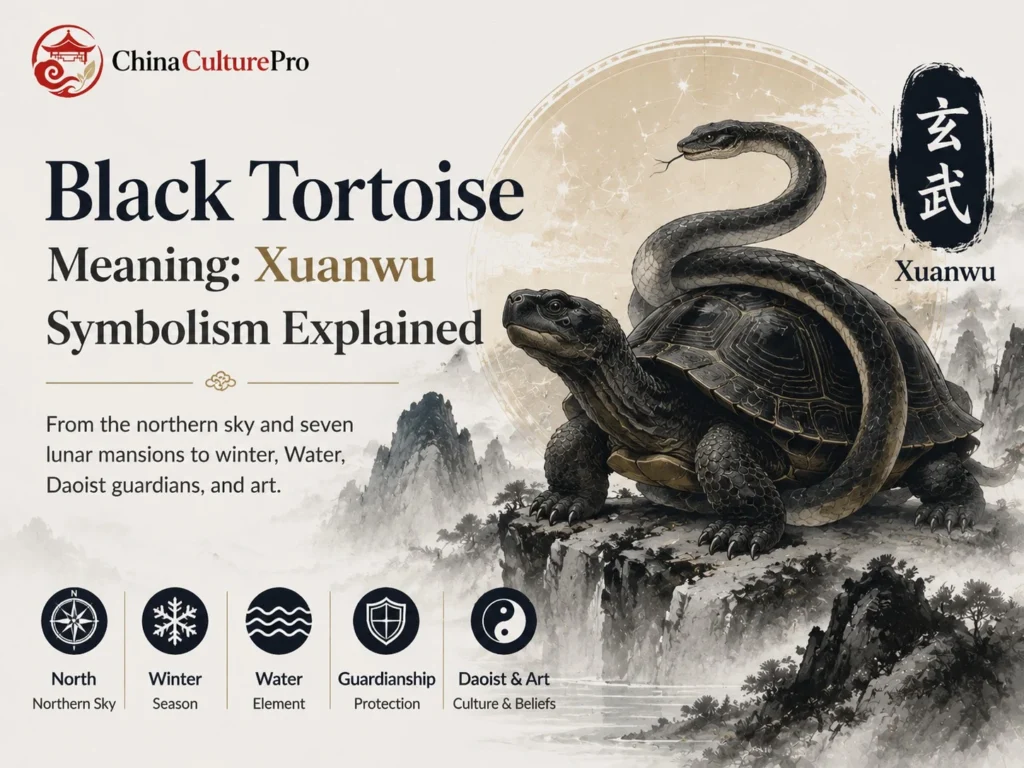

Quick Answer: What Does the Black Tortoise Symbolize?
The Black Tortoise, or Xuanwu (玄武, Xuánwǔ), symbolizes the northern sky within the Four Symbols of Chinese mythology. Its mature image is a tortoise entwined with a snake. The emblem links north with winter, the Water phase, and a dark cosmological color. Funerary guardianship, the Daoist title Zhiming Shenjun, the later deity Zhenwu, and modern ideas of stability developed in different historical settings; they are not one timeless definition.
- North and the northern sky: Xuanwu represents the seven northern lunar mansions as one celestial region.
- Winter and the Water phase: It expresses seasonal withdrawal, storage, and latent renewal within correlative cosmology—not literal water magic.
- Seasonal stillness: Its winter association suggests rest, concentration, and potential held in reserve.
- Directional and funerary order: Han and later tomb art used Xuanwu to mark the north and complete a protected cosmic space.
- Later religious and modern meanings: Daoism personified the emblem, while contemporary design often emphasizes steadiness, endurance, and northern identity.
For the wider visual language, see Chinese symbols and their meanings.
Xuanwu is often reduced to a black-colored sacred turtle. A Northern Song funerary model at The Metropolitan Museum of Art gives a more accurate starting point: its pale qingbai porcelain body shows a tortoise tightly entwined with a snake, not a solitary turtle and not a creature painted black.[1] The object’s tomb context also matters. It was made to mark the northern quarter of an ordered burial cosmos, not to illustrate a fantasy animal with one fixed set of powers.
The Black Tortoise therefore has to be read in layers. It began as a celestial and directional emblem, gained ritual and funerary functions, received the Daoist guardian title Zhiming Shenjun, and later contributed to the fully anthropomorphic cult of Zhenwu. Separating those layers explains both the image and the many names attached to it.
What Is the Black Tortoise or Xuanwu?
Xuanwu is written 玄武 in both simplified and traditional Chinese and pronounced Xuánwǔ. It is the northern member of the Four Symbols and gives one visual identity to the seven northern lunar mansions. It is not one star, a modern International Astronomical Union constellation, a zodiac animal, or a biological species.[2]
Several English names refer to the same emblem. Black Tortoise reflects its dominant animal form; Black Warrior or Dark Warrior is more literal; the Hong Kong Space Museum uses Murky Warrior.[2] Black Tortoise–Snake makes the compound image explicit. These are translation choices, not separate creatures.
The characters do not literally mean “black tortoise.” 玄 can mean dark, profound, or mysterious, while 武 means martial or warrior. The animal body belongs to the visual tradition, and “black” marks a cosmological correspondence rather than a required pigment.
Xuanwu belongs to the broad field of Chinese mythical creatures, but its foundation is cosmological rather than story-driven. It has no single early biography or skill set. Nor does it belong to the Four Auspicious Creatures, which express virtue and auspicious rule rather than celestial direction.
What Xuanwu Means in Different Contexts
No single meaning covers every Xuanwu image. Star diagrams, tomb sculptures, Daoist robes, temple statues, and games activate different historical layers.
| Context | Primary meaning | Typical carrier | Interpretation limit |
|---|---|---|---|
| Astronomy and the northern sky | The seven northern lunar mansions organized as one celestial emblem | Star charts, astronomical texts, cosmological mirrors | Not one modern constellation, a fortune symbol, or a being with a fixed personality |
| Winter and the Water phase | North, winter, dark color, and Water within a coordinated cosmological system | Five Phases diagrams, Han ritual art, calendrical texts | Water is a conceptual phase here, not proof that Xuanwu controls seas, rain, or personal luck |
| Ritual and spatial order | The north or rear within a conventional south-facing formation | Military banners, processions, court and architectural plans | A rule of orientation and ceremony, not an automatic protective effect |
| Tombs and protected space | The northern side of a tomb and the complete cosmos surrounding the deceased | Tomb murals, stone carvings, mirrors, funerary models | A funerary function that should not be imposed on every tortoise or snake design |
| Later Daoist religion | The northern guardian known as Zhiming Shenjun | Daoist texts, ritual robes, talismans, temple imagery | A later divine layer, not the original identity of every pre-Daoist Xuanwu |
| Zhenwu worship | An anthropomorphic Daoist deity and protector with an independent cult | Song–Ming temples, statues, prints, and Wudang traditions | Historically derived from Xuanwu, but not interchangeable with every celestial tortoise–snake image |
| Modern design and popular culture | Stability, endurance, stillness, winter, or Chinese-inspired fantasy | Tattoos, logos, games, film, fashion, and cultural products | Combat ranks, spells, and exact personality traits are modern creative choices |
A late Qing Daoist priest’s robe at The Met still uses the entwined tortoise and snake as the northern emblem within a complete cosmic program.[8] Its religious setting does not erase the image’s astronomical foundation.
As with other Chinese symbolism in art, meaning comes from date, function, position, inscription, and companion motifs—not a universal keyword such as “protection.”
Why Is Xuanwu Shown as a Tortoise and Snake?
In its mature form, Xuanwu is a composite image: a snake coils around, across, or beside a tortoise. The scene is not automatically a battle or one animal attacking the other. Details vary by medium, but the intertwined pair is the most reliable visual feature.
Later interpreters found complementary qualities in the animals: the tortoise could suggest firmness and stillness, while the snake suggested movement and flexibility. Readings such as hard and soft or still and active explain later reception, but do not prove why the image was invented.
The form’s original source remains unsettled. Proposed explanations include celestial patterning and the merger of older animal emblems, but no hypothesis supports a universal origin story.
The internet claim that tortoises could reproduce only by mating with snakes is later folklore, not biological fact or a documented origin of Xuanwu.
A lone tortoise may instead express longevity, divination, or another idea discussed in turtle and tortoise symbolism in Chinese culture. A lone snake also needs directional, compositional, or inscriptional evidence before it can be called Xuanwu.
Why North, Winter, Water, and Black Belong Together
Xuanwu’s meanings come from a model coordinating direction, season, color, and Five Phase. Its sequence is north–winter–dark or black–Water; the other quarters follow parallel relationships.
Winter gives the emblem themes of closure, storage, and energy held in reserve. Water is the matching phase, not a claim that Xuanwu governs rivers, causes rain, or changes a person’s life.
The color term 玄 is broader than flat modern black and can evoke depth, darkness, distance, and mystery. See black meaning in Chinese culture for its wider uses. Here it is a cosmological assignment before an artisan’s instruction.
The Met model is bluish-white porcelain, while mirrors retain bronze surfaces.[1][3] Both are authentic Xuanwu images. Position, compound form, and Four Symbols context matter more than pigment.
Xuanwu and the Seven Northern Lunar Mansions
Traditional Chinese astronomy divided a broad belt of the sky into twenty-eight lunar mansions and arranged them in four groups of seven. The northern group forms Xuanwu: Dipper, Ox, Girl, Emptiness, Rooftop, Encampment, and Wall.[2]
| Chinese | Pinyin | Standard English translation | Approximate modern star region |
|---|---|---|---|
| 斗 | Dǒu | Dipper | Sagittarius |
| 牛 | Niú | Ox | Capricornus |
| 女 | Nǚ | Girl | Aquarius |
| 虚 / 虛 | Xū | Emptiness | Aquarius |
| 危 | Wēi | Rooftop | Aquarius and Pegasus |
| 室 | Shì | Encampment | Pegasus |
| 壁 | Bì | Wall | Pegasus |
The modern regions are locating aids, not equivalents. Chinese lunar mansions and IAU constellations use different boundaries and purposes, so a mansion may overlap more than one modern constellation.
The English names translate traditional asterisms, not magical abilities. They do not establish that each mansion governs wealth, romance, danger, or personality. Any later astrological reading should be labeled by its own date and context.
Together, the seven mansions organized a northern region for tracking celestial motion and seasonal time. The tortoise–snake made that large area visually memorable.
How Xuanwu Symbolism Developed Through History
From Celestial Emblem to the Standard Tortoise–Snake Form
Xuanwu did not appear fully formed. Early tortoise and snake motifs need northern position, a directional set, an inscription, or another Four Symbols context before they can be identified as Xuanwu.
The Book of Rites places the Red Bird in front, Black Warrior behind, Azure Dragon left, and White Tiger right.[4] In a south-facing view, these positions are south, north, east, and west. The passage records ritual orientation, not an origin myth.
Han art made the compound image increasingly visible on mirrors, tomb murals, and reliefs. A seventh-century Sui–Tang mirror at The Met presents the full set around a central boss, including an entwined snake and tortoise in the north.[3] The museum notes that the animal-direction associations developed over centuries.
The Northern Song qingbai model shows Xuanwu as an independent funerary object.[1] Its entwined bodies and tomb function establish the northern identity without the other three figures. It ordered burial space rather than merely depicting a long-lived animal.
From Xuanwu to Zhenwu in Daoist Religion
Daoist traditions added divine identities. The Yunji Qiqian names the northern guardian Zhiming, with Mengzhang in the east, Lingguang south, and Jianbing west.[5] Zhiming Shenjun is a later religious title, not the name of every earlier Xuanwu.
A further transformation produced Zhenwu, an anthropomorphic deity. The Met traces this human form to the eleventh century and Song imperial patronage.[6] Mature images usually show a loose-haired, barefoot god with the tortoise and snake below or nearby.
In 1012, the name Xuanwu was changed to Zhenwu in an imperial context to avoid a taboo involving xuan. Research follows the deity through Song–Ming court ritual, Daoist institutions, local practice, and state religion.[7] Ming patronage linked Zhenwu especially closely with Wudang Mountain and protection of the state.
Stories about a prince, ascetic cultivation, and tortoise-and-snake generals belong to later Daoist hagiography. They explain Zhenwu worship, not the early celestial emblem, and should not be projected backward.
Xuanwu, Zhiming Shenjun, and Zhenwu: What Is the Difference?
The three names are connected but describe different layers. Treating them as synonyms makes an astronomical mirror sound like a temple idol.
| Dimension | Xuanwu (玄武) | Zhiming Shenjun (执明神君) | Zhenwu (真武 / 玄天上帝) |
|---|---|---|---|
| Core identity | Northern celestial and directional emblem in the Four Symbols | Daoist guardian title for the northern emblem | Fully anthropomorphic Daoist deity with an independent cult |
| Main historical layer | Pre-imperial roots and Han standardization | Later Daoist development | Human form established in the Song; cult flourished in the Song–Ming period |
| Typical visual form | Tortoise entwined with snake; no human body | Often retains the tortoise–snake emblem or appears in ritual guardian imagery | Human deity, commonly loose-haired and barefoot, with tortoise and snake below or nearby |
| Primary function | Organizes the northern sky, winter, direction, and tomb space | Guards the northern quarter within Daoist ritual cosmology | Receives temple worship and serves as a powerful religious and state protector |
| Typical carrier | Mirrors, tiles, tomb objects, murals, star diagrams | Daoist texts, robes, talismans, ritual images | Statues, temple paintings, woodblock prints, Wudang sites |
| Error to avoid | Do not call every Xuanwu a human Zhenwu or a generic longevity turtle | Do not apply the title automatically to pre-Daoist artifacts | Do not replace the whole Four Symbols tradition with the later Zhenwu cult |
The simplest hierarchy is that Xuanwu is the foundational northern emblem, Zhiming Shenjun is its Daoist guardian title, and Zhenwu is a later personified god whose tradition grew from that emblem. The later layers add meaning without rewriting the earlier ones.
How to Recognize Xuanwu in Chinese Art
Identification should begin with composition, direction, carrier, and inscription—not black pigment alone. A structured check is more reliable than matching one modern illustration:
- Look for the compound body: A tortoise and snake entwined, crossing, or coiling together is the strongest visual clue. A lone animal is not enough.
- Check the full set: Appearance with Azure Dragon, Vermilion Bird, and White Tiger provides high-confidence Four Symbols context.
- Reconstruct the orientation: In a conventional south-facing layout, Xuanwu occupies the north or rear. In tombs it often belongs on the northern wall or side.
- Find companion signs: Northern mansion names, earthly branches, directional labels, or a square-and-circle cosmogram strengthen the identification.
- Read inscriptions: 玄武, 北方玄武, or 执明 can identify a celestial or religious form directly.
- Separate Xuanwu from Zhenwu: A human god standing or sitting above a tortoise and snake is normally Zhenwu imagery, not the original nonhuman emblem.
- Exclude similar creatures: A longevity tortoise, dragon-headed turtle, or stele-bearing Bixi has a different form and cultural function.
Bixi belongs to the Nine Sons of the Dragon tradition and usually supports a stone monument. A “dragon turtle” has a dragon-like head on a tortoise body and lacks Xuanwu’s essential entwined snake. These differences prevent visually related creatures from inheriting one another’s meanings.
Xuanwu and the Vermilion Bird: How the North–South Axis Works
Xuanwu and the Vermilion Bird form the north–south axis of the Four Symbols. Their relationship is complementary: rear and front, north and south, winter and summer, Water and Fire, concealment and full seasonal expansion. Traditional cosmology gives them equal but different functions; it does not stage a permanent battle between them.
The Book of Rites places the Red Bird in front and Black Warrior behind in a conventional formation.[4] From a south-facing position, that arrangement puts Zhuque in the south and Xuanwu in the north. The same frame places the Azure Dragon to the east or left and the White Tiger to the west or right.
Some mirrors, murals, garments, or digital reproductions appear reversed because of reflection, viewing direction, or the position of the original wearer or tomb occupant. A cropped image cannot establish an error. Reconstruct the intended viewpoint before judging the layout. Claims about Xuanwu defeating Zhuque through Water, or Zhuque overpowering Xuanwu through Fire, belong to modern fantasy rather than the classical directional model.
How to Interpret or Use a Black Tortoise Symbol Correctly
For a museum label, tattoo, logo, garment, architectural motif, or cultural product, use a context-first checklist:
- Choose the intended layer: Decide whether the subject is celestial Xuanwu, funerary Xuanwu, Zhiming Shenjun, the human deity Zhenwu, or an ordinary tortoise design.
- Preserve the defining image: If the design claims to represent Four Symbols Xuanwu, include both the tortoise and the entwined snake unless an inscription and historical context clearly establish an unusual variant.
- Match the message: North, winter, Water, stillness, storage, endurance, and cosmic order fit Xuanwu more naturally than generic romance, wealth, or career success.
- Use color flexibly: Black or deep blue can reinforce the northern association, but bronze, stone, ink, pale glaze, and other historically appropriate materials are valid.
- Avoid borrowed anatomy: Dragon horns, a treasure pearl, a stele, or a dragon-turtle head can change the creature’s identity.
- Keep the full set coherent: When all four symbols appear, establish the viewing direction and preserve their north–south and east–west relationships.
- Review permanent or commercial work: Compare the image with museum objects, proofread Chinese text, and consider religious sensitivity if the design uses Zhenwu rather than the older emblem. The guide to Chinese tattoo symbols and meanings provides additional safeguards.
A Xuanwu design can communicate cultural history and visual ideas of northern stillness without claiming measurable effects. It should not promise longevity, wealth, automatic protection, fertility, or a change in destiny. Responsible modern adaptation states what is historical and what has been newly invented.
Final Takeaway
Xuanwu begins as the emblem of the seven northern lunar mansions and the northern quarter of an ordered cosmos. Its mature tortoise–snake body, funerary guardianship, Daoist title Zhiming Shenjun, and Song–Ming transformation into the human deity Zhenwu belong to successive historical layers. Accurate interpretation checks the period, carrier, position, and visual form before applying a meaning. The Black Tortoise is therefore not merely a black turtle or a lucky charm, but a changing symbol of north, winter, Water, and cosmic order.
FAQs About Black Tortoise Meaning and Symbolism
How Do You Pronounce Xuanwu?
In standard Mandarin, Xuánwǔ has a rising second tone on xuán and a dipping third tone on wǔ. A rough English aid is “shwahn-woo,” although English spelling cannot reproduce the original consonants and tones precisely. Xuanwu is the standard pinyin form; Black Tortoise and Black Warrior are descriptive translations.
Is the Black Tortoise Part of the Chinese Zodiac?
No. Xuanwu belongs to the Four Symbols, a system of celestial quarters, seasons, and directional order. The Chinese zodiac is a separate twelve-animal cycle used to name years and organize calendrical folklore. The two systems have different members and functions; there is no Black Tortoise zodiac year.
Is Xuanwu Male or Female?
The original celestial Xuanwu has no fixed biological sex. North, winter, Water, and related yin qualities describe cosmological relationships, not human gender. Later Zhenwu images normally portray a male anthropomorphic deity, but that gender belongs to the personified religious form and cannot be projected backward onto every tortoise–snake emblem.
Is Xuanwu the Strongest of the Four Symbols?
No traditional Four Symbols framework ranks the emblems by combat power. Xuanwu organizes the northern sky and winter, while the other three govern their own celestial quarters and seasonal relationships. They are complementary parts of one system. Power levels, elemental attacks, and battles among them are generally modern fantasy inventions.
Are Chinese Xuanwu, Japanese Genbu, Korean Hyeonmu, and Vietnamese Huyền Vũ Identical?
No. These regional traditions share historical roots in the transmission of Four Symbols astronomy and ritual culture, but each developed localized names, religious roles, art styles, and popular interpretations. Shared ancestry does not make every later image interchangeable. Identify the country, period, and context before applying a Chinese Xuanwu explanation.
Is Xuanwu the Same as a Dragon Turtle or Bixi?
No. Xuanwu is the northern celestial emblem whose mature form combines an entwined tortoise and snake. A dragon turtle has a dragon-like head and tortoise body, usually without the snake. Bixi is a dragon-related, tortoise-shaped figure that commonly carries a stone stele. Their bodies, histories, carriers, and symbolic functions are distinct.
Sources
[1] The Metropolitan Museum of Art. Model of Tortoise Entwined with Snake, Symbol of the North (Xuanwu)
[2] Hong Kong Space Museum. Glossary of Chinese Star Regions, Asterisms and Star Names
[3] The Metropolitan Museum of Art. Mirror with Symbols of the Four Cardinal Directions
[4] Chinese Text Project. Book of Rites: Qu Li I
[5] Wikisource. Yunji Qiqian, Volume 14
[6] The Metropolitan Museum of Art. Daoist Deity Zhenwu
[7] Shin-Yi Chao. Daoist Ritual, State Religion, and Popular Practices: Zhenwu Worship from Song to Ming, 960–1644
[8] The Metropolitan Museum of Art. Daoist Priest’s Ritual Robe with Celestial Palace