
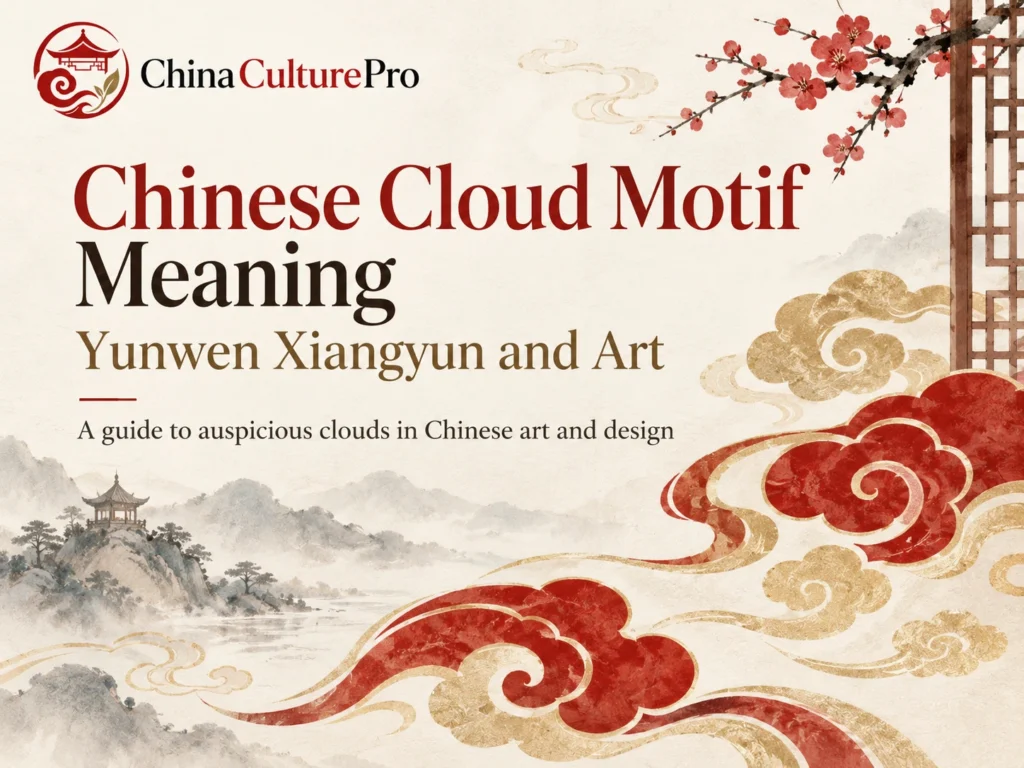

Quick Answer: What Does the Chinese Cloud Motif Mean?
Chinese cloud motifs, called yunwen (云纹, yún wén), can express auspicious wishes, evoke celestial realms, or organize a composition. In an auspicious setting, clouds are often called xiangyun (祥云, xiáng yún), meaning “auspicious clouds.” Their meaning depends on the object and its surrounding imagery.
- Good wishes: Clouds may suggest favorable omens, harmony, or a flourishing world.
- Celestial settings: Clouds around immortals or sacred figures can evoke a realm beyond ordinary life.
- Visual movement: Flowing cloud forms can connect figures, suggest rising motion, or fill a border.
- Context: Date, material, placement, inscriptions, and companion motifs guide interpretation.
These are cultural associations, not promises of luck or protection. A cloud-shaped curl does not carry one fixed meaning everywhere.
Clouds appear across Chinese textiles, ceramics, lacquer, jade, and architecture. This guide helps you distinguish their visual families and read them within a complete object. For the broader relationship between individual motifs and decorative compositions, see Chinese patterns and motifs.
What Are Yunwen and Xiangyun?
Yunwen names a broad category of cloud-related ornament rather than one standardized drawing. A cloud may be a compact cluster, a long curling ribbon, a field of floating forms, or a geometric spiral identified through a historical catalogue term. Material and technique affect the shape: a woven cloud and a carved cloud need not share the same outline.
Xiangyun emphasizes an auspicious association. It can describe clouds understood as favorable signs or their representation in art. It does not specify a single silhouette. Several cloud forms can serve an auspicious theme, while a similar form elsewhere may primarily establish a setting or balance a composition.
The terms therefore overlap: yunwen helps identify what is depicted, while xiangyun draws attention to how the clouds are understood. Neither label establishes religious affiliation, imperial ownership, or occasion of use.
These labels are useful without forming a rigid classification system. A separate cloud cluster can also have a lobed head and belong to an auspicious scene. Catalogue descriptions may therefore use more than one term for the same design.
How Do Clouds Acquire Their Symbolic Meanings?
Auspicious signs provide one source of meaning. Unusual or colorful clouds could be interpreted as favorable omens, and their depiction became part of a visual language of wishes for a harmonious, flourishing world. This is a historical way of understanding nature, rather than evidence that a weather formation predicts prosperity. On decorated objects, the association becomes a blessing expressed through an image.[3]
A second source is celestial imagery. Clouds can place immortals, mythical creatures, or sacred figures in an extraordinary realm. They may carry figures above the ground, surround them, or connect different parts of a scene. The Han jade pillow with painted birds, beasts, and cloud-vapor decoration includes immortals riding creatures among clouds. Here the accompanying figures make an otherworldly reading more persuasive than a general label such as “good luck.”[6]
Clouds also serve composition. Repeated curls can guide the eye around a vessel; trailing clouds can give an animal a sense of motion. A border also frames the main scene. Decorative work and symbolic meaning can coexist, so calling a cloud a background element does not prove that it has no cultural significance.
Cloud symbolism should not automatically be explained through a pun on fortune. Mandarin yún, “cloud,” and yùn, “luck,” have different tones. Their resemblance may invite wordplay, but it is not enough to establish the origin of a historical cloud motif.
Cloud, Thunder and Ruyi Patterns: How Can You Tell Them Apart?
A ruyi (如意, rúyì) is a traditional handheld or display object with a decorated head. Its cloudlike or fungus-shaped outline helps explain why some cloud ornaments resemble ruyi patterns. Shape alone, however, does not make a painted curl a complete ruyi object.
| Family | Visual clues | Useful context | Interpretation limit |
|---|---|---|---|
| Yunleiwen (云雷纹, yún léi wén), cloud-and-thunder pattern | Dense repeated spirals; rounded turns called cloud forms, squared turns called thunder forms | Especially associated with ancient bronze decoration, often beneath a larger motif | The name describes the pattern; it does not settle its original meaning.[1] |
| Yunqiwen (云气纹, yún qì wén), cloud-vapor pattern | Long, flowing curls linked with animals or figures | Han–Jin textiles and scenes of extraordinary beings | Read the whole scene; flowing lines do not independently identify a particular deity.[4][6] |
| Duoyun (朵云, duǒ yún), cloud clusters | Separate, rounded clouds, sometimes with trailing tails | Scattered ornament or groups within a larger scene | An auspicious reading requires context, not a prescribed number of lobes. |
| Ruyi cloud motifs (如意云纹, rú yì yún wén) | Rounded, lobed heads resembling a ruyi or lingzhi fungus | Especially familiar in Ming–Qing decorative arts | The visual overlap does not make every cloud a ruyi pattern.[2] |
Also distinguish huiwen (回纹, huí wén), a squared meander often used in borders, from cloud ornament. Plant scrolls have stems and leaves, while waves usually relate to a water scene. Start with the line’s role and surrounding forms, rather than naming every repeated curl a cloud.
For a difficult border, trace one complete unit. Does it repeat as a squared meander, develop into a recognizable leaf, or end in a rounded cloud head? This observation helps separate possible families before assigning a meaning.
How Did Chinese Cloud Motifs Change Over Time?
Shang and Zhou bronze decoration offers an early, well-documented family of geometric cloud-and-thunder spirals. These can form a dense ground around larger designs. The conventional names should not be treated as proof that the original makers intended the same auspicious message as later artists.[1]
During the Han–Jin period, clouds and animals appeared together in flowing textile compositions. A silk textile dated to the first–third centuries, now in the Metropolitan Museum of Art, combines animals, cloudlike mountains, and a woven auspicious inscription (2003.385a–e). It shows how imagery and words could reinforce a larger theme.[4]
In Ming–Qing decoration, stylized ruyi- or lingzhi-shaped clouds were widespread. A Qianlong-period carved lacquer box in the Palace Museum (故00108629) has eight symmetrically arranged ruyi clouds on its lid. Its underside bears a reign inscription and the name “ruyi cloud box,” supporting identification of the ornament.[2][5]
These are selected landmarks, not a complete chronology. Earlier forms could persist alongside newer ones, and cloud designs changed with different crafts rather than following one universal sequence.
An object’s date and a motif’s history are separate questions. Finding an older-looking spiral on a later piece does not date the piece to the earliest period associated with that pattern.
How Do Companion Motifs and Objects Change the Meaning?
The cloud’s companions often provide the strongest clue to the overall subject:
- Dragons and phoenixes: Clouds can support an auspicious or celestial setting. Interpret the dragon’s symbolism separately; clouds alone cannot establish royal ownership.
- Sacred figures and immortals: Clouds can establish an extraordinary setting. A Buddhist sutra cover with dragons, phoenixes, and clouds uses designs shared with other Ming court arts, showing that religious function and court ornament can overlap.[7]
- Bats and longevity imagery: Bats, peaches, or a longevity character can make blessings or long life the central theme. The clouds participate in the composition rather than replacing those more specific clues.[3]
Consider the seventeenth-century Qing Imperial Court Robe in the Metropolitan Museum of Art (30.75.5). Its material is silk and metallic-thread tapestry, or kesi (缂丝, kè sī). Five-clawed dragons, clouds, and flaming jewels appear against a blue ground above waves and mountains. Variants of shou (寿, shòu), the character for longevity, occur across the robe.[8]
Read these features together. The dragons and garment type establish a court context; the longevity characters make the decoration especially appropriate for birthday celebrations. Clouds help connect the imagery and its auspicious setting. The catalogue also records later embroidered additions at the neck and sleeves, reminding us that one object can contain more than one period of work.[8]
The evidence supports a courtly, longevity-related interpretation. It does not identify a particular wearer or prove that the robe was worn at a particular birthday. A cloud motif alone would establish neither. The broader guide to symbolism in Chinese clothing explains why the complete garment matters.
How Are Chinese Cloud Motifs Used in Modern Design?
The Beijing 2008 Olympic torch is a clear example of traditional cloud imagery used in a new setting. Its curved aluminum body resembles rolled paper and carries a lucky-cloud pattern. Red and silver form the main color scheme. [9]
Here, clouds help present a recognizable Chinese visual tradition within an international sporting event. The form is contemporary design, rather than a reproduction of one historical ceremonial object.
Clouds also lend themselves to jewelry, clothing, and graphic design because their curls can be extended, repeated, or simplified. A designer may retain an auspicious association, emphasize movement, or use the outline for visual pleasure. Neither red nor gold is a mandatory cloud color. A monochrome carving, blue painted cloud, and multicolored textile cloud can all use the same recognizable outline. Color becomes meaningful through the particular work, rather than through a universal cloud-color chart. When explaining a new design, distinguish its intended meaning from meanings documented on historical objects.
How Should You Interpret a Chinese Cloud Motif?
Use this five-step method when looking at an object or its museum photographs:
- Establish context: Check the documented date, place, material, and original function before deciding what the decoration means.
- Identify form and placement: Compare the cloud family and note whether it is a main motif, background, or border.
- Inspect companions: Look for dragons, sacred figures, bats, peaches, or characters that narrow the theme.
- Read supporting evidence: Consult inscriptions and catalogue notes. Distinguish an explicit identification from a plausible interpretation.
- State a bounded conclusion: Explain the supported meaning and what remains uncertain; separate historical use from a modern designer’s intention.
A cropped photograph may omit the main figure, a reverse-side inscription, or another part of a continuous pattern. If those details are missing, keep the interpretation provisional rather than supplying a universal cloud meaning.
FAQs About Chinese Cloud Motifs
What Is the Chinese Cloud Pattern Called?
Yunwen is the broad name for cloud ornament. Xiangyun means auspicious clouds. More specific names distinguish geometric spirals, flowing cloud vapor, separate cloud clusters, and ruyi-shaped forms.
Does Every Chinese Cloud Motif Mean Good Luck?
No. Some clouds mainly establish a setting or organize a composition. Early geometric patterns also cannot automatically be assigned the meanings of later auspicious decoration.
Is a Chinese Cloud Pattern the Same as a Ruyi Pattern?
The categories overlap. Ruyi-shaped clouds share an outline with the head of a ruyi, but cloud ornament includes many other forms. A cloud pattern is also distinct from the complete handheld object.
Are Chinese Cloud Motifs Buddhist or Daoist?
They are not exclusive to either tradition. Clouds appear in religious and secular art; the figures and object’s function clarify the setting. Clouds themselves are not a member of the Buddhist Eight Auspicious Symbols.[10]
What Does a Chinese Cloud Tattoo Mean?
It may evoke auspicious wishes, a celestial setting, movement, or a personal aesthetic choice. Shape and companion images matter, and there is no universal tattoo interpretation or protective effect.
Sources
[1] Palace Museum. 云雷纹
[2] Palace Museum. 如意式云头纹
[3] Palace Museum. 祥瑞图大搜索
[4] Metropolitan Museum of Art. Textile with animals and woven inscription
[5] Palace Museum. 剔犀如意云纹方盒
[6] National Museum of China. 彩绘描金鸟兽云气纹玉枕
[7] Metropolitan Museum of Art. Sutra cover with dragons and phoenixes amid clouds
[8] Metropolitan Museum of Art. Imperial Court Robe
[9] Olympic Museum. Reference record. Beijing 2008, torch.
[10] Palace Museum. 八吉祥