
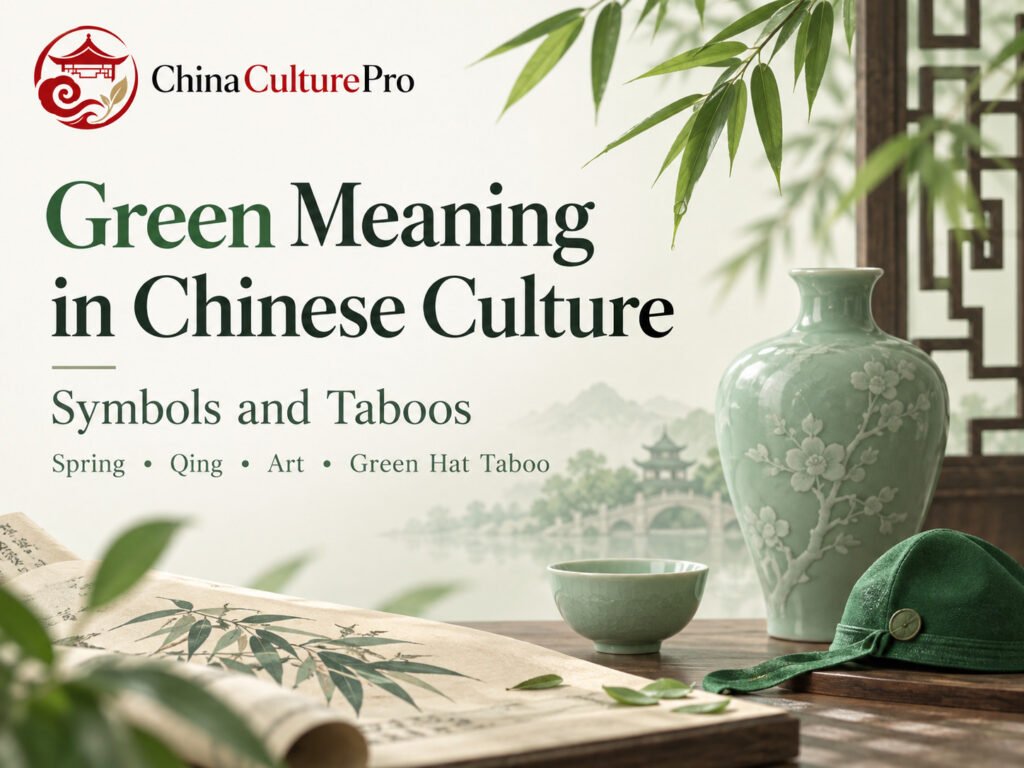

Quick Answer: What Does Green Symbolize in Chinese Culture?
Green (绿, lǜ) has no single lucky or unlucky meaning in Chinese culture. Its interpretation changes with the period, medium and social setting.
- Spring and growth: Green vegetation evokes renewal, vitality and the return of spring.
- Classical cosmology: The older color category qing (青, qīng)—not modern green alone—corresponds to Wood in Wuxing (五行, wǔxíng), the east and spring.
- Art and materials: Mineral pigments, celadon (青瓷, qīngcí) glazes and jade create distinct traditions of blue-green refinement; their meanings come from medium and craft, not hue alone.
- A narrow taboo: “Wearing a green hat” (戴绿帽子, dài lǜ màozi) is an insulting idiom implying that a man’s partner has been unfaithful.
- Modern public language: Green commonly signals environmental responsibility, permission or safe passage, while regulated Green Food (绿色食品, lǜsè shípǐn) has a specific certification meaning.
Green does not inherently attract money, improve health or offer protection. The green-hat taboo is also narrow: it does not make ordinary green clothes, gifts or decorations offensive.
Green is one of the easiest Chinese colors to oversimplify. Some explanations call it an unqualified symbol of growth and good fortune; others reduce it to the green-hat taboo. Neither account explains how historical color words, dress codes, artworks and modern public language produce different meanings.
The safest method is contextual. First identify the Chinese color term, then the date, material and setting. A green robe in a Tang court, a blue-green mountain in a painting, a celadon vessel and a modern ecological logo may look related, but they do not communicate the same idea. For the broader system, see our guide to Chinese color meanings and symbolism.
Green Is Not One Chinese Color: Lü, Qing, Bi and Cui
English “green” can translate several Chinese words, but those words are not interchangeable. Premodern color names often describe the appearance of a particular material or object rather than a fixed point on a modern digital color chart.[1]
What Lü Means in Modern Chinese
Lü is the normal modern word for green. The early dictionary Shuowen Jiezi glosses it as silk with a qing-yellow color, linking the term to dyed fabric rather than to a universal numerical hue. In later color theory, green could be described as an “intermediate” color produced from qing and yellow. That classification concerns a traditional hierarchy of correct and mixed colors; it does not make green socially inferior in every period or medium.[2]
Modern lü has largely lost that ritual hierarchy. It identifies an everyday color used for plants, clothing, packaging, traffic signals and digital design. Context—not the word alone—determines whether an additional cultural meaning is present.
Why Qing Is Not Simply Green
Qing is a much broader historical category. Depending on the object and text, it may describe tones that English speakers call green, blue, blue-green, gray-green or even very dark. Grass can be qing, the sky can be qing, and a ceramic glaze can be qing without all three sharing one exact color.[1]
Two other words are strongly tied to things being described. Bi (碧, bì) often suggests a clear blue-green associated with water or certain stones. Cui (翠, cuì) originally invokes the brilliant coloring of kingfisher feathers and commonly describes vivid foliage or green jade. Their literary associations do not create fixed RGB or HEX values.
This distinction matters in translation. Rendering every qing as “green” erases blue and gray possibilities; rendering every qing as “blue” erases its connection with growing vegetation. A good translation follows the object, period and visual evidence.
Is Green One of the Five Traditional Chinese Colors?
Not exactly. The traditional Five Colors are qing, red, yellow, white and black. Qing—not modern lü as an independent category—was paired with Wood, the east and spring in the classical system. Later commentarial color theory explicitly described qing as an eastern “correct color” and green as an intermediate color made from qing and yellow.[2]
The system organized ritual space, seasons and cosmological correspondences. It was not a personal color test, and it does not establish green as a scientifically effective “lucky color.” The directional emblem is the Azure Dragon, Qinglong (青龙, Qīnglóng), whose name should not be mechanically translated as “Green Dragon.” “Azure Dragon” preserves the wider range and established cultural identity of qing.
Modern English summaries sometimes call green the color of Wood because qing can look green in the context of spring vegetation. That shorthand is understandable, but the historically precise answer is that Wood corresponds to qing. The dedicated qing tradition is broader than modern green.
Why Green Suggests Spring, Growth and Renewal
Green’s most stable positive association comes from observation rather than a promise of good fortune. New shoots, willow leaves, grasses and cultivated fields turn the landscape green as winter recedes. In a farming society, that visible return of vegetation naturally marked seasonal renewal and continuing life.
Classical phrases such as “green-green riverside grass” use color to make spring growth immediate. Painting and poetry likewise employ fresh vegetation to establish a season, a landscape or a mood. In these contexts, green can suggest youthfulness, freshness and regeneration.
The limit is important: an image of green plants may simply describe nature. Even when renewal is intended, the association does not guarantee health, longevity, professional success or financial growth. Those stronger claims require separate words, motifs or textual evidence.
Green in Chinese Clothing and Social Rank
Green did not represent one social rank throughout Chinese history. Dress regulations changed by dynasty, reign, garment and occasion. Under one recorded Tang system, sixth-rank officials wore dark green and seventh-rank officials light green, while higher and lower ranks used other colors.[3] Green in that setting was an administrative marker, not a general symbol of shame.
Other periods assigned green or blue-green clothing to different official grades, occupations or socially marked groups. A Ming dress record, for example, states that performers of the imperial entertainment office wore green headcloths to distinguish them from scholars and commoners.[4] Such rules could give green headwear a low-status association in a specific context, but they did not make every green textile degrading.
The correct interpretation therefore needs a date and wearer. “Green meant low status in ancient China” is too broad, as is “green was an honored official color.” Both can describe particular regulations; neither works as a timeless definition.
Why Is a Green Hat Taboo in China?
What “Wearing a Green Hat” Means Today
In contemporary Chinese, the idiom means that a man has been betrayed by an unfaithful wife or partner. Calling someone a “green-hat wearer,” presenting a man with a green hat or arranging a photograph to make one appear on his head can therefore be insulting. The expression remains recognizable even when used as a joke.[4][5]
The taboo is much narrower than “green is unlucky.” A green shirt, dress, bag, plant, logo or gift box normally carries no suggestion of infidelity. Women’s green hats do not conventionally perform the same idiomatic function, although any joke that deliberately invokes the expression can still be awkward.
Historical Dress Rules and the Uncertain Origin
The expression is often traced to rules that used colored headcloths to identify entertainers, sex workers’ households or other marked groups. Texts from different periods are frequently combined into a single neat origin story, but the evidence does not identify one uncontested moment when the modern idiom was created.
What can be documented is the older use of green or blue-green headwear as a visible social distinction. The Ming History records green headcloths for entertainment-office performers.[4] Other transmitted accounts link green head coverings with humiliation or with men in households associated with prostitution. Over time, low-status headwear, sexual dishonor and popular insult appear to have converged.
That is more defensible than repeating a colorful legend as fact. Historical regulations help explain the association, while the precise path from those regulations to the modern phrase remains uncertain.
Green in Chinese Painting, Ceramics and Jade
Blue-and-Green Landscapes and Mineral Pigments
Blue-and-green landscape (青绿山水, qīnglǜ shānshuǐ) is a painting tradition, not a general code for “good luck.” Artists used mineral colors—especially blue azurite and green malachite—alongside ink to construct mountains, trees and patterned terrain. The pigments could remain saturated and luminous, giving the landscape a deliberately archaic or decorative presence.
Chen Hongshou’s 1633 Scholar-recluse in Blue-Green Landscape uses flat color planes, patterned foliage and strongly outlined landforms to allude to an antique style. Its stylization also heightens the solitary atmosphere around the scholar; the green is part of a complex artistic language rather than a free-standing prosperity symbol.[6]
Mineral green can therefore indicate technique, stylistic lineage or an idealized natural world. A painting’s title, inscription, figures and historical context should guide any deeper interpretation.
Celadon and Jade Are Not One Green Symbol
Celadon (青瓷, qīngcí) names a broad family of high-fired ceramics whose iron-bearing glazes can range from sky blue and gray-green to sea green. Longquan wares are celebrated for smooth, luminous glazes often compared with jade, but “green porcelain” is too narrow a translation for the full qing continuum.[7]
Jade (玉, yù) is equally diverse. Early Chinese jades were predominantly nephrite and occur in white, cream, brown and several greenish tones. Bright apple-green jadeite became prominent much later. Jade’s importance grew from rarity, toughness, laborious working methods, ritual use and moral comparison—not from green color alone.[7] Our separate guide to yellow in Chinese culture illustrates the same principle: material, named shade and institutional setting cannot be collapsed into a generic color meaning.
Neither celadon nor green jade automatically means wealth, healing or protection. A museum label that identifies material and technique is stronger evidence than a commercial gemstone description that assigns powers to color.
What Does a Green Face Mean in Chinese Opera?
Peking opera facial makeup (京剧脸谱, jīngjù liǎnpǔ) uses combinations of color and pattern to help characterize stage roles. Green commonly points toward bravery joined with irascibility, forcefulness or an unruly temperament.[8] The exact reading still depends on the character, design and theatrical tradition; color is only one part of the face pattern.
This code belongs to performance. It does not mean that a person wearing green is violent, stubborn or heroic, and it should not be transferred to paintings, clothing or modern branding. Even within opera, memorizing one adjective per color is less reliable than reading the complete role and pattern.
Modern Green: Environment, Food Labels and Public Language
Modern Chinese gives green several meanings that did not govern ancient artifacts. “Green development” and “green living” refer to environmental protection, lower-carbon development, resource conservation and a more sustainable relationship between human activity and nature. These are contemporary policy and public-language uses.[9]
Green also signals permission or safe passage in traffic lights, access indicators and other standardized systems. This convention is practical and internationally shared; it is not derived from the Five Colors.
Green Food (绿色食品, lǜsè shípǐn) has a narrower legal and commercial meaning in China. The name applies to products that meet the relevant standards and are authorized to use the certification mark under the official management system.[10] A green package does not make a product certified Green Food, and the Chinese category should not automatically be translated as “organic.” Organic certification is a separate standard.
These modern usages are positive, but they do not prove that ancient green objects symbolized environmentalism, safety or certified healthfulness.
Green in Weddings, Gifts and Everyday Etiquette
Green is normally safe in daily Chinese life. Practical etiquette depends more on the object than on the hue.
| Setting | Normal use | Useful caution |
|---|---|---|
| Everyday clothing | Green shirts, dresses, shoes and bags are ordinary choices. | No general taboo applies. |
| Weddings | Guests may wear green; there is no nationwide prohibition. | Red in Chinese culture remains more recognizably festive, so follow the couple’s dress guidance. |
| Lunar New Year | Green can appear in clothing, plants and multicolor decorations. | It is not a primary traditional festival color, but it is not forbidden. |
| Gifts | Green plants, ceramics, textiles and packaging are generally acceptable. | Do not give a green hat to a Chinese man unless you know the recipient welcomes the joke. |
An all-green design is not inherently offensive. The potential problem arises when a hat, wording or visual placement activates the idiom. For cross-cultural branding, test the complete image rather than rejecting the color itself.
Does Green Mean Luck, Wealth, Health or Love?
| Claimed meaning | Default answer | When it can apply | What not to infer |
|---|---|---|---|
| Luck | No universal meaning | Spring or celebratory designs may use green positively. | Green does not guarantee favorable outcomes. |
| Wealth | No | A costly jade object may communicate value because of its material and craftsmanship. | The green hue does not attract money. |
| Health | Limited modern association | Environmental language and healthy-living campaigns often use green. | Color has no healing or medical effect. |
| Love | No standard positive meaning | A modern personal design may assign its own meaning. | Traditional green does not symbolize romance or fidelity; the green-hat idiom is a separate negative expression. |
| Protection | No | A specific religious or decorative object may have its own documented role. | Ordinary green clothing, jade or décor does not provide supernatural protection. |
“Positive association” and “effective power” are not the same claim. Cultural symbolism can express a wish or idea without causing the hoped-for result.
Chinese Green and Western Green: Key Differences
Both Chinese and Western traditions connect green with vegetation and, in modern public design, with environmentalism or permission. The differences lie in their language-specific histories. Chinese distinguishes lü from the older, wider qing category and gives the green hat a particular infidelity-related meaning. English has its own expressions, such as “green with envy,” that do not transfer automatically into Chinese.
Western festivals such as St. Patrick’s Day also give green a setting-specific identity that is not native to Chinese tradition. Conversely, the Chinese green-hat taboo should not be projected onto every Western green hat. Cross-cultural interpretation works best when idioms, historical classifications and modern visual standards are kept separate.
How to Interpret Green Correctly in Chinese Culture
- Identify the term: Determine whether the source says lü, qing, bi or cui; translation may change with the object.
- Date the context: Separate classical cosmology, dynastic dress codes, traditional art and modern public language.
- Identify the medium: A dyed robe, mineral pigment, ceramic glaze, jade stone and traffic sign do different cultural work.
- Read the complete setting: Check the wearer, object, inscription, accompanying motifs and social occasion.
- Use the narrowest supported meaning: If no textual or contextual evidence activates a symbol, treat green as a color or natural description rather than inventing luck, status or supernatural power.
This method also prevents a modern idiom from swallowing the history of an entire color.
Common Misreadings of Green Symbolism
- Five Colors: Green is not a separate traditional Five Color; the historical category is qing.
- Qing translation: Qing can include blue, blue-green, gray-green and dark tones, not just green.
- General luck: Only particular objects and expressions—most notably the green hat—create a taboo.
- Green clothing: The infidelity idiom concerns a green hat placed on a man, not normal green garments.
- One origin story: Dress rules provide historical context, but the phrase’s precise development remains debated.
- Social status: Green’s official and social uses changed across dynasties and occupations.
- Celadon and jade: Their value comes from different materials, technologies and histories.
- Gemstone powers: Claims that green jade attracts money or protects its wearer are commercial or personal beliefs, not established effects of the color.
FAQs About Green Meaning in Chinese Culture
Is green a lucky color in China?
Green is neither a universal lucky color nor a generally unlucky one. It can positively suggest spring, vegetation and renewal, but Chinese tradition does not assign it an automatic power to improve fortune.
Why is wearing a green hat offensive in China?
“Wearing a green hat” is an idiom implying that a man’s wife or partner has been unfaithful. Historical rules for socially marked green headcloths help explain the association, although the expression has no single proven origin story.
Is green the Wood color in the Five Elements?
The precise traditional answer is qing, not modern green alone. Qing corresponds to Wood, the east and spring, but its historical color range includes blue-green and other tones.
Is Chinese jade always green?
No. Chinese jade occurs in white, cream, brown and many greenish shades. Its cultural prestige comes primarily from the stone’s material qualities, workmanship and ritual or moral history.
Can you wear green to a Chinese wedding or Lunar New Year celebration?
Yes. There is no nationwide rule against green at weddings or Lunar New Year. Follow any event-specific dress request, and avoid gifting a green hat to a Chinese man because of the familiar idiom.
Sources
[1] Victoria Bogushevskaya. Chinese Color Language
[2] Chinese Text Project. Analects with Commentaries: Yang Huo
[3] Wikisource. Old Book of Tang, Volume 45: Treatise on Carriages and Clothing
[4] Chinese Text Project. History of Ming: Treatise on Dress and Carriages III
[5] South China Morning Post. Why in Chinese Culture “Wearing a Green Hat” Means a Man Has a Cheating Wife
[6] The Metropolitan Museum of Art. Scholar-recluse in Blue-Green Landscape
[7] National Museum of Asian Art. Green
[8] ChinaCulture.org. The Colors of Peking Opera
[9] State Council Information Office of China. China’s Green Development in the New Era
[10] Ministry of Agriculture and Rural Affairs of China. Measures for the Administration of the Green Food Mark