
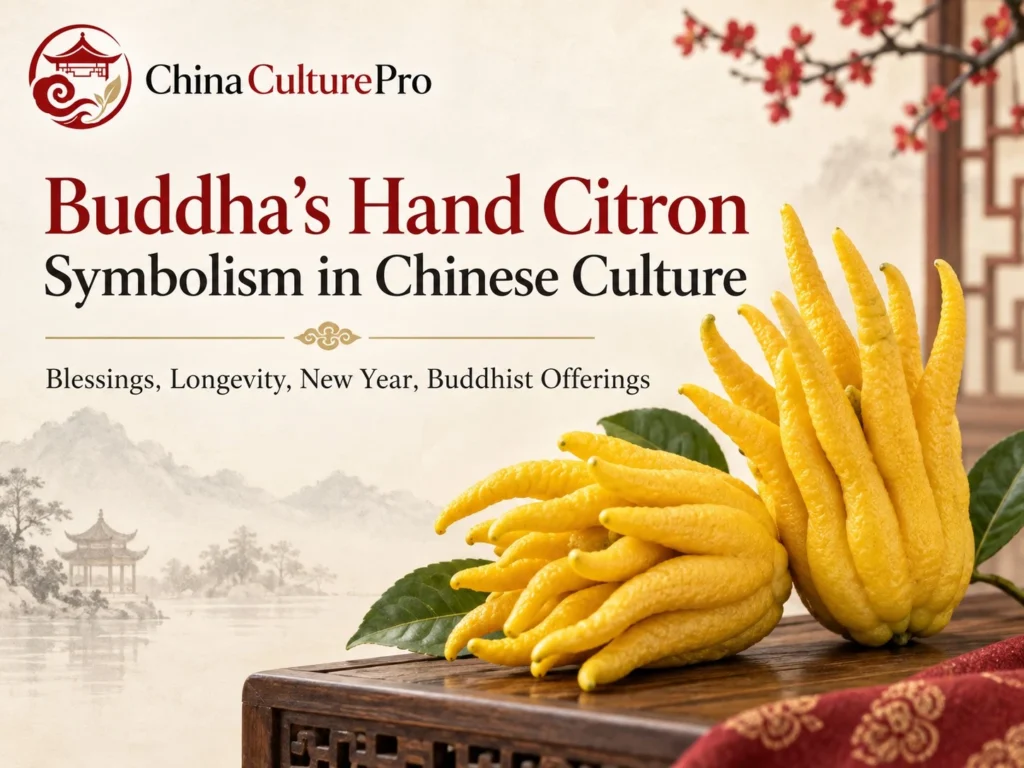

Quick Answer: What Does Buddha’s Hand Symbolize in Chinese Culture?
Buddha’s Hand citron (佛手, fóshǒu) is an auspicious fruit in Chinese art whose meaning depends on wordplay, setting, and companion motifs. Its name resembles 福寿 (fúshòu), “blessings and longevity,” while its fingered form evokes a hand associated with the Buddha.
- Blessings and longevity: the near-homophone 佛手/福寿 turns the fruit into a visual rebus.
- Three Abundances: with a peach and pomegranate, it contributes blessings; the other fruits represent longevity and descendants.
- New Year wishes: fragrant winter fruit displayed in seasonal arrangements can express hopes for a fortunate, peaceful year.
- Buddhist context: it may appear as a temple offering, but it is not one of Buddhism’s standardized Eight Auspicious Symbols.
These are cultural wishes, not claims that the fruit can attract money, extend life, protect a home, or change anyone’s luck. A lone fruit in a still life may also be simply an elegant botanical subject.
With its yellow rind divided into long, curling “fingers,” Buddha’s Hand (佛手, fóshǒu) is one of the most recognizable fruits in Chinese decorative art. Yet its meaning is more precise than the familiar labels “luck” or “prosperity” suggest. Chinese artists used the fruit’s name, shape, fragrance, season, and companions to build different readings. A jade carving, a New Year still life, a Buddhist offering, and a design containing three fruits do not necessarily say the same thing. The safest interpretation begins with the object and its context, as it does across Chinese flower and plant symbolism.
What Is Buddha’s Hand Citron? Names, Species and Visual Features
The cultural object discussed here is Buddha’s Hand citron, usually called 佛手 (fóshǒu) or 佛手柑 (fóshǒugān) in Chinese. It is a fingered form of citron, commonly classified as Citrus medica var. sarcodactylis. The fruit belongs to the citrus family, but instead of forming a round body with ordinary segments, it divides into projections that resemble fingers.
Its thick, intensely fragrant rind matters more to its historical display value than juicy flesh. The University of California, Riverside’s Citrus Variety Collection describes its Buddha’s Hand accession as having a yellow, highly aromatic rind, solid white interior, and no juicy pulp or seeds. The same account notes that cultivated forms vary, so “Buddha’s Hand” should not be reduced to one perfectly uniform shape.[1]
The name refers to the fruit’s handlike form. It does not mean that the plant is a miraculous object or that every depiction is religious. In Chinese visual culture, a recognizable natural form could become meaningful through resemblance and through language at the same time.
Buddha’s Hand vs Bergamot and Other Citrons
Buddha’s Hand is frequently confused with bergamot because 佛手柑 is sometimes mistranslated as “bergamot.” The two are not the same fruit. Buddha’s Hand is the fingered citron associated with Citrus medica; true bergamot is Citrus bergamia, a round citrus whose aromatic oil is famously used to flavor Earl Grey tea. UCR explicitly warns that “bergamot” is a mistranslation when applied to the Chinese fingered citron.[1]
Nor does every citron automatically inherit Buddha’s Hand symbolism. The cultural image depends on the conspicuous fingered form and the Chinese name attached to it. If an artwork shows only a conventional round citrus fruit and provides no inscription or museum identification, calling it Buddha’s Hand—and assigning it the same rebus—would be speculative.
Why Buddha’s Hand Represents Blessings and Longevity
The fruit’s most established auspicious reading is “blessings and longevity.” A seventeenth- or eighteenth-century Chinese nephrite carving in the Asian Art Museum is identified as a Buddha’s-hand citron. The museum explains that 佛手 (fóshǒu) functions as a visual pun for 福寿 (fúshòu), blessings and longevity, and reads the object as a wish that the recipient enjoy both.[2]
This matters because it corrects two opposite mistakes. Buddha’s Hand is not merely a neutral fruit in every Chinese artwork; its name really did support an auspicious rebus. But “auspicious” does not mean that it guaranteed a result. A carved citron expressed a courteous wish, much as a congratulatory phrase does. It did not claim to alter fate, health, or wealth.
How the Foshou–Fushou Wordplay Works
The wordplay is close rather than perfectly identical in modern standard Mandarin. 佛 (fó, “Buddha”) and 福 (fú, “blessing”) differ in their vowel. 手 (shǒu, “hand”) and 寿 (shòu, “longevity”) share their basic sound but have different tones. Calling the two full expressions exact homophones therefore overstates the linguistic match.
Traditional rebus design did not require the sort of letter-for-letter identity expected in an English pun. A strong sound resemblance, a familiar object, and an established viewing convention could work together. Once the association became conventional, a viewer could recognize a Buddha’s Hand fruit as a compact wish for 福寿 (fúshòu), especially on a gift, carving, textile, or festive display.
Why Is It Called Buddha’s Hand—and Is It a Buddhist Symbol?
The fruit’s separated lobes resemble the elongated fingers seen in idealized representations of the Buddha. The Asian Art Museum’s object record explicitly connects the fruit’s form with lotus-shaped fingers in Buddhist imagery and notes its use as a fragrant altar offering at New Year.[2] Shape therefore helps explain both the name and the fruit’s suitability in devotional settings.
That connection needs a firm boundary. Buddha’s Hand is not one of the standardized Eight Auspicious Symbols (八吉祥, bā jíxiáng), the well-known Buddhist set that includes such emblems as the wheel, conch, lotus, parasol, paired fish, treasure vase, victory banner, and endless knot. A citron offered at an altar is a pious or auspicious offering, not automatically a doctrinal emblem or ritual implement.
Context is decisive. A fruit placed on a temple altar can evoke reverence, purity of intention, or a wish for well-being. The same fruit carved in jade for a domestic collector may operate mainly as a phonetic rebus. A painted citron in a botanical still life may emphasize unusual form and fragrance. The name alone does not convert every example into Buddhist iconography.
What Buddha’s Hand Means in the Three Abundances
The Three Abundances (三多, sānduō), also called the Three Plenties, are a fixed fruit combination: Buddha’s Hand citron, peach, and pomegranate. Each member contributes a different wish. The Buddha’s Hand stands for many blessings, the peach for long life, and the pomegranate for many descendants. An Asian Art Museum hairpin from about 1800–1900 names all three fruits in its object title, while a related museum textile describes the motif as a wish for blessings, longevity, and sons.[3][4]
| Fruit | Role in the Three Abundances | Mechanism |
|---|---|---|
| Buddha’s Hand citron | Many blessings | 佛手 (fóshǒu) recalls 福 (fú), blessing |
| Peach | Long life | The peach is an established longevity fruit |
| Pomegranate | Many descendants | Its many seeds visualize numerous children |
This division of labor does not cancel the single fruit’s broader 福寿 reading. It shows how meaning becomes more specialized inside a composition. Alone, Buddha’s Hand can suggest blessings and longevity through its full name. Inside the Three Abundances, it conventionally supplies the blessings component because the peach and pomegranate make the other two wishes explicit.
All three fruits must be present before an image should be identified confidently as the complete Three Abundances. Buddha’s Hand with a peach can suggest blessings and longevity, but it lacks the pomegranate’s descendants component. A lone citron cannot stand for the complete trio.
How Companion Motifs Change the Meaning
Chinese decorative art often creates meaning through combination. The fruit establishes one possible reading, while nearby objects narrow or amplify it. Titles, inscriptions, and museum cataloguing remain more reliable than guessing from shape alone.
| Composition | Most defensible reading | Important limit |
|---|---|---|
| Buddha’s Hand alone | Blessings and longevity; or elegant fruit study | Does not automatically mean money, protection, or the full Three Abundances |
| Buddha’s Hand and peach | A strengthened wish for blessings and long life | Not the complete Three Abundances without pomegranate |
| Buddha’s Hand, peach, and pomegranate | Many blessings, long life, and many descendants | A historical family wish, not a modern prescription |
| Buddha’s Hand and bat | Reinforced blessing imagery because 蝠 (fú), bat, echoes 福 (fú), blessing | No fixed phrase should be invented without a title or inscription |
| Buddha’s Hand in a seasonal still life | New Year wishes, fragrance, and refined display | The precise meaning depends on the other objects and text |
The principle is simple: do not let one object absorb the meanings supplied by everything around it. If longevity comes from a peach, descendants from a pomegranate, or fulfillment from a named ruyi composition, those contributions should remain distinct.
Buddha’s Hand in New Year Displays and Seasonal Offerings
Buddha’s Hand suited elite winter display for practical and aesthetic reasons. Its fruit ripens in the cooler part of the year, its yellow form is visually striking, and its rind gives off a strong fragrance. It could therefore appear in a New Year arrangement or as an altar offering when auspicious wishes were especially appropriate. The Asian Art Museum record specifically links the fruit’s fragrance and altar use with New Year.[2]
In a New Year display, the fruit might participate in 岁朝清供 (suìcháo qīnggòng), a “New Year pure offering” or refined seasonal still life. Such arrangements brought together flowers, fruits, antiques, and auspicious objects on a scholar’s table. Their meanings came from the selected ensemble rather than from a universal checklist.
The historical practice should not be turned into a claim that Buddha’s Hand was compulsory in every Chinese household. It was especially compatible with literati, courtly, temple, and affluent domestic display, while regional and social practices varied. Modern ornaments and gift packaging have made the motif more widely visible, but popularity today does not prove a nationwide ancient custom.
Buddha’s Hand in Chinese Art and Decorative Objects
The fruit’s sculptural shape made it particularly attractive for three-dimensional carving. In nephrite, hardstone, ivory, or other luxury materials, the spreading fingers gave craftspeople a chance to display naturalistic observation and technical control. The resulting object could be admired as a miniature botanical sculpture and read as an auspicious rebus at the same time.
Textiles and jewelry often compress the fruit into a clearer emblem. The Asian Art Museum’s short hairpin with a bat and the Three Abundances shows how several small motifs can be assembled into a dense field of wishes.[3] A sleeve band documented through Google Arts & Culture similarly uses the three fruits to express longevity, descendants, and blessings.[4] These objects demonstrate why identification of companion motifs is essential.
Painting permits another possibility: simple observation. A hand citron rendered without a festive title, auspicious inscription, or recognizable partners may celebrate its eccentric silhouette and fragrance. Museum descriptions sometimes identify only material, period, and subject. When the catalogue does not assign symbolic meaning, readers should resist supplying an elaborate one.
Does Buddha’s Hand Mean Wealth, Protection or Good Luck?
“Good luck” is acceptable only as a broad translation of an auspicious wish, and even then “blessings” is usually more accurate. The Chinese 福 (fú) can encompass favorable circumstances, well-being, and good fortune; it is not simply a synonym for cash or commercial profit. The fruit’s yellow color does not establish an independent wealth code.
| Claim | Assessment | Reason |
|---|---|---|
| Blessings | Established, context-sensitive | Supported by the 佛手/福寿 rebus and museum interpretations |
| Longevity | Established, context-sensitive | Present in the full foshou–fushou pun; strengthened by a peach |
| Wealth | Not a default meaning | 福 is broader than money, and color alone does not prove a wealth theme |
| Protection or exorcism | Not established as a general meaning | An altar offering is not automatically a protective talisman |
| Guaranteed good luck | Not a traditional claim | Auspicious images communicate wishes rather than causal powers |
The same caution applies to commercial claims about fruit form. Open- and closed-fingered citrons are real horticultural variations, but there is no stable traditional rule that one “attracts wealth” while the other “prays for blessings.” Without historical inscriptions or reliable object records, that binary should be treated as modern sales language.
How to Interpret a Buddha’s Hand Motif Correctly
- Confirm the fruit. Look for the citron’s unmistakable fingered body, and do not substitute round bergamot or an unidentified citrus.
- Identify the medium and setting. A jade carving, textile, temple offering, New Year still life, and botanical painting invite different emphases.
- Check companion motifs. Peach and pomegranate indicate the Three Abundances; a bat can reinforce 福; other objects may introduce their own wishes.
- Read the title and inscription. A work’s historical name, dedicatory phrase, or museum interpretation outranks a generic symbolism list.
- Use the narrowest supported meaning. If evidence is limited, describe the object as a fragrant seasonal fruit or elegant decorative subject instead of inventing a complex message.
For a modern tattoo, logo, or gift, personal meanings such as gratitude, family memory, or resilience are entirely possible. They should simply be labeled modern interpretations rather than presented as fixed ancient meanings. The same evidence-first rule applies when interpreting other Chinese symbols and meanings.
Common Misreadings of Buddha’s Hand Symbolism
- Buddha’s Hand and 福寿 are exactly identical in Mandarin. They are near-homophones, not a perfect sound match.
- Buddha’s Hand is bergamot. It is a fingered citron; true bergamot is a different citrus species.[1]
- It is one of the Buddhist Eight Auspicious Symbols. It is not part of that standardized set, although it can be used as an offering.
- A single fruit represents the complete Three Abundances. The full motif also requires a peach and pomegranate.
- A single fruit cannot mean longevity. It can through the full 佛手/福寿 rebus, even though peach supplies longevity inside the Three Abundances.
- Open fingers attract money and closed fingers bring prayer. The shapes are horticultural variations, not a proven traditional fortune code.
- The yellow rind makes the fruit a wealth symbol. Color alone does not establish that meaning.
- Displaying the fruit changes luck, protects a house, or lengthens life. Traditional auspicious art expresses hope; it does not demonstrate supernatural effects.
FAQs About Buddha’s Hand Citron Symbolism
What does Buddha’s Hand symbolize in Chinese culture?
It most often expresses blessings and longevity through the near-homophone between 佛手 (fóshǒu), Buddha’s Hand, and 福寿 (fúshòu), blessings and longevity. In New Year, temple, and decorative settings, its fragrance and unusual form can add seasonal or devotional associations. Context still determines whether symbolism is intended.
Why is the fruit called Buddha’s Hand?
Its citron segments divide into long projections resembling fingers. Chinese and English names connect that form with the hand of the Buddha. The resemblance explains the name but does not make every image a formal Buddhist emblem.
Is Buddha’s Hand an official Buddhist symbol?
It is not one of the standardized Eight Auspicious Symbols and is not automatically a doctrinal emblem. It has, however, been used as a fragrant altar offering, so it can acquire devotional meaning in an explicitly Buddhist setting.
What does Buddha’s Hand mean with peaches and pomegranates?
Together they form the Three Abundances: Buddha’s Hand represents many blessings, the peach represents longevity, and the pomegranate represents many descendants. The combination reflects historical family wishes and should not be treated as a modern instruction or promise.
Is Buddha’s Hand citron the same as bergamot?
No. Buddha’s Hand is a fingered form of citron associated with Citrus medica var. sarcodactylis. Bergamot is Citrus bergamia, a round fruit best known for aromatic oil. Calling Buddha’s Hand “bergamot” is a translation error.
Sources
[1] University of California, Riverside Citrus Variety Collection. Buddha’s Hand Citron
[2] Asian Art Museum. Buddha’s-hand Citron, China, 1700–1800
[3] Asian Art Museum. Short Hairpin with Bat and the Three Abundances
[4] Asian Art Museum via Google Arts & Culture. Sleeve Band Decorated with Three Plenties Motif