
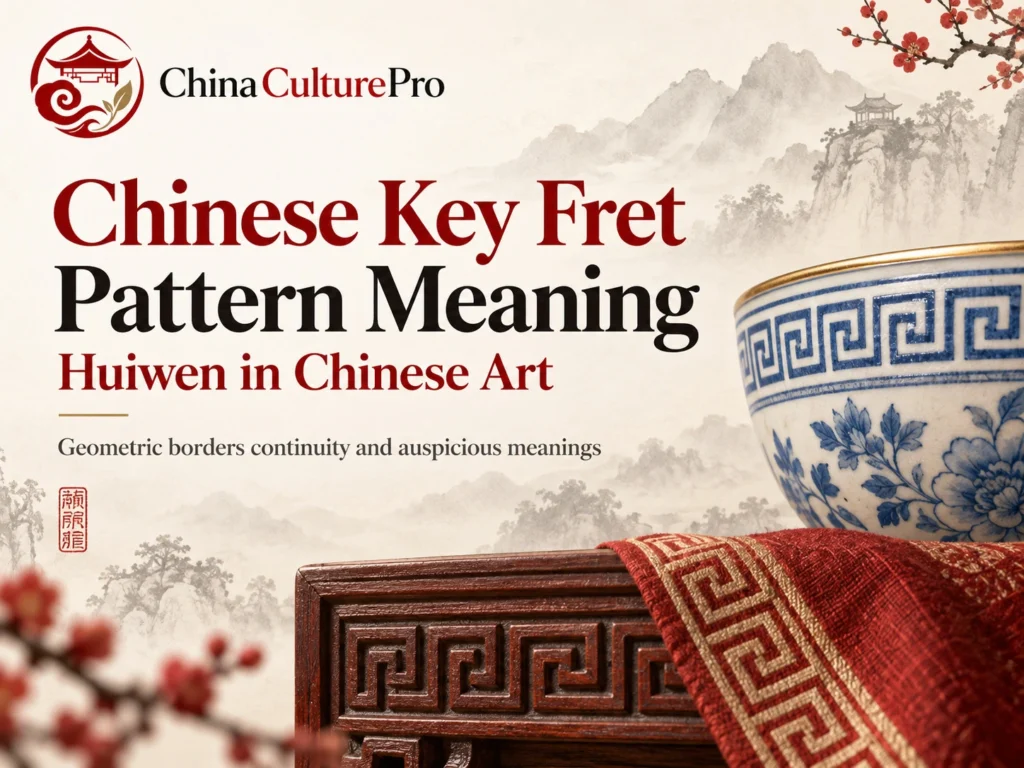

Quick Answer: What Does the Chinese Key Fret Pattern Mean?
The Chinese key fret pattern, commonly called Huiwen (回纹, huí wén), is geometric ornament built from repeated angular turns. It often frames a larger design and can carry wishes for continuity or enduring good fortune in later auspicious contexts.
- Form: Squared spirals or hooked lines arranged in repeating units.
- Function: A border that separates areas and gives a surface visual rhythm.
- Association: Later folk readings include prosperity without an end.
- Context: Meaning depends on the object, period, companion motifs, and inscriptions.
These associations express cultural wishes; they do not establish an original universal meaning or a power to change fortune.
A border around a plate may resemble ornament on furniture or a textile while belonging to a different context. This guide applies the broader Chinese patterns and motifs framework to Huiwen: identify the repeated shape, then read the complete object.
What Is Huiwen, and How Can You Recognize It?
Huiwen takes its name from a resemblance to the Chinese character 回, whose nested outline helps explain the familiar square-within-square appearance.[3] English descriptions may use key pattern, key fret, or meander. These are decorative-art terms, not evidence that the design depicts a physical key or derives from musical frets.
The most useful visual clues are:
- Turns: Straight sections bend back on themselves, typically at right angles.
- Repetition: Similar angular units recur along a band or across a surface.
- Spacing: The spaces between lines help make the repeated structure legible.
Some designs resemble one continuous path; others repeat separate units. Line width, spacing, and connections can vary. Do not require perfect mathematical regularity from every carved, molded, or woven example. Key patterns are broadly described as repeated rectilinear hooks, sometimes crossing.[1]
Trace several units before naming a cropped detail. One isolated corner may belong to a different motif, a character, or the edge of a larger composition.
What Does Huiwen Symbolize in Chinese Culture?
Repetition gives Huiwen an immediate sense of continuation: the eye follows a unit into the next one. That visual effect helps explain why later decorative readings emphasize enduring wishes. A visible rhythm, however, does not tell us precisely what an early maker intended.
In Suzhou folk usage, Huiwen has been associated with wealth and distinction continuing without an end. This is a documented auspicious interpretation, rather than a translation that explains every occurrence across Chinese history.[2]
Longevity becomes a stronger reading when other elements establish that theme. A Qing black-lacquer table in the Palace Museum combines Huiwen with peaches, bats, and the Shou character (寿, shòu), meaning longevity.[2] The whole composition provides evidence for a blessing; the border alone does not supply every part of it.
Religious settings introduce another interpretive layer. Infinity, unity, and reincarnation have been proposed as meanings for meanders in Buddhist art, explicitly as speculative interpretation rather than a recovered explanation from early Buddhist texts.[3] Such proposals should not become a universal definition for a porcelain rim or furniture frame.
Read an auspicious interpretation from the complete design or its documented use. Repetition alone cannot identify the intended blessing.
How Is Huiwen Related to Earlier Thunder Patterns?
Huiwen is conventionally connected with angular ornament on earlier pottery and bronzes.[2] That relationship concerns recognizable forms and their reuse; it does not prove that one meaning traveled unchanged through every period.
Leiwen (雷纹, léi wén), or thunder pattern, commonly names squared spirals in early bronze decoration. Rounded and angular spirals are also grouped under Yunleiwen (云雷纹, yún léi wén), cloud-and-thunder ornament. Real examples can mix shapes and occur as grounds or bands.[5]
A Song plate from the Ding ware tradition (定窑, dìng yáo) preserves a molded Huiwen band at its inner rim, predating Ming and Qing examples.[4] Qing furniture later made extensive use of Huiwen along frames, rails, and other parts.[2]
These examples establish historical uses more securely than a proposed invention date. A later catalogue name can classify an older shape, and related forms can be adapted to new materials. Avoid turning the sequence into a rigid rule that every early spiral is Leiwen and every later border is Huiwen. Period and placement are useful clues, not sufficient definitions.
Huiwen vs. Leiwen, Wan Patterns and the Greek Key
Compare the repeated unit and the whole composition before deciding which name is useful. The following distinctions describe common contexts rather than four mutually exclusive boxes.
| Pattern | Visual clue | Common context | Interpretive limit |
|---|---|---|---|
| Huiwen | Angular turns repeating as a band or field | Chinese borders on vessels and furniture | An auspicious reading needs contextual evidence |
| Leiwen | Squared spirals, often densely arranged | Early bronze grounds and bands | Original significance is uncertain; small size is not a defining requirement.[3][5] |
| Wan patterns (万字纹, wàn zì wén) | Hooked-cross units based on 卍 | Buddhist imagery and related decorative compositions | Identify the actual unit; it can be combined with a meander.[2][3] |
| Greek key / meander | Repeated rectilinear turns | Greek ornament and later classical designs | English naming and geometry may overlap; resemblance alone does not establish shared meaning.[1] |
Terminology is broader in some catalogues than in others. English key-pattern vocabularies group several related names together, so a familiar label should not replace inspection of the object.[1]
Cross-cultural comparison also requires restraint. Similar geometry cannot, by itself, prove direct borrowing or complete independence. Research on particular meanders considers possible transmission and adaptation, rather than establishing one origin story for every angular border.[3]
Where Does Huiwen Appear, and Why Does Placement Matter?
Placement shows what the pattern does within a composition. A border can frame a subject, divide zones, or connect repeated sections without becoming the subject itself.
- Ceramic rims: A narrow band can separate the vessel’s edge from its main decoration. Follow it around the full circumference before judging its relationship to the center. The wider Chinese porcelain patterns guide explains how vessel surfaces organize imagery.
- Furniture frames: Huiwen can follow rails, frames, or feet, emphasizing the outline of a constructed object.[2] Its placement emphasizes the frame rather than the imagery it surrounds.
- Textiles and architectural framing: Meanders appear on depicted Buddhist robes and in cave-ceiling arrangements.[3] Their setting matters; a geometric band does not automatically make every surrounding work religious.
Scale and viewpoint can also affect recognition. A close photograph may enlarge a small supporting border until it looks dominant. Examine the complete object, then return to the detail. Separating visual prominence from cultural meaning prevents a tiny edge pattern from explaining everything around it.
A Worked Example: A Song Ding-Ware Plate with a Huiwen Border
The Palace Museum’s white-glazed Ding plate with molded chrysanthemums and phoenixes, accession 新00105264, is dated to the Song dynasty. Its decoration offers several distinct layers to examine.[4]
- Visible facts: Huiwen circles the inner rim; lotus motifs decorate the wall; two phoenixes and chrysanthemums occupy the center. The designs are molded, not painted.[4]
- Contextual evidence: The plate’s manufacture belongs to the Song period. A Qianlong imperial poem was engraved on its underside later, in the Qing period.[4]
- Supported reading: The angular border frames the central imagery. The later poem adds evidence of Qing appreciation and collection history, rather than documenting the original maker’s intention.
- Limits: Neither the border nor the later inscription proves that the plate was originally made as an imperial birthday gift.
Reading the underside changes the evidence available, but does not change when the ceramic body was made. Distinguish an object’s original decoration from the meanings and associations added during its later life.
How Should You Interpret or Adapt a Huiwen Pattern Today?
Work from the complete object toward a supported interpretation:
- Establish the source: Check its recorded period, material, and function. Separate an old object from a later reproduction or modern design.
- Follow the repeated unit: Examine the turns, connections, and spaces. Locate the pattern as a border, background, or main design.
- Read the accompanying evidence: Check neighboring imagery, characters, inscriptions, and later additions. Decide which elements actually establish a theme.
- Compare the record: Consult the museum description or relevant research. Separate visible features, documented history, folk readings, and scholarly proposals.
Modern jewelry, graphics, and interiors can borrow Huiwen’s geometry for rhythm or cultural reference. A designer may also add a personal meaning. Describe that as contemporary intent, rather than treating it as proof of an ancient message. Likewise, changing the direction, color, or number of repeats does not establish a fixed system of good or bad fortune.
FAQs About the Chinese Key Fret Pattern
What Is the Chinese Key Pattern Called?
Huiwen is a common Chinese name for angular repeating ornament. English descriptions may say key fret or meander. Catalogue terminology can overlap, so check the actual design rather than treating every label as an exact translation.
Is Huiwen the Same as Leiwen?
They are related but not automatically interchangeable. Leiwen commonly describes early bronze spirals; Huiwen often describes angular repeating borders. Shape, placement, period, and the catalogue’s usage help clarify the particular example.
Is the Chinese Key Fret Pattern the Same as the Greek Key?
Their geometry and English labels can overlap. That does not establish identical cultural meaning or one shared origin. Comparing specific objects requires more evidence than the resemblance between their right-angled lines.
Does Huiwen Mean Endless Wealth or Long Life?
Enduring prosperity is a documented later folk reading, not a universal meaning. Longevity interpretations are stronger when other motifs or text establish that theme. These are cultural wishes, not guarantees of wealth or lifespan.
Sources
[1] Getty Research Institute. Art & Architecture Thesaurus: key pattern
[2] Palace Museum. 黑漆描金嵌玉寿字炕桌
[3] Jeong-hee Lee-Kalisch. The Transmission of Ornaments in Buddhist Art: On the Meander or Huiwen
[4] Palace Museum. 定窑白釉印花菊凤纹盘
[5] Academia Sinica, Museum of the Institute of History and Philology. 雲紋,雷紋,雲雷紋