
Quick Answer: What Is Longjing Tea?
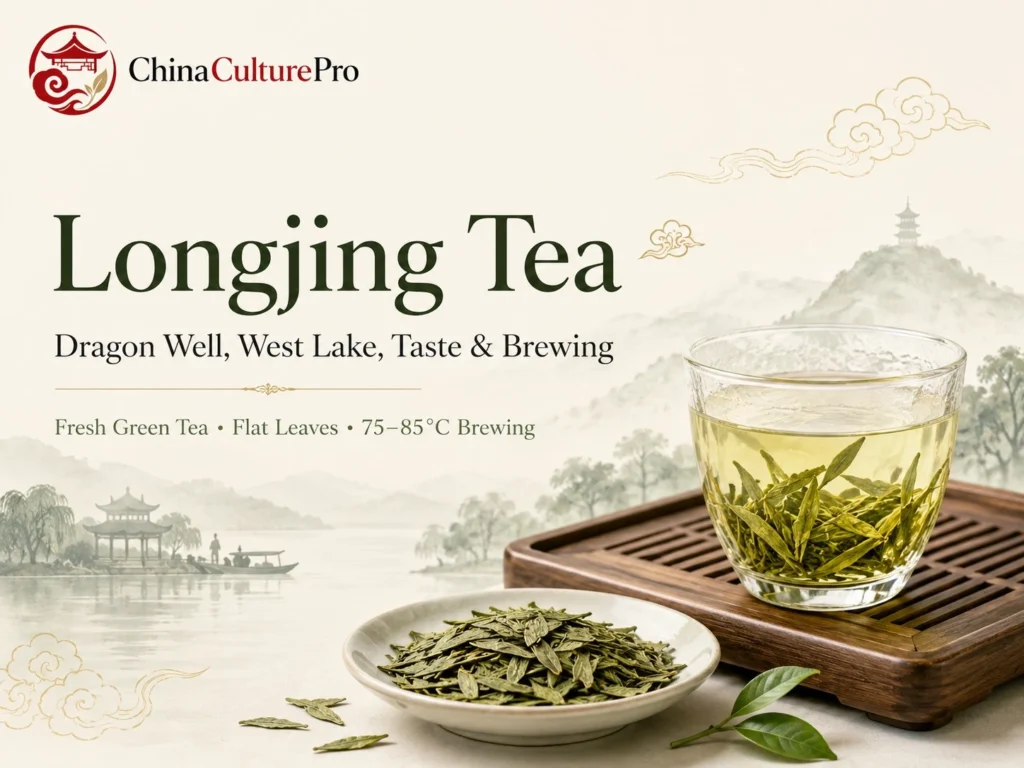
Longjing Tea, also called Dragon Well Tea, is one of China’s most famous green teas. It comes from Hangzhou, Zhejiang Province, and nearby tea-growing areas. It is known for its flat leaf shape, pan-fired processing, clean bean-like or chestnut-like aroma, clear liquor, and fresh mellow taste.
The basic points are:
Tea Type: Chinese green tea, usually pan-fired and unoxidized.
Most Famous Origin: West Lake / Xihu in Hangzhou.
Leaf Shape: flat, smooth, straight, and tender.
Typical Aroma: bean-like, chestnut-like, lightly roasted, sometimes gently floral.
Taste: fresh, clean, mellow, lightly sweet, with gentle bitterness that can fade.
Brewing: usually 75–85°C, using a glass cup, porcelain cup, or gaiwan.
Buying Caution: Longjing does not automatically mean West Lake Longjing.
Key Point: Longjing is not a general name for every flat green tea, and West Lake Longjing is not the same as all Longjing tea. Good Longjing should be judged by origin, harvest time, cultivar, pan-firing skill, dry leaf shape, aroma, liquor clarity, fresh taste, and returning sweetness. Good Longjing is not simply greener or more expensive.
Longjing Tea, Dragon Well Tea, and West Lake Longjing: Are They the Same?
The names can be confusing because English tea shops often use Longjing Tea, Dragon Well Tea, West Lake Longjing, and Xihu Longjing in different ways.
| Term | Chinese | Meaning | Scope |
|---|---|---|---|
| Longjing Tea | 龙井茶 | the general name for Longjing tea | broadest term; includes West Lake, Qiantang, Yuezhou, and other Longjing teas |
| Dragon Well Tea | 龙井茶 | English translation of Longjing Tea | same as Longjing Tea |
| West Lake Longjing | 西湖龙井 | Longjing from the West Lake area in Hangzhou | the most famous and most protected origin type |
| Xihu Longjing | 西湖龙井 | pinyin for West Lake Longjing | same as West Lake Longjing |
| Qiantang Longjing | 钱塘龙井 | Longjing from the Qiantang production area | usually more affordable than West Lake Longjing |
| Yuezhou Longjing | 越州龙井 | Longjing from Yuezhou areas in Zhejiang | another recognized Longjing origin style |
| Longjing-Style Tea | 龙井风格茶 | tea made in a similar flat green tea style | may be drinkable, but should not be sold as West Lake Longjing |
A simple way to remember it: all West Lake Longjing is Longjing tea, but not all Longjing tea is West Lake Longjing. This distinction matters because price, origin value, flavor, and buying risk are very different.
Why West Lake Longjing Is So Famous
West Lake Longjing is famous because of place, history, craftsmanship, and scarcity. It is not only a tea name. It is also closely tied to Hangzhou’s landscape and Chinese tea culture.
Its reputation comes from several factors:
- West Lake Geography And Culture: the hills, mist, soil, and traditional tea villages around Hangzhou shaped Longjing’s image.
- Traditional Producing Areas: names such as Shifeng, Longjing Village, Meijiawu, Yunqi, and Hupao are often linked with classic West Lake Longjing.
- Historical Prestige: Longjing has long been treated as one of China’s most respected spring green teas.
- Spring Harvest Value: early spring Longjing, especially Mingqian tea, is limited in volume and highly sought after.
- Pan-Firing Skill: classic Longjing depends heavily on careful pan-firing, which shapes the flat leaves and creates its bean-like or chestnut-like aroma.
- Market Reputation: because West Lake Longjing is famous, it is expensive and frequently imitated.
A Chinese tea master would not say that every West Lake Longjing automatically tastes better than every non-West Lake Longjing. Origin matters, but raw material, harvest timing, cultivar, pan-firing, storage, and freshness still decide the cup.
Where Longjing Tea Comes From
Longjing tea is mainly associated with Zhejiang Province, especially Hangzhou and nearby regions. Different origins can affect price, aroma, freshness, and buying risk.
| Origin | Chinese Name | Location | General Style | Typical Price Position |
|---|---|---|---|---|
| West Lake Longjing | 西湖龙井 | protected West Lake area in Hangzhou, including famous traditional villages | classic bean-like or chestnut-like aroma, fresh mellow liquor, high cultural value | highest |
| Qiantang Longjing | 钱塘龙井 | areas around the Qiantang region, including parts of Hangzhou outside West Lake | close to Longjing style, often more affordable and suitable for daily drinking | medium |
| Yuezhou Longjing | 越州龙井 | areas such as Shaoxing, Xinchang, and nearby Zhejiang regions | often stronger in taste, more practical for everyday use | lower to medium |
| Other Longjing-Style Tea | 其他龙井风格茶 | areas outside classic Longjing origins | flat green tea style, but flavor and quality vary widely | varies |
Origin affects value, but it is not the only standard. A tea from a famous origin can still be weak if the leaves are poor, the firing is rough, or storage is bad. A non-West Lake Longjing can still be pleasant if it is clean, fresh, well-fired, and honestly labeled.
What Does Longjing Tea Taste Like?
Good Longjing tea should taste fresh, clean, mellow, and lightly sweet. Its aroma is often described as bean-like, chestnut-like, lightly roasted, fresh, and sometimes gently floral.
| Tasting Point | Good Longjing | Weak Or Poor Longjing |
|---|---|---|
| Aroma | clean bean-like, chestnut-like, lightly roasted, or light floral aroma | heavy grassiness, dull smell, stale odor, or artificial fragrance |
| First Sip | fresh, smooth, mellow, and clear | harsh, thin, sour, or rough |
| Bitterness | light and able to fade | heavy bitterness that stays |
| Astringency | gentle and clean if present | drying, rough, or throat-tightening |
| Liquor | clear, bright, pale yellow-green or apricot-green | dull, dark, muddy, or cloudy |
| Finish | clean, lightly sweet, comfortable | dry mouth, stale aftertaste, or throat irritation |
| Hui Gan | gentle returning sweetness | weak or absent aftertaste |
The classic Longjing flavor is often described through bean aroma or chestnut aroma. This does not mean the tea should smell like strong roasted food. It should be natural and clean, not sharp or perfumed.
A common mistake is thinking that strong grassy flavor means freshness. In Longjing, too much raw grassiness can suggest rough processing or poor firing. A good cup should feel fresh, not raw.
What Good Longjing Tea Looks Like
Dry leaf appearance gives the first clue, but it is not the whole answer. Longjing should be judged by both dry leaves and brewed tea.
| Good Signs | Warning Signs |
|---|---|
| flat, smooth, straight leaves | too many broken pieces or powder |
| tender, even buds and leaves | uneven leaf size or mixed material |
| natural tender yellow-green or light rice-yellow color | dull gray, dark brown, or lifeless color |
| dry and crisp texture | damp, soft, or flexible leaves |
| natural bean-like or chestnut-like dry aroma | moldy, sour, stale, or chemical smell |
| clean, neat appearance | dusty, dirty, or heavily crushed leaves |
Good Longjing is not simply “the greener, the better.” Traditional pan-fired Longjing often has a natural tender yellow-green or light rice-yellow tone. Very vivid green leaves can come from cultivar differences, such as Longjing 43, or from processing style. But color alone does not prove quality.
Experienced Longjing drinkers often look for leaves that are flat but not dead, tender but not fragile, and clean without looking artificially polished.
How Longjing Tea Is Made
Longjing is a pan-fired green tea. It is not steamed like many Japanese green teas. Pan-firing fixes the green tea character, reduces raw grassy notes, shapes the flat leaf, and creates the classic bean-like or chestnut-like aroma.
| Step | Chinese Term | What Happens | Why It Matters |
|---|---|---|---|
| Picking | 采摘 | tender buds and leaves are picked in spring | leaf tenderness affects grade and taste |
| Spreading | 摊放 | fresh leaves rest and lose some moisture | reduces grassy sharpness and prepares the leaf |
| Sha Qing | 杀青 | leaves are heated in a pan to stop oxidation | fixes green tea freshness and aroma |
| Shaping | 理条 / 造型 | leaves are pressed and shaped in the hot pan | creates the flat, smooth Longjing form |
| Final Firing | 辉锅 / 炒干 | leaves are slowly dried and refined | develops aroma and stabilizes dryness |
| Drying | 干燥 | final moisture is reduced for storage | helps preserve the tea |
Traditional hand-fired Longjing depends on the skill of the tea maker. The well-known hand movements of Longjing firing are often summarized as the “ten techniques,” but beginners do not need to memorize them. The important point is that the maker uses heat, pressure, timing, and hand feel to flatten the leaves and bring out aroma without burning them.
Harvest Time: Mingqian, Yuqian, and Later Spring Longjing
Harvest time strongly affects Longjing’s price, tenderness, aroma, and taste. Many buyers focus only on Mingqian Longjing, but that is not always the best choice for every drinker.
| Harvest Period | Chinese Name | Time | Characteristics | Price Position |
|---|---|---|---|---|
| Pre-Qingming | 明前 | before Qingming, often late March to early April | very tender, fresh, delicate, limited in quantity | highest |
| Pre-Grain Rain | 雨前 | before Grain Rain, usually mid to late April | slightly larger leaves, steadier aroma, fuller taste, good value | medium to high |
| Late Spring | 春尾茶 | after Grain Rain and before early summer | stronger taste, lower tenderness, more affordable | lower |
| Summer / Autumn Tea | 夏秋茶 | summer or autumn harvest | more bitter, less fresh, usually not used for high-quality Longjing | lowest |
Mingqian Longjing is Longjing picked before Qingming. It is early, tender, limited, and expensive. Yuqian Longjing can be more practical for daily drinking because it often has stronger flavor, steadier aroma, and better value. A useful buying rule: Mingqian is about tenderness and rarity; Yuqian is often about balance and value.
Longjing Cultivars: Qunti Zhong, Longjing 43, and Others
Cultivar affects harvest time, leaf appearance, aroma, and price. It should be considered, but it should not be treated as the only quality standard.
| Cultivar | Chinese Name | Main Characteristics | Common Impression |
|---|---|---|---|
| Longjing 43 | 龙井43号 | sprouts early, leaf shape is neat, color is often tender green | common in the market, especially early spring Longjing |
| Qunti Zhong | 群体种 | traditional mixed local population cultivar, sprouts later, appearance may be less uniform | often valued by traditional drinkers for deeper Longjing character |
| Other Cultivars | 其他品种 | includes cultivars such as Zhongcha 108 or Longjing Changye | used in some production areas; varies by producer and origin |
Longjing 43 can be fresh, clean, and elegant. Qunti Zhong can be deeper and more traditional. One is not automatically better than the other. Quality still depends on origin, picking, firing, and storage.
How to Brew Longjing Tea
Longjing is a green tea. It should not be attacked with boiling water. High heat can destroy freshness, create a cooked taste, and make the tea bitter.
| Brewing Method | Teaware | Water Temperature | Leaf Amount | Steeping Time | Best For |
|---|---|---|---|---|---|
| Glass Cup Brewing | glass cup | 75–85°C | 2–3g / 200ml | 2–3 minutes | seeing leaf shape and clear liquor |
| Gaiwan Brewing | porcelain gaiwan | 75–85°C | 3–4g / 150ml | 30–60 seconds for first infusion | better control and multiple infusions |
| Porcelain Teapot | porcelain teapot | 75–85°C | 3–4g / 150ml | 1–2 minutes | sharing with two or more people |
Brewing tips:
- Use 75–85°C water. Tender Mingqian Longjing often does better around 75–80°C. Yuqian or slightly more mature Longjing can use 80–85°C.
- Do not rinse Longjing. The first infusion carries fresh aroma and sweetness. Rinsing wastes the best part.
- Do not steep too long. Longjing becomes bitter if left too long in hot water.
- Use glass for visual enjoyment. A glass cup lets you see the flat leaves slowly open.
- Use a gaiwan for control. A gaiwan makes it easier to adjust strength and pour out cleanly.
- Brew 2–3 times. Good Longjing can usually be infused again, though it is not as long-lasting as oolong or Pu-erh.
Common glass-cup methods include adding tea after water, or first adding a small amount of water to moisten the leaves before filling the cup. Both help reduce harshness compared with pouring boiling water directly onto the leaves.
For water temperature and brewing control, read our How to Brew Chinese Tea guide. For gaiwans, glass cups, and fairness cups, read our Chinese Teaware guide.
How to Taste Longjing Tea
Tasting Longjing is different from tasting roasted oolong, aged Pu-erh, or dark tea. Longjing should be fresh, clean, mellow, and comfortable. It should not be judged only by aroma strength.
| Tasting Check | What To Look For |
|---|---|
| Dry Leaf Aroma | natural bean-like or chestnut-like aroma; no stale or sour smell |
| Liquor Color | clear pale yellow-green, apricot-green, or light yellow; not muddy |
| Wet Aroma | bean-like, chestnut-like, lightly roasted, or gentle floral note |
| First Sip | fresh, mellow, clean, not harsh |
| Bitterness | light if present, and able to fade |
| Astringency | gentle and not throat-tightening |
| Hui Gan | clean returning sweetness after swallowing |
| Mouthfeel | smooth, light, and comfortable |
| Spent Leaves | tender, even, natural-looking; no obvious red stems or damaged leaves |
Good Longjing is often gentle. Do not expect it to hit like roasted oolong or aged Pu-erh. Its strength is in clarity, freshness, and balance.
For aroma, mouthfeel, Hui Gan, and aftertaste, read our Chinese Tea Tasting guide.
West Lake Longjing vs Other Longjing Tea
West Lake Longjing has the strongest cultural reputation, but other Longjing teas can still be good choices. The right choice depends on why you are buying the tea.
| Point | West Lake Longjing | Qiantang / Yuezhou Longjing |
|---|---|---|
| Reputation | highest; one of China’s most famous teas | lower, but still recognized in Longjing production |
| Origin Value | protected and culturally important | less famous, often more practical |
| Price | high to very high, especially Mingqian tea | more affordable |
| Flavor | classic bean-like or chestnut-like aroma, fresh mellow style | similar direction, sometimes stronger or simpler |
| Scarcity | limited production | larger production |
| Buying Risk | high imitation risk | lower imitation pressure, but quality still varies |
| Best For | gifts, origin-focused tasting, cultural experience | daily drinking and value-focused buying |
Buying West Lake Longjing means paying for origin, culture, scarcity, and reputation. Buying Qiantang or Yuezhou Longjing often means focusing more on taste, freshness, and value.
How to Choose and Buy Longjing Tea
Longjing is one of the most imitated Chinese teas, especially when the label says West Lake Longjing or Mingqian West Lake Longjing. Buying carefully matters.
| What To Check | Good Sign | Warning Sign |
|---|---|---|
| Origin | clearly says West Lake, Qiantang, Yuezhou, or another specific origin | only says “Longjing” with no origin detail |
| Harvest Time | states Mingqian, Yuqian, or spring harvest clearly | vague “premium spring tea” with no date context |
| Year / Production Date | current-year tea with clear production information | no year, no production date, or old stock sold as fresh tea |
| Traceability | protected-origin label, reliable seller record, or origin verification where available | strong claims with no proof |
| Dry Leaf Shape | flat, clean, dry, even leaves | broken, dusty, damp, or uneven leaves |
| Leaf Color | natural tender yellow-green or light rice-yellow | unnaturally bright green, dull gray, or dark brown |
| Aroma | natural bean-like, chestnut-like, or light floral aroma | chemical fragrance, sour odor, stale smell, or heavy grassiness |
| Packaging | practical, sealed, and informative | luxury box with vague tea information |
| Grade Claims | origin, harvest, and storage details support the claim | “top grade” or “special grade” with no useful details |
| Price | matches origin, harvest time, and seller credibility | very cheap “Mingqian West Lake Longjing” |
The safest approach is not always buying the most expensive tea. If you do not have a reliable West Lake Longjing source, a clearly labeled Qiantang or Yuezhou Longjing from the current year may be a better choice than a suspicious “top grade West Lake Longjing.”
Good Longjing is not cheap, but expensive Longjing is not automatically good.
How to Store Longjing Tea
Longjing is green tea. It values freshness. It does not age like Pu-erh tea, and poor storage can quickly damage its aroma and fresh taste.
Store Longjing tea this way:
- Seal It Tightly: use a sealed tin, foil bag, or airtight container.
- Keep It Away From Light: light speeds up flavor loss.
- Keep It Cool: refrigeration can help, especially for high-quality spring Longjing.
- Keep It Dry: moisture can ruin green tea quickly.
- Avoid Odors: Longjing absorbs smells from spices, coffee, flowers, and other teas.
- Use Small Portions: divide larger amounts into smaller packs to reduce repeated opening.
- Drink After Opening: for best freshness, finish opened Longjing within about 1–3 months.
If refrigerating Longjing, seal it well before placing it in the refrigerator. Let the sealed package return closer to room temperature before opening, so condensation does not form on the tea.
Common Mistakes With Longjing Tea
Many Longjing problems come from treating it like a stronger or darker tea.
| Mistake | Better Method |
|---|---|
| Using boiling water | use 75–85°C water to protect freshness |
| Steeping too long | keep glass cup brewing around 2–3 minutes; use shorter gaiwan infusions |
| Thinking greener always means better | look for natural tender yellow-green or rice-yellow tones |
| Thinking all Longjing is West Lake Longjing | check the origin: West Lake, Qiantang, Yuezhou, or other |
| Chasing Mingqian only | consider Yuqian Longjing for better daily value |
| Ignoring storage | Longjing loses freshness quickly if exposed to heat, light, air, or odor |
| Using smelly cups or water | clean teaware and clean water are essential |
| Thinking heavy bitterness means strong tea | good Longjing should have light bitterness that can fade |
| Buying only by gift packaging | packaging does not prove tea quality |
| Judging authenticity only by price | expensive tea can still be fake or poorly stored |
A practical order is: first learn how to brew Longjing, then learn how to buy Longjing. A good tea can taste poor if brewed with boiling water or left too long in the cup.
Longjing Tea Benefits
Longjing tea is often enjoyed because it feels fresh, clean, and refreshing. It is a daily tea for many Chinese green tea drinkers.
Longjing tea may fit a daily routine because it is:
- Refreshing: it contains caffeine and can feel clear and lively.
- Low In Calories: plain Longjing tea has almost no calories when unsweetened.
- Rich In Tea Polyphenols: like other green teas, it contains natural plant compounds.
- A Lighter Alternative To Sweet Drinks: it gives flavor without sugar.
- Easy To Drink Daily: when brewed well, it is clean, gentle, and fresh.
Longjing is tea, not medicine. It should not be presented as a treatment for disease, weight loss, blood pressure, or cancer.
How Longjing Tea Connects to Chinese Tea Culture
Longjing is one of the clearest examples of Chinese green tea culture. Use these guides to place it inside the larger Chinese tea cluster:
- To understand where Longjing fits among Chinese green teas, read our Chinese Green Tea guide.
- To compare Longjing with other tea categories, read our Chinese Tea Types guide.
- For water temperature and brewing control, read our How to Brew Chinese Tea guide.
- For aroma, mouthfeel, Hui Gan, and aftertaste, read our Chinese Tea Tasting guide.
- For gaiwans, glass cups, and fairness cups, read our Chinese Teaware guide.
- To understand the larger cultural background, read our Chinese Tea Culture guide.
Final Thoughts
Longjing is not a general name for every flat green tea, and West Lake Longjing is not the same as all Longjing tea.
Real Longjing should be judged by origin, harvest time, cultivar, pan-firing skill, dry leaf shape, aroma, liquor clarity, fresh taste, and returning sweetness. Good Longjing is not simply greener or more expensive.
A good cup should have flat, smooth leaves with a natural tender yellow-green tone, clean bean-like, chestnut-like, or light floral aroma, clear liquor, fresh and mellow taste, light bitterness that can fade, and a clean comfortable finish.
FAQs About Longjing Tea
What is Longjing tea?
Longjing tea, also called Dragon Well tea, is a famous Chinese green tea from Hangzhou, Zhejiang, and nearby areas. It is known for flat smooth leaves, bean-like or chestnut-like aroma, clear liquor, and fresh mellow taste.
Is Longjing the same as Dragon Well tea?
Yes. Longjing is the Chinese pinyin name. Dragon Well is the English translation. Both refer to the same tea style.
Is all Longjing tea West Lake Longjing?
No. West Lake Longjing is the most famous origin type, but Longjing can also come from Qiantang, Yuezhou, and other Longjing-style production areas. All West Lake Longjing is Longjing, but not all Longjing is West Lake Longjing.
What does Longjing tea taste like?
Good Longjing tastes fresh, mellow, clean, and lightly sweet. It often has bean-like, chestnut-like, lightly roasted, or subtle floral aroma. The bitterness should be light and able to fade.
Why is West Lake Longjing expensive?
West Lake Longjing is expensive because the protected origin is limited, spring harvest time is short, demand is high, and traditional processing requires skill. Its cultural reputation also increases its price.
What is Mingqian Longjing?
Mingqian Longjing is Longjing picked before Qingming. It is early, tender, limited, and expensive. It is prized for freshness and delicacy, but Yuqian Longjing may offer better value for daily drinking.
How do you brew Longjing tea?
Use 75–85°C water, a glass cup or porcelain gaiwan, and about 2–3g of tea per 200ml for glass cup brewing. Do not use boiling water, do not rinse the tea, and do not steep it too long.
Should Longjing tea be rinsed?
No. Longjing tea should usually not be rinsed. The first infusion carries much of its fresh aroma and sweetness. Rinsing can waste the best part of the tea.
How can you tell if Longjing tea is good?
Good Longjing has flat smooth leaves, natural tender yellow-green color, clean bean-like or chestnut-like aroma, clear liquor, fresh mellow taste, light bitterness that fades, clean returning sweetness, and tender even spent leaves.
How should Longjing tea be stored?
Store Longjing tea sealed, cool, dry, dark, and away from odors. Refrigeration can help if the tea is well sealed. After opening, finish it as soon as possible, ideally within 1–3 months.