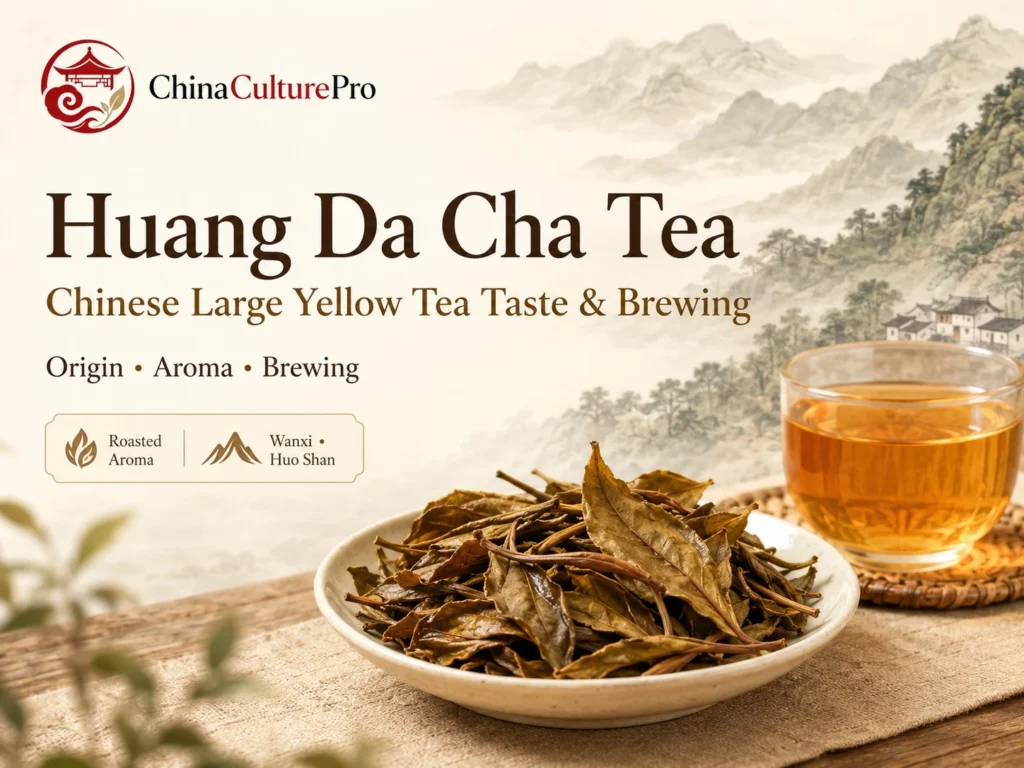

Quick Answer: What Is Huang Da Cha Tea?
Huang Da Cha Tea, also called Huangda Tea, Chinese Large Yellow Tea, or simply Large Yellow Tea, is a mature-leaf style of Chinese yellow tea. It is best represented by Wanxi Huang Da Cha and Huo Shan Huang Da Cha from western Anhui.
It is not green tea, dark tea, or a lower-grade version of yellow bud tea. Huang Da Cha is a distinct yellow tea category built around mature leaves, stems, yellowing, and old-fire roasting.
The basic identity is clear:
Tea Type: Chinese yellow tea.
Category: Huang Da Cha / Large Yellow Tea.
Representative Teas: Wanxi Huang Da Cha and Huo Shan Huang Da Cha.
Main Origin: western Anhui, especially Huo Shan, Jinzhai, and Lu’an in the Dabie Mountain tea region.
Leaf Style: large leaves, thick stems, mature leaves, and connected stems and leaves.
Traditional Appearance: large branches and leaves, plump stems and fat leaves, fishhook-like connected stems and leaves, brownish golden color, and an oily sheen.
Processing Key: yellowing / men huang plus old-fire roasting / laohuo.
Aroma: guoba aroma, rice-crust aroma, roasted grain, bread crust, caramel, cacao, or a light coffee-like note.
Liquor: deep yellow, orange-yellow, or yellow-brown, ideally clear and bright.
Taste: thick, mellow, warm, sweet, and smooth.
Brewing: usually best with 90–95°C / 194–203°F water.
The charm of Huang Da Cha is not tenderness, but thickness, aroma, warmth, sweetness, and everyday drinkability. A good cup should feel substantial, roasted, and warm without becoming coarse, burnt, or harsh.
To understand the broader category, read our [Chinese Yellow Tea] guide.
Name, Tea Type, and Category
The name Huang Da Cha explains the tea’s category and raw material style.
| Term | Chinese | Meaning |
|---|---|---|
| Huang | 黄 | yellow, referring to yellow tea |
| Da | 大 | large, referring to mature leaves, larger leaves, and stems |
| Cha | 茶 | tea |
| Huang Da Cha | 黄大茶 | Large Yellow Tea / Big Yellow Tea |
The word large does not mean low quality. It describes the tea’s mature leaves and stems, which give Huang Da Cha more body, roasted aroma, sweetness, and daily drinkability than tender yellow bud teas.
Chinese yellow tea is often divided by leaf tenderness and style:
| Yellow Tea Category | Chinese | Typical Leaf Material | Examples | Style |
|---|---|---|---|---|
| Huang Ya Cha | 黄芽茶 | single buds or very tender buds and leaves | Junshan Yinzhen, Meng Ding Huang Ya, Huo Shan Huang Ya | delicate, elegant, fresh, refined |
| Huang Xiao Cha | 黄小茶 | one bud with one or two leaves, or smaller leaf material | Beigang Maojian, Weishan Maojian | between freshness and mellow body |
| Huang Da Cha | 黄大茶 | one bud with two or three leaves, or more mature leaves and stems | Wanxi Huang Da Cha, Huo Shan Huang Da Cha | thick, roasted, warm, sweet, everyday-friendly |
For the tender-bud side of yellow tea, compare Junshan Yinzhen and Meng Ding Huang Ya.
This classification matters because Huang Da Cha is often misunderstood. It is not rough green tea, aged dark tea, roasted green tea, or a cheap substitute for yellow bud tea. Yellow bud tea values tenderness; small yellow tea balances freshness and body; Huang Da Cha values thickness, roasted grain aroma, warmth, and practical daily drinking.
To compare yellow tea categories, read our Chinese Tea Types guide.
Main Origins: Anhui, Huo Shan, Jinzhai, and Wanxi
Huang Da Cha is most closely associated with western Anhui, known in Chinese as Wanxi (皖西). Wanxi does not mean one small village. It refers to the western Anhui tea region, especially areas around Huo Shan, Jinzhai, and Lu’an.
| Origin Name | Chinese | Location | Why It Matters |
|---|---|---|---|
| Wanxi | 皖西 | western Anhui | the core regional name behind Wanxi Huang Da Cha |
| Huo Shan | 霍山 | Huo Shan County, Lu’an, Anhui | important for both Huo Shan Huang Ya and Huo Shan Huang Da Cha |
| Jinzhai | 金寨 | Jinzhai County, Lu’an, Anhui | another important Huang Da Cha producing area in the Dabie Mountains |
| Lu’an | 六安 | western Anhui | major tea region also known for Liu An Gua Pian |
| Dabie Mountains | 大别山 | mountain region across western Anhui and nearby areas | provides the broader mountain tea environment |
Huang Da Cha should stay tied to western Anhui, especially Wanxi, Huo Shan, Jinzhai, and the Dabie Mountain tea region. It is usually made later than early spring bud teas, allowing larger leaves and stems to develop more substance. This is why local tea language values it as da zhi da ye da xiang cha — a tea of large branches, large leaves, and strong aroma.
A Chinese tea drinker does not judge Huang Da Cha by delicacy. The better question is whether it has body, roasted grain aroma, clean sweetness, and a warm, satisfying cup.
To explore a famous Anhui green tea with a very different style, read our Lu’an Guapian Tea guide.
History and Cultural Background
Huang Da Cha has a different cultural position from famous yellow bud teas. It is less about rare tender buds and more about the daily drinking tradition of western Anhui.
| Period / Context | Cultural Meaning |
|---|---|
| Ming Dynasty Tradition | Huang Da Cha is often traced to the Ming dynasty, with some accounts connecting its formation to the Longqing period |
| Western Anhui Tea Culture | Wanxi has a deep tea culture that also includes Huo Shan Huang Ya and Liu An Gua Pian |
| Northern Market Tradition | Huang Da Cha was historically appreciated in northern markets for its strong body, roasted aroma, and suitability for daily large-pot brewing |
| Folk Daily Tea | its mature leaves, stems, and old-fire character made it practical, warming, and durable |
| Modern Rediscovery | as yellow tea gains renewed attention, Huang Da Cha is being recognized again as a distinctive mature-leaf yellow tea style |
Huang Da Cha is often traced to Ming-period development, but historical claims should not be overstated. Its cultural value is clear enough: Chinese yellow tea is not only about rare, delicate bud teas. It also includes a grounded daily route built on mature leaves, thick taste, roasted grain aroma, and a warm cup people can drink often.
Huang Da Cha should not be treated as a lower version of Huo Shan Huang Ya. It belongs to the same broad yellow tea world, but expresses another kind of value.
How Huang Da Cha Is Made
Huang Da Cha depends on three elements: mature leaf material, yellow tea transformation, and old-fire roasting.
Its raw material is more mature than yellow bud tea: one bud with two or three leaves is common, larger leaves and stems are intentionally used, and stems are valued for body, sweetness, and durability.
A typical Huang Da Cha process may follow this general direction:
| Step | Chinese Term | What It Does | Key Point |
|---|---|---|---|
| Spreading / Withering | 摊放 | lets leaves and stems lose some moisture and soften | prepares mature material for later processing |
| Fixation | 杀青 | uses heat to stop strong enzymatic oxidation | keeps the tea within the yellow tea path |
| Rolling | 揉捻 | shapes leaves and breaks cells slightly | helps large leaves and stems form a coherent strip |
| Yellowing | 闷黄 | uses warmth and moisture to encourage yellow tea transformation | proves Huang Da Cha is not just roasted tea |
| Roasting / Old Fire | 烘焙 / 老火 | uses stronger firing to develop aroma and body | creates guoba aroma, rice-crust aroma, and roasted grain depth |
| Drying | 干燥 | removes final moisture and stabilizes the tea | locks in aroma, color, and storage stability |
The yellowing step, or men huang, proves Huang Da Cha is still yellow tea, not simply roasted tea. It softens mature leaves, reduces raw greenness, deepens the liquor color, and makes the taste more mellow.
Old-fire roasting, or laohuo, gives Huang Da Cha its most recognizable aroma: guoba, roasted grain, bread crust, caramel-like sweetness, cacao-like depth, or a light coffee-like impression. Producers vary the level of yellowing and roasting, but the core logic remains: yellow tea transformation plus old-fire roasting.
What Huang Da Cha Tastes Like
Huang Da Cha is not a tea of delicate bud fragrance. Its key words are thick, aromatic, warm, sweet, and roasted.
| Tasting Point | Good Huang Da Cha |
|---|---|
| Dry Leaf | large leaves and stems, plump stems and fat leaves, connected stems and leaves, brownish golden color, oily sheen |
| Aroma | guoba aroma, rice-crust aroma, roasted grain, bread crust, caramel, cacao, sometimes light coffee-like notes |
| Liquor Color | deep yellow, orange-yellow, yellow-brown, clear and bright |
| Taste | thick, mellow, warm, sweet, smooth |
| Mouthfeel | substantial but not rough, warming but not drying |
| Aftertaste | clean roasted sweetness, comfortable warmth |
| Leaf Base | yellow-brown, soft, mature, not blackened or stiff |
The Chinese phrase guoba xiang (锅巴香) is central. It means rice-crust aroma: the warm, toasted smell of rice crust at the bottom of a pot. This is not the same as burnt flavor. Good guoba aroma is warm, clean, grain-like, and comforting.
English tasting words such as roasted grain, bread crust, caramel, cacao, or coffee-like can help readers imagine the cup. But the Chinese core is more accurate: rice-crust aroma, thick mellow taste, warm sweetness, and daily drinkability.
Good Huang Da Cha should have fire aroma without burnt fire, roasted depth without smoke, and thickness without roughness.
| Good Huang Da Cha | Problem Huang Da Cha |
|---|---|
| large leaves and thick stems, brownish golden and oily | too many broken pieces, dull dark green or blackened color |
| natural guoba aroma and roasted grain aroma | burnt, smoky, moldy, or warehouse smell |
| deep yellow or orange-yellow clear liquor | muddy, dull, or overly dark liquor |
| thick, mellow, sweet, warm taste | bitter char, rough astringency, thin body |
| yellow-brown soft leaf base | blackened, stiff, or lifeless leaf base |
Huang Da Cha does not try to be tender. It tries to be satisfying.
How to Taste Huang Da Cha Like a Tea Drinker
Huang Da Cha should not be judged like Junshan Yinzhen or Huo Shan Huang Ya. Look for maturity, roasting, body, and clean warmth.
- Look At The Dry Leaf Good Huang Da Cha should show large leaves and stems, plump stems and fat leaves, and connected stems and leaves that may look like small fishhooks. The color should be brownish golden, not dull black.
- Smell The Dry Aroma Look for guoba aroma, roasted grain, bread crust, or warm caramel-like sweetness. Avoid burnt, smoky, moldy, sour, or warehouse smells.
- Check The Liquor Color The liquor should be deep yellow, orange-yellow, or yellow-brown, with good clarity. A muddy or lifeless liquor is a warning sign.
- Smell The Wet Leaf The wet aroma should show warm roasted grain and mellow sweetness. A clean rice-crust note is desirable; harsh smoke is not.
- Taste The Liquor The taste should be thick, mellow, and smooth. It should not be bitter, charred, sour, or rough.
- Feel The Mouthfeel Good Huang Da Cha should feel warm and substantial without scratching the throat. A useful standard is: thick but not coarse, warm but not drying.
- Notice The Aftertaste The returning sweetness should feel warm and clean. It is not the delicate sweetness of bud tea; it is more like roasted grain sweetness.
- Look At The Leaf Base The brewed leaves should look yellow-brown, soft, and mature. They should not be blackened, stiff, or lifeless.
For Chinese tea drinkers, the four-word test is simple: hou, xiang, nuan, tian — thick, aromatic, warm, and sweet.
For a broader framework for aroma, mouthfeel, Hui Gan, and aftertaste, read our Chinese Tea Tasting guide.
How to Brew Huang Da Cha Tea
Huang Da Cha can handle hotter water than tender yellow bud teas. Higher heat helps open its large leaves, stems, roasted aroma, and thick body.
| Brewing Method | Teaware | Water Temperature | Leaf Amount | Steeping Time | Best For |
|---|---|---|---|---|---|
| Gaiwan | 100–120ml gaiwan | 90–95°C / 194–203°F | 5g | 15–30 seconds for first infusion, then extend | aroma, layers, and controlled strength |
| Zisha / Clay Pot | small clay pot | 90–95°C / 194–203°F | 5–6g / 150ml | 20–40 seconds to start | rounder body and stronger warmth |
| Porcelain Pot | small porcelain pot | 90–95°C / 194–203°F | 4–5g / 200ml | 2–3 minutes | sharing with others |
| Western Cup | mug or large cup | 90–95°C / 194–203°F | 3–4g / 250ml | 3–5 minutes | daily simple brewing |
| Simmering | kettle or small pot | boiling, then low simmer | 3–5g / 500ml | simmer 3–5 minutes | autumn, winter, stronger body |
Brewing tips:
- Use enough heat: 90–95°C helps open the large leaves, stems, and roasted grain aroma.
- Lower the temperature for broken or heavily fired tea: 85–90°C can reduce bitter char.
- Do not oversteep heavily roasted tea: long steeping can turn warmth into bitterness.
- Use clay or porcelain for body: zisha and porcelain both work well.
- Western cup brewing is acceptable: Huang Da Cha is practical and daily-friendly.
- Simmering is optional: it can bring out body in colder seasons, but it is not the only correct method.
- Drink it plain: milk and sugar cover the rice-crust aroma and mellow sweetness.
Huang Da Cha is more forgiving than tender bud teas, but it still rewards control: enough heat to open the aroma, not so much time that the liquor becomes bitter.
To learn practical brewing methods, read our How to Brew Chinese Tea guide. For gaiwans, clay pots, porcelain pots, and cups, see our Chinese Teaware guide.
Huang Da Cha vs Green Tea
Huang Da Cha can confuse readers because it has yellow-brown color, mature leaves, and roasted aroma. Some may mistake it for old green tea or roasted green tea. It is neither.
| Point | Huang Da Cha | Green Tea |
|---|---|---|
| Tea Type | yellow tea | green tea |
| Core Process | fixation, yellowing, old-fire roasting | fixation and drying, usually without yellowing |
| Leaf Material | mature leaves, large leaves, stems | usually tender buds and leaves |
| Liquor Color | deep yellow, orange-yellow, yellow-brown | green, yellow-green, or pale green |
| Aroma | guoba aroma, roasted grain, caramel, bread crust | fresh, vegetal, chestnut, bean-like, grassy |
| Taste | thick, mellow, warm, sweet | fresh, brisk, crisp, sometimes sharp |
| Mouthfeel | substantial and warming | clean, light, refreshing |
| Drinking Scene | autumn, winter, after meals, daily large-cup drinking | spring freshness, light daily drinking |
The key difference is not only roasting. Huang Da Cha also has yellow tea transformation: men huang softens the mature leaves and moves the tea away from green-tea sharpness, while laohuo builds rice-crust aroma and thick body.
Green tea values freshness and green clarity. Huang Da Cha values warmth, body, roasted aroma, and mellow sweetness. They are different routes, not higher or lower grades.
For the broader green-tea category, read our Chinese Green Tea guide.
Huang Da Cha vs Huang Ya Cha and Huang Xiao Cha
Huang Da Cha makes the most sense when placed inside the yellow tea family.
| Category | Huang Ya Cha | Huang Xiao Cha | Huang Da Cha |
|---|---|---|---|
| Chinese | 黄芽茶 | 黄小茶 | 黄大茶 |
| Leaf Material | single buds or very tender buds and leaves | one bud with one or two leaves, smaller leaf material | one bud with two or three leaves, mature leaves, large leaves and stems |
| Appearance | delicate buds, fine shape | tighter strips, smaller leaves | large branches and leaves, thick stems, connected stems and leaves |
| Liquor | apricot-yellow, yellow-green, bright | yellow, orange-yellow, bright | deep yellow, orange-yellow, yellow-brown |
| Aroma | tender sweetness, chestnut, floral, elegant | fresh, sweet, mellow | guoba aroma, roasted grain, bread crust, caramel |
| Taste | fresh, refined, mellow | mellow, sweet-refreshing | thick, warm, mellow, sweet |
| Fire Level | light or moderate | moderate | often stronger, old-fire style |
| Examples | Junshan Yinzhen, Meng Ding Huang Ya, Huo Shan Huang Ya | Beigang Maojian, Weishan Maojian | Wanxi Huang Da Cha, Huo Shan Huang Da Cha |
| Best For | delicate yellow tea experience | balanced yellow tea style | roasted, warming, everyday drinking |
A simple way to remember the difference:
- Huang Ya Cha values tenderness.
- Huang Xiao Cha values balance.
- Huang Da Cha values thickness.
This is not a ranking. Huang Da Cha is a different route within yellow tea, built around mature leaves, stems, roasted aroma, and daily comfort.
To explore a strip-shaped Hunan yellow tea, read our Beigang Maojian Tea guide.
Huang Da Cha vs Huo Shan Huang Ya
This comparison is necessary because both names may include Huo Shan. Huo Shan Huang Ya and Huo Shan Huang Da Cha can come from the same broader region, but they are different teas.
| Point | Huo Shan Huang Ya | Huo Shan Huang Da Cha |
|---|---|---|
| Tea Category | Huang Ya Cha / yellow bud tea | Huang Da Cha / large yellow tea |
| Leaf Material | tender buds and young leaves | mature leaves, large leaves, thick stems |
| Appearance | tender buds and leaves, neat and refined | large branches and leaves, thick stems, connected stems and leaves |
| Liquor | yellow-green or bright yellow | deep yellow, orange-yellow, yellow-brown |
| Aroma | chestnut, tender nutty sweetness, fresh yellow tea aroma | guoba aroma, roasted grain, bread crust, caramel |
| Taste | fresh, mellow, sweet, refined | thick, mellow, warm, sweet |
| Fire Level | usually lighter | stronger old-fire character |
| Drinking Style | elegant yellow bud tea | roasted, warming, daily yellow tea |
| Common Appeal | freshness and chestnut sweetness | body, warmth, rice-crust aroma |
One is “tender”; the other is “large.” Huo Shan Huang Ya leans toward chestnut sweetness and fresh elegance; Huang Da Cha leans toward rice-crust aroma and thick warmth.
They are not substitutes. Choose Huo Shan Huang Ya for yellow bud elegance, and Huang Da Cha for roasted body, warmth, and everyday comfort.
To compare a classic yellow bud tea from the same region, read our Huo Shan Huang Ya Tea guide.
How to Choose Good Huang Da Cha
| Checkpoint | What To Look For | Warning Signs |
|---|---|---|
| Origin | Anhui, Wanxi, Huo Shan, Jinzhai, Lu’an | vague origin or unrelated non-traditional source |
| Tea Type | clearly identified as Huang Da Cha or Large Yellow Tea | described only as green tea, roasted tea, or dark tea |
| Dry Leaf | large leaves and stems, plump stems, connected stems and leaves, brownish golden color, oily sheen | too many broken pieces, dull dark green, blackened color |
| Aroma | guoba aroma, roasted grain, bread crust, clean fire aroma | burnt, smoky, moldy, sour, warehouse smell |
| Liquor | deep yellow, orange-yellow, yellow-brown, clear | muddy, dark, cloudy, or greenish |
| Taste | thick, mellow, sweet, warm, smooth | bitter char, rough astringency, thin body |
| Fire Level | roasted but not burnt, fired but not smoky | sharp fire, burnt throat feeling, harsh smoke |
| Leaf Base | yellow-brown, soft, mature | blackened, stiff, lifeless |
Two checks matter most: the aroma should be right, and the liquor should be clear. Good guoba aroma is warm and grain-like, not burnt, smoky, moldy, or storage-like.
Good Huang Da Cha should be thick but bright, aromatic but clean, and sweet but not cloying. Bitterness, smoke, or muddy liquor usually points to problems with fire, storage, or raw material.
How to Store Huang Da Cha
Huang Da Cha is more stable than tender yellow bud tea, but it should not be stored like pu-erh or dark tea. Poor storage can make its roasted grain aroma fade or turn dull.
Use these storage rules:
- Seal It Well: use a sealed pouch, tin, or jar.
- Keep It Dry: moisture makes roasted aroma turn dull and stuffy.
- Avoid Light: strong light weakens aroma and liquor clarity.
- Use Cool Room-Temperature Storage: refrigeration is usually unnecessary.
- Avoid Strong Odors: keep it away from coffee, spices, smoke, incense, pu-erh, and scented teas.
- Let New Fire Settle Briefly: if the tea feels too sharp after roasting, a short resting period can make it smoother.
- Drink After Opening: finish opened Huang Da Cha within 12–18 months for better aroma.
- Do Not Create An Aging Myth: it is not meant to age like pu-erh.
Drink Huang Da Cha while its rice-crust aroma and thick warmth are still clear. Long storage can reduce the aroma that makes it special.
Benefits and Caffeine
Huang Da Cha contains common tea compounds such as tea polyphenols, amino acids, and caffeine. Many drinkers find it warmer, thicker, and less sharp than tender green tea because of its mature leaves, stems, yellowing, and roasting.
It may suit people who like roasted grain aroma, want a thicker yellow tea than delicate bud teas, prefer substantial daily tea, or enjoy tea after meals and in colder seasons.
Important cautions:
- Huang Da Cha contains caffeine.
- Avoid drinking large amounts before sleep.
- People sensitive to caffeine should drink moderately.
- People with stomach sensitivity should adjust amount and strength.
- Pregnant people, people taking medication, or people with medical concerns should ask a qualified professional.
- Do not treat Huang Da Cha as medicine.
Enjoy Huang Da Cha for its taste and cultural value. Do not treat it as a weight-loss, blood-sugar, blood-pressure, cancer-prevention, or disease-treatment tea.
Final Thoughts
Huang Da Cha is not green tea, dark tea, or a lower-grade version of yellow bud tea. It is Chinese Large Yellow Tea: the mature-leaf route within the yellow tea family.
Its representative forms are Wanxi Huang Da Cha and Huo Shan Huang Da Cha from western Anhui. Its value comes from large leaves and stems, the Dabie Mountain tea region, yellow tea transformation, old-fire roasting, guoba aroma, thick mellow taste, and everyday drinkability.
A good Huang Da Cha should show large branches and leaves, plump stems, fishhook-like connected stems and leaves, brownish golden color with an oily sheen, deep yellow or orange-yellow clear liquor, thick mellow taste, and natural rice-crust or roasted grain aroma.
Its charm is not tenderness, but thickness, aroma, warmth, sweetness, and comfort. For drinkers who like roasted aroma, fuller body, autumn and winter tea, or a practical daily cup with real character, Huang Da Cha is one of the most underrated styles in Chinese yellow tea.
FAQs About Huang Da Cha Tea
What is Huang Da Cha tea?
Huang Da Cha Tea is Chinese Large Yellow Tea. It is a mature-leaf style of yellow tea made with larger leaves and stems. Representative examples include Wanxi Huang Da Cha and Huo Shan Huang Da Cha from western Anhui.
Is Huang Da Cha green tea or yellow tea?
Huang Da Cha is yellow tea, not green tea. It has yellow tea transformation through men huang and often uses old-fire roasting to create its rice-crust aroma and thick mellow taste.
Why is it called Large Yellow Tea?
It is called Large Yellow Tea because it uses larger, more mature leaves and stems than yellow bud teas. “Large” describes the material and style, not low quality.
Where is Huang Da Cha from?
The most representative Huang Da Cha comes from western Anhui, especially Huo Shan, Jinzhai, and Lu’an in the Dabie Mountain tea region. It is often called Wanxi Huang Da Cha or Huo Shan Huang Da Cha.
What does Huang Da Cha taste like?
Huang Da Cha usually tastes thick, mellow, warm, sweet, and roasted. It often has guoba aroma, rice-crust aroma, roasted grain, bread crust, caramel, cacao, or light coffee-like notes.
How do you brew Huang Da Cha?
Use 90–95°C / 194–203°F water. For gaiwan brewing, use about 5g for 100–120ml and start with 15–30 seconds. For Western cup brewing, use 3–4g for 250ml and steep for 3–5 minutes.
Is Huang Da Cha the same as Huo Shan Huang Ya?
No. Huo Shan Huang Ya is a yellow bud tea made from tender buds and young leaves. Huo Shan Huang Da Cha is Large Yellow Tea made from mature leaves and stems. Huang Ya is fresher and more delicate; Huang Da Cha is thicker, warmer, and more roasted.
What is the difference between Huang Da Cha and Huang Xiao Cha?
Huang Xiao Cha, such as Beigang Maojian, usually uses one bud with one or two leaves and sits between freshness and body. Huang Da Cha uses larger, more mature leaves and stems, giving it a thicker body and stronger roasted aroma.
Is Huang Da Cha heavily roasted?
Many traditional Huang Da Cha teas have an old-fire roasted character. Good roasting should create rice-crust aroma and roasted grain sweetness, not burnt, smoky, or bitter flavor.
Does Huang Da Cha have caffeine?
Yes. Huang Da Cha contains caffeine. It can be refreshing, but people sensitive to caffeine should drink it moderately and avoid large amounts before sleep.
How should I store Huang Da Cha tea?
Store Huang Da Cha in a sealed, dry, cool, dark place away from strong odors. Room-temperature storage is usually enough. After opening, drink it within 12–18 months for the best rice-crust aroma and thick mellow taste.