
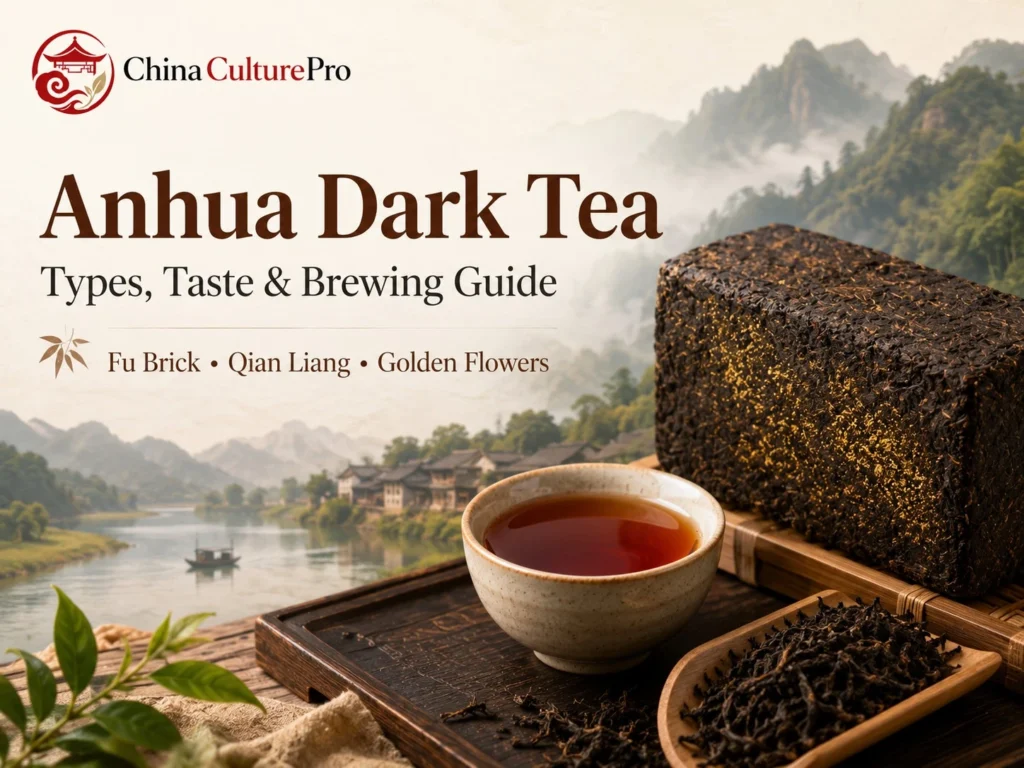

Quick Answer: What Is Anhua Dark Tea?
Anhua Dark Tea, also called Anhua Hei Cha or Hunan Dark Tea, is a regional Chinese dark-tea system from Anhua County in Yiyang, Hunan. It is not English black tea, Pu-erh tea, or one standardized tea brick.
Most traditional products are made from locally produced hei mao cha and refined into basket-packed teas, pressed bricks, and cylindrical Huajuan teas.
Its basic identity is:
Chinese Name: 安化黑茶.
Tea Type: Chinese dark tea, or hei cha.
Origin: Anhua County, Yiyang, Hunan.
Regional Setting: The northern Xuefeng Mountains and Zi River basin.
Base Tea: Hei mao cha.
Traditional System: Three Jian teas, Three Brick teas, and Huajuan teas.
Three Jian Teas: Tian Jian, Gong Jian, and Sheng Jian.
Three Brick Teas: Hei Zhuan, Hua Zhuan, and Fu Zhuan.
Representative Huajuan Tea: Qian Liang Tea.
Defining Techniques: Piling, Seven-Star Stove baking, basket packing, brick pressing, Fu Brick flowering, and Huajuan treading.
Common Aromas: Pine smoke, flowers, wood, grain, fungal-floral notes, herbs, medicine, and clean aged fragrance.
Liquor: Orange-yellow, orange-red, or reddish brown.
Brewing: Usually 95–100°C through gongfu brewing, large-pot steeping, thermos steeping, or boiling.
Golden flowers belong mainly to Fu Brick Tea and are not required in Tian Jian, Hei Zhuan, Hua Zhuan, or Qian Liang. Smoke, stems, compression, dark liquor, and age are also not automatic signs of quality.
Good Anhua dark tea should have a clearly identified product type, clean aroma, bright substantial liquor, integrated smoothness, returning sweetness, and a comfortable throat.
To understand where it fits among China’s fermented-tea traditions, read our [Chinese Dark Tea] guide.
Name, Tea Type, and Basic Identity
Anhua is the name of a county in Hunan. Anhua Dark Tea therefore describes a regional product system rather than one fixed tea.
| Identity Point | What It Means |
|---|---|
| Chinese Name | 安化黑茶 |
| Common English Names | Anhua Dark Tea, Anhua Hei Cha, Hunan Dark Tea |
| Misleading Search Name | Anhua Black Tea |
| Tea Category | Chinese dark tea / hei cha |
| Main Base Material | Locally produced hei mao cha |
| Product System | Three Jian teas, Three Brick teas, and Huajuan teas |
| Representative Features | Seven-Star Stove baking, Fu Brick flowering, Huajuan treading, border-tea history, and aging |
| Not The Same As | English black tea, Pu-erh tea, Liu Bao Tea, or ordinary smoked tea |
Anhua tea is dark tea, not English black tea. Hei cha develops through piling, microbial activity, later processing, and storage-related transformation, while English black tea corresponds to Chinese hong cha and is shaped mainly by enzymatic oxidation.
Anhua dark tea also should not be reduced to Fu Brick or Qian Liang. Each product has its own raw-material grade, structure, processing, aroma, and quality standard.
For an overview of China’s major processing families, see Chinese Tea Types.
Origin and History: Anhua, the Zi River, and Border Tea
Anhua County lies in central Hunan under the administration of Yiyang. Its tea areas extend through mountainous terrain associated with the northern Xuefeng range and the middle reaches of the Zi River.
| Place | Role in Anhua Dark Tea |
|---|---|
| Anhua County | Core production region and source of the Anhua Dark Tea identity |
| Xuefeng Mountains | Mountain system shaping the tea-growing environment |
| Zi River | Historical route for moving tea out of the mountain districts |
| Yuntai Mountain | Associated with Yuntai large-leaf tea resources |
| Dongting Lake and Hankou | Important links to larger inland trade routes |
| Northwestern China | Major historical market for border tea |
The region is warm and humid, with steep hills, valleys, cloud, and substantial rainfall. Important local tea resources include Yuntai large-leaf tea, Zhuyeqi, and other regional cultivars and populations.
Anhua has a long tea history, but early references to local tea do not prove that the complete modern dark-tea system already existed in the Tang dynasty. Specialized processing, official border-tea status, and compressed product forms developed gradually over later centuries.
A key historical point came in 1595, during the Wanli reign, when Anhua dark tea entered the official border-tea system. Tea traveled through the Zi River, Dongting Lake, the Yangtze River, Hankou, and inland routes toward Shaanxi, Gansu, Qinghai, Ningxia, Xinjiang, and other northern and northwestern markets.
Compressed baskets, bricks, and Huajuan cylinders reduced bulk and made tea easier to handle, transport, and store. Later factory production increased standardization, expanded brick production, and preserved techniques such as Fu Brick flowering and Qian Liang treading within modern heritage systems.
Its trade and processing history also forms part of the wider story of Chinese Tea Culture.
Main Types of Anhua Dark Tea
The traditional system is commonly summarized as the Three Jian teas, Three Brick teas, and the Huajuan family.
| Product | Chinese | Family | Form | Defining Feature | General Style |
|---|---|---|---|---|---|
| Tian Jian | 天尖 | Three Jian | Basket-packed loose tea | Relatively finer material | Clearer fragrance, pine smoke, flowers, herbs, and liveliness |
| Gong Jian | 贡尖 | Three Jian | Basket-packed loose tea | Intermediate material grade | Balanced wood, smoke, sweetness, and body |
| Sheng Jian | 生尖 | Three Jian | Basket-packed loose tea | More mature leaves and stems | Deeper wood, fuller body, and steadier aged character |
| Hei Zhuan | 黑砖 | Three Brick | Rectangular brick | Steamed, pressed, and dried | Firm body, wood, grain, and smoke |
| Hua Zhuan | 花砖 | Three Brick | Decorated brick | Developed from Huajuan-related traditions | Wood, smoke, grain, and rounded compressed-tea character |
| Fu Zhuan | 茯砖 | Three Brick | Flowered brick | Controlled flowering and golden flowers | Fungal-floral aroma, sweetness, wood, and soft liquor |
| Qian Liang | 千两茶 | Huajuan | Bamboo-wrapped cylinder | Treading and prolonged natural drying | Pine smoke, wood, herbs, medicine, and aging depth |
The Three Jian teas are basket-packed grades, while Hei Zhuan, Hua Zhuan, and Fu Zhuan differ in production history, blending, structure, and finishing. Fu Zhuan is distinguished by controlled flowering.
Huajuan teas are cylindrical products formed through wrapping, treading, binding, and natural drying. The practical rule is to identify the product first rather than applying one quality standard to every Anhua tea.
What Does Anhua Dark Tea Taste Like?
Anhua dark tea does not have one fixed flavor. Product type, raw-material grade, smoke, flowering, compression, age, and storage all change the cup.
| Product | Common Aroma Direction | Liquor | Body and Finish |
|---|---|---|---|
| Tian Jian | Pine smoke, flowers, herbs, sweet wood | Orange-yellow to orange-red | Lively, rounded, clear, and capable of returning sweetness |
| Gong Jian | Pine smoke, wood, grain, mature leaves | Orange-red | Balanced, smooth, and moderately full |
| Sheng Jian | Mature wood, herbs, smoke, early aged notes | Orange-red to reddish brown | Deeper, steadier, and fuller |
| Hei Zhuan | Wood, grain, smoke, warm baked notes | Orange-red to reddish brown | Firm, substantial, and structured |
| Hua Zhuan | Wood, smoke, grain, occasional sweet or floral lift | Orange-red to reddish brown | Rounded and compact |
| Fu Zhuan | Fungal-floral aroma, sweet grain, wood, herbs | Orange-red to reddish brown | Soft, sweet, smooth, and approachable |
| Qian Liang | Pine smoke, wood, herbs, medicine, aged fragrance | Orange-red to deep reddish brown | Dense, persistent, and suited to gradual development |
| Desirable Character | Possible Defect |
|---|---|
| Clean pine smoke | Soot, burnt oil, ash, or chemical smoke |
| Fungal-floral aroma | Mold, basement odor, or damp mustiness |
| Clean wood | Rotten or wet wood |
| Mature herbal or medicinal notes | Dirty warehouse or chemical odor |
| Mellow body | Empty, watery liquor |
| Full tea soup | Sticky, oppressive, or dull heaviness |
| Transforming bitterness | Persistent roughness or throat locking |
| Bright aged fragrance | Sourness, rancidity, or wet-storage contamination |
Traditional pine smoke should feel dry, warm, and integrated rather than burnt or irritating. Fu Brick’s fungal-floral aroma should be clean and sweet rather than damp or moldy.
Chinese tea drinkers also distinguish mellow from empty: mellow tea retains body after roughness softens, while empty tea may look dark but lacks aroma, sweetness, and development.
A useful shared standard is clean aroma, bright liquor, real body, integrated smoothness, returning sweetness, and a comfortable throat.
How Anhua Dark Tea Is Made
Most traditional products begin with hei mao cha, a primary processed dark-tea material distinct from Yunnan sun-dried mao cha.
The process usually follows these stages:
- Plucking And Spreading / 采摘、摊放 Leaves are harvested according to the intended product and allowed to release surface moisture.
- Kill-Green / 杀青 Heat reduces enzymatic activity, softens the leaves, and prepares them for rolling.
- Primary Rolling / 初揉 Rolling shapes the material and helps later humid-heat transformation proceed more evenly.
- Piling / 渥堆 The rolled leaves are gathered under controlled warmth and moisture to reduce raw greenness and build dark-tea character. Poor control can create sourness, stale heat, or dirty fermentation odors.
- Secondary Rolling / 复揉 The leaves are rolled again to refine their structure and shape.
- Drying Or Seven-Star Stove Baking / 干燥、七星灶烘焙 Traditional material may be dried over pinewood fire in a Seven-Star Stove. Clean smoke should integrate with the tea rather than resemble soot, ash, or burnt oil.
- Sorting And Blending / 筛分、拼配 Hei mao cha is screened, cleaned, graded, and blended for the intended product. Mature leaves and a suitable proportion of stems are normal in many bricks and Huajuan teas.
- Product-Specific Refining / 精制
- Three Jian teas: Sorted, blended, steamed, basket packed, dried, and rested.
- Hei Zhuan and Hua Zhuan: Blended, steamed, molded, pressed, cooled, and dried.
- Fu Zhuan: Built or pressed, flowered under controlled conditions, gradually dried, and stabilized.
- Qian Liang: Steamed, loaded into plant and bamboo wrapping, trodden, tightened, bound, and naturally dried.
- Resting And Storage / 静置、储存 Finished tea is stabilized before drinking or aging. Product structure affects how quickly smoke, sweetness, aroma, and body change.
Golden Flowers in Fu Brick Tea
Golden flowers are yellow or golden fungal structures formed during the controlled flowering of Fu Brick Tea.
| Golden Flower Point | What It Means |
|---|---|
| Chinese Name | 金花 |
| Main Characteristic Fungus | Aspergillus cristatus |
| Older Tea-Literature Name | Eurotium cristatum |
| Formation Stage | Controlled fahua, or flowering |
| Common Location | Usually more visible inside an opened brick |
| Aroma Association | Fungal-floral aroma, grain sweetness, wood, and mild fermentation |
| Quality Role | One process indicator, not a complete quality grade |
Golden flowers are not petals, pollen, flavoring, decorative powder, or ordinary mold. More visible flowers do not automatically mean better tea.
A sound Fu Brick should come from a traceable producer, remain dry and stable, smell clean, and brew normally. Dampness, stickiness, abnormal fuzz, strong mold, sourness, rot, rancidity, or chemical odor are warning signs.
Qian Liang production is already covered in the product-specific refining step. Its plant-and-bamboo casing, coordinated treading, binding, and prolonged natural drying are important craft features, but they do not require a separate module in this overview article.
For a broader framework for aroma, mouthfeel, hui gan, and aftertaste, read our Chinese Tea Tasting guide.
How to Taste Anhua Dark Tea Like a Tea Drinker
Begin by identifying the exact product. Anhua Dark Tea is too broad a label for accurate tasting.
- Confirm The Product Identify whether the tea is Tian Jian, Gong Jian, Sheng Jian, Hei Zhuan, Hua Zhuan, Fu Zhuan, Qian Liang, or another Anhua product.
- Examine The Material Note leaf maturity, stem content, cleanliness, compression, packaging, and internal condition.
- Smell The Dry Tea Look for clean pine smoke, flowers, wood, grain, fungal-floral aroma, herbs, or aged fragrance appropriate to the product.
- Check The Warm Aroma After a quick rinse, smell the heated leaves. Warmth often reveals soot, sourness, mold, storage contamination, or excessive fermentation.
- Observe The Liquor Orange-yellow, orange-red, and reddish brown may all be appropriate. Brightness and clarity matter more than darkness.
- Taste The Tea Soup Judge body, smoothness, sweetness, vitality, and bitterness transformation. The liquor should not feel watery, sticky, oppressively heavy, or hollow.
- Judge The Aroma In Context Pine smoke, fungal-floral notes, herbs, wood, or age should suit the product and remain integrated with the tea.
- Follow The Finish Look for returning sweetness, salivation, throat comfort, and structure across later infusions.
- Inspect The Leaf Base The infused material should be reasonably clean for its grade, without slime, rot, abnormal growth, severe burning, or chemical odor.
The practical Chinese approach is straightforward: identify the tea first, then judge whether its aroma is clean, its liquor has substance, and its finish makes you want another cup.
How to Brew Anhua Dark Tea
Most Anhua dark teas respond well to 95–100°C water.
| Brewing Method | Teaware | Water Temperature | Leaf Amount | Steeping Time | Best For |
|---|---|---|---|---|---|
| Gongfu Brewing | Gaiwan, Yixing pot, or glazed clay pot | 95–100°C / 203–212°F | 5–8g / 100–120ml | Quick rinse, then 10–20 seconds | Evaluating aroma, body, and infusion changes |
| Large-Pot Brewing | Porcelain, glass, or clay pot | Near boiling | 4–6g / 400–500ml | 3–5 minutes | Daily shared drinking |
| Thermos Steeping | Heat-safe thermos | Boiling | 2–4g / 400–500ml | 20–40 minutes | Convenient concentrated drinking |
| Boiling | Glass, ceramic, or metal kettle | Gentle boil | 4–7g / 700–1000ml | 3–8 minutes | Mature material or already-infused leaves |
Brewing tips:
- Tian Jian: Use slightly less leaf or faster early infusions when the material is fine and aromatic.
- Fu Zhuan: Use full heat to reveal fungal-floral sweetness without overextracting coarse material.
- Hei Zhuan And Hua Zhuan: Keep the piece relatively intact and extend later infusions gradually.
- Qian Liang: Use a representative piece containing both leaves and stems.
- Break Compressed Tea Carefully: Work along natural layers and avoid crushing the entire sample.
- Rinse According To Condition: One quick rinse suits many clean teas; a second may suit tight, older, or dusty material.
- Use A Gaiwan For Evaluation: Porcelain makes smoke, aroma, liquor, and defects easier to judge.
- Boil Mature Or Spent Leaves: Boiling can deepen sweetness but also magnifies sourness, roughness, and mustiness.
Milk-and-salt tea belongs to the authentic northwestern border-tea tradition. Plain brewing remains more useful for evaluating the tea itself.
For practical brewing guidance, read our How To Brew Chinese Tea guide. For gaiwans, Yixing pots, glazed clay pots, kettles, and other brewing vessels, see our Chinese Teaware guide.
Anhua Dark Tea vs Liu Bao vs Ripe Pu-erh
Anhua Dark Tea, Liu Bao, and ripe Pu-erh belong to related post-fermented traditions but differ in region, raw material, processing, aroma, and history.
| Tea | Region | Category | Defining Technique | Common Aroma | Best For |
|---|---|---|---|---|---|
| Anhua Dark Tea | Anhua, Hunan | Regional system of Jian, Brick, and Huajuan teas | Hei mao cha processing, brick pressing, flowering, and Huajuan treading | Pine smoke, wood, grain, fungal-floral notes, herbs, medicine, and age | Drinkers who want a broad Hunan dark-tea system |
| Liu Bao Tea | Wuzhou, Guangxi | Guangxi dark tea | Humid-heat processing or wet-piling; basket tradition | Wood, medicine, fungi, jujube, age, and possible betel-nut-like notes | Drinkers interested in basket culture and South China–Southeast Asia history |
| Ripe Pu-erh | Yunnan | Yunnan post-fermented tea | Ripe-tea wet-piling | Wood, dates, fermentation, earth, and aged sweetness | Drinkers who want Yunnan material and ripe Pu-erh aging culture |
Choose Anhua dark tea for its wide product range, pine-smoke tradition, Fu Brick flowering, and Huajuan craft. Choose Liu Bao for Wuzhou basket culture, or ripe Pu-erh for the Yunnan wet-piled tradition.
To compare other regional dark teas, read our Liu Bao Tea and Pu-erh Tea guides.
How to Choose Good Anhua Dark Tea
Begin by identifying the exact product. “Anhua Dark Tea” alone does not tell you the raw-material grade, compression, flowering, aroma, or suitable quality standard.
| Checkpoint | What To Look For | Warning Signs |
|---|---|---|
| Product Type | Clear Tian Jian, Gong Jian, Sheng Jian, Hei Zhuan, Hua Zhuan, Fu Zhuan, or Qian Liang identity | Generic Anhua tea with no product type |
| Origin | Clear Anhua or Hunan production information | Vague or misleading place names |
| Producer | Traceable factory, cooperative, artisan, or seller | Anonymous repacking |
| Raw Material | Maturity and stem content appropriate to the product | Claims that all stems are defects or all coarse material is premium |
| Processing | Relevant information on basket packing, pressing, flowering, Seven-Star Stove baking, or Huajuan production | Vague “ancient handmade process” with no explanation |
| Date And Batch | Plausible production information | Unsupported old-tea story |
| Brick Or Basket Condition | Dry, stable, and appropriate to the form | Dampness, swelling, stickiness, internal rot, or damaged packaging |
| Aroma | Clean smoke, wood, grain, fungal-floral, herbal, or aged notes | Mold, sourness, soot, perfume, rancidity, or chemical scent |
| Liquor | Bright orange, red, or reddish brown | Abnormal dullness, cloudiness, or heaviness with off-odors |
| Mouthfeel | Substantial, smooth, lively, and capable of returning sweetness | Thinness, stickiness, harshness, throat locking, or empty darkness |
| Leaf Base | Clean and reasonably coherent for the grade | Slime, rot, abnormal growth, or severe burnt odor |
| Storage | Clean, stable, and odor-free history | Dampness, pests, mold, or absorbed odors |
Judge each product by its own logic:
- Tian Jian: Look for relatively refined material, aromatic clarity, integrated smoke, liveliness, and body.
- Fu Zhuan: Check hygiene, flowering, fungal-floral aroma, sweetness, liquor, and storage—not flower count alone.
- Hei Zhuan And Hua Zhuan: Check sound compression, clean wood and smoke, sufficient depth, and no internal dampness.
- Qian Liang: Check material, casing, even compression, complete drying, storage, and current cup quality.
Choose a traceable tea whose product type is clear, aroma is clean, liquor is bright and substantial, and finish is sweet and comfortable.
Storage and Aging
Anhua dark tea can change during storage, but not every tea improves with age.
| Product Form | General Transformation Tendency |
|---|---|
| Basket-Packed Jian Tea | Greater air contact may allow relatively faster change |
| Hei Zhuan And Hua Zhuan | Moderate compression creates a slower product-specific path |
| Fu Zhuan | Fungal-floral, grain, sweet, and woody notes may gradually integrate |
| Qian Liang | Dense structure often produces slower internal transformation |
During clean storage, pine smoke may soften, fungal-floral notes may become quieter, wood and aged aromas may integrate, bitterness may round out, and sweetness may become clearer.
Storage rules:
- Keep It Stable: Avoid repeated temperature and humidity swings.
- Keep It Dry: Prevent condensation and sustained dampness.
- Protect The Tea: Keep it away from dust, insects, pests, and physical damage.
- Avoid Odors: Do not store it near coffee, spices, perfume, incense, smoke, chemicals, mothballs, or scented wood.
- Use Suitable Wrapping: Retain clean, dry original paper, baskets, bamboo casing, or outer packaging when appropriate.
- Do Not Add Water: Home humidification cannot reproduce professional flowering or aging.
- Do Not Seal Damp Tea: Plastic can trap moisture and accelerate spoilage.
- Check It Periodically: Inspect the packaging, aroma, moisture, and signs of pests.
Clean aging may make the tea calmer and more integrated. Deterioration produces sourness, mold, rancidity, wet cardboard, chemical odor, pest damage, or unpleasant dampness.
A clean younger tea can be better than a badly stored old one.
Benefits and Caffeine
Anhua Dark Tea naturally contains caffeine. Its mellow taste, post-fermentation, golden flowers, or aged character do not make it caffeine-free or necessarily low in caffeine.
Large leaf amounts, long steeping, thermos brewing, boiling, and repeated drinking can increase total caffeine intake. Research into tea compounds and microbial transformation should not be presented as established medical treatment in humans.
Important cautions:
- Anhua Dark Tea contains caffeine.
- Strong brewing increases extraction.
- Caffeine-sensitive drinkers should avoid strong tea before sleep.
- People with stomach sensitivity should adjust the amount and strength.
- Pregnant people, people taking medication, or people with medical concerns should seek professional advice.
- Golden flowers are not a proven human probiotic.
- Anhua dark tea should not be treated as medicine.
Do not use it as a promise for weight loss, detoxification, cholesterol reduction, blood sugar control, liver protection, cancer prevention, or treatment of digestive disease.
Final Thoughts
Anhua Dark Tea is not one fixed brick and cannot be reduced to golden-flowered Fu Brick. It is a regional Hunan system built on hei mao cha and developed into the Three Jian teas, Three Brick teas, and Huajuan products.
Its identity comes from Anhua raw material, piling, Seven-Star Stove baking, basket packing, brick pressing, Fu Brick flowering, Huajuan treading, border-tea history, and long-term transformation.
Good Anhua dark tea should have a clear product identity, clean aroma, bright substantial liquor, integrated smoothness, returning sweetness, and a comfortable throat. Smoke, stems, golden flowers, size, and age matter only when they support the actual quality of the tea.
FAQs About Anhua Dark Tea
What is Anhua Dark Tea?
Anhua Dark Tea is a regional Chinese dark-tea system from Anhua County, Hunan. It includes basket-packed Jian teas, pressed bricks, Fu Brick Tea, and Huajuan products such as Qian Liang.
Is Anhua Dark Tea black tea or dark tea?
It is dark tea, or hei cha. English black tea corresponds to Chinese hong cha and follows a different oxidation process.
What are the main types of Anhua Dark Tea?
The traditional system includes Tian Jian, Gong Jian, Sheng Jian, Hei Zhuan, Hua Zhuan, Fu Zhuan, and Huajuan teas such as Qian Liang.
What is Hei Mao Cha?
Hei mao cha is the primary processed base tea used for many Anhua products. Its representative processing includes kill-green, rolling, piling, secondary rolling, and drying or Seven-Star Stove baking.
Does all Anhua Dark Tea have golden flowers?
No. Golden flowers are mainly associated with Fu Brick Tea. Tian Jian, Hei Zhuan, Hua Zhuan, and Qian Liang do not require visible golden flowers.
What is Qian Liang Tea?
Qian Liang is a cylindrical Huajuan tea wrapped in plant material and bamboo, compressed through coordinated treading, and dried gradually under natural day-and-night conditions.
What does Anhua Dark Tea taste like?
The flavor depends on the product. Tian Jian may be floral, smoky, and lively; Fu Brick may show fungal-floral sweetness and wood; Qian Liang may show pine smoke, herbs, medicine, wood, and aged fragrance.
How is Anhua Dark Tea different from Pu-erh?
Anhua dark tea comes from Hunan and includes multiple product families built on hei mao cha. Pu-erh comes from Yunnan and uses Yunnan large-leaf sun-dried mao cha. Their processing, forms, trade histories, and sensory standards differ.
How do you brew Anhua Dark Tea?
Use approximately 5–8 grams per 100–120ml with 95–100°C water for gongfu brewing. Begin with short infusions and adjust according to the exact product.
Does Anhua Dark Tea improve with age?
It can become more integrated under clean storage, but age does not guarantee improvement. Raw material, processing, compression, drying, packaging, and storage determine the result.
How should Anhua Dark Tea be stored?
Keep it stable, dry, odor-free, protected from insects, and suitably wrapped. Avoid sustained humidity, condensation, strong odors, and sealing damp tea in plastic.
Does Anhua Dark Tea contain caffeine?
Yes. Anhua dark tea naturally contains caffeine. Leaf amount, water temperature, steeping time, boiling, and total consumption affect intake.