

Quick Answer: What Numbers Are Unlucky in Chinese Culture?
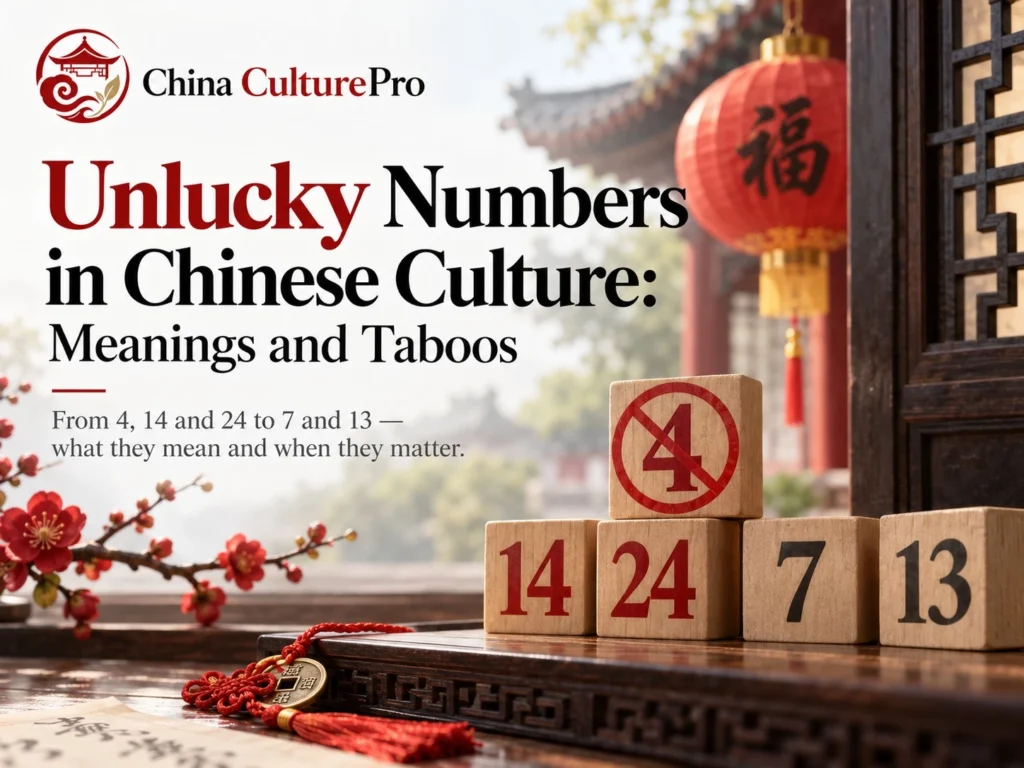
The most widely recognized unlucky number in Chinese culture is four (四, sì), because its pronunciation resembles death (死, sǐ) in several Chinese language varieties. The association is common, but it is a social convention rather than a universal rule.
- 4: Often avoided in room numbers, gifts, phone numbers and ceremonial amounts, especially when the audience is sensitive to the pun.
- 14 and 24: Can carry stronger death-related readings in Cantonese-speaking settings, but they are not equally sensitive everywhere.
- 7: Seven (七, qī) is generally neutral. Its solemn associations belong mainly to seventh-lunar-month rites, while the Qixi Festival (七夕, Qīxī) gives it a positive context.
- 13: Not an established indigenous Chinese taboo; avoidance in international hotels or offices usually reflects Western custom.
Number taboos vary by language, region, setting and individual. They can shape etiquette and prices, but they do not cause illness, accidents, financial loss or bad fortune.
Simple lists of “lucky” and “unlucky” Chinese numbers miss how the system works. Pronunciation matters, but so do language variety, sequence and occasion. A number that sounds ominous in Cantonese may be neutral—or even favorable—when read in Mandarin. A digit associated with ritual remembrance is not automatically unlucky in ordinary life.
This guide separates those mechanisms so travelers, gift-givers and designers can respond tactfully without turning a cultural preference into a supernatural rule. For the wider framework, see our guide to Chinese number symbolism.
There is no canonical Chinese text that supplies a timeless blacklist of numbers. What people now call an “unlucky number” is usually a recognizable pun or convention that has become relevant in a particular social decision: labeling a floor, choosing a phone number, setting a red-envelope amount or naming a table at a banquet. Recognition can be widespread even when observance is optional.
How Numbers Become Unlucky in Chinese Culture
Chinese number taboos usually arise from three mechanisms: sound resemblance, a conventional reading of a longer sequence, or association with a ritual calendar. These mechanisms can overlap, but they are not interchangeable.
Sound Resemblance Is Language-Specific
“Chinese” is not a single pronunciation system. Mandarin, Cantonese and other Sinitic varieties may assign different sounds—and therefore different puns—to the same written digit. A 2015 Hong Kong study comparing Cantonese and Putonghua speakers found that interpretations could change with the language used. One striking example was 54: Cantonese speakers could hear a favorable “not die” reading, while Putonghua speakers could hear a negative “I will die” reading.[2]
Even familiar associations are often near-homophones rather than exact matches. Tone, syllable structure and conventional usage all matter. It is more accurate to say that a number “resembles” a word than to claim that every Chinese speaker hears a perfect homophone.
A Digit, a Sequence and a Ritual Context Are Not the Same
A single 4, the sequences 14 and 24, and the seventh lunar month (农历七月, nónglì qīyuè) belong to different categories. The first is a digit-level pun; the second involves a conventional reading of a sequence; the third is an association with seasonal rites. None automatically determines the meaning of another.
Modern slang is another separate layer. Two hundred and fifty (二百五, èr bǎi wǔ), usually shortened to 250 in writing, is a colloquial insult for a foolish or rash person. It is not an unlucky number in the ritual sense, and people do not generally avoid every price, address or quantity containing 250.
The distinction is useful in practice. A homophonic taboo asks what a number sounds like; a sequence code asks how a whole string is conventionally parsed; a ritual association asks when and where the number appears. Treating all three as “bad luck” erases the reason that each convention exists.
Unlucky Chinese Numbers at a Glance
| Number | Common association | Main mechanism | Where it matters most | Important limit |
|---|---|---|---|---|
| 4 | Death-related unease | Near-homophony | Rooms, floors, phone numbers, gifts and ceremonial amounts | Widely recognized, but not universally observed |
| 14 / 24 | Stronger death-related readings | Conventional Cantonese sequence readings | Hong Kong and some Cantonese-speaking communities | Not a uniform Mandarin or nationwide rule |
| 7 | Solemn ritual association | Seventh-lunar-month calendar context | Ghost Festival and ancestor-remembrance settings | Neutral in most daily uses and positive at Qixi |
| 13 | Western bad-luck association | Imported superstition | International hotels and globally oriented buildings | Not an established indigenous Chinese number taboo |
| 250 | “Fool” or “simpleton” | Modern colloquial usage | Informal speech and online banter | An insult, not a number believed to bring bad luck |
This table is a practical map, not a hierarchy of supernatural danger. It describes how people may interpret a number, not what the number can make happen.
Why 4 Is Avoided in Many Chinese Contexts
Four and “Death” in Mandarin and Cantonese
In Standard Mandarin, four is pronounced sì and death is pronounced sǐ. The consonant and vowel are the same, but the tones differ, so the words are near-homophones rather than identical pronunciations. The resemblance is still easy to notice and supports the familiar pun.
The Chinese University of Hong Kong’s Cantonese lexicon gives four as sei3 and death as sei2. Here too, the syllable is closely matched while the tone differs.[3] This close resemblance helps explain why avoidance can be especially visible in Cantonese-speaking commercial settings.
The association is socially real. A Medical Journal of Australia study noted that some Hong Kong buildings omitted floors ending in 4 and that numbers such as 4, 14 and 24 had death-related readings in Cantonese.[4] Still, knowing the pun and actively avoiding the number are different behaviors. Many people recognize it without reorganizing daily life around it.
Why the Rule Is Strong but Not Universal
Four has never had only one meaning in Chinese culture. Classical systems freely organized the world through the Four Seasons, Four Directions and the Four Symbols of Chinese mythology. Those structures treated four as a number of order and completeness, not as an omen.[1]
Modern avoidance should therefore not be projected backward as an eternal ban. Nor should it be exaggerated into a legal or national rule. Buildings may label the fourth floor normally, businesses may accept addresses containing 4, and individuals differ in how seriously they take the association.
For etiquette, the safest approach is proportionate. Avoid conspicuous clusters of 4 when selecting a wedding gift amount, a celebratory set or a number for a traditional client. There is usually no reason to apologize for an assigned seat, ordinary date or existing address that happens to contain it.
Context also changes the strength of the signal. Choosing four identical gifts for a celebratory presentation may look more deliberate than receiving an automatically assigned room 404. In the first case, selecting another quantity is an easy courtesy. In the second, most people will understand that the number was not a message.
Why 14 and 24 Can Be More Sensitive Than 4
In Cantonese-speaking settings, a longer number sequence can acquire a conventional phrase-like reading. The 2003 Hong Kong mortality study described 14 and 24 as being heard respectively as “must die” and “easy to die,” making them more sensitive than a lone 4 for some speakers.[4] These are culturally established readings of the sequences, not literal translations produced by reading ordinary cardinal numbers word by word.
That distinction matters. Pronunciation and interpretation can change across Cantonese, Mandarin and other varieties, so 14 and 24 are not equally charged in every Chinese-speaking community. In mainland Mandarin settings, many people simply treat them as ordinary numbers, although the final 4 may still prompt mild avoidance.
English glosses such as “must die” are explanatory shortcuts, not universal dictionary meanings of 14 or 24. They describe how particular listeners may conventionalize a sound sequence. Translators and designers should preserve that dialect boundary instead of presenting the gloss as a literal Chinese reading.
When a Longer Sequence Reverses the Meaning
Whole-sequence meaning can override an individual digit. The online code 1314 is conventionally read as yīshēng yīshì, “for one lifetime,” and is used as a romantic expression of lasting commitment. It contains a 4, yet the complete sequence is positive.
This is why a mechanical rule such as “any number containing 4 is unlucky” fails. Ask how the entire string is read, by whom, and in what context. That principle also explains why internet codes, license plates and ceremonial amounts can develop meanings that isolated digits do not possess.
Is 7 an Unlucky Number in Chinese Culture?
The Seventh Lunar Month and Ghost Festival Context
The solemn reputation of seven comes mainly from the seventh lunar month (农历七月, nónglì qīyuè). In several Chinese communities, this month includes offerings, performances and remembrance rites for ancestors and wandering spirits. The Zhongyuan Festival (中元节, Zhōngyuán Jié), often called the Ghost Festival in English, is observed on the fifteenth day; Buddhist Yulanpen traditions and local folk practices also shape the season.[6]
These associations can make the month feel ritually serious. Some families or communities may avoid major celebrations or follow local precautions during it. But the caution attaches to a calendrical and religious context, not to every appearance of the digit 7.
Why 7 Is Mixed Rather Than Universally Unlucky
The clearest counterexample is the Qixi Festival (七夕, Qīxī), held on the seventh day of the seventh lunar month. Its Cowherd and Weaver Girl story gives double seven an association with reunion and romantic devotion.[7] The same month can therefore hold both remembrance rites and a beloved festival without contradiction.
Outside those contexts, 7 is generally an ordinary number. A seventh floor, a gift of seven items or a date containing 7 does not trigger a broadly shared Chinese taboo. Treat claims that “7 means death in China” as an overgeneralization from specific lunar-calendar practices.
The calendar distinction is essential: the seventh lunar month is a named ritual period, whereas the digit 7 on a hotel door or product code is merely a numeral. Cultural interpretation should follow the event, label and community practice rather than transfer the month’s atmosphere to every unrelated use.
Is 13 Unlucky in China?
Thirteen does not carry the same established indigenous Chinese homophonic taboo as four. Its negative reputation is primarily associated with Western traditions, where fear of 13 has been linked to religious and historical stories such as the Last Supper.[8]
An international hotel or office tower in China may omit a 13th floor to accommodate global guests or follow an international brand standard. That does not turn 13 into a traditional Chinese unlucky number. In ordinary Chinese social, gift and business contexts, it usually needs no special handling.
Some buildings omit both 4 and 13, but the shared omission does not imply a shared origin. One responds to Chinese-language wordplay; the other generally responds to international customer expectations.
Where Unlucky-Number Preferences Affect Everyday Life
| Setting | What you may see | Sensible practice | What not to assume |
|---|---|---|---|
| Floors and rooms | Some buildings omit 4, 14 or 24, especially in Hong Kong | Accept local numbering; choose another room if a host clearly cares | Omission is not a construction law or a safety measure |
| Phone numbers and license plates | Numbers containing several 4s may attract less demand | Avoid conspicuous 4-heavy strings for a traditional-facing business | A lower price does not mean greater practical risk |
| Red envelopes and gifts | Celebratory amounts or sets may avoid ending in 4 | For weddings and openings, use a neutral or positively associated amount | An accidental 4 is not a threat or curse |
| Weddings and openings | Hosts may prefer dates or tables without 4 | Follow the organizer’s stated preference | The event’s validity or outcome does not depend on the number |
| International hotels | Both 4 and 13 may be omitted | Read the numbering as customer accommodation | It does not prove the two taboos have the same cultural origin |
If you are choosing an auspicious alternative, 6, 8 and 9 are common options, but their meanings also depend on context. Our guide to lucky numbers in Chinese culture explains the differences.
The practical rule is simple: adapt when you are making a conspicuous symbolic choice for someone else. Do not let the convention create anxiety around unavoidable or functionally irrelevant numbers.
What Unlucky Numbers Do—and Do Not—Change
Number preferences can affect human decisions and therefore market prices. A study of 292 Hong Kong license-plate auctions held from 1997 to 2008 found a significant discount for plates containing 4 and a premium for those containing 8. For ordinary four-digit plates, each additional 4 was associated with an average discount of about 11 percent.[5] The number changed bidders’ willingness to pay, not the vehicle’s safety or performance.
The same distinction appears in health data. Researchers analyzed 17,346 cardiac deaths in Hong Kong from 1995 to 2000 and found no statistically significant rise on the 4th, 14th or 24th days of either the Gregorian or lunar month.[4]
These findings illustrate two different claims. A taboo can have measurable economic and social consequences because people act on it. That does not demonstrate that the number has an independent power to cause death, illness, accidents, business failure or misfortune.
This distinction also prevents a common reasoning error. A lower auction price for a plate containing 4 measures demand under a cultural preference. It cannot be used as evidence that the plate changes driving outcomes. Likewise, the absence of a floor label changes navigation and marketing, not the physical position of the floor.
Common Misreadings of Unlucky Numbers
- Misreading: Four and death sound exactly identical in Mandarin. Correction: Sì and sǐ share the same consonant and vowel but have different tones; the association is a near-homophonic pun.
- Misreading: Every number containing 4 is unlucky. Correction: Whole sequences can create different meanings; 1314 is a familiar positive counterexample.
- Misreading: Four has always been forbidden in China. Correction: Classical culture used four positively and neutrally in the Four Seasons, Directions and Symbols.
- Misreading: Seven is China’s universal death number. Correction: Its solemn associations are tied mainly to seventh-lunar-month rites, while Qixi gives seven a positive context.
- Misreading: Thirteen is a traditional Chinese taboo. Correction: Its avoidance in China is usually an accommodation to Western custom.
- Misreading: An unlucky number directly causes bad outcomes. Correction: The evidence supports effects on preferences, pricing and etiquette—not supernatural causation.
FAQs About Unlucky Numbers in Chinese Culture
What Is the Unluckiest Number in Chinese Culture?
Four is the most widely recognized unlucky number in contemporary Chinese-speaking culture because it resembles the word for death. The association is especially visible in Cantonese-speaking commercial settings, but it remains a preference rather than a universal prohibition.
Why Is 4 Unlucky in Chinese Culture?
In Mandarin, four (sì) and death (sǐ) differ by tone; in Cantonese, four (sei3) and death (sei2) also differ by tone. Their close sound resemblance supports a death-related pun that can influence room numbers, gifts, plates and phone numbers.
Are 14 and 24 Unlucky in China?
They can be particularly sensitive in Cantonese-speaking communities, where conventional sequence readings evoke “must die” and “easy to die.” The association is weaker and less consistent in Mandarin-speaking contexts, so it is not a uniform nationwide rule.
Is the Number 7 Unlucky in Chinese Culture?
Not generally. Seven has solemn associations in seventh-lunar-month Ghost Festival rites, but it is neutral in most daily uses and positive in Qixi, the festival held on the seventh day of the seventh lunar month.
Is 13 Unlucky in Chinese Culture?
Thirteen is not an established indigenous Chinese taboo. Buildings serving international guests may omit it because of Western superstition, but ordinary Chinese etiquette does not require avoiding the number.
Sources
[1] Andrea Bréard. “Numerical Superstition”
[2] Yau Hau Tse. “To Be or Not to Be Superstitious—That’s the Question”
[3] Chinese University of Hong Kong. “Cantonese Pronunciation Search: sei”
[4] K. S. Panesar et al. “Is Four a Deadly Number for the Chinese?”
[5] Travis Ng, Terence Chong and Xin Du. “The Value of Superstitions”
[6] Margaret Chan. “The Hungry Ghost Festival in Singapore: Getai (Songs on Stage) in the Lunar Seventh Month”
[7] ChinaCulture.org. “Culture Insider: Qixi—the Chinese Valentine’s Day”
[8] University at Buffalo. “Fear of Friday the 13th Most Likely Originated from Jesus’ Last Supper and Crucifixion”