
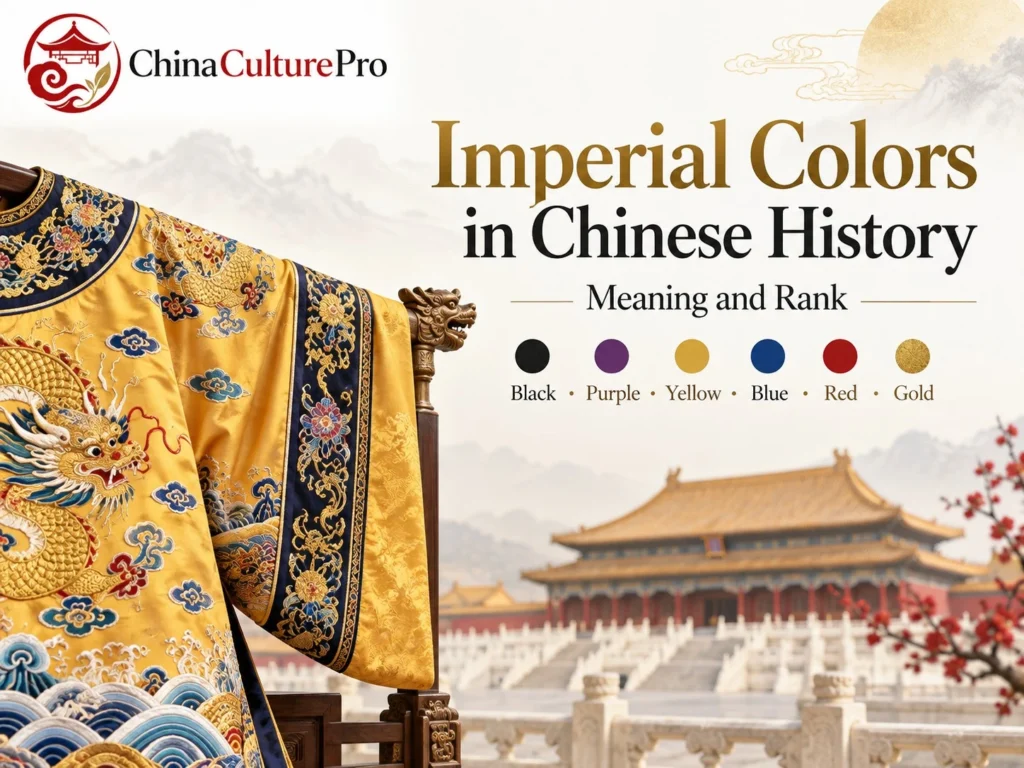

Quick Answer: What Were the Imperial Colors in Chinese History?
China did not have one permanent imperial color. A hue gained meaning through its dynasty, rank, garment, motif, material, and ritual occasion.
- Qin political color: The Qin favored black under the Five Virtues Succession theory (五德终始, wǔdé zhōngshǐ), presenting the dynasty as ruling through Water.
- Tang and Song rank colors: The rank-color dress system (品色服, pǐnsèfú) used purple, scarlet, green, and qing to distinguish officials; purple marked high office, not the emperor alone.
- Ming and Qing yellow: Yellow became increasingly restricted; Qing bright yellow (明黄, mínghuáng) marked the highest court rank.
- Ritual colors: A Qing emperor’s court robe (朝服, cháofú) could be blue, red, or bluish white (月白, yuèbái) for particular sacrifices rather than yellow.
- Garment and motif: An auspicious robe (吉服, jífú) or dragon robe (龙袍, lóngpáo) must be read through its cut, motifs, wearer, and occasion.
Yellow was the strongest late-imperial marker, especially under the Qing, but it was never a timeless code for every dynasty or court object.
The familiar picture of a Chinese emperor in a bright yellow robe is historically real, but it belongs mainly to the highly regulated court culture of the Ming and Qing dynasties. Projecting that image backward across all of Chinese history obscures Qin political cosmology, Tang and Song official rank colors, Qing sacrificial dress, and the functional color system of palace architecture.
Imperial color is best understood as a set of rules rather than a single swatch. This guide explains how dynastic legitimacy, bureaucratic rank, ceremonial function, garment structure, motifs, and building use combined to create status. It also shows why a museum label or documented provenance matters more than a modern color name. That distinction helps readers evaluate court portraits, museum textiles, palace roofs, antiques, reproductions, and modern designs without projecting one late-imperial rule onto every object.
What “Imperial Color” Actually Meant in China
“Imperial color” is a useful modern English phrase, not one unified category used consistently in premodern China. Historical sources instead describe different systems that sometimes overlapped. A court could favor one color in political theory, assign several others to official ranks, and require the ruler to change dress for a particular sacrifice.
Three Systems: Dynastic Legitimacy, Court Rank and Ritual Use
| System | What color communicated | Representative case | Interpretive limit |
|---|---|---|---|
| Dynastic legitimacy | A claim about cosmic succession and political authority | Qin preference for black under Water Virtue | Does not make every black object imperial |
| Court rank | An official’s bureaucratic grade or a member of the ruling house | Tang and Song purple, scarlet, green, and qing robes | A high-ranking color is not necessarily an emperor’s color |
| Ritual function | The ceremony, deity, season, or cosmic relationship being honored | Qing blue for Heaven, red for the Sun, and bluish white for the Moon | A non-yellow imperial robe is not an exception caused by error or personal taste |
These systems answer different questions. Dynastic color asks how a regime represented its right to rule. Rank color asks who could wear a regulated garment. Ritual color asks what the wearer was doing. Combining them into a one-color timeline produces misleading claims such as “black was the emperor’s color in every Qin context” or “purple was China’s royal purple.”
Why Color Alone Cannot Identify an Emperor
Color was only one coordinate in a larger court code. To identify imperial status, historians and curators also examine the date, garment category, cut, number and placement of motifs, textile, accessories, inscription, provenance, and occasion. A similar yellow could appear on different members of the imperial house, while one emperor could own robes in several regulated colors.
Dragon imagery also requires caution. Five-clawed dragons are closely associated with the highest rank, but authorized grants, later alterations, theatrical clothing, export objects, and uncertain museum attributions can complicate a visual judgment. The Twelve Symbols (十二章, shí’èr zhāng)—including the sun, moon, stars, mountain, dragon, and other emblems—can provide stronger evidence when they appear in a documented imperial dress context. Even then, the complete object and its provenance should control the conclusion.
How Imperial Colors Changed Across Chinese Dynasties
Chinese court color developed through changing political ideas and dress regulations. The broad movement was not a clean sequence in which one dynasty simply replaced one official hue with another. Several color systems could operate at the same time, and rules recorded in texts did not always describe every surviving object or every moment of practice. This layered view explains why a portrait, legal text, excavated textile, and later reproduction from the same dynasty may present different colors without any one of them automatically disproving the others.
| Period | Important color pattern | Main function | What not to assume |
|---|---|---|---|
| Pre-Qin and Qin | Qin preference for black | Dynastic legitimacy and state ceremony | All pre-Qin courts shared one imperial color |
| Han to Sui | Changing cosmological and ceremonial schemes | Ritual order, political theory, and developing dress codes | One stable color ruled the entire period |
| Tang and Song | Purple, scarlet, green, and qing arranged by rank | Bureaucratic identification | Purple was reserved for the monarch |
| Ming | Stronger royal association and restrictions around yellow | Centralized court hierarchy | Every yellow object was imperial |
| Qing | Bright yellow at the top, with other yellows and ritual colors regulated by identity and use | Integrated hierarchy and ceremony | The emperor always wore yellow |
Qin Black and the Five Virtues Theory
After unifying China in 221 BCE, the Qin state associated its rule with Water in a political theory of dynastic succession. Because Water was linked with black in the relevant correspondence system, court clothing, banners, tallies, and related state display favored black. The Records of the Grand Historian preserves the concise statement that clothing, banners, tallies, and flags “all honored black.”[1]
Black therefore communicated Qin legitimacy in an official political setting. It did not become the sole meaning of black throughout Chinese culture, and it was not simply the emperor’s private fashion preference. Later regimes continued to debate and reuse phase-based legitimacy theories, so it is safer to say that Qin made black a conspicuous state color than that black’s imperial meaning vanished completely the moment the dynasty fell. For black’s wider meanings in cosmology, ink art, and modern language, see black in Chinese culture.
Tang and Song Rank Colors: Purple, Scarlet, Green and Qing
Tang regulations turned color into a readable bureaucratic hierarchy. Rules changed during the dynasty, but the mature pattern placed purple at the top, followed by scarlet, green, and qing for lower grades, with shade and belt material adding further distinctions. One Tang formulation assigns purple to third rank and above, scarlet to the next grades, green to sixth and seventh ranks, and qing to eighth and ninth.[2]
Song official dress broadly inherited the same descending sequence, although terminology, garment type, grants of higher color, and detailed rank boundaries changed. The History of Song records purple for third rank and above, scarlet for fifth and above, green for seventh and above, and qing for ninth and above.[3]
This was a system for officials, not a Chinese version of Western “royal purple.” Purple could signal senior office or an imperial grant to an official, but it was not reserved for the sovereign. The historical range of qing (青, qīng) also resists a single English color label; depending on material and period, it can overlap with blue-green or darker tones. The separate guide to purple in Chinese culture explains how its rank meaning differs from its astronomical and literary associations.
How Yellow Became the Strongest Imperial Marker
Yellow’s rise was gradual. In the classical Chinese color system, yellow was associated with Earth and the center; that cosmological position did not automatically make every yellow surface royal. Court preference and legal restriction accumulated over later dynasties, with stronger associations under the Tang and Song and more systematic controls under the Ming.
The Qing court then made particular yellows highly legible within an elaborate hierarchy of garments, people, motifs, and ceremonies. This late imperial system produced the image now treated as timeless: bright yellow silk, gold-thread dragons, and court regalia. The result was powerful but historically specific. The development is examined in more detail in the guide to yellow in Chinese culture.
Imperial Yellow in the Qing Court
Qing dress regulation was especially detailed, but it should not be reduced to a paint chart. Court dress included formal ceremonial clothing, auspicious or festival dress, regular dress, travel dress, military dress, rainwear, and informal clothing. Color rules changed with garment category, sex, rank, occasion, and sometimes reign period. Museum objects also show the difference between a written norm and an actual textile.
Bright Yellow, Apricot Yellow and Golden Yellow
In Qing men’s auspicious dress, bright yellow stood at the summit; apricot yellow (杏黄, xìnghuáng) and golden yellow (金黄, jīnhuáng) marked lower positions within the imperial house. A useful simplified hierarchy for male festival robes is emperor in bright yellow, crown prince in apricot yellow, and imperial princes in golden yellow, while princes and officials below used other regulated grounds such as blue or dark blue. Women’s court dress had its own rules, and bright yellow was also available to the empress dowager and empress—not to the emperor alone.[4]
This is why a universal table assigning every yellow shade to one person is unreliable. A shade’s meaning must be tied to a named garment and regulation. “Apricot yellow” on a prince’s auspicious robe does not automatically describe every ceremonial robe worn by every consort, and an aged textile may no longer match its original color. These historical terms also do not correspond to fixed HEX or RGB values.
Why a Dragon Robe Is More Than Its Ground Color
The English phrase “dragon robe” often hides several Chinese garment categories. For Qing auspicious dress, documented imperial dragon robes combine a regulated ground color with a particular cut, dragon program, border scheme, and, for the emperor, the Twelve Symbols. A late eighteenth-century yellow festival robe in the Metropolitan Museum of Art is made of silk with metallic-thread embroidery; its museum classification and provenance matter as much as its visible yellow ground.[7]
The distinction between a dragon and a four-clawed mang motif is important in formal rules, but visual shortcuts still fail. Dragons may be partly hidden by folds, claws can be altered, and an object may have been granted, remade, or misidentified. A documented Qing robe should therefore be read through five fields: exact garment name, wearer, ground color, motif program, and occasion. Color is evidence, not a verdict.
Why the Emperor Also Wore Blue, Red and Bluish White
Qing imperial court dress changed color for major sacrifices. Blue was prescribed for sacrifices to Heaven and prayers for grain or rain; red for the morning rite to the Sun; and bluish white (月白, yuèbái) for the evening rite to the Moon. Bright yellow served major court occasions such as New Year, the emperor’s birthday, the winter solstice, and ancestral-temple rites.[5]
| Robe color | Qing ceremonial use | Interpretive point |
|---|---|---|
| Blue | Sacrifices to Heaven; prayers for grain or rain | Ritual relationship to Heaven took priority over the usual yellow ground |
| Red | Rite to the Sun | This is ceremonial correspondence, not the folk meaning of festive red |
| Bluish white | Rite to the Moon | Yuèbái is a pale blue range, not modern pure white |
| Bright yellow | Major court and ancestral ceremonies | The dominant high-rank color still had bounded uses |
A surviving Qianlong-period bluish-white court robe has five-clawed dragons, the Twelve Symbols, yellow cords, and a palace label identifying the emperor. Its complete design shows why a pale-blue ground did not lower its rank.[5] The wider distinction between ancient blue terms and modern blue is covered in blue in Chinese culture.
Imperial Colors in Palace Architecture
Court architecture made rank visible at a much larger scale, but building color also responded to function and cosmological association. Roof tiles, walls, columns, decorative painting, and gilded fittings performed different jobs. A roof color should therefore be read with the building’s purpose and construction history.
Yellow Roofs and Red Walls in the Forbidden City
The Forbidden City’s major halls are strongly identified with yellow glazed roofs and vermilion-painted structural surfaces. Yellow roofs signaled the highest architectural status in the Ming-Qing court system, while vermilion created a formal, durable, and visually unified palace setting. The two colors did not mean the same thing.
Palace vermilion should not be explained simply as Lunar New Year luck. In architecture, material, construction practice, state dignity, and hierarchy are the primary context. Likewise, not every building inside the palace compound used the same roof color. The function of the hall could override the expected red-and-yellow image. For the separate folk, textual, and artistic meanings of red, see red in Chinese culture.
Blue, Green and Black Roofs as Ritual and Functional Exceptions
- Blue: The principal buildings of the Temple of Heaven use blue glazed tiles to connect the sacrificial complex with Heaven. Blue here is a ritual architectural choice, not a general imperial rank color.[6]
- Green: Wenhua Hall had green glazed tiles when it was associated with the crown prince. In 1536, after its function shifted to an emperor’s auxiliary hall, its roof was changed to yellow—a rare case where a functional change is visible in the color history of one building.[6]
- Black: Wenyuan Pavilion, built to house the Siku Quanshu, used a black glazed roof with green elements. The color drew on the association between black, Water, and protection from fire, matching a library’s practical vulnerability.[6]
These roofs are not random exceptions. They show that architectural color balanced hierarchy with ritual object, direction, building use, and protective symbolism. Green roofs could also mark princely architecture below the emperor’s yellow-roofed halls.
Why Gold and Vermilion Were Not Simply “Imperial Colors”
Yellow, gold, and vermilion can appear together, but they belong to different categories. Yellow is a hue whose court meaning came from regulation. Gold may be a metal, metal thread, gilding, leaf, powder, or imitation surface; its status depends on material value and craft. Vermilion is a red pigment and architectural color with ritual and technological histories beyond the palace.
| Term | Primary category | Court role | Common error |
|---|---|---|---|
| Yellow | Regulated hue | Ground color linked to rank, especially under the Qing | Treating all yellow objects as imperial |
| Gold | Material or surface technique | Added cost, brilliance, and status through metal, thread, or gilding | Equating a gold-looking surface with yellow rank color |
| Vermilion | Pigment and architectural finish | Formal red on palace structures and selected ritual objects | Explaining palace red only through festival luck |
A gilded object can be non-imperial, and a regulated yellow robe can gain much of its brilliance from metal thread. The material history of gold in Chinese culture is therefore distinct from the institutional history of yellow.
How to Identify Imperial Status from Color, Motif and Context
Use this sequence when reading a robe, porcelain vessel, painted image, or palace building:
- Confirm the period: Do not apply Qing yellow rules to Qin, Tang, Song, or an undated reproduction.
- Identify the medium: A robe, roof tile, porcelain glaze, lacquer surface, and painted portrait followed different conventions.
- Read the exact color term: Distinguish bright yellow, apricot yellow, and golden yellow; qing from modern blue or green; and vermilion from generic red.
- Check form and motifs: For clothing, examine garment category, cut, dragon or mang claws, Twelve Symbols, borders, belt, and accessories. For buildings, examine roof form, tile color, axis, and function.
- Verify occasion and provenance: Use inscriptions, palace records, excavation context, and the museum’s current object identification. Treat an unsupported marketplace label as marketing, not evidence.
When those fields are missing, the responsible description is usually “court-style,” “decorative,” or simply the visible material and color. Imperial status should be demonstrated, not inferred from a dramatic hue.
Common Misreadings of Chinese Imperial Colors
- Timeless yellow: Yellow’s strongest exclusive force belongs to late imperial regulation, especially the Qing; earlier practice was less uniform.
- One color per dynasty: Dynastic legitimacy, official rank, and ritual dress were separate systems that could operate together.
- Every yellow dragon robe was imperial: Identify the garment, shade, motifs, wearer, occasion, and provenance before assigning rank.
- Chinese “royal purple”: In Tang and Song rank dress, purple primarily marked senior officials rather than the monarch alone.
- Gold equals yellow: Gold describes a material or surface effect; yellow is a color category regulated in specific settings.
- Festival-red palace walls: Palace vermilion belongs first to architecture, craft, and formal court order—not New Year symbolism.
- Only yellow royal roofs: Blue, green, and black roofs could express sacrifice, princely status, education, storage, or fire-protection symbolism.
- Personal luck: Historical court colors encoded institutions and ceremonies; they are not a system for changing health, wealth, or destiny.
FAQs About Imperial Colors in Chinese History and Culture
What Was the Main Color of the Qing Emperor?
Bright yellow was the Qing emperor’s principal high-rank color for many court and ancestral occasions. It was not his only formal color: blue, red, and bluish white were required for specified sacrifices. Bright yellow was also permitted in the highest-ranking women’s court dress, including that of the empress dowager and empress.
Was Yellow Always Reserved for Chinese Emperors?
No. Yellow’s association with the political center is ancient, but increasingly restrictive royal use developed over time. The familiar exclusive-looking system is chiefly a Ming-Qing, and especially Qing, institution—not a rule that can be applied unchanged to every dynasty.
Why Did the Qin Dynasty Favor Black?
The Qin linked its rule with Water in the Five Virtues Succession theory. Because black corresponded to Water, state clothing, banners, tallies, and other official display favored black as a claim of dynastic legitimacy.
Did Purple Mean Royalty in Imperial China?
Not in the broad Western sense of “royal purple.” Tang and Song dress codes used purple mainly for the highest officials and for special grants. Other Chinese associations of purple—such as the Purple Forbidden Enclosure in astronomy—belong to different systems.
Why Did Imperial Buildings Use Different Roof Colors?
Roof color balanced rank with purpose. Yellow marked the highest palace architecture, blue suited sacrifices to Heaven, green could mark princely or educational spaces, and black could invoke Water in a library’s fire-protection symbolism. Function could therefore qualify hierarchy.
Sources
[1] Sima Qian. Records of the Grand Historian: Basic Annals of the First Emperor of Qin
[2] Liu Xu et al. Old Book of Tang: Treatise on Carriages and Dress
[3] Toqto’a et al. History of Song, Volume 152
[4] Palace Museum. The Qing Court Dress System and Its Cultural Meaning
[5] Palace Museum. Bluish-White Kesi Imperial Court Robe with Cloud-and-Dragon Design
[6] Palace Museum. The Colors of Roofs in the Forbidden City
[7] Metropolitan Museum of Art. Festival Robe, Qing Dynasty