
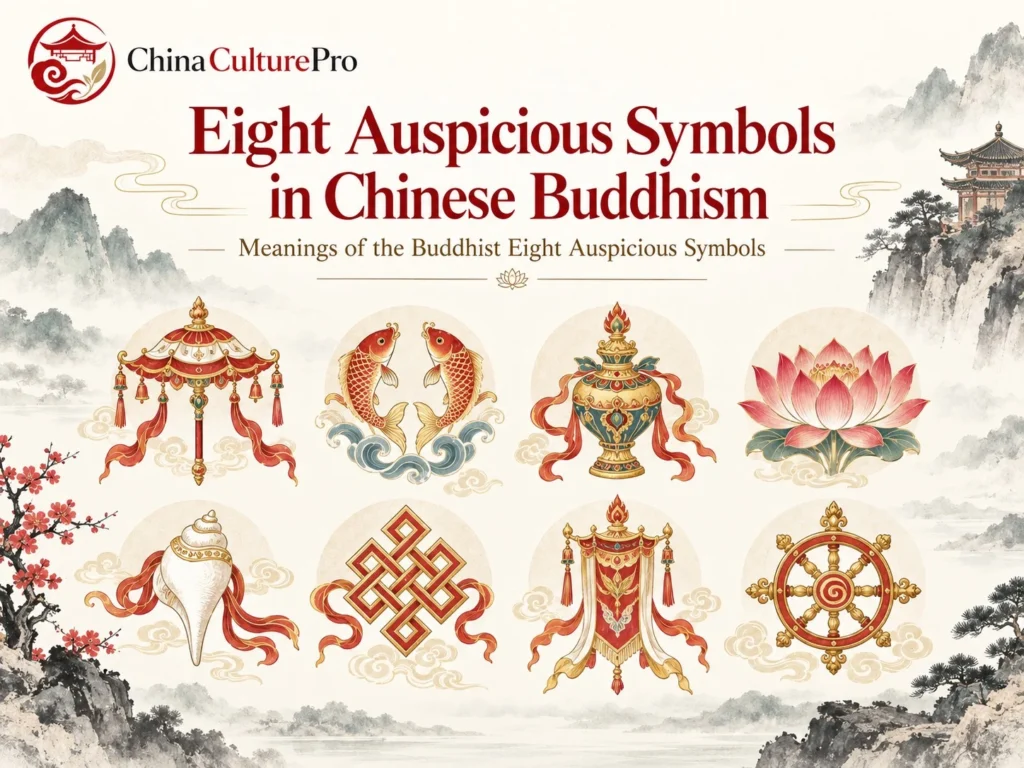

Quick Answer: What Are the Eight Auspicious Symbols in Chinese Buddhism?
The Eight Auspicious Symbols, or Ashtamangala (八吉祥, bā jíxiáng), are Buddhist emblems of the Dharma, awakening, protection, and spiritual well-being. Chinese sources also call them the Eight Auspicious Marks (八吉祥相, bā jíxiáng xiàng).
- Origins: Buddhism reinterpreted older Indian auspicious and royal emblems through its teachings.
- Tibetan convention: Its common list includes the victory banner (胜利幢, shènglì chuáng).[4][5]
- Qing court convention: Museum objects document a white canopy (白盖, báigài) instead of the banner; the other seven members match.[1][2][3]
- Context: The set appears in Tibetan religious art and Chinese court objects influenced by Tibetan Buddhism.
The emblems are not a Chinese numerology code or a guarantee of wealth, health, protection, or changed fate.
An isolated floral, animal, vessel, or knot motif can be misread because each also appears in secular Chinese art. Identify the composition, medium, date, companions, and religious setting before assigning a meaning. This method applies across Chinese symbols and meanings.
The set is especially important in Tibetan Buddhist art and Chinese objects shaped by Tibetan Buddhist patronage. “Chinese Buddhist symbols” does not mean every Chinese school, temple, or period used one identical list.
Which Eight Symbols Are Included?
The Common Tibetan Buddhist List
The widely recognized Tibetan convention contains the eight emblems shown in the comparison table below. Their order varies across mandalas, temples, ritual objects, and reference works.[4][5]
The Qing Court List in Chinese Art
Qing court art often uses a closely related grouping. A Yongzheng-reign enamel object and a Qing imperial seal casket both carry the court convention shown below.[1][2]
The table compares the two conventions. Its order is for reference, not a claim about a mandatory ritual sequence.
| Symbol, Chinese, and pinyin | Common Tibetan list | Qing court list | Core Buddhist association |
|---|---|---|---|
| Dharma wheel (法轮, fǎlún) | Yes | Yes | Dharma and the path to awakening |
| White conch (法螺, fǎluó) | Yes | Yes | The far-reaching sound of Buddhist teaching |
| Precious parasol (宝伞, bǎosǎn) | Yes | Yes | Protection and spiritual dignity |
| Victory banner (胜利幢, shènglì chuáng) | Yes | No | Victory of the Dharma over ignorance and obstacles |
| White or celestial canopy (白盖, báigài; 天盖, tiāngài) | No | Yes | Shelter, honor, and sacred dignity |
| Lotus (莲花, liánhuā) | Yes | Yes | Purity and awakening |
| Treasure vase (宝瓶, bǎopíng) | Yes | Yes | Inexhaustible merit and beneficial qualities |
| Pair of golden fish (双金鱼, shuāng jīnyú) | Yes | Yes | Fearless freedom in the ocean of suffering |
| Endless knot (盘长, páncháng) | Yes | Yes | Continuity and the union of wisdom and compassion |
Why Names and Order Vary
As Buddhist imagery moved across Asia, names, sequences, and artistic forms changed. Court workshops also standardized motifs for particular objects. The evidence shows different conventions; it does not prove that one authority replaced the banner with the canopy in a single historical event.
A Yuan-dynasty silver cup stand even uses seven Buddhist treasures and places paired rhinoceros horns where its catalog expects the eighth emblem, showing that variation existed in Chinese art before Qing standardization.[7]
The two lists produce nine distinct names because one position differs, not because a “Nine Auspicious Symbols” set exists. Name the tradition or object instead of forcing every source into one order.
This flexibility is why museum catalogues are often more reliable than generic symbol charts when identifying a damaged or unfamiliar object.
Where Did the Eight Auspicious Symbols Come From?
Indian Emblems and Buddhist Adaptation
Ashtamangala is Sanskrit for a group of eight auspicious emblems. Such sets existed in several Indian religious and ceremonial traditions, with different members. Buddhism adopted a prominent group and connected it with the Buddha, Dharma, freedom from suffering, and awakening.[4]
Devotional accounts may describe the emblems as offerings after the Buddha’s enlightenment; this is religious tradition, not securely dated event history. The set predates its Chinese use and did not originate from the modern eight–prosperity wordplay.
Tibetan Buddhism and Chinese Court Art
Tibetan Buddhism gave the emblems a visible role in mandalas, temples, ritual art, and textiles. Through Tibetan Buddhist interaction with Chinese rulers and workshops, they entered Chinese imperial and decorative arts.
Chinese objects carried the Buddhist emblem group before the height of Qing patronage, but Qing production made it especially prominent. Enamel, jade, porcelain, textile, and ceremonial objects kept recognizable Buddhist emblems within imperial design.[1][2][3] Court use should not be projected onto every household or Buddhist school.
What Does Each Auspicious Symbol Mean?
The Dharma Wheel
The Dharma wheel often rests on a lotus support. Its movement represents the continuing activity of Buddhist teaching. Eight spokes commonly correspond to the Noble Eightfold Path: right view, intention, speech, action, livelihood, effort, mindfulness, and concentration.[5][6]
Spoke count varies, so identify the wheel through its setting. A cartwheel, solar disk, or circular border is not automatically a Dharma wheel.
The White Conch
The white conch represents the far-reaching sound of the Dharma calling beings out of ignorance. Tibetan explanations value a shell spiraling clockwise or to the right.[5]
It may be jeweled, ribboned, or set on a lotus. Stylization can obscure direction. A seashell needs Buddhist companions or context before it can be identified as a ritual conch.
The Precious Parasol
The precious parasol evokes protection, honor, and elevated status. It represents the shelter Buddhist teaching offers from suffering and mental obstacles.[5]
It may have a domed top, hanging fabric, jewels, or ribbons. Its ceremonial meaning differs from an everyday umbrella and from the canopy listed separately in Qing court art.
The Lotus
The lotus rises from muddy water, making it an image of purity and awakening. Lotus seats also mark the sacred status of Buddhas and bodhisattvas.[5][6]
This is only one part of lotus symbolism in Chinese culture. Scholar paintings, ponds, and fish rebuses may be ethical, poetic, or secular. Deities, lotus thrones, altars, or the full set strengthen a Buddhist reading.
The Treasure Vase
The treasure vase suggests inexhaustible merit, wisdom, beneficial conditions, and qualities of the Dharma. It may also evoke longevity and well-being.[5][6]
It is often a rounded, lidded vessel with jewels or ribbons. This differs from the secular Chinese pun linking vase, 瓶, with peace, 平.
The Pair of Golden Fish
The paired fish move freely through water, symbolizing fearlessness and liberation within the “ocean” of cyclic suffering—not merely wealth, fertility, or romance.[5][6]
“Golden fish” is the emblem’s name, not a required species or color. Chinese fish may also convey surplus or family wishes, so the paired arrangement and Buddhist companions matter.
The Endless Knot
The endless knot is an interlaced design without an obvious beginning or end. It expresses continuity, interdependence, and the union of wisdom and compassion.[4][5]
“Eternal love” is a modern reduction, not its full Buddhist meaning. The emblem may be painted, woven, cast, or knotted, but not every decorative cord knot is this design.
Victory Banner and Canopy: The Main List Difference
The victory banner represents the triumph of Buddhist teaching and knowledge over ignorance, spiritual obstacles, and the forces that obstruct awakening. Its victory is doctrinal, not an endorsement of military conquest.[5][6]
The white or celestial canopy in the Qing court list is an overhead emblem of shelter, honor, and sacred dignity. Museum descriptions of Chinese court objects list the canopy separately from the precious parasol, even though the two can look similar in highly stylized decoration.[1][2][3]
These are best treated as different members used by different listing conventions. “Victory banner,” “parasol,” and “canopy” should not be presented as three English translations of one object.
How Do the Symbols Appear in Chinese Buddhist Art?
The eight emblems do not require one composition. Their layout depends on the object and the visual space available.
- Devotional and ritual art: Mandalas, temple walls, offering objects, and ritual implements may display the full group in a clearly Buddhist setting.
- Court objects: Enamel, porcelain, jade, metalwork, and textiles may place each emblem on a lotus support or among scrolling flowers, clouds, ribbons, and imperial motifs.[1][2][3]
- Composite designs: The emblems may appear in a row, around a circular field, in paired panels, or as interwoven forms. Order alone is not a reliable identifier.
- Modern decoration: Jewelry, prints, furnishings, and souvenirs may borrow one or more emblems while reducing their devotional role.
A single vase, lotus, shell, fish, wheel, or knot is insufficient evidence for the complete set. Count the motifs, check whether they repeat as a coordinated group, and read the object’s date, function, and surrounding imagery.
On court objects, the emblems often rest on individual lotus flowers or appear in matching cartouches around a vessel. Damage, cropping, or an incomplete view may hide one member, so museum cataloging and views from several angles can be more reliable than visual counting alone.
Eight Auspicious Symbols vs. Similar Chinese Symbol Sets
Buddhist Eight Treasures vs. Generic Eight Treasures
The Buddhist Eight Treasures (佛教八宝, Fójiào bābǎo) is a Chinese label commonly used for the Eight Auspicious Symbols. The broader term Eight Treasures (八宝, bābǎo), however, can name other decorative groups. One Chinese object catalogued by the British Museum carries both the Buddhist emblems and a separate set of secular “Eight Precious Things,” showing that the categories could coexist rather than mean the same thing.[3]
The number eight alone never proves Buddhist identity. The actual objects shown are the decisive evidence.
Buddhist Emblems vs. the Hidden Eight Immortals
The Hidden Eight Immortals (暗八仙, àn bāxiān) are the attributes associated with the Eight Immortals of Daoist and popular tradition. They identify figures through objects such as a fan, sword, flute, flower basket, or lotus. Although English descriptions may call both groups “Eight Treasures,” the Hidden Eight Immortals and Buddhist Ashtamangala belong to different religious and artistic systems.
The Endless Knot vs. Chinese Knotwork
Chinese knotwork (中国结, zhōngguó jié) is a broad craft category containing many structures and decorative forms. The endless knot is one specific Buddhist emblem that can be rendered through knotwork or imitated as a flat pattern. It is therefore incorrect to label every red Chinese knot as the Buddhist endless knot.
Other major Buddhist signs—including the swastika, 卍, vajra, stupa, and Bodhi tree—are also separate from the standard group of eight.
How Should You Interpret or Use the Symbols Today?
- Identify the set before the meaning: Look for a coordinated group, then verify the object, period, and religious setting.
- Name the tradition: Use “common Tibetan Buddhist list” or “Qing court list” when the difference affects the explanation.
- Respect devotional contexts: Decorative use is possible, but religious objects should not be reduced to promises of money, health, romance, or luck.
- Check permanent designs carefully: For tattoos, jewelry, logos, or architectural work, verify orientation, missing lines, and whether the chosen emblem carries the intended meaning.
There is no universally documented feng shui direction, color, number, or placement that activates the set. A modern owner may value the symbols as religious reminders, cultural art, or personal inspiration without claiming measurable supernatural effects.
Common Misreadings of the Eight Auspicious Symbols
| Common claim | More accurate interpretation |
|---|---|
| The set was created because eight means wealth in Chinese. | The symbols developed from Indian auspicious traditions and entered China through Buddhism. |
| Every Buddhist tradition uses the same list and order. | Lists and sequences vary; Tibetan and Qing court conventions are a clear example. |
| Parasol, canopy, and victory banner are three translations of one symbol. | They are distinct emblems, although stylized parasols and canopies may look similar. |
| The paired fish primarily promise money, children, or marriage. | Within the Buddhist set, they primarily express fearless freedom from suffering. |
| Every lotus in Chinese art means Buddhist enlightenment. | Lotus imagery also belongs to poetry, literati ethics, seasonal art, and secular rebuses. |
| Every Chinese knot is an endless knot. | Chinese knotwork is a broad craft; the endless knot is one specific Buddhist design. |
| The swastika or vajra is one of the standard eight. | Both are important Buddhist symbols, but neither belongs to this standard group. |
| “Eight Treasures” always means the Buddhist set. | Chinese decorative art uses the term for several different groups. |
| Displaying the symbols guarantees luck or protection. | They express teachings and auspicious wishes, not verifiable control over events. |
FAQs About the Eight Auspicious Symbols
Are the Eight Auspicious Symbols Chinese or Tibetan?
Neither label tells the whole story. The emblems have Indian roots, became especially systematic and visible in Tibetan Buddhism, and were then incorporated into Chinese Buddhist and imperial art. A Chinese Qing object and a Tibetan mandala may therefore use related but not identical lists.
Why Do Some Lists Include a Victory Banner and Others a Canopy?
The common Tibetan list includes the victory banner, while Qing court objects catalogued by major museums commonly include a canopy alongside the parasol. Surviving sources demonstrate different conventions, but they do not establish one universally documented moment when one emblem officially replaced the other.
Are the Eight Auspicious Symbols the Same as the Buddhist Eight Treasures?
Often, yes: Buddhist Eight Treasures is a common Chinese art-historical label for the set. The shorter term Eight Treasures is less precise because it can also identify secular or Daoist-related groups. The motifs themselves must confirm which set is present.
Is the Endless Knot the Same as a Chinese Knot?
No. The endless knot is one defined Buddhist emblem. Chinese knotwork is a larger craft tradition with many named structures and uses. An endless knot can be produced through knotwork, but most Chinese knots are not the Buddhist emblem.
Do the Eight Symbols Bring Good Luck?
They can express auspicious wishes and remind practitioners of Buddhist teachings. That cultural and religious value is real, but there is no evidence that displaying the motifs guarantees wealth, health, protection, or a change in fate.
Sources
[1] Palace Museum. Painted Enamel Dharma Wheel with Eight Auspicious Symbols, Yongzheng Reign
[2] The Metropolitan Museum of Art. Seal Casket with Cover
[3] British Museum. Abacus Decorated with the Eight Treasures of Buddhism and the Eight Precious Things
[4] Robert Beer. The Handbook of Tibetan Buddhist Symbols
[5] Foundation for the Preservation of the Mahayana Tradition. The Eight Auspicious Signs
[6] Salisbury University. The Eight Auspicious Symbols
[7] The Metropolitan Museum of Art. Cup Stand with Eight Treasures