

Quick Answer: What Are the Three Abundances in Chinese Culture?
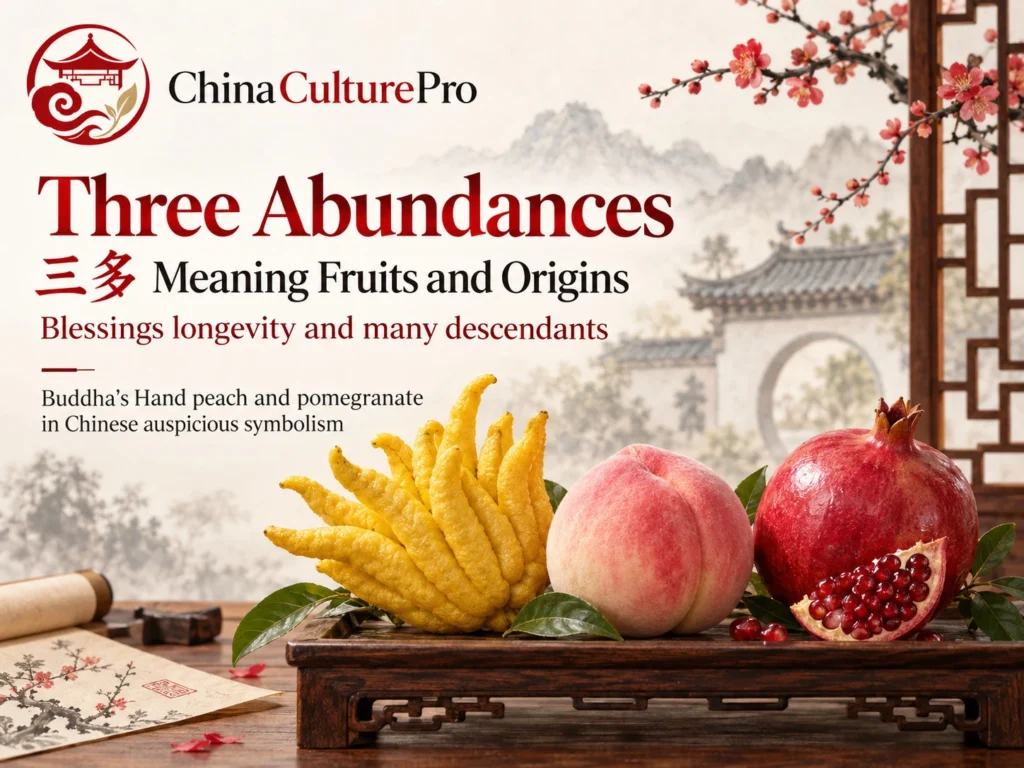
The Three Abundances (三多, sān duō), also called the Three Plenties, are a Chinese auspicious motif expressing three wishes: abundant blessings, longevity and many descendants. In the best-known Qing form, Buddha’s Hand citron, peach and pomegranate carry those meanings.
- Standard fruit trio: Buddha’s Hand citron (佛手, fóshǒu), peach (桃, táo) and pomegranate (石榴, shíliu).
- Three wishes: abundant blessings, long life and family continuity.
- Historical context: the idea is related to three wishes recorded in the Zhuangzi, but that text does not describe the fruit motif.
- Typical settings: ceramics, textiles, hardstone carvings, furniture and architectural decoration.
- Important distinction: the Three Abundances are not the Five Blessings (五福, wǔfú) or Fu Lu Shou (福禄寿, fú lù shòu).
These meanings are cultural wishes, not promises of wealth, lifespan or children. One fruit by itself usually represents only its own theme, not the complete Three Abundances.
Chinese auspicious art often communicates through combinations rather than through a single universal symbol. The Three Abundances motif (三多纹, sānduōwén) is a clear example: three fruits work together to express blessings, longevity and descendants. Western museum catalogues also call it the Three Plenties.
The familiar Qing arrangement uses Buddha’s Hand citron, peach and pomegranate, but the system is older and more flexible than a fixed fruit chart. Its ideas connect to a classical account of three human wishes, while its visual form developed through later decorative practice. Reading it accurately therefore requires attention to the whole composition, its date and the object on which it appears.
What Do the Three Abundances Actually Mean?
The motif brings together three distinct wishes. “Abundance” refers to having more of each valued condition, not simply to money or material excess.
| Traditional expression | Useful English rendering | Core idea | Interpretive limit |
|---|---|---|---|
| 多福, duō fú | Abundant blessings or good fortune | A life with ample well-being and favorable circumstances | Broader than wealth and more stable than a lucky accident |
| 多寿, duō shòu | Longevity or long life | Living a long and fulfilled life | A wish, not a promise of immortality or a predicted lifespan |
| 多子, duō zǐ | Many descendants or family continuity | Traditionally, numerous sons and continuation of the family line | Historically patriarchal language, not a modern expectation about reproduction |
The last wish needs particular context. In the social world that produced the motif, sons carried the family name and performed important lineage duties. Museum descriptions therefore often translate the phrase as “many sons.” For contemporary readers, “many descendants” or “family continuity” conveys the broader cultural theme without presenting an old family ideal as a present-day obligation.
Why Do Buddha’s Hand, Peach and Pomegranate Represent the Three Abundances?
The common fruit trio uses three different meaning-making mechanisms: wordplay, mythology and visible natural form. Palace Museum records identify Buddha’s Hand, peach and pomegranate as a standard Qing Three Abundances design.[1][2]
| Fruit | Wish | How the association works | Recognition clues |
|---|---|---|---|
| Buddha’s Hand citron (佛手, fóshǒu) | Abundant blessings | The first syllable of fóshǒu is associated by near-sound with fú, “blessing.” This is conventional rebus wordplay, not a strict Mandarin homophone. | A yellow or green citron divided into long, finger-like sections |
| Peach (桃, táo) | Longevity | Peaches became classic long-life emblems through traditions surrounding the immortality peaches of the Queen Mother of the West. | A rounded fruit with a pointed top and a lengthwise seam |
| Pomegranate (石榴, shíliu) | Many descendants | Its many seeds provide a direct visual analogy for numerous children and continuation of the family. | A crowned calyx and, when shown open, clusters of visible seeds |
The meanings belong to the recognized composition. A single peach can express longevity, and a single pomegranate can suggest fertility or descendants, but neither is automatically a complete Three Abundances design. The Philadelphia Museum of Art and the Metropolitan Museum of Art both preserve objects in which the three fruits appear together as a coordinated auspicious group.[5][6] For fuller background on each fruit, see our guides to Buddha’s Hand citron symbolism, peach symbolism and pomegranate symbolism.
Where Does the Three Abundances Idea Come From?
The Three Wishes in the Zhuangzi
A related three-part wish appears in the “Heaven and Earth” chapter of the Zhuangzi. The border warden of Hua offers Yao three wishes: long life, riches and many sons. Yao declines each one, and the ensuing exchange turns the familiar wishes into a philosophical discussion about desire, responsibility and good government.[3]
This passage is best treated as an intellectual antecedent, not an origin certificate for the decorative motif. It names no Buddha’s Hand, peach or pomegranate, and its tone is not a simple celebration of worldly abundance. Later culture retained the recognizable trio of desirable conditions while leaving behind much of the story’s questioning framework.
From a Classical Wish to a Decorative Fruit Motif
The transformation from verbal wishes to a fruit composition happened gradually through Chinese decorative art. There is no securely documented inventor or single date of creation. By the Ming and Qing periods, artists were using groups of auspicious fruits on ceramics, textiles and carvings, while the Qing trio of Buddha’s Hand, peach and pomegranate became especially familiar.
A Qianlong-period underglaze-red meiping in the Palace Museum shows flowering branches with the three standard fruits and explicitly links them to blessings, longevity and sons.[2] An eighteenth-century agate carving at the Metropolitan Museum groups the same fruits with lingzhi, adding another long-life association without changing the identity of the central trio.[6]
Are the Three Abundances Fruits Always the Same?
No. Buddha’s Hand, peach and pomegranate form the best-known Qing arrangement, but surviving objects document alternatives. A Wanli-period stem cup in the British Museum combines peach, persimmon and pomegranate; the museum identifies the three fruits with long life, happiness and children.[4]
| Documented version | Fruit group | Associated wishes | What it shows |
|---|---|---|---|
| Common Qing form | Buddha’s Hand, peach, pomegranate | Blessings, longevity, descendants | The standard combination in later decorative art |
| Wanli-period museum example | Peach, persimmon, pomegranate | Long life, happiness, children | The concept could be expressed through another recognized fruit set |
The stable feature is the three-part auspicious program, not an absolutely unchanging botanical list. Identification is strongest when all three fruits form a coherent, documented set or when a museum record confirms the subject. An unfamiliar trio should not be labeled Three Abundances solely because it contains three fruits.
How Does the Three Abundances Motif Appear in Chinese Art?
The Three Abundances can be painted, carved, embroidered or modeled in the round. It appears on imperial and non-imperial ceramics, hardstone and jade carvings, textiles, furniture and architectural decoration. A Qing skirt panel in the Asian Art Museum uses the three fruits on clothing, showing that the motif was not confined to vessels or tabletop objects.[7]
- Look for a coordinated trio: the fruits should read as one visual group rather than unrelated border ornaments.
- Check the date: Qing works are especially likely to use the familiar Buddha’s Hand, peach and pomegranate arrangement.
- Read companion motifs separately: bats, lingzhi, ruyi heads, peonies and longevity characters add meanings but are not part of the basic trio.
- Use object context: a birthday gift may emphasize longevity, while a family furnishing may bring descendants to the foreground.
Color alone is not decisive. The fruit can appear in underglaze red, enamel colors, monochrome carving or embroidered silk. Shape, grouping, inscription and museum provenance are more reliable than a modern color-symbolism chart.
Three Abundances vs. Five Blessings and Fu Lu Shou
Several Chinese blessing systems overlap in theme, but their lists and visual languages are not interchangeable.
| System | Core components | Typical visual form | Key distinction |
|---|---|---|---|
| Three Abundances (三多, sān duō) | Blessings, longevity, descendants | A three-fruit composition | Family continuity is a defining theme |
| Five Blessings (五福, wǔfú) | Longevity, wealth, health and peace, love of virtue, natural completion of life | Written text or five-bat imagery | A classical five-part model of a fulfilled life |
| Fu Lu Shou (福禄寿, fú lù shòu) | Blessing, official emolument or career prosperity, longevity | Three characters or three personified star gods | Includes rank and livelihood rather than descendants |
The Three Abundances and the Five Blessings both include long life and favorable circumstances, but the Five Blessings add physical well-being, moral conduct and a natural completion of life. Fu Lu Shou replaces the descendants theme with lu, historically associated with official salary and rank. Our guide to Chinese character symbols explains how written blessing systems differ from pictorial motifs.
How Should You Use or Interpret the Three Abundances Today?
The motif remains suitable for New Year decoration, birthday gifts, family celebrations and designs inspired by Chinese art. Context-sensitive use preserves its cultural meaning without treating it as a formula.
- Identify the full composition: verify the fruit forms and whether they create a recognized trio.
- Separate core and added meanings: distinguish the three fruits from bats, lingzhi, inscriptions or other companion motifs.
- Account for period and medium: a Ming cup, a Qing court vessel and a modern pendant may use related imagery differently.
- Explain descendants historically: acknowledge the traditional “many sons” wording while using inclusive language for modern audiences.
- Avoid claims of efficacy: the motif expresses wishes; it does not produce fertility, extend life or guarantee prosperity.
For tattoos, logos or highly simplified graphics, retain enough detail for the fruits to remain distinguishable. A generic three-fruit cluster may be aesthetically attractive but lose the specific Three Abundances reading.
Common Misreadings of the Three Abundances
| Common claim | More accurate interpretation |
|---|---|
| It means three kinds of wealth. | The three wishes concern blessings, longevity and descendants; money is not the organizing theme. |
| Any Buddha’s Hand, peach or pomegranate is the complete motif. | One fruit carries one main association. The Three Abundances require a recognized three-part composition. |
| The fruit list never changes. | The Qing trio is standard, but museum collections preserve historical variants. |
| The Zhuangzi invented the fruit design. | Its three-wish narrative is an antecedent; it contains no fruit motif. |
| It is another name for the Five Blessings. | The systems differ in source, number of elements and content. |
| It is the same as Fu Lu Shou. | Fu Lu Shou includes official livelihood or career prosperity, not descendants. |
| “Many sons” is a universal modern ideal. | It reflects historical lineage values and can be explained today as descendants or family continuity. |
| The motif can cause fertility, longevity or luck. | It communicates cultural wishes and has no verified supernatural effect. |
FAQs About the Three Abundances
What Are the Three Fruits in the Three Abundances?
The most familiar Qing combination is Buddha’s Hand citron, peach and pomegranate, representing abundant blessings, longevity and many descendants. Historical objects also document variants, so the trio is standard rather than absolutely universal.
Does the Three Abundances Motif Mean Wealth?
Not primarily. The visual motif centers on blessings, longevity and descendants. The related Zhuangzi narrative includes riches among its three wishes, but that does not make every later Three Abundances design a wealth symbol.
Is the Three Abundances Motif Buddhist?
No. It is a broadly used Chinese auspicious motif, not an exclusively Buddhist emblem. Buddha’s Hand is the name of a citron and may also appear in Buddhist settings, but the complete three-fruit system belongs to wider court and popular decorative culture.
Are the Three Abundances the Same as Fu Lu Shou?
No. The Three Abundances wish for blessings, longevity and descendants. Fu Lu Shou combines blessing, official emolument or career prosperity, and longevity. The two systems overlap in two themes but differ in their third component and usual visual form.
Sources
[1] The Palace Museum. Three Abundances Motif
[2] The Palace Museum. Underglaze-Red Meiping with Three-Fruit Design, Qianlong Period
[3] Chinese Text Project. Zhuangzi, “Heaven and Earth”
[4] The British Museum. Stem Cup with Three Abundances, Wanli Period
[5] Philadelphia Museum of Art. Dish with Design of the Three Plenties
[6] The Metropolitan Museum of Art. Group of the Three Fruits: Buddha’s-Hand Citron, Peach, and Pomegranate
[7] Asian Art Museum. Panels from a Lady’s Skirt