
Quick Answer: What Is Laba Festival 2027?
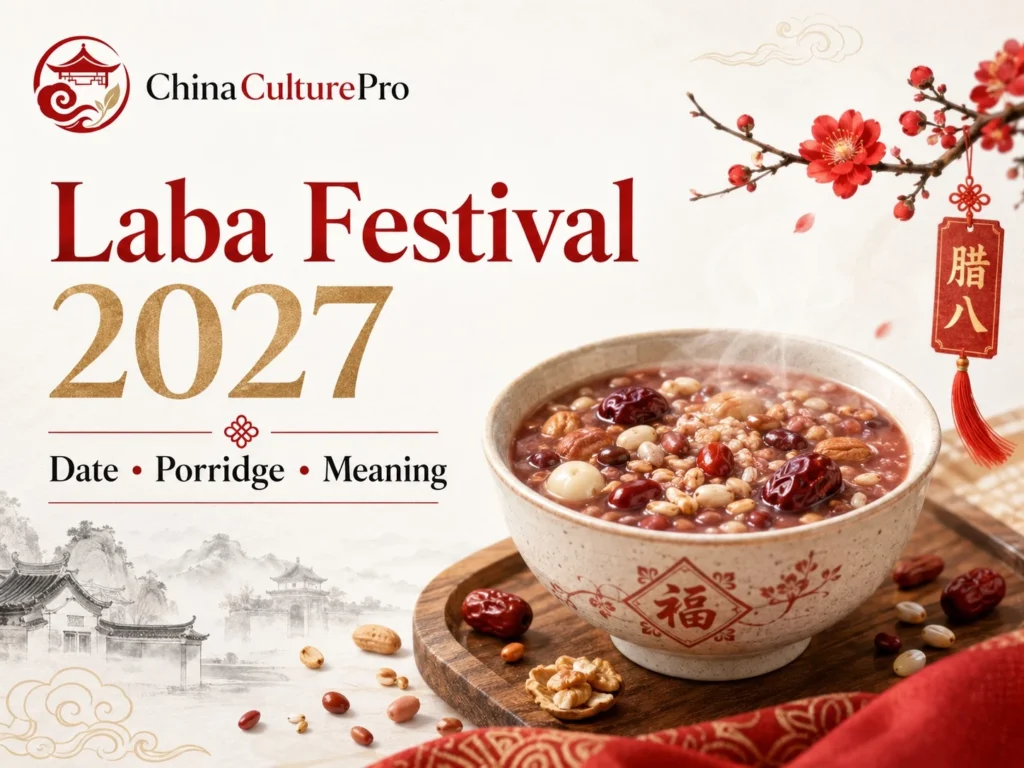
Laba Festival 2027 falls on Friday, January 15, 2027. It is celebrated on the 8th day of the 12th lunar month.
In Chinese, the festival is called Laba Jie (腊八节). “La” refers to the last lunar month of the old year, and “ba” means eight. In English, it is often called Laba Festival or Laba Rice Porridge Festival.
The main food is Laba porridge, also called Laba congee. It is made with mixed grains, beans, nuts, dried fruits, and other ingredients. Other customs include making Laba garlic, ancestor worship, prayers for the coming year, and temple porridge distribution.
The core meaning of Laba is year-end blessing, winter nourishment, Buddhist enlightenment memory, and the beginning of Chinese New Year preparation. A common saying explains its place clearly: “After Laba comes the New Year.”
| Item | Detail |
|---|---|
| 2027 Date | January 15, 2027 |
| Day of Week | Friday |
| Chinese Name | Laba Jie / 腊八节 |
| Also Called | Laba Rice Porridge Festival |
| Lunar Date | 8th day of the 12th lunar month |
| Main Food | Laba porridge / Laba congee |
| Other Customs | Laba garlic, ancestor worship, prayers, temple porridge |
| Main Meaning | Year-end blessing, winter nourishment, New Year preparation |
What Is Laba Festival?
Laba Festival is not just a day for eating porridge. It is one of the earliest signs that Chinese New Year is approaching.
Its position is special. Laba falls on the 8th day of the 12th lunar month, in the final month of the old lunar year. Chinese New Year has not arrived yet, but it is close. In many years, Laba comes roughly three weeks before New Year’s Eve.
In traditional rural life, this was the time when fieldwork slowed, stored grains were brought out, and households began turning their attention from daily work to New Year preparation. That is why people say, “After Laba comes the New Year.” The saying does not mean Spring Festival begins on Laba. It means the mood changes.
Laba porridge carries this shift. It gathers many separate ingredients into one warm pot. Grains, beans, nuts, and dried fruits lose their separate edges and become one shared taste. In that sense, Laba is a festival of gathering before the great New Year gathering.
The most moving part of Laba is not how complicated the porridge is. It is that, in the coldest part of the old year, scattered grains are simmered into one pot, and ordinary days begin to turn toward New Year preparation.
When Is Laba Festival? Date Rule and Upcoming Dates
Laba Festival is always celebrated on the 8th day of the 12th lunar month. Because it follows the Chinese lunar calendar, its Gregorian date changes every year.
It usually falls in January, though in some years it may fall in late December. It is not Chinese New Year Day, but it usually comes shortly before Chinese New Year and marks the start of the New Year preparation period in folk life.
Laba Festival is not a public holiday in Mainland China. People usually work or study as usual, though families, temples, schools, communities, and businesses may still observe the day.
| Gregorian Year | Laba Festival Date | Day of Week | Lunar Date |
|---|---|---|---|
| 2026 | January 26, 2026 | Monday | Yi Si year, 12th lunar month, 8th day |
| 2027 | January 15, 2027 | Friday | Bing Wu year, 12th lunar month, 8th day |
| 2028 | January 4, 2028 | Tuesday | Ding Wei year, 12th lunar month, 8th day |
| 2029 | January 22, 2029 | Monday | Wu Shen year, 12th lunar month, 8th day |
| 2030 | January 11, 2030 | Friday | Ji You year, 12th lunar month, 8th day |
Date note: Laba is not fixed on the Gregorian calendar and is not Chinese New Year Day. Because Laba often falls in January before Chinese New Year, its lunar year may still belong to the previous zodiac year, not the new zodiac year that begins at Spring Festival. For example, Laba on January 15, 2027 still belongs to the Bing Wu year, the lunar Horse year, not the Fire Goat year that begins after Chinese New Year 2027.
Why Laba Marks the Beginning of Chinese New Year Preparations
Laba is one of the clearest early signs of the Chinese New Year season. The folk saying “After Laba comes the New Year” captures this better than any formal explanation.
The saying does not mean Laba is the same as Chinese New Year. It means the household rhythm changes after Laba. People begin to prepare.
In older life, Laba came at a practical time. The weather was cold, stored food mattered, and families had to plan for the year’s most important festival. After Laba, the steps toward Chinese New Year became denser: pickling garlic, preparing food, cleaning the home, buying New Year goods, arranging offerings, and waiting for the reunion dinner.
| Time | New Year Preparation Meaning |
|---|---|
| Laba Festival | New Year mood begins |
| After Laba | Families start preparing food and supplies |
| Little New Year | Kitchen God rituals and deeper cleaning |
| Before New Year’s Eve | Cleaning, shopping, couplets, steamed foods |
| New Year’s Eve | Reunion dinner and final preparation |
| Lantern Festival | Chinese New Year cycle closes |
Laba garlic shows this time logic clearly. In northern China, garlic is placed in vinegar on Laba day, but it is not meant to be eaten immediately. It waits until Chinese New Year, when it is served with dumplings.
Chinese New Year does not arrive all at once. It comes closer from Laba: first a pot of porridge, then a jar of garlic, then cleaning, New Year goods, couplets, and finally the reunion dinner. Laba is the first signpost on that road.
Laba Porridge: The Heart of the Festival
Laba porridge is the heart of Laba Festival. It is also called Laba congee or, in some English descriptions, eight-treasure congee. But it should not be understood as a fixed recipe.
There is no single correct version of Laba porridge. Different regions and families use different ingredients. Some families use eight ingredients because eight fits the name Laba and carries an auspicious feeling. Others use more. The point is not mathematical accuracy. The point is gathering.
Common ingredients include grains, beans, nuts, dried fruits, seeds, and other stored foods. They are simmered slowly until the mixture becomes thick, warm, and sweet or lightly savory, depending on local taste.
| Ingredient Type | Examples | Meaning |
|---|---|---|
| Grains | Rice, glutinous rice, millet | Staple food, harvest |
| Beans | Red beans, mung beans, black beans | Fullness, nourishment |
| Nuts | Peanuts, walnuts, chestnuts | Strength and winter energy |
| Dried Fruits | Red dates, longan, raisins, goji berries | Sweetness, blessing |
| Seeds / Lotus | Lotus seeds, sesame | Texture, good wishes |
In older practice, Laba porridge could be offered to ancestors, offered to the Buddha, shared with family, given to neighbors, or distributed by temples. One pot could carry gratitude for the old year’s harvest, prayer for the coming year, winter nourishment, Buddhist compassion, and family warmth.
Laba porridge is not a luxury food. It is a food of gathering. Rice, beans, fruits, and nuts each have their own taste, but after slow cooking, they become one pot. What people eat is not one ingredient, but the warmth of the old year’s harvest gathered together.
That is why Laba porridge should not be reduced to “Chinese oatmeal.” It is not only breakfast. It is a seasonal bowl, a year-end offering, a family memory, and the first warm taste of the coming New Year.
Laba Porridge Origins: La Sacrifices, Buddhism, and Folk Winter Food
Laba Festival does not come from only one source. Like the porridge itself, it is formed by several layers cooked together: ancient year-end sacrifices, Buddhist enlightenment memory, and folk winter food customs.
Ancient La Sacrifices and Year-End Offerings
The word la is closely connected with old year-end sacrificial customs. In ancient China, the last lunar month was a time for offerings to ancestors, heaven, earth, and protective spirits. People thanked the unseen powers for the year’s harvest and prayed for peace, health, and good fortune in the coming year.
This is the older base of Laba. Before the festival became strongly associated with porridge or Buddhist temple practice, it belonged to the rhythm of the year’s ending. The household and the community had to make a final account with ancestors, land, grain, and fate.
Buddhist Enlightenment and Temple Porridge
After Buddhism spread in China, Laba gained another important meaning: the day of Shakyamuni Buddha’s enlightenment.
According to Buddhist tradition, before enlightenment, the Buddha had practiced severe austerities and become extremely weak. A young woman offered him milk porridge or a nourishing grain food. After recovering strength, he sat under the Bodhi tree and attained enlightenment. In Chinese Buddhist practice, the 8th day of the 12th lunar month became connected with this event.
Because of this, many temples cook porridge on Laba. The porridge may be offered to the Buddha and distributed to monks, visitors, worshippers, or the public. This adds meanings of enlightenment, compassion, giving, and shared blessing.
Folk Winter Food and Family Warmth
At the folk level, Laba porridge is also practical winter food. In the coldest part of the year, families used stored grains, beans, dried fruits, nuts, and seeds to make a warm, nourishing meal.
This was not only symbolic. It warmed the body, used stored harvest ingredients, and brought the family together around the stove.
| Origin Layer | What It Adds |
|---|---|
| Ancient La Sacrifices | Ancestors, harvest, year-end prayers |
| Buddhist Enlightenment | Buddha, Bodhi, temple porridge, compassion |
| Folk Winter Food | Warmth, nourishment, stored grains |
| New Year Prelude | Beginning of Spring Festival preparation |
Laba belongs to the altar, the temple, the kitchen, and the New Year road at the same time.
Laba Garlic: The Northern Taste of Waiting
Laba garlic is one of the most distinctive Laba customs in northern China, especially in Beijing and parts of North China.
It is important to understand the timing: Laba garlic is not mainly eaten on Laba day. It is started on Laba day.
The method is simple. Garlic cloves are peeled, placed in vinegar, sealed, and left in a cool place. Over the next twenty days or so, the garlic slowly turns a bright jade green. The vinegar takes on the sharp fragrance of garlic, and the garlic becomes crisp, sour, and slightly spicy.
This jar is meant for Chinese New Year. When dumplings are served on New Year’s Eve or during the first days of the New Year, the Laba garlic appears on the table. A few green cloves and a small dish of vinegar become the perfect companion to dumplings.
| Step | Meaning |
|---|---|
| Peel garlic on Laba | Start New Year preparation |
| Soak in vinegar | Time slowly changes the flavor |
| Garlic turns green | Winter transformation |
| Eat with dumplings | Links Laba to Chinese New Year |
There is also a folk sound association. Garlic is suan, and suan can also mean to calculate or settle accounts. Around the end of the year, families and businesses often think about accounts, debts, and balances. This makes Laba garlic feel even more connected with year-end settlement.
The beauty of Laba garlic is not eating it on Laba day. It is waiting. Garlic enters vinegar on Laba and comes out at Chinese New Year green, crisp, sharp, and full of New Year flavor. This jar tells you something simple: some good things cannot be rushed.
Other Laba Festival Customs and Regional Variations
Laba customs vary by region, religion, and family background. Laba porridge is the most famous custom, but it is not the only one.
| Custom | Region / Context | Meaning |
|---|---|---|
| Temple Porridge | Buddhist temples | Blessing, sharing, compassion |
| Laba Garlic | Northern China | New Year preparation, dumpling pairing |
| Ancestor Worship | Family / local tradition | Year-end remembrance |
| Laba Tofu / Noodles | Regional food customs | Local winter flavor |
| Packaged Congee | Urban life | Simplified festival memory |
Temple porridge distribution is one of the most visible public customs. Some temples begin cooking early in the morning and distribute porridge to worshippers, visitors, and local residents. For many people, receiving a bowl of temple porridge is both a blessing and a community experience.
Ancestor worship may appear in some families or regions. Because Laba belongs to the final lunar month, it can be understood as part of the year-end cycle of remembrance, gratitude, and prayer.
There are also regional foods. Some places have Laba tofu, Laba noodles, Laba rice, or other local winter foods. These should not be treated as national customs, but they show how Laba adapts to local ingredients and habits.
In modern cities, many people no longer cook a full traditional Laba porridge from scratch. They may buy eight-treasure congee, packaged grains, a prepared Laba porridge mix, or simply post a bowl of porridge online with the phrase “After Laba comes the New Year.” The ritual is lighter, but the memory remains.
Is Laba Festival a Buddhist Festival or a Folk Festival?
Laba Festival is both Buddhist and folk. It should not be reduced to only one identity.
| Layer | Main Focus |
|---|---|
| Buddhist Laba | Buddha’s enlightenment, temple porridge, compassion |
| Folk Laba | Ancestor worship, harvest prayers, winter food |
| New Year Laba | Start of Spring Festival preparation |
| Family Laba | Sharing porridge, warmth, household rhythm |
The Buddhist layer connects Laba with Shakyamuni Buddha’s enlightenment, temple offerings, chanting, and porridge distribution. This is why many Buddhist temples treat the day seriously.
The folk layer connects Laba with year-end offerings, winter food, household warmth, and New Year preparation. This is why many people who are not Buddhist still eat Laba porridge or make Laba garlic.
Laba is interesting because it belongs neither only to the temple nor only to the kitchen. In a temple, one pot of porridge is charity. At home, one pot of porridge is daily life. On Laba, they meet.
How Laba Festival Is Celebrated Today
Today, Laba Festival is still observed, but usually in a quieter way than Chinese New Year itself. It is not a major public holiday, but it remains familiar in family life, temple life, schools, communities, and food culture.
Common modern ways to observe Laba include:
- Cooking Laba porridge at home with mixed grains, beans, nuts, and dried fruits.
- Buying eight-treasure congee, mixed-grain porridge, or prepared Laba porridge ingredients.
- Making Laba garlic in northern Chinese households.
- Visiting temples that distribute Laba porridge.
- Teaching children about grains, harvest, and traditional food.
- Sharing Laba porridge photos and New Year greetings on social media.
- Using the day as a reminder that Chinese New Year is approaching.
In schools and kindergartens, teachers may introduce the grains and ingredients used in Laba porridge. Children learn that a bowl of porridge can contain rice, beans, dates, nuts, and other foods from the harvest. This turns Laba into a simple lesson about food, seasons, and tradition.
In businesses and supermarkets, Laba often appears through porridge ingredients, gift packs, eight-treasure congee, and health-oriented winter foods. Commercial forms may be simplified, but they still keep the festival visible.
For many modern people, Laba is light but recognizable. You may not hold a full ritual, but you know that today calls for a warm bowl. You know the New Year is no longer far away.
How to Celebrate Laba Festival Respectfully
Laba is easy to join, but it helps to understand that it is not just a porridge day. It carries year-end prayers, Buddhist memory, ancestor remembrance, winter nourishment, and New Year preparation.
- Cook Laba porridge with mixed grains, beans, nuts, and dried fruits.
- Do not worry about using exactly eight ingredients; variety and gathering matter more.
- Try Laba garlic if you want to experience a northern Chinese custom.
- Remember that Laba garlic is started on Laba and eaten near Chinese New Year.
- If you visit a temple porridge event, follow the rules, wait patiently, and thank the people serving.
- Do not reduce Laba porridge to “Chinese oatmeal.”
- Use the day to think about warmth, health, gratitude, and the approaching New Year.
- Send a simple greeting if you have Chinese friends or family.
A common greeting is “Happy Laba Festival.” In Chinese, you can say Laba Jie Kuai Le, written as 腊八节快乐. A warmer festival wish would be: “Wishing you warmth and health as the New Year approaches.”
How This Guide Connects to Chinese Festivals and Zodiac Content
Laba Festival is one of the most important winter festivals in the Chinese festival year. It stands close to Chinese New Year because it marks the beginning of New Year preparation, even though it is not the formal start of the New Year.
For the full festival calendar, start with our Chinese Festivals and Holidays guide.
Laba and Chinese New Year are closely connected. Laba is the first clear sign that the New Year season is approaching; Chinese New Year is the formal celebration itself. To understand the festival that Laba prepares for, read our Chinese New Year guide.
Laba also belongs to the wider Spring Festival cycle. The New Year mood begins around Laba, grows through the final lunar month, reaches its height on New Year’s Eve and Chinese New Year, and closes with the first full moon. To follow the New Year season to its final full-moon celebration, read our Lantern Festival guide.
If you came from zodiac content, note that Laba usually falls before Chinese New Year, so it should not be read as a Chinese Zodiac festival. Its date often belongs to the previous lunar year, even when the Gregorian year has already changed.
FAQs About Laba Festival
When is Laba Festival 2027?
Laba Festival 2027 is on Friday, January 15, 2027. It falls on the 8th day of the 12th lunar month. Because it follows the Chinese lunar calendar, its Gregorian date changes every year.
What is Laba Festival?
Laba Festival is a traditional Chinese festival on the 8th day of the 12th lunar month. Its main customs include eating Laba porridge, making Laba garlic, ancestor worship, prayers, temple porridge distribution, and preparing for Chinese New Year.
Why do people eat Laba porridge?
People eat Laba porridge because it carries several meanings: year-end offerings, winter nourishment, harvest gratitude, Buddhist memory, and New Year preparation. The porridge gathers grains, beans, nuts, and dried fruits into one warm pot, symbolizing stored harvest and family warmth.
What is in Laba porridge?
There is no fixed recipe. Common ingredients include rice, glutinous rice, millet, red beans, mung beans, peanuts, walnuts, chestnuts, red dates, longan, raisins, goji berries, lotus seeds, sesame, and other grains or dried fruits. Some families use eight ingredients; others use more.
Is Laba Festival the start of Chinese New Year?
Laba Festival is not the official start of Chinese New Year. However, the folk saying “After Laba comes the New Year” means that New Year preparation begins around this time. From Laba onward, families start getting ready for the Spring Festival season.
What is Laba garlic?
Laba garlic is a northern Chinese custom. On Laba day, peeled garlic cloves are soaked in vinegar and left until Chinese New Year. The cloves turn bright green and are eaten with dumplings during the New Year period.
Is Laba Festival a Buddhist festival?
Laba Festival has a Buddhist layer, but it is not only Buddhist. It is connected with Shakyamuni Buddha’s enlightenment and temple porridge distribution. It also has folk meanings, including year-end offerings, ancestor remembrance, winter food, and New Year preparation.
Is Laba Festival a public holiday in China?
No. Laba Festival is not a public holiday in Mainland China. People usually work or study as usual. However, families, temples, schools, communities, and food businesses may still mark the festival.
How do you say Happy Laba Festival in Chinese?
You can say “Laba Jie Kuai Le,” written as 腊八节快乐. It means Happy Laba Festival. A warmer greeting is: “Wishing you warmth and health as the New Year approaches.”
What does “After Laba comes the New Year” mean?
“After Laba comes the New Year” means that once Laba Festival arrives, Chinese New Year is close. It does not mean the New Year has officially begun. It means families begin preparing food, cleaning, buying New Year goods, making offerings, and waiting for the reunion season.