
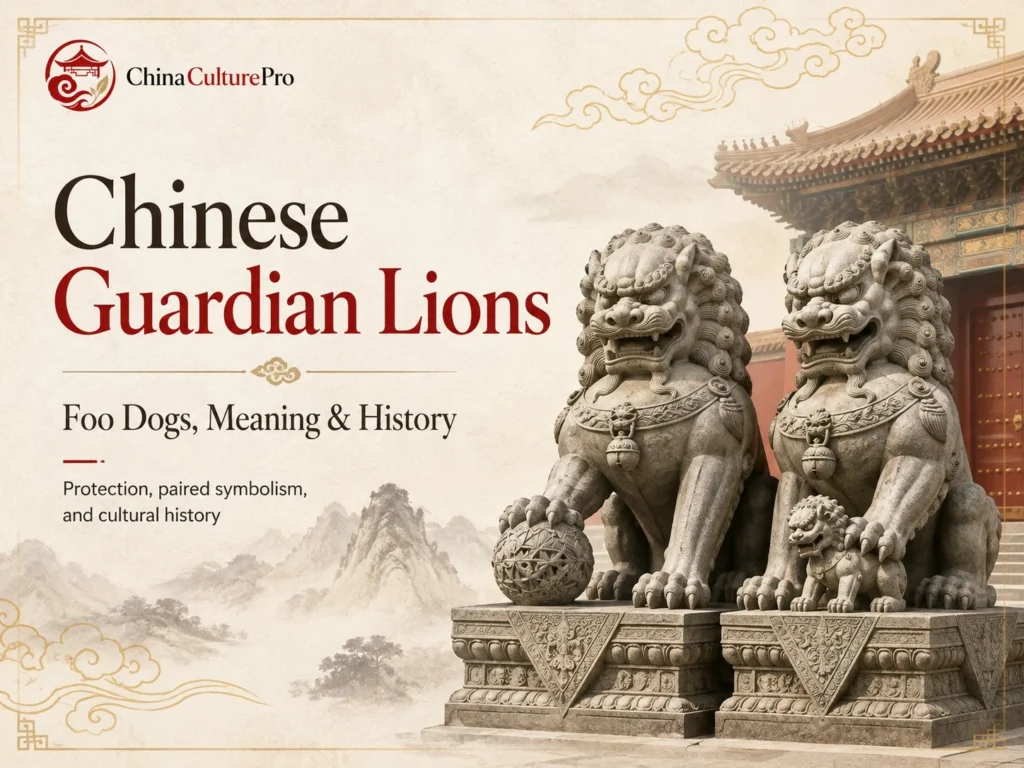

Quick Answer: What Do Chinese Guardian Lions Symbolize?
Chinese guardian lions are stylized lion images used to mark and protect important spaces. Their meaning depends on where and when they appear: a tomb lion, a Buddhist temple lion, and a Qing-dynasty palace pair do not carry exactly the same message. “Foo dog” or “fu dog” is an informal English label, not the traditional Chinese name.
- Guardianship and boundary protection: They guard entrances, tomb chambers, temples, palaces, and other significant spaces.
- Buddhist authority: At temples, lions can express the power of Buddhist teaching and the image of the Buddha’s lion-like roar.
- Imperial and civic authority: At palaces and government buildings, they communicate status, controlled access, and formal order.
- Ordered pairing and continuity: In later art, the ball-and-cub pair can suggest authority, nurture, and family continuity.
- Modern cultural identity: At Chinatowns, hotels, restaurants, and in design, they often signal Chinese heritage and visual tradition.
These are cultural meanings and historical beliefs. A lion statue has no verifiable power to guarantee protection, wealth, or good luck.
Visitors around the world often meet them at palace gates, Buddhist temples, and Chinatown entrances: imposing beasts popularly called “Foo Dogs.” The name is misleading. These figures are stylized Chinese guardian lions, not a traditional Chinese dog breed.
A muscular Northern Qi tomb lion and a playful Qing porcelain pair with a ball and cub look strikingly different. That contrast matters. The familiar “male with a ball, female with a cub” design is a late convention, not an unchanged template inherited from remote antiquity.
What Are Chinese Guardian Lions?
Chinese guardian lions are protective lion images used in architecture, funerary art, religious settings, and decorative objects. In Chinese, a lion is shīzi (狮子 / 獅子), while a stone lion is shíshī (石狮 / 石獅). “Chinese guardian lion” is the clearest general English name.
Their model is the real lion, but Chinese artists did not simply copy an animal from nature. Over centuries they enlarged the eyes, curled the mane, broadened the muzzle, heightened the claws, and adjusted posture to suit tombs, temples, gateways, ceramics, and court art. The result can look fantastic or even doglike to viewers accustomed to naturalistic European lions.
Stone is common in monumental settings, but it does not define the whole tradition. Guardian lions also appear in bronze, iron, marble, wood, earthenware, and porcelain. An eighteenth-century porcelain pair could serve as incense or taper holders on a scholar’s desk, showing how the motif moved far beyond outdoor gates.[6]
Material changes scale and use more reliably than it changes meaning. A massive stone figure can define a threshold or tomb approach; a cast-metal lion can serve a court entrance; a porcelain example can bring the same visual vocabulary into an interior. None of those materials creates a universal symbolic code by itself.
A guardian lion is not a separate zoological species or a single deity worshipped through one national cult. Nor does every lion image automatically belong to the entrance-guardian tradition. Date, placement, paired composition, inscriptions, and the object’s original use all matter. This contextual method also applies across the wider guide to Chinese symbols and their meanings.
Why Are Chinese Guardian Lions Called Foo Dogs?
“Foo dog,” “fu dog,” “lion dog,” and “dog of Fo” developed in Western-language collecting and popular culture. Chinese sources ordinarily call the animal a lion, a stone lion, or by its material—such as a bronze lion. The statues are not traditionally classified as dogs in China.
The exact origin of “Foo Dog” is not settled. Proposed explanations connect Fo with an older rendering of fó (佛, Buddha), fu with fú (福, blessing or good fortune), Western exposure to Japanese komainu, or the simple misidentification of a highly stylized lion as a dog. Nineteenth-century Western travelers and collectors did apply dog language to these figures, but that does not prove one exclusive etymology for every form of the name.[4]
Older museum catalogues still use labels such as “lion-dog” and “dogs of fo.” Those labels are useful evidence for how the object was described in English, not evidence that the Chinese subject was originally canine. Two Qing porcelain examples, for instance, are catalogued as lion-dogs while their attributes clearly follow a male-and-female lion pair.[6]
The practical wording rule is simple: use Chinese guardian lion as the main term. Add “Foo Dog” in parentheses when it helps readers recognize the object or find the page.
What Chinese Guardian Lions Mean in Different Contexts
The setting is the fastest route to an accurate interpretation. A later palace convention should not be projected backward onto an early tomb sculpture.
| Context | Primary meaning | Typical carrier | Interpretation limit |
|---|---|---|---|
| Han–Six Dynasties tombs | Funerary guardianship, imposing presence, and an ordered protected burial space | Tomb roads, chamber entrances, stone sculpture, burial models | No fixed ball-and-cub or family-lineage message |
| Buddhist temples | Buddhist authority, protection of sacred space, and the “lion’s roar” of the Dharma | Temple gates, cave temples, Buddhist sculpture, throne bases | The lion is not automatically an independently worshipped deity |
| Imperial palaces and offices | Authority, controlled access, hierarchy, and institutional dignity | Palace gates, government offices, imperial tomb approaches | Court rules cannot be applied unchanged to every dynasty or private home |
| Bridges and civic structures | Public-space marking, structural dignity, and protective wishes | Bridge posts, city gates, civic architecture | Not every public lion has a specifically Buddhist meaning |
| Late-imperial decorative art | Complementary pairing, continuity, and auspicious wishes | Porcelain, incense holders, desk objects, domestic crafts | These later meanings should not define early tomb lions |
| Modern commercial and diaspora settings | Chinese cultural identity, visual heritage, and entrance framing | Chinatowns, restaurants, hotels, logos, and cultural products | Modern use does not automatically follow imperial ritual or feng-shui rules |
Pairs were associated with palaces, temples, government offices, and elite residences, but their exact function changed with the building.[5] A palace pair could frame authority, while a temple pair could guard Buddhist teaching. Modern entrance lions often retain the visual language of guardianship without preserving an ancient institution behind it. The architectural setting therefore matters as much as the animal itself; the broader principles are explored in Chinese symbolism in architecture.
How Chinese Guardian Lions Developed Through History
Chinese guardian lions did not appear fully formed at one moment. The tradition grew through contact with real lions, funerary sculpture, Buddhist imagery, court architecture, and later decorative standardization.
Real Lions, Han China, and Early Guardian Images
Lions were not native to China. Animals and information about them arrived from the west through diplomacy and long-distance exchange. By the Western Han period, lions were among the exotic animals kept in imperial parks.[2] Artists therefore worked from rare encounters, imported models, stories, and established Chinese beast imagery rather than from an everyday native animal.
Pairs of stone lions have been found guarding Han-dynasty tombs, although early forms and names were not identical to the mature lions placed at later palace gates.[1] “Guardian lion” is useful when the object and context support that identification, but it should not become a label for every ancient winged beast. Tianlu, bixie, Pixiu, and unnamed tomb creatures have their own uncertain or changing classifications.
This distinction also corrects a common museum-reference error: The Met object numbered 2002.478.2 is a Tang earthenware lion from roughly the late seventh to first half of the eighth century. Its collection note discusses Western Han lions, but the object itself is not Han.[2]
Buddhist Lions and Medieval Temple Art
Buddhism gave the lion a powerful new setting. The Buddha’s teaching was likened to a lion’s roar—authoritative, fearless, and able to carry across the spiritual world. Lions consequently appeared at temple entrances and within Buddhist sculpture as signs of sacred authority and protection.[3]
In northern China, lion imagery became especially visible in Buddhist cave temples during the fifth and sixth centuries. A mid-sixth-century Northern Qi limestone lion now in New York once formed one of a pair. Comparable lions excavated from Northern Qi tombs guarded the entrance to the innermost coffin chamber.[1]
Buddhism was therefore a major force in the development of Chinese lion art, but it does not explain every lion in the same way. A lion at a Buddhist temple can guard the Dharma; a tomb lion organizes and protects funerary space; a later government-office pair projects official authority. A guardian lion is also not automatically the mount of Manjushri simply because both images use a lion.
From Court and Civic Guardians to the Late-Imperial Pair
Lion sculptures spread across imperial palaces, government offices, royal tomb approaches, temples, bridges, and elite residences. Large materials and labor-intensive carving also made monumental pairs visible statements of rank, resources, and controlled access.
During the Ming and Qing periods, the familiar paired composition became increasingly standardized: a male lion with a paw on an embroidered ball and a female with a cub. Both could have full curling manes and similarly fierce faces. This is one reason later Western viewers could misread them as fantastic dogs rather than male and female lions.[4]
The motif also became portable. Qing porcelain pairs could stand on decorated stools, hold incense or tapers, and turn monumental architecture into intimate desk art.[6] Late-imperial pair conventions are therefore important, but they are one historical layer—not the original definition of every Chinese guardian lion.
How the Male-and-Female Guardian Lion Pair Works
The ball-and-cub composition is the clearest late-imperial method of assigning complementary roles. It is an artistic system, not a lesson in lion biology: both figures may have manes, and their bodies can be nearly identical.
| Feature | Common late-imperial reading | Interpretation limit |
|---|---|---|
| Embroidered or brocade ball | Authority, ordered rule, unity, or—in some court interpretations—the world under control | Not automatically Earth, a pearl, a money ball, or a promise of wealth |
| Cub | Nurture, descendants, continuity, and care for life within the protected space | Not every female lion in every period has a cub |
| Pair | Complementary roles and protection of an entrance as a complete unit | Single guardian lions and unpaired lion objects also exist |
| Orientation | In a common formal arrangement, the male is on the building’s left when looking outward; to a visitor outside facing the entrance, he is on the right | Viewpoint must be stated, and surviving regional or object-specific arrangements can differ |
An eighteenth-century marble pair provides a clear museum example: the female appears with a cub, while the male places a paw on an embroidered ball.[5] The pair is sometimes interpreted through yin and yang, but the roles should not be reduced to a permanent biological formula of “male power versus female submission.” They function together to complete the visual order of an entrance.
One documented Qing pair places the ball-bearing male on the visitor’s right and the cub-bearing female on the visitor’s left when the visitor faces the lions.[8] That example clarifies the viewpoint; it does not prove that every surviving pair follows an exceptionless rule.
The safest reading begins with the object’s date and original location. A ball-and-cub pair at a Qing gate supports a later complementary interpretation. A Northern Qi tomb lion without these attributes should be read through funerary protection, not retrofitted with the full Qing scheme.
How to Recognize Chinese Guardian Lions in Art
No single color, curl count, mouth position, or claw number identifies every authentic guardian lion. Use a sequence of contextual checks:
- Establish the date and setting: Tomb, temple, palace, government office, bridge, incense object, and modern entrance are different contexts.
- Check the composition: A pair flanking a gate is strong evidence, but a documented burial figure or decorative lion may appear alone.
- Look for lion features: Common traits include a broad muzzle, large eyes, visible teeth, claws, a thick or curled mane, and a powerful seated or crouching posture.
- Use the ball and cub carefully: These are strong clues for a later paired convention, not requirements for early guardian lions.
- Do not assume stone: Bronze, iron, marble, wood, earthenware, and porcelain all occur.
- Prioritize inscriptions and records: A museum label, archaeological context, building archive, or matching pair is stronger evidence than an online appearance chart.
- Compare the whole object: Early lions may look muscular and naturalistic; later examples can be rounder, more ornamental, or deliberately playful.
The Northern Qi lion’s crouching body, exposed fangs, splayed claws, and rippling muscles differ sharply from the rounder porcelain figures of the Qing period.[1][6] Variation is part of the tradition, not evidence that one version is “real” and another is fake.
Chinese Guardian Lions vs. Similar Chinese Creatures
Chinese art contains several protective or lionlike creatures, but a shared fierce face does not place them in one system.
| Creature | Core system | Main function | Typical carrier | Key difference |
|---|---|---|---|---|
| Chinese guardian lion | Architectural, funerary, and Buddhist guardian art | Guards or frames important spaces; expresses authority and order | Tombs, gates, temples, bridges, ceramics | A stylized lion tradition rather than a winged wealth beast or judicial creature |
| Pixiu | Early fierce-beast texts, tomb guardians, and later wealth folklore | Early protection; later wealth-retention wishes | Winged tomb beasts, jewelry, modern statues | Often horned or winged; not the same entrance-lion tradition |
| Qilin | Confucian and Four Numinous Creatures traditions | Benevolence, sage rule, peace, and worthy descendants | Painting, textiles, court and folk art | A composite benevolent beast, not a stylized real lion |
| Xiezhi | Judicial symbolism | Distinguishes right from wrong and represents justice | Court dress, legal offices, official art | Usually identified by its horn and judicial context |
| Suanni | Lion-related classical terminology and some Nine Sons of the Dragon lists | Associated in later texts with incense smoke, seats, and Buddhist settings | Incense burners, throne bases, literature | Related to changing lion imagery but not a universal name for gate lions |
| Lion-dance lion | Festival and performance tradition | Celebration, community ritual, and auspicious performance | Costumes, drums, parades, ceremonies | A moving performance figure, not an architectural sculpture |
Identification should begin with the object’s carrier and function. A winged tomb beast is not a stone lion merely because both guard a space; an incense-burner Suanni is not automatically one of a palace-gate pair.
How to Interpret or Use Guardian Lion Designs Correctly
Use the following checks for museum interpretation, logos, tattoos, clothing, entrance decoration, or cultural products:
- Choose a historical layer: Decide whether the reference is an early tomb lion, Buddhist lion, court gate lion, Qing decorative pair, or modern reinterpretation.
- Name it accurately: Use Chinese guardian lion as the main English term. Add “Foo Dog” only as a familiar search label.
- Label later conventions: If the design uses a ball and cub, describe that pairing as a late-imperial convention rather than an eternal rule.
- Define the viewpoint: Any left-right explanation must say whether the viewer stands inside looking out or outside facing the entrance.
- Reject universal appearance codes: Mouth position, color, mane curls, and claw number do not form one dependable cross-dynasty dictionary.
- Separate symbolism from effect: A design can express protection, authority, continuity, or cultural identity, but it cannot guarantee wealth or ward off real harm.
- Review permanent uses: Before finalizing a building feature, brand mark, or Chinese-symbol tattoo, compare the design with a dated museum object and consider its funerary, religious, or court associations.
Modern adaptation is not automatically disrespectful. Accuracy comes from knowing what has been changed and avoiding invented claims about ancient rules or supernatural results.
Final Takeaway
Chinese guardian lions developed as real lions were reimagined through funerary art, Buddhism, architecture, court culture, and decorative craft. “Foo Dog” is a familiar but misleading English name: the subject is a lion, not a dog. The ball-and-cub pair is also a late historical convention, not a rule for every guardian lion ever made. Accurate interpretation begins with date, setting, material, and documented use.
FAQs About Chinese Guardian Lions
How Do You Pronounce Shishi?
Stone lion is shíshī in standard Mandarin: both syllables sound roughly like “shir,” but the first has a rising tone and the second a high, level tone. Lion is shīzi, with a neutral final syllable. English approximations cannot reproduce Mandarin tones exactly.
Are Chinese Guardian Lions Part of the Chinese Zodiac?
No. Guardian lions belong to architectural, funerary, religious, and decorative traditions. The Chinese zodiac is a twelve-year calendar cycle. Its Tiger, Dog, and Dragon signs do not make guardian lions zodiac animals.
Why Do Some Guardian Lion Pairs Have Open and Closed Mouths?
Open-and-closed mouths can be meaningful in particular regional or religious traditions, especially outside China, but they are not a universal Chinese rule. Many Chinese pairs have both mouths open, partly open, or shaped according to the sculptor’s composition. Identify the work through date and context rather than an “open equals male” chart.
Do Mane Curls Show a Guardian Lion’s Rank?
Some modern charts assign official grades by counting mane curls, but this is not a reliable rule for guardian lions across Chinese history. Styles vary by workshop, period, material, scale, and location. Use a building record or object catalogue before making a rank claim.
Why Do Some Guardian Lions Wear Bells or Collars?
Bells, collars, tassels, ribbons, and harness-like ornaments belong to particular decorative styles rather than one compulsory guardian-lion code. They can make the lion look controlled, courtly, or playfully domesticated, especially on later ceramics. Their meaning should be read from the dated object instead of assigned through a universal online chart.
Do Guardian Lions Have the Same Meaning Across East Asia?
No. Chinese lion imagery influenced related traditions, but each region localized it. A fourteenth-century Japanese pair, for example, distinguishes an open-mouthed karashishi, or Chinese lion, from a closed-mouthed, once-horned komainu, or Korean dog.[7] Japanese komainu and Ryukyuan shisa should therefore not be treated as unchanged Chinese Foo Dogs.
Sources
[1] The Metropolitan Museum of Art. Guardian Lion
[2] The Metropolitan Museum of Art. Lion
[3] Cleveland Museum of Art. Guardian Lion
[4] University of Chicago Public Art. Chinese Stone Lions at the Cochrane-Woods Art Center
[5] Herbert F. Johnson Museum of Art, Cornell University. Guardian Lion
[6] British Museum. Figure: Pair of Porcelain Lion-Dogs or “Dogs of Fo”
[7] Cleveland Museum of Art. Pair of Guardian Animals: Karashishi and Komainu
[8] Field Museum. Lion Statues