
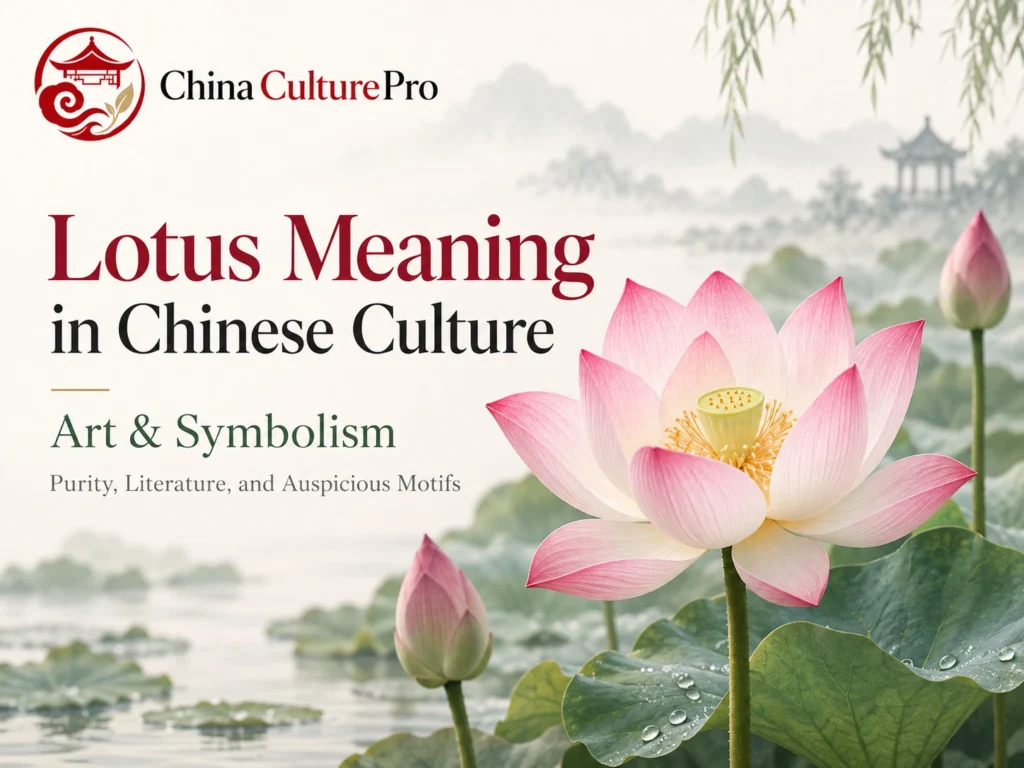

Quick Answer: What Does the Lotus Symbolize in Chinese Culture?
The Chinese lotus has no single meaning that applies to every artwork. Its most common associations belong to five distinct contexts:
- Buddhist images: purity, freedom from defilement, sacred presence, and awakening, especially when a Buddha or bodhisattva sits or stands on a lotus throne.
- Confucian literati culture: the gentleman (君子, jūnzǐ) who remains upright and morally independent in a compromised world.
- Ming-Qing auspicious designs: wishes produced by complete combinations, such as lotus with fish for continuing surplus, a twin lotus (并蒂莲, bìngdìlián) for joined partners, or lotus with children for descendants.
- Classical poetry: waterside beauty, summer, desire, separation, or an admired person, depending on the poem.
- Naturalistic art: a seasonal pond subject valued for observation, brushwork, and atmosphere, with no necessary religious or auspicious message.
A lotus by itself therefore does not automatically mean wealth, marriage, fertility, or enlightenment. These are cultural and artistic meanings, not promises of luck or supernatural effects.
In Chinese art, the same lotus (莲花, liánhuā) can belong to entirely different systems of meaning. A ninth- or tenth-century Dunhuang banner shows a bodhisattva standing on a lotus pedestal, where the flower marks sacred presence and Buddhist purity. A Qing painting of red lotus and fish instead turns the plants and animals into the secular wish “abundance year after year” (连年有余, liánnián yǒuyú).[4][7] The difference is not the flower itself, but its date, medium, companions, inscription, and use. This guide separates five contexts that simplified symbol dictionaries often collapse.
Lotus, Water Lily, Lianhua, and Hehua: What Is the Difference?
In everyday Chinese, liánhuā and héhuā usually name the sacred lotus, but historical texts use a wider vocabulary for the plant and its parts. English adds another difficulty: lotus and water lily (睡莲, shuìlián) are often treated as interchangeable common names even though botany separates them. Kew recognizes sacred lotus as Nelumbo nucifera in the family Nelumbonaceae, while water lilies belong to the genus Nymphaea in Nymphaeaceae.[1][2]
| Chinese term | Pinyin | Recommended English | Practical distinction |
|---|---|---|---|
| 莲花 / 荷花 | liánhuā / héhuā | lotus / sacred lotus | Nelumbo; leaves and flowers usually rise on long stalks, and the plant develops a distinctive seedpod |
| 睡莲 | shuìlián | water lily | Nymphaea; leaves and flowers generally rest close to the water, without a lotus seedpod |
| 水芙蓉 | shuǐfúróng | water lotus | A literary name for lotus; the water setting matters |
| 木芙蓉 | mùfúróng | cotton rose / hibiscus | A woody terrestrial Hibiscus, not a lotus |
| 菡萏 | hàndàn | lotus bud | A classical term commonly referring to an unopened bud |
| 芙蕖 | fúqú | lotus plant | A classical name that may refer to the plant more broadly |
The first substantive occurrence of water lily (睡莲, shuìlián) in a catalogue should not be translated back into “lotus” merely because an older English title does so. Conversely, highly stylized ceramics may not preserve enough botanical detail for confident identification. In those cases, prioritize the museum’s official title, inscriptions, period vocabulary, and the whole scene rather than counting petals or guessing from color.
Why Does the Lotus Symbolize Purity in Chinese Culture?
Purity is important, but it entered Chinese lotus symbolism through more than one intellectual route. The shared starting point was visible growth: the plant roots in mud yet sends clean-looking flowers above the water. Chinese writers and religious artists could turn that contrast into a moral image without possessing a modern scientific theory of the leaf’s surface.
Buddhist lotus imagery arrived earlier through a religious and artistic system with roots in India. A lotus throne separates an awakened or sacred figure from the ordinary ground. It may evoke freedom from defilement, spiritual emergence, or a pure realm. These meanings depend on such cues as a Buddha, bodhisattva, halo, altar, or devotional setting; a lone flower in a pond is not automatically Buddhist.
The Confucian association is a separate Northern Song construction. In “On the Love of the Lotus” (爱莲说, Ài Lián Shuō), Zhou Dunyi praises the flower for rising unstained from mud, growing upright, and refusing to trail or branch. He calls it the “gentleman among flowers,” making the lotus a model of moral integrity rather than a sign of Buddhist enlightenment.[5] Zhou’s short essay later became central to interpretations of his philosophy and ethical self-cultivation.[6] The two traditions share an image of remaining untainted, but their doctrines, audiences, and visual settings should not be merged.
How Lotus Symbolism Changed Across Chinese History
Early Lotus Imagery Before Buddhist Symbolism
Lotus imagery existed in China long before Buddhist art. In the Book of Poetry, “Ze Po” places lotus plants beside rushes at the edge of a marsh and uses the waterside scene within a poem of longing for an admired person.[3] Here the plant belongs to landscape, desire, and poetic comparison. It is not yet a lotus throne, Zhou Dunyi’s gentleman, or a Ming-Qing rebus.
That chronological distinction matters. An early reference to lotus does not prove that every later meaning was already present. Pre-Buddhist poems may use the plant to establish place, season, beauty, or emotional atmosphere. When an early motif has no inscription or ritual context, “natural waterside plant” is often more responsible than assigning it purity, annual abundance, or marital harmony after the fact.
Early vocabulary also resists a one-word symbol dictionary. A poem may name the whole plant, its flower, bud, leaves, or seeds, and the chosen term can serve sound, rhythm, or description rather than an encoded blessing. Translators should therefore ask what the plant is doing inside the poem: setting a scene, describing someone, marking a season, or supporting an emotional comparison. That question is more reliable than importing a later museum-label meaning into an earlier line.
Lotus Thrones and Sacred Presence in Chinese Buddhist Art
As Buddhist texts and images circulated in China, lotus pedestals, lotus ponds, and handheld lotuses became part of a recognizable devotional vocabulary. The Metropolitan Museum of Art’s ninth- or tenth-century Dunhuang banner depicts a bodhisattva standing on a full lotus pedestal below a seated Buddha. The museum identifies the fragment as a banner likely displayed in a temple or cave sanctuary, or used in ceremonies.[4]
The crucial clue is not simply a flower. It is the flower’s structural role: the lotus supports a sacred figure and belongs to an organized religious scene. In this setting, purity refers to release from defilement and elevated spiritual status. A naturalistic ink painting of an empty pond, even if its blossoms are white, does not inherit that meaning automatically. This is also why the Buddhist lotus should be read within the broader iconography of the Eight Auspicious Symbols rather than as a generic good-luck flower.
Zhou Dunyi and the “Gentleman Among Flowers”
Zhou Dunyi’s 1072 essay created one of the most influential Chinese readings of the lotus. Its logic is ethical and visual. Mud represents a compromised environment; remaining unstained suggests that character need not be dictated by surroundings. The hollow, straight stem evokes openness and upright conduct. The plant’s lack of clinging vines becomes an image of independence, while its fragrance spreading at a distance suggests reputation grounded in virtue.
In a literati painting or study object accompanied by Zhou’s words, the lotus can therefore represent disciplined self-cultivation, reserve, and moral integrity. The meaning is not “purity” in an undifferentiated sense. It is the cultivated stance of a scholar who remains principled without withdrawing from the world. The Internet Encyclopedia of Philosophy notes Zhou’s later importance within the Neo-Confucian tradition, giving this compact flower essay a much larger intellectual afterlife.[6]
Ming-Qing Rebuses and Secular Auspicious Art
By the Ming and Qing periods, lotus imagery flourished in porcelain, textiles, lacquer, New Year pictures, and wedding objects. Artisans could combine pictures with homophones to create readable wishes. Lotus with fish suggested continuing surplus; paired blossoms could suggest joined partners; a lotus, box, and paired harmony figures could express harmony and union; children and seedpods could support wishes for descendants.
These designs did not erase Buddhist or literati meanings. Several systems continued in parallel. A Qing artist could paint lotus as brushwork, a workshop could place it on wedding porcelain, and a temple could use a lotus pedestal, all within the same century. The safest interpretation begins with medium and function: devotional object, scholar painting, marriage furnishing, seasonal picture, or decorative commodity. Ming-Qing auspicious grammar should not be projected backward onto every earlier lotus.
Workshop repetition can make a motif look more fixed than it was. A design copied across bowls, robes, and New Year prints often became legible to a wide audience, yet a painter could still quote, alter, or ignore that convention. Inscriptions sometimes confirm the intended phrase; object shape and occasion may do the same. Without those controls, a plausible rebus should remain a possibility, not be promoted to a certainty.
Common Lotus Motifs and Their Meanings in Chinese Art
The complete composition is the smallest reliable unit of interpretation. The following table gives default readings, not permanent definitions.
| Motif | Most likely reading | Cues required | Do not assume |
|---|---|---|---|
| Single lotus without context | Seasonal, literati, or decorative subject | Date, inscription, medium, and setting | Automatically Buddhist, wealthy, or romantic |
| Lotus pedestal with deity | Buddhist purity and sacred presence | Buddha or bodhisattva, halo, altar, devotional setting | Wedding or literati meaning |
| Lotus with fish | Continuing surplus or abundance through the years | Both elements in a decorative, New Year, or auspicious context | That lotus itself means “year” |
| Lotus with mandarin ducks | Companion or marital wish | A pair of ducks, pond setting, and wedding or congratulatory use | Any lotus-and-bird picture is romantic |
| Twin blossom or joined-stalk lotus | Joined partners and harmony | Explicitly paired flower, often with wedding context | Every lotus symbolizes marriage |
| Lotus with child or seedpod | Wish for continuing descendants | Child, many-seeded pod, festive object, or inscription | A fertility guarantee |
| Lotus, box, and Hehe figures | Harmony and union | Figures plus lotus or leaf and a box | A lone lotus means domestic harmony |
| Lotus with dragonfly or other birds | Usually a seasonal nature study; occasionally a specific rebus | Museum label, inscription, or well-established wordplay | A universal code for every companion animal |
Lotus and Fish: How “Abundance Year After Year” Actually Works
Lotus-and-fish is one of the best-known Chinese visual puns, but English explanations often describe its sound mechanism incorrectly. Lotus, lián (莲), is a full homophone of “continuous” or “in succession,” lián (连). Fish, yú (鱼), is a full homophone of “surplus,” yú (余). Together they help evoke liánnián yǒuyú, “may there be surplus year after year.”
Lotus does not sound like “year”: lián and nián are different syllables. The word for year enters the completed saying rather than being supplied by a direct lotus-year pun. The Met’s Qing painting Red Lotus and Fish correctly identifies the picture as an auspicious New Year message, although its short online explanation compresses the phonology.[7]
Context still matters. In decorative or New Year art, the rebus is a strong reading. In a natural pond study, the same two living things may simply share a habitat. The broader mechanics of the fish-surplus pun belong to the site’s guide to fish symbolism in Chinese culture.
Lotus, Paired Birds, Children, and Hehe Erxian
A paired lotus may narrow the image toward partnership. The twin lotus, bìngdìlián, describes two flowers joined on one stalk and can suggest two people united at the root. The association is strongest on wedding objects, in congratulatory poetry, or where inscriptions confirm the couple theme. A single flower does not activate it.
Lotus ponds with paired mandarin ducks can carry a marital wish because the birds already possess a documented wedding association in later Chinese decorative art. Even then, object type matters: a naturalistic bird-and-flower scene may be observation rather than a wedding message. The distinction is explored further in the guide to mandarin duck symbolism.
Children and seedpods form another conditional branch. The sound of lián can suggest continuity, while a child or abundant seeds supplies a descendants theme. On festive family objects, the combination may express a wish for successive sons or continuing generations. It does not describe biology, predict pregnancy, or make a lone seedpod into a universal fertility emblem.
The Hehe Erxian (和合二仙, Hé-Hé Èrxiān), or He-He Immortals, provide a more explicit harmony composition. A Met porcelain figure belongs to a pair of boys holding a lotus leaf and a box; the museum explains that these objects form a rebus for harmony and union.[10] 荷 hé can evoke 和 hé, “harmony,” while 盒 hé evokes 合 hé, “union.” The figures, lotus or leaf, and box work together; one isolated element does not carry the entire message.
Lotus with Dragonflies and Other Companions
Dragonflies, waterbirds, reeds, and aquatic plants often place lotus within a summer ecosystem. In most unsigned flower-and-insect pictures, season, movement, and painterly observation should be considered before auspicious wordplay.
The Smithsonian’s Ming tapestry Dragonfly and Lotus Plants is a useful exception with a tightly documented reading. Its label explains that 荷 hé can sound like 和 hé, “peace,” while the dragonfly contributes another sound association, producing an image of clear, peaceful waters. The museum connects that particular composition to hopes for stability under Ming rule.[8] This does not establish a universal “dragonfly plus lotus” meaning. It shows why a museum label, inscription, or period-specific pun can legitimately narrow one object’s interpretation.
What Does the Lotus Mean in Chinese Poetry and Painting?
Poetry and painting keep lotus meaning unusually open. In early verse, it can mark a marsh and intensify longing. After Zhou Dunyi, a literati inscription may turn it into the moral self-image of a gentleman. Elsewhere, drooping leaves, broken stems, rain, birds, or empty water can suggest late summer, solitude, political disappointment, or the pleasures of ink itself.
This is the domain of bird-and-flower painting (花鸟画, huāniǎohuà), where observation and brushwork may matter more than a coded blessing. Bada Shanren’s ca. 1690 Birds in a Lotus Pond is a revealing example. The Met discusses the torn leaf as an abstract form, the difficult satin surface, and the enigmatic relationship between dark leaves, light birds, water, and open space; it does not reduce the work to luck, marriage, or Buddhist awakening.[9]
Three checks are especially useful: read the inscription, identify the artist’s genre and historical position, and ask whether the work was made for a temple, study, wedding, birthday, market, or court. An image can also sustain more than one interpretation, but each layer needs evidence. The broader rules for reading combinations, inscriptions, and media appear in Chinese flower and plant symbolism and the overview of Chinese symbols and meanings.
Seasonal details provide another control. Fresh blossoms above broad leaves may establish summer abundance in a visual sense without forming a verbal pun. Rain-bent stems, insect damage, seedpods, or withered leaves can shift attention toward time, decline, survival, or formal experimentation. These readings should be stated as evidence-based possibilities unless an inscription or documented commission makes the artist’s intention explicit.
What a Chinese Lotus Symbol Does Not Automatically Mean
| Common claim | More accurate boundary |
|---|---|
| Every Chinese lotus means Buddhist enlightenment | A lotus throne in a sacred scene supports that reading; literati, poetic, auspicious, and naturalistic lotus images follow other systems |
| Lotus sounds like “year” | Incorrect: lián 莲 matches lián 连, not nián 年; fish yú 鱼 matches surplus yú 余 |
| Lotus is a default Chinese love flower | Marriage requires such cues as twin blossoms, paired mandarin ducks, Hehe figures, inscriptions, or a wedding object |
| Lotus always promises children | Descendants wishes depend on children, seedpods, inscriptions, or family-celebration contexts; they have no effect on fertility |
| Lotus and water lily are the same plant | Sacred lotus is Nelumbo; water lilies are Nymphaea, although old catalogues and stylized art can blur common names |
| Red, white, pink, and blue lotus have one ancient code | No color table works across Buddhist ritual, literati painting, porcelain, embroidery, and modern design |
| A lotus image attracts wealth, love, or spiritual protection | Such claims turn cultural symbolism into an unsupported promise of real-world effects |
The recurring problem is not that every popular association is invented. Many have authentic histories. The problem is removing the conditions that made them meaningful. “Purity,” for example, can be appropriate in Buddhist and Confucian settings, but those settings explain it differently. “Harmony” can be appropriate when a lotus participates in a Hehe rebus, but not as an automatic translation of every pond scene.
How to Interpret or Use a Chinese Lotus Symbol Correctly
Use this six-step sequence for museum objects, antiques, wedding designs, logos, and tattoos:
- Identify the plant. Decide whether the work shows Nelumbo lotus, Nymphaea water lily, cotton rose, or a stylized flower that cannot be identified securely.
- Establish the date. Separate pre-Buddhist poetry, Buddhist art, Northern Song literati thought, Ming-Qing auspicious design, and modern reinterpretation.
- Identify the medium and function. A cave banner, handscroll, porcelain bowl, wedding textile, album leaf, and tattoo invite different questions.
- Read the companions. Look for a deity, fish, paired ducks, child, seedpod, box, Hehe figures, dragonfly, inscription, or ritual setting.
- Assign the image to the strongest system. Choose natural, Buddhist, Confucian-literati, auspicious-rebus, or purely decorative as the primary reading, then add secondary layers only when evidence supports them.
- Separate historical meaning from modern intent. A designer may create a new association, but should label it as reinterpretation rather than an ancient rule.
In a museum, a Dunhuang lotus pedestal should be read through Buddhist iconography, while Tang Guang’s fish-and-lotus picture invites the New Year rebus. An unsigned ink pond should begin with naturalistic or literati possibilities. For a wedding, twin lotus, paired mandarin ducks, or a documented Hehe composition communicates partnership more clearly than a single flower. For a tattoo, lotus may express integrity, spiritual aspiration, endurance, or a personal memory, but Chinese tradition offers no fixed tattoo canon, lucky direction, or guaranteed effect.
FAQs About Lotus Symbolism in Chinese Culture
Is the Lotus Always a Buddhist Symbol in China?
No. The Buddhist lotus is one major tradition, especially when a deity sits or stands on a lotus pedestal. The plant also appears in pre-Buddhist waterside poetry, Zhou Dunyi’s Confucian gentleman metaphor, Ming-Qing rebuses with fish or family figures, and naturalistic summer painting. A religious interpretation needs visual or textual evidence such as a Buddha, bodhisattva, halo, altar, or Pure Land setting.
What Does a Lotus with Fish Mean in Chinese Art?
In an auspicious or New Year context, lotus with fish commonly expresses continuing surplus. The sound logic is lián 莲, “lotus,” matching lián 连, “continuous,” and yú 鱼, “fish,” matching yú 余, “surplus.” Lotus does not sound like “year,” nián. A plain pond painting may still be naturalistic, so date, medium, and intended use remain important.
Does the Lotus Symbolize Love or Marriage?
Not by default. A joined-stalk twin lotus can suggest united partners, while lotus with paired mandarin ducks or Hehe figures may convey marital harmony on wedding and congratulatory objects. A single lotus, an ordinary pond, or an unidentified pair of birds does not automatically mean romance. The complete composition and the object’s use determine whether a marriage reading is justified.
Do Lotus Colors Have Fixed Meanings in Chinese Culture?
No universal system assigns one stable meaning to every red, white, pink, or blue lotus across Chinese history. Particular Buddhist schools, rituals, workshops, inscriptions, and modern designers may use color deliberately, but those local conventions cannot be applied to all paintings, porcelain, textiles, or tattoos. Without contextual evidence, color is a visual choice rather than a reliable code for luck or spiritual rank.
What Does a Chinese Lotus Tattoo Mean?
A modern lotus tattoo can reference Zhou Dunyi’s moral integrity, Buddhist aspiration, resilience, or a personal story. Its meaning is established by the wearer and by accompanying imagery. There is no ancient Chinese lotus-tattoo canon, no traditional rule assigning luck by color or direction, and no supernatural promise of purification, wealth, marriage, or pregnancy. Historically specific claims should be matched to historically specific visual cues.
Sources
[1] Royal Botanic Gardens, Kew. Nelumbo nucifera Gaertn.
[2] Royal Botanic Gardens, Kew. Nymphaea L.
[3] Chinese Text Project. Ze Po
[4] The Metropolitan Museum of Art. Banner with Bodhisattva, possibly Mahamayuri
[5] Chinese Text Project. Ai Lian Shuo
[6] Internet Encyclopedia of Philosophy. Zhou Dunyi
[7] The Metropolitan Museum of Art. Red lotus and fish
[8] Smithsonian National Museum of Asian Art. Dragonfly and lotus plants
[9] The Metropolitan Museum of Art. Birds in a lotus pond
[10] The Metropolitan Museum of Art. Boy with leaves and box