

Quick Answer: What Are the Eight Chinese Cuisines?
The Eight Great Cuisines (八大菜系, bā dà càixì) are Shandong, Sichuan, Cantonese, Jiangsu, Zhejiang, Fujian, Hunan and Anhui. A cuisine tradition (菜系, càixì) brings together regional habits of choosing ingredients, seasoning food and cooking. The following table gives the standard eight-name framework and its main provincial associations.[1]
| Cuisine and Chinese name | Short name | Main province |
|---|---|---|
| Shandong cuisine (鲁菜, Lǔcài) | Lu | Shandong |
| Sichuan cuisine (川菜, Chuāncài) | Chuan | Sichuan |
| Cantonese cuisine (粤菜, Yuècài) | Yue | Guangdong |
| Jiangsu cuisine (苏菜, Sūcài) | Su | Jiangsu |
| Zhejiang cuisine (浙菜, Zhècài) | Zhe | Zhejiang |
| Fujian cuisine (闽菜, Mǐncài) | Min | Fujian |
| Hunan cuisine (湘菜, Xiāngcài) | Xiang | Hunan |
| Anhui cuisine (徽菜, Huīcài) | Hui | Anhui |
These are broad culinary traditions with local branches, rather than eight uniform menus. They are a useful introduction to Chinese food, but leave many other regional and community traditions outside the list.
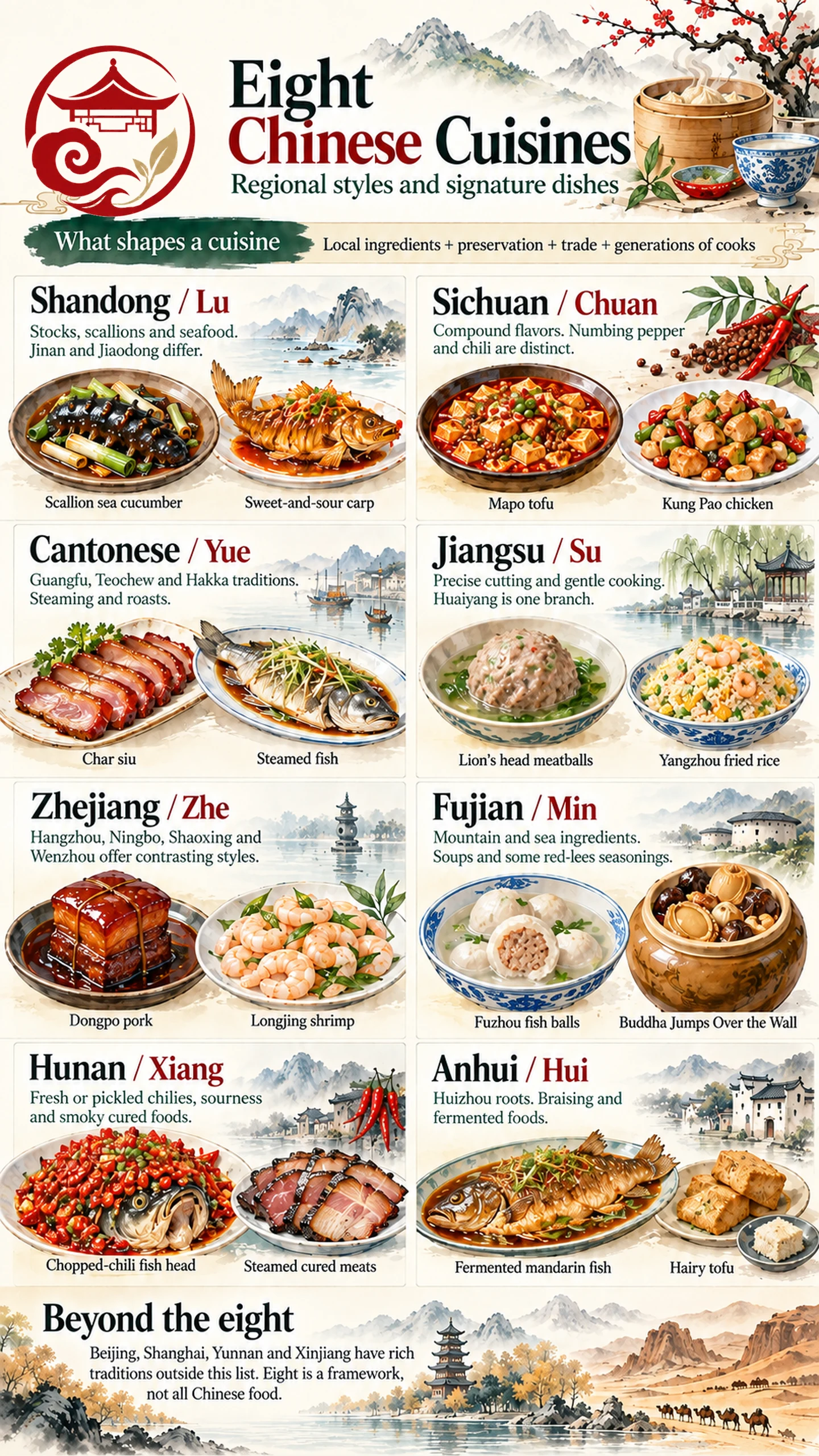
The same fish can become a crisp, sweet-and-sour centerpiece, a gently steamed dish or a bowl scented with pickled chilies. Regional cooking explains those differences better than the idea of one national flavor. This guide connects eight familiar cuisine labels with their ingredients, techniques and signature dishes, showing the variety behind the names.
How Ingredients and Cooking Traditions Shape a Cuisine
Regional cooking starts with what people can obtain. Shandong’s coast supplies seafood, while rivers and lakes provide freshwater fish and shrimp across Jiangsu and Zhejiang. Fujian combines coastal produce with mushrooms and bamboo shoots from its mountainous interior. These different supplies help explain why seafood, freshwater dishes and mountain ingredients receive different emphasis.[2][3][4]
Preservation adds another layer. Salting, smoking and fermentation can turn seasonal ingredients into foods with distinctive aromas and textures. Hunan’s cured meats and Anhui’s fermented fish show how a storage practice can also become a defining flavor. Such techniques are part of a regional repertoire, rather than proof that everyone in a mountainous area cooks alike.[5][6]
Trade, migration and the movement of cooks also carry ingredients and methods across regions. Guangdong cooking developed through exchanges between local foodways and traditions brought from elsewhere. Geography therefore provides ingredients and opportunities; generations of cooks shape what happens to them. Climate alone cannot explain a cuisine’s entire flavor range, and a modern classification should not be mistaken for a fixed boundary around centuries of cooking.[7]
The Eight Cuisines: Flavors, Techniques and Signature Dishes
Compare the cuisines through ingredients, seasoning and texture as well as heat. Two representative dishes accompany each tradition below, showing how different techniques work within the same regional repertoire. Recipes and restaurant versions vary.
Shandong Cuisine (Lu): Stocks, Scallions and Seafood
In Shandong cooking, Jinan’s inland tradition and Jiaodong’s coastal cooking provide two useful starting points. Other branches, including Qufu’s banquet traditions, widen the picture. Jinan is associated with carefully prepared stocks; Jiaodong emphasizes seafood and fresh flavors. Both belong to a cuisine with a broad repertoire of rapid stir-frying, frying and braising.[8]
Clear stock (清汤, qīngtāng) and milky stock (奶汤, nǎitāng) can give different results from poultry and meat. In traditional milky stock, cooking produces the pale, opaque appearance; the name does not mean milk must be added. Stock and scallion fragrance help build savory depth without making every dish taste alike.[2]
Scallion-braised sea cucumber (葱烧海参, cōngshāo hǎishēn) combines sea cucumber with cooked scallions and a glossy braising sauce. Its appeal lies in the contrast between aromatic scallion, rich seasoning and the sea cucumber’s soft, yielding texture.[9]
Sweet-and-sour carp (糖醋鲤鱼, tángcù lǐyú) takes a different approach: a whole carp is scored, coated and fried before receiving a tangy, sweet sauce. The crisp exterior, tender flesh and curved presentation make it recognizable. Shandong’s influence on northern cooking is substantial, but northern food is a wider category.[10][2]
Sichuan Cuisine (Chuan): More Than Numbing Heat
Sichuan cooking is best understood through combinations of flavors. Sichuan pepper (花椒, huājiāo) produces a tingling, numbing sensation; chilies provide heat. Their familiar combination is mala (麻辣, málà), but it is only one possibility. Sweetness, acidity, fermented savoriness and fresh aromatics also shape the cuisine.[9]
Chili-bean paste, or doubanjiang (豆瓣酱, dòubànjiàng), supplies a fermented base in many dishes, while pickled vegetables and ginger bring acidity. Quick stir-frying and dry-frying produce different textures. There are also dishes with little or no chili, so a Sichuan label does not establish one fixed level of heat.[9][11]
Mapo tofu (麻婆豆腐, mápó dòufu) combines tender tofu with a savory chili-bean sauce, Sichuan pepper and, traditionally, minced beef. Pork versions are common, and vegetarian adaptations exist. A meat-free-looking bowl still needs its broth and seasonings checked if vegetarian preparation matters.[11]
Kung Pao chicken (宫保鸡丁, Gōngbǎo jīdīng) contrasts tender diced chicken with crunchy peanuts and dried chilies. Its Sichuan versions balance savory seasoning with sweetness and acidity. The quick cooking matters as much as the chili: the dish should offer contrasting textures, not simply a hot sauce. Other regional versions also exist.[12]
Cantonese Cuisine (Yue): Steaming, Roasts and Fresh Flavors
In a broad Guangdong classification, Cantonese cuisine includes Guangfu (广府, Guǎngfǔ), Teochew (潮州, Cháozhōu) and Hakka (客家, Kèjiā) traditions. English usage sometimes applies “Cantonese” more narrowly to Guangzhou-associated cooking, so the scope matters. These traditions share a provincial setting without having identical menus.[7]
Steamed seafood, roast meats and carefully prepared soups are useful entry points. Attention to freshness and texture does not mean an absence of seasoning: savory sauces, sweet glazes and aromatic finishes can all play important roles. Teochew soy-braised foods and Hakka braises and stews add further variety beyond the familiar Guangzhou restaurant menu.[7]
Char siu (叉烧, chāshāo) is marinated, roasted pork, often made from shoulder or collar. Its glossy glaze, browned edges and sweet-savory flavor distinguish it from steamed dishes; the cut and marinade vary.[13]
Steamed fish (清蒸鱼, qīngzhēng yú) offers a contrasting example: tender fish with soy seasoning, ginger or scallions, often finished with hot oil. Dim sum (点心, diǎnxin), meanwhile, is a varied small-dish tradition associated with tea. It is one part of Cantonese dining, rather than a definition of the whole cuisine.[9][7]
Jiangsu Cuisine (Su): Knife Skills and Gentle Cooking
Jiangsu cuisine includes Huaiyang cuisine (淮扬菜, Huáiyáng cài), associated with Huai’an, Yangzhou and Zhenjiang; Jinling (金陵, Jīnlíng), centered on Nanjing; Suxi (苏锡, Sūxī), associated with Suzhou and Wuxi; and Xuhai (徐海, Xúhǎi), around Xuzhou and Lianyungang. Jiangsu is therefore wider than either Suzhou or Huaiyang cooking alone.[14]
Precise cutting, controlled heat and freshwater ingredients are important themes. The aim may be a delicate texture rather than conspicuous spice. Sweeter Suzhou-Wuxi dishes represent one tendency within the province, not a flavor rule for every Jiangsu meal. The same regional framework accommodates soups, braises, meat dishes and rice preparations.[14]
Lion’s head meatballs (狮子头, shīzitóu) are large pork meatballs, often made with finely chopped meat for a loose, tender texture. Clear-stewed and red-braised versions show how a shared preparation can produce different finishes; the meatball should not be understood as one dense, standardized product.[14]
Yangzhou fried rice (扬州炒饭, Yángzhōu chǎofàn) combines rice and egg with ingredients such as ham, shrimp and vegetables. Small, evenly prepared additions and separate grains make the dish recognizable. There are different working versions, rather than one universal ingredient list for every kitchen.[15]
Zhejiang Cuisine (Zhe): Seasonal Ingredients and Contrasting Styles
Zhejiang cuisine is often grouped into Hangzhou, Ningbo, Shaoxing and Wenzhou traditions. Seasonal ingredients and careful cooking run through these styles, but their flavors differ. Hangzhou is associated with delicate freshwater dishes; coastal Ningbo has a strong seafood identity, while Shaoxing adds distinctive rice-wine and preserved-food aromas.[3]
Stir-frying, simmering, steaming and braising all belong to the repertoire. A rich pork dish and a lightly cooked plate of shrimp can therefore represent the same cuisine without contradiction. “Light and fresh” describes an important tendency, not a requirement that every Zhejiang dish have a pale sauce or restrained richness.[3]
Dongpo pork (东坡肉, Dōngpō ròu) is slowly braised, skin-on pork belly, commonly cooked with rice wine and sweet-savory seasoning. Its layered fat and meat become soft beneath a glossy sauce. Stories connect its name with the poet-official Su Shi, but those stories should not be treated as a settled account of invention.[16]
Longjing shrimp (龙井虾仁, Lóngjǐng xiārén) pairs tender shrimp with Longjing green tea. Brief cooking preserves the shrimp’s delicate texture, while the tea adds fragrance. Compared with Dongpo pork, it demonstrates a different use of local ingredients and heat rather than a separate cuisine.[16]
Fujian Cuisine (Min): Soups, Seafood and Mountain Ingredients
Fujian cuisine combines coastal seafood with mountain ingredients such as mushrooms and bamboo shoots. Fuzhou, southern Fujian and western Fujian have distinct traditions. Fuzhou’s soups and snacks are a useful introduction, but neither one city nor one elaborate banquet dish can represent the whole province.[4]
Soups make texture, broth and ingredient combinations particularly important. Red wine lees (红糟, hóngzāo), a rice-wine fermentation ingredient rather than grape-wine sediment, adds color and aroma to some preparations. It is a regional seasoning tool, not a compulsory ingredient in every Fujian dish.[17]
Fuzhou fish balls (福州鱼丸, Fúzhōu yúwán) commonly have a springy fish-paste exterior surrounding a minced-pork filling. Served in broth or as a snack, they show how seafood can become an everyday food through processing and shaping. Fish species, fillings and individual makers’ versions vary; a fish-based name does not mean the filling is necessarily seafood.[17]
Buddha Jumps Over the Wall (佛跳墙, Fótiàoqiáng) belongs to a different setting. This elaborate slow-cooked dish layers ingredients such as seafood, meat and bamboo shoots in a rich broth. It demonstrates banquet craftsmanship, rather than the normal complexity of a family’s weekday meal. Its ingredients also vary between versions.[17]
Hunan Cuisine (Xiang): Chili, Sourness and Smoke
Hunan cuisine often brings together fresh chili heat, sourness and fermented flavors. Chopped pickled chilies (剁椒, duòjiāo) contribute acidity and savoriness as well as heat. Western Hunan’s cured foods add another dimension: smoke and concentrated meat flavors can be as important as the chilies on the plate.[18]
Steaming, stir-frying and curing lead to different results within this tradition. Compared with Sichuan, Hunan often puts fresh or pickled chili flavor and sourness further forward. Hunan food is not defined by a total ban on Sichuan pepper, and an individual dish’s seasoning matters more than a simple regional heat ranking.[18][5]
Chopped-chili fish head (剁椒鱼头, duòjiāo yútóu) steams a large fish head, commonly bighead carp, under chopped pickled chilies. The chilies season the tender fish and its cooking juices, making fermentation and steaming visible parts of the dish’s character.[18]
Steamed assorted cured meats (腊味合蒸, làwèi hézhēng) combines preserved ingredients such as pork, fish, chicken or sausage. Steam brings their aromas together, producing a savory dish with a pronounced cured-food character. The assortment changes by household and locality; pork, chicken and fish are familiar examples, not an unchangeable three-item formula.[5]
Anhui Cuisine (Hui): Braising and Huizhou Traditions
Anhui cuisine is strongly associated with historic Huizhou in southern Anhui. Mountain produce, freshwater ingredients and braising or stewing are important reference points. Northern Anhui has different food traditions, so the province’s entire cooking landscape should not be reduced to a single Huizhou menu.[4]
Fermentation makes two emblematic foods particularly distinctive. Fermented mandarin fish (臭鳜鱼, chòu guìyú) is salted and fermented before cooking, commonly by braising. It develops a pungent aroma and firm, separable flakes. The interest is in a controlled regional preparation, rather than fish simply being left to spoil.[6]
Hairy tofu (毛豆腐, máo dòufu) develops a visible coat of white fungal growth during fermentation, then is cooked, often by frying. Its soft interior and browned surface give it a different identity from the many foods grouped under “stinky tofu.” The names should not be substituted for one another.[6]
There is also an important naming distinction: this cuisine’s Hui is 徽, Huī, referring to Huizhou. Hui Muslim food (回族饮食, Huízú yǐnshí) concerns a different cultural and religious category. Many Anhui dishes contain pork. A menu labeled “Hui cuisine” in the Anhui sense therefore does not establish halal preparation; the ingredients and kitchen practices need to be checked.
What the Eight-Cuisine Framework Leaves Out
The eight-cuisine list is not a complete map of China’s regional cooking. Beijing has traditions including roast duck and lamb hot pot; Shanghai has its own local cooking alongside influences from neighboring regions. Some classifications explicitly add Beijing and Shanghai to the eight.[4]
Farther afield, Yunnan offers distinctive uses of mushrooms, herbs and flowers, while Xinjiang has rich traditions involving lamb, beef, breads and noodles. Neither region has only one community or cooking style. Being outside the standard eight-name list says nothing about the quality or depth of those foods.
Use the framework to organize an introduction, then look closer at cities, communities and particular dishes. Regional labels help explain patterns, but recipes and cooks move across provincial boundaries, and culinary traditions continue to change.
FAQs About the Eight Chinese Cuisines
How do Sichuan and Hunan cuisines differ?
Sichuan and Hunan cooking use different combinations of seasonings. Sichuan includes many compound flavors, including numbing heat; Hunan often emphasizes fresh or pickled chilies, sourness and cured foods. Neither cuisine has one fixed spice level, and neither is uniformly hot.
Is Huaiyang cuisine the same as Jiangsu cuisine?
Within this eight-cuisine framework, Huaiyang is an important branch of Jiangsu cooking, alongside Nanjing, Suzhou-Wuxi and Xuzhou-Haizhou traditions. Other classifications may list Huaiyang separately. The relationship depends on the classification being used, so the names are not always interchangeable.[14]
Are all eight Chinese cuisines spicy?
No. Many Cantonese, Jiangsu and Zhejiang dishes emphasize ingredient flavors and delicate textures, and many Shandong, Fujian and Anhui classics contain no chili. Sichuan and Hunan also include non-spicy dishes. Check the dish and its preparation when chili heat matters.
Is Anhui Hui cuisine the same as Hui Muslim food?
No. Anhui’s Hui refers to 徽, Huī, associated with Huizhou; Hui Muslim food refers to 回, Huí, and different community and religious traditions. Anhui cuisine includes pork dishes, so the shared English spelling does not establish halal suitability.
Sources
[1] Beijing Municipal Culture and Tourism Bureau. China’s Eight Famous Cuisines
[2] Shandong Publicity Department. Discovering the Craft Preserved in a Lu Cuisine Museum
[3] Zhejiang Provincial Government. Eating in Zhejiang
[4] Academy of Chinese Studies. How Many Chinese Cuisines Are There?
[5] Jinshi Municipal Government. The Taste of Jinshi: Steamed Assorted Cured Meats
[6] China Today. Yang Ji Xing’s Stinky Mandarin Fish
[7] Guangzhou Municipal Government. The Diversity and Harmony of Cantonese Cuisine
[8] Shandong Publicity Department. Explore Shandong Through Its Culture and Food
[9] Lee Kum Kee. The Eight Great Traditions of Chinese Cuisine
[10] Office of Chinese Local Chronicles. Sweet-and-Sour Carp
[11] Chengdu New East Culinary School. Traditional Mapo Tofu Preparation
[12] Chengdu Museum. The Question of Kung Pao Chicken
[13] Hong Kong Tourism Board. Taste Hong Kong: Wan Chai
[14] Jiangsu Provincial Government Taiwan Affairs Office. Four Regional Traditions of Jiangsu Cooking
[15] Yangzhou Municipal Bureau of Culture, Radio, TV and Tourism. Precise Art of Making Yangzhou Fried Rice Draws Diners In
[16] Hangzhou Municipal Government. Get a Taste of Hangzhou
[17] Foreign Affairs Office of Fujian Province. Local Cuisine: Fuzhou, the Umami Capital
[18] Hunan Provincial Government. About Hunan Cuisine