

Quick Answer: What Are the Five Traditional Colors in Chinese Culture?
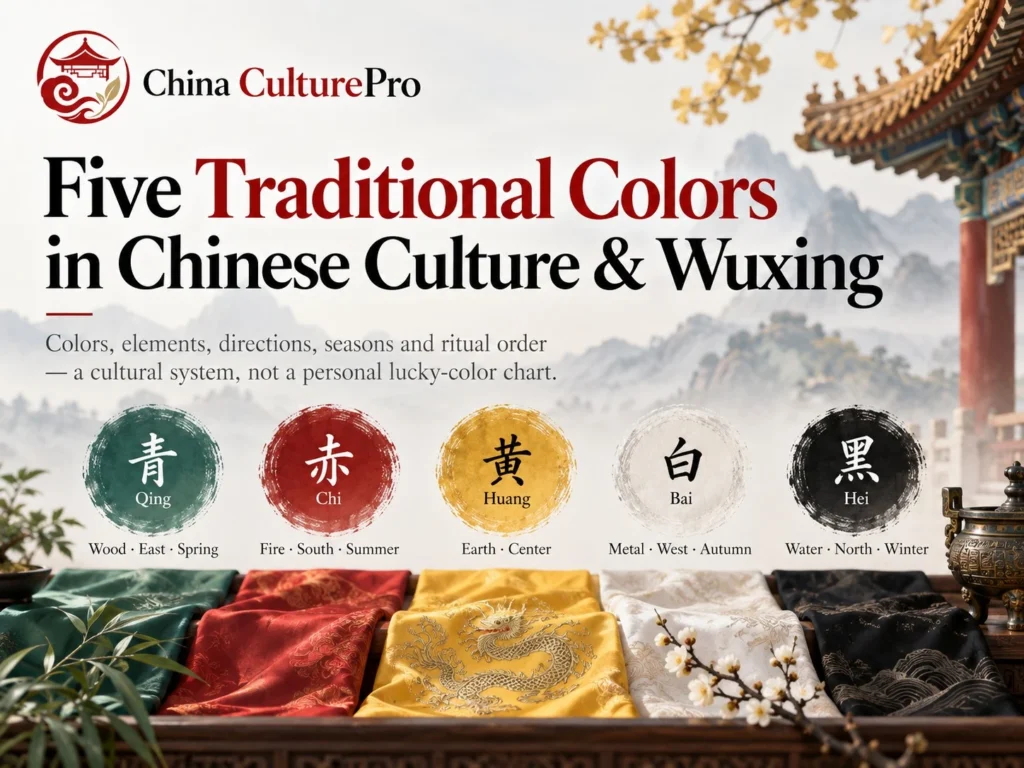
The Five Colors (五色, wǔsè) form the canonical Chinese color set. In the best-known Wuxing (五行, wǔxíng) model—better translated as the Five Phases rather than five fixed substances—they organize relationships among color, direction, season, and ritual order.[1][2]
- Qing (青, qīng): Wood, east, and spring; emergence and growth.[3]
- Chi (赤, chì): Fire, south, and summer; heat and flourishing brightness.
- Huang (黄, huáng): Earth and the center; support, balance, and ordered space.
- Bai (白, bái): Metal, west, and autumn; contraction and restraint.
- Hei (黑, hēi): Water, north, and winter; depth, storage, and stillness.
This is a historical relationship model, not a fixed palette or a list of personal lucky colors. Its details developed over time, and a color on an object does not automatically activate every association in the chart.
Many English-language summaries reduce the Five Traditional Colors in Chinese culture to five lucky swatches or a simple Five Elements chart. That misses the system’s real complexity. The colors were shaped by historical vocabulary, ritual classification, cosmological thought, pigments, dyes, and the changing uses of objects. Early Chinese color categories were closely tied to the material or surface that carried color rather than to an abstract spectrum alone.[1]
The result is not one timeless code. A classical text, a seasonal ritual, a court robe, a tomb mural, and a modern poster may use similar colors for different reasons. This guide explains the best-known correspondences, shows how they formed, and gives a practical method for deciding when the Five-Color model is relevant.
What the Five Colors System Actually Is
The Five Colors are a relational classification system. In its narrow ritual and cosmological sense, the term names the canonical five-part set. In wider literary usage, however, “five colors” can simply mean many colors or a richly multicolored display. Context determines whether a passage names the canonical set or uses five as a conventional expression of variety.
This distinction is central to accurate interpretation. The narrow system connects visible categories with directions, seasons, natural processes, and forms of human order. The wider expression describes visual abundance. A lacquer box decorated in many hues is not automatically a diagram of the Five Phases. The arrangement, purpose, inscription, and historical context must support that reading.
For a broader guide to how period, material, ritual, and custom change color meanings, see Chinese color meanings and symbolism.
Wuse and Wuxing Are Related but Not Identical
Wuse (五色, wǔsè) names a set of color categories. Wuxing is a much broader model of processes and relationships commonly rendered as Wood, Fire, Earth, Metal, and Water. “Five Phases” is often the clearer English translation because the model concerns movement, transformation, and patterned interaction, not five inert building blocks.
The Five Colors can be discussed without turning every object into a Wuxing diagram. A craft text may describe colors and materials; a poem may use a color for landscape or emotion; a ritual text may place the color inside a larger set of seasonal correspondences. Mature correlative systems brought these fields together, but their connection is analytical and historical, not automatic.
This is also why the Five Colors should not be used as a personal fortune tool. Historical correlations can explain why a direction, season, ceremonial object, or court practice used a color. They do not demonstrate that wearing a corresponding shade changes health, wealth, or fate.
Canonical Colors and Intermediate Colors
Later ritual and commentarial theory distinguishes canonical colors (正色, zhèngsè) from intermediate colors (间色, jiànsè). The five canonical colors represent primary, properly ordered categories within that framework. Intermediate colors such as purple and green could be explained as derived or combined colors. This was a classification of ritual legitimacy and order, not a universal recipe for physically mixing pigments.
The familiar line about disliking purple for “displacing” vermilion appears in the Analects. Traditional commentary identifies vermilion as a canonical color and purple as an attractive intermediate color, making the criticism about an improper replacement of the established category—not a claim that purple itself was evil or forbidden.[4] The later history of purple in Chinese culture shows how dramatically a color’s rank could change.
Canonical and intermediate categories also varied across periods and commentarial traditions. They should not be projected indiscriminately onto every painting, textile, ceramic glaze, or modern design.
The Five Colors and Wuxing Correspondence Table
The table below presents the most widely transmitted Five-Color framework. It is useful as a map of relationships, not as proof that every item of the same hue carries the same meaning. The Artificers’ Record associates qing, chi, bai, and hei with the four directions while also pairing Xuan (玄, xuán) with heaven and yellow with earth; calendrical texts developed more integrated seasonal schemes.[2][5]
| Traditional color | English handling | Five Phase | Direction | Seasonal position | Systemic image | Interpretive limit |
|---|---|---|---|---|---|---|
| Qing (青, qīng) | Keep qing when the historical category matters | Wood | East | Spring | Emergence and new growth | Qing can cover modern green, blue, gray-green, and dark ranges; not every qing object “belongs to Wood” |
| Chi (赤, chì) | Chi or canonical red | Fire | South | Summer | Heat, rising energy, and brilliance | Chi is not interchangeable with every shade called red in modern Mandarin |
| Huang (黄, huáng) | Yellow | Earth | Center | Late summer or seasonal transitions in different schemes | Centering, support, and ordered space | Later imperial status is an added historical layer, not the original meaning of this row |
| Bai (白, bái) | White | Metal | West | Autumn | Contraction, clarity, and restraint | This correspondence does not make white a universal color of death |
| Hei (黑, hēi) | Black; distinguish Xuan (玄, xuán) where the text does | Water | North | Winter | Depth, storage, and stillness | The category has no inherent meaning of evil or misfortune |
These rows should not be converted into RGB or HEX values. Historical colors depended on plants, minerals, binders, textile fibers, glaze chemistry, firing, surface finish, aging, and language. Even when two objects share a color name, their actual appearance and cultural work may differ.
Why Five Colors Do Not Map Neatly onto Four Seasons and Four Symbols
The Five Directions (五方, wǔfāng) consist of east, south, west, north, and a center. Four seasons and the Four Symbols (四象, sìxiàng), by contrast, are four-part structures. The mismatch is built into the models: yellow and Earth occupy the center, while spring, summer, autumn, and winter move around the four directions.
In the directional set, the Azure Dragon (青龙, Qīnglóng) belongs to the east, the Vermilion Bird (朱雀, Zhūquè) to the south, the White Tiger (白虎, Báihǔ) to the west, and the Black Tortoise (玄武, Xuánwǔ), also called the Black Warrior, to the north. The system has no single universally canonical central animal. Yellow Dragon and qilin appear as central figures in later variants, but neither is an original companion required in every Five-Color scheme.
Earth’s seasonal place is likewise variable. Some transmitted correlations assign it to late summer; others let Earth govern transitions between seasons. These are alternative ways of fitting a central fifth phase into a four-season cycle, not an error that can be solved by choosing one permanent answer.
What Each of the Five Colors Means in the System
Each color has a defined job inside the Five-Color correspondence, but that job is narrower than the color’s complete cultural history. The descriptions below explain the systemic layer only; the linked guides cover changing materials, customs, taboos, and later meanings.
Qing: Wood, East and Spring
Qing corresponds to Wood, the east, and spring. Its primary systemic image is emergence: plants sprout, days lengthen, and the seasonal cycle begins again. This connection helps explain why qing became productive in words related to youth, fresh vegetation, and early growth.
Qing is not one fixed hue. Historical usage can describe green plants, a blue sky, blue-green ceramic glaze, or dark hair. Linguistic analysis places it across a green-blue continuum that can extend toward dark tones; this difference in vocabulary does not mean historical viewers could not distinguish the colors they saw.[3] The dedicated guide to qing in Chinese culture explains those translation choices, while the green and blue guides cover the narrower modern categories.
Chi: Fire, South and Summer
Chi corresponds to Fire, the south, and summer. Within the system it evokes heat, upward movement, fullness, and brightness. These are seasonal and cosmological relationships, not a complete explanation of why later weddings and New Year celebrations favored red.
Chi, zhu, dan, and the broad modern word hong all belong to the history of Chinese red terminology, but they are not perfect synonyms. Chi is the canonical category used in the Five-Color model; zhu often names vermilion or a vermilion-like red in particular material and textual settings; modern hong covers a much wider everyday range. The red meaning in Chinese culture guide separates this ritual layer from festive, documentary, architectural, and modern political uses.
Huang: Earth, Center and Ordered Space
Huang corresponds to Earth and the center. The relationship comes from a spatial model in which the central ground supports and coordinates the four surrounding directions. Its systemic meanings are therefore centrality, support, balance, and an ordered field—not “imperial power” by default.
Yellow’s courtly prestige accumulated later through changing dynastic rules for garments, buildings, and objects. Those institutional uses should not be read backward as the original reason yellow occupied the center. The full guide to yellow in Chinese culture distinguishes the Wuxing category from later imperial shades, religious use, ordinary yellow materials, and modern language.
Bai: Metal, West and Autumn
Bai corresponds to Metal, the west, and autumn. Inside the model it marks contraction, ripening, restraint, and the turning of the seasonal cycle toward closure. These associations come from the correlative structure; they do not make every white object austere or funerary.
Traditional white mourning dress belongs to a separate system of kinship, material plainness, and ritual conduct. It can overlap with broader ideas of restraint, but it is not simply caused by the Wuxing row for white. White porcelain, unpainted paper, pale jade, and modern clothing also require their own material and social contexts. See the guide to white in Chinese culture for those distinctions.
Hei: Water, North and Winter
Hei corresponds to Water, the north, and winter. Its systemic images are depth, stillness, storage, and the hidden potential of the cold season. None of these qualities is a moral judgment, and black has no built-in Chinese meaning of evil.
Classical texts may use xuan (玄, xuán) for a profound, dark, or blackish tone, especially in cosmological or literary language. Xuan is related to the history of dark-color terms but should not be flattened into modern pure black. Ink painting, lacquer, Qin political color, opera makeup, and modern negative compounds all belong to other contexts explained in the guide to black in Chinese culture.
How the Five-Color System Developed Over Time
The Five-Color system was not invented in a single book or installed across China at one moment. The strongest historical model is gradual formation. Archaeological materials and transmitted texts show changing ritual selections, technical vocabularies, and correlative schemes rather than one perfectly consistent chart from the earliest period.[1][6]
- Early ritual distinctions: In Shang and Zhou settings, color already mattered in sacrificial choices, painted surfaces, textiles, and ceremonial objects. These practices provided important material and ritual foundations, but they did not yet amount to the complete popular chart now reproduced online.
- Late Zhou and Warring States correlation: Texts increasingly connected colors with directions, materials, seasons, and political order. The Artificers’ Record is especially important because it gives qing to the east, chi to the south, bai to the west, and hei to the north, while setting xuan and yellow in a heaven-and-earth pairing.[2] That passage is close to the mature system, but it is not identical to a later five-row table.
- Han-era synthesis and transmission: Calendrical and cosmological writings brought color, phase, direction, season, ritual action, and political order into denser networks. The Monthly Ordinances associates seasonal courts and rites with changing colors and other correspondences.[5] These transmitted models became highly influential, while later commentators continued to adjust details.
The dates and layers of classical compilations remain subjects of scholarship, and surviving objects do not always behave like idealized textual charts. That is not a failure of the evidence. It shows that a prescriptive model, a workshop practice, and a local ritual could overlap without being identical.
How the Five Colors Worked in Ritual, Clothing and Art
The Five Colors gave historical communities a language for organizing space, season, ceremony, and status. Their actual use depended on the carrier. Scholarship on early East Asian color emphasizes both symbolic systems and the material technologies that made colored surfaces possible.[6]
| Carrier | What color could do | Evidence to look for | Do not automatically infer |
|---|---|---|---|
| Ritual and calendrical texts | Coordinate season, direction, offerings, clothing, and court action | Named month, direction, phase, prescribed object, or formal color term | Every later ritual followed one unchanged chart |
| Tomb and architectural programs | Orient images and spaces through directional schemes | Placement, Four Symbols, inscription, tomb plan, or excavation report | Any four colored animals form a canonical directional set |
| Court dress and ceremonial textiles | Mark rank, occasion, season, or institutional order | Dynasty-specific regulation, garment type, wearer, motif, and textile analysis | Color alone identifies an emperor or official |
| Painting, lacquer, ceramics, and craft | Express material technique, genre, surface, and sometimes symbolic order | Pigment, dye, glaze, recipe, composition, title, or museum catalog | Five visible hues automatically encode Wuxing |
The same visual palette can therefore perform different tasks. Five dyes in an embroidered border may be decorative; five directional zones around a central yellow field may be structural; a restored pigment may reveal workshop technology rather than symbolism. Interpretation becomes reliable only when color, placement, object function, and textual evidence point in the same direction.
How to Interpret a Five-Color Scheme Correctly
Use this sequence for a museum object, historical text, garment reconstruction, decorative motif, or modern design that claims to use the Five Colors:
- Date the source: Decide whether the evidence belongs to Shang-Zhou ritual practice, a late Zhou or Warring States text, a Han synthesis, a later court regulation, or modern reinterpretation.
- Check the original color words: Distinguish qing from modern blue or green, chi from the broad modern category red, and hei from xuan where the source does so.
- Test the set and arrangement: Ask whether all five canonical colors appear and whether their directions, center, sequence, or seasonal relationships are visible. One or two matching colors are weak evidence.
- Identify the carrier’s job: Determine whether the object is ritual, calendrical, official, funerary, artistic, technical, or simply decorative. The medium controls which meaning is plausible.
- Look for independent support: Use an inscription, title, recipe, regulation, excavation context, or museum catalog to confirm that the Five-Color model is intended.
When evidence is incomplete, the safest reading is material or decorative: identify the dye, pigment, glaze, surface, or aesthetic function without upgrading it into cosmology. A modern designer may consciously reuse the old mapping, but that should be described as a modern interpretation rather than proof of an ancient rule.
Common Misreadings of the Five Traditional Colors
- Misreading: The Five Colors have exact RGB or HEX values. Historical categories depended on words, materials, processes, and surfaces. No digital swatch can represent every historical qing, chi, huang, bai, or hei.
- Misreading: Qing means either pure blue or pure green. Qing is a broad historical category whose English translation changes with the object and phrase.
- Misreading: Chi is simply the modern word for red. Chi is the canonical red category in this system; hong, zhu, and dan have overlapping but different histories and uses.
- Misreading: The complete chart was fixed from the beginning of Chinese history. Early ritual color choices and classical mappings developed in stages. The familiar integrated table reflects later synthesis and transmission.
- Misreading: Yellow was always superior because it belongs at the center. Central Earth is a structural relationship. Restricted imperial yellows were created by later court institutions.
- Misreading: White means death and black means evil. Those shortcuts ignore the correspondence model, in which white marks Metal and autumn while black marks Water and winter. Mourning and negative language require separate contexts.
- Misreading: Gold and purple are also canonical Five Colors. The canonical set contains only qing, chi, huang, bai, and hei. Gold is primarily a material and surface category, while purple occupies a different historical classification.
- Misreading: Wuxing colors can diagnose or change personal fortune. The historical system organized relationships in cosmology and ritual. It does not provide evidence for color healing, protection, or guaranteed luck.
FAQs About the Five Traditional Colors in Chinese Culture
What are the five traditional Chinese colors?
The five canonical colors are qing, chi, huang, bai, and hei. In simplified modern English they are often described as blue-green, red, yellow, white, and black, but qing and chi require more careful historical translation.
How do the Five Colors correspond to Wuxing?
The best-known mapping pairs qing with Wood and east, chi with Fire and south, huang with Earth and the center, bai with Metal and west, and hei with Water and north. This is a relational cosmological and ritual model, not a list of five physical substances.
Is qing blue or green?
Qing can be blue, green, blue-green, gray-green, or dark depending on the object and period. Green vegetation, blue sky, dark hair, and celadon glaze can all use qing-related vocabulary, so translation must follow context.
Why is yellow placed at the center?
The model uses five spatial positions: four directions plus a center. Earth and yellow occupy the center because the ground supports and coordinates the surrounding directions. That structural role does not mean yellow was always an imperial monopoly or inherently superior.
Are the Five Colors lucky colors?
No. They are historical categories used in ritual, cosmology, technical writing, and material culture. Individual colors may gain auspicious meanings in specific customs, but the Five-Color correspondence itself is not a personal luck chart.
Sources
[1] Victoria Bogushevskaya. Chinese Color Language
[2] Chinese Text Project. The Artificers’ Record in the Rites of Zhou
[3] Victoria Bogushevskaya. GRUE in Chinese: On the Original Meaning and Evolution of Qing
[4] Chinese Text Project. The Analects with Commentary: Yang Huo
[5] Chinese Text Project. Book of Rites: Monthly Ordinances
[6] Spencer Museum of Art. Color in Ancient and Medieval East Asia