
Quick Answer: What Does the Vermilion Bird Symbolize?
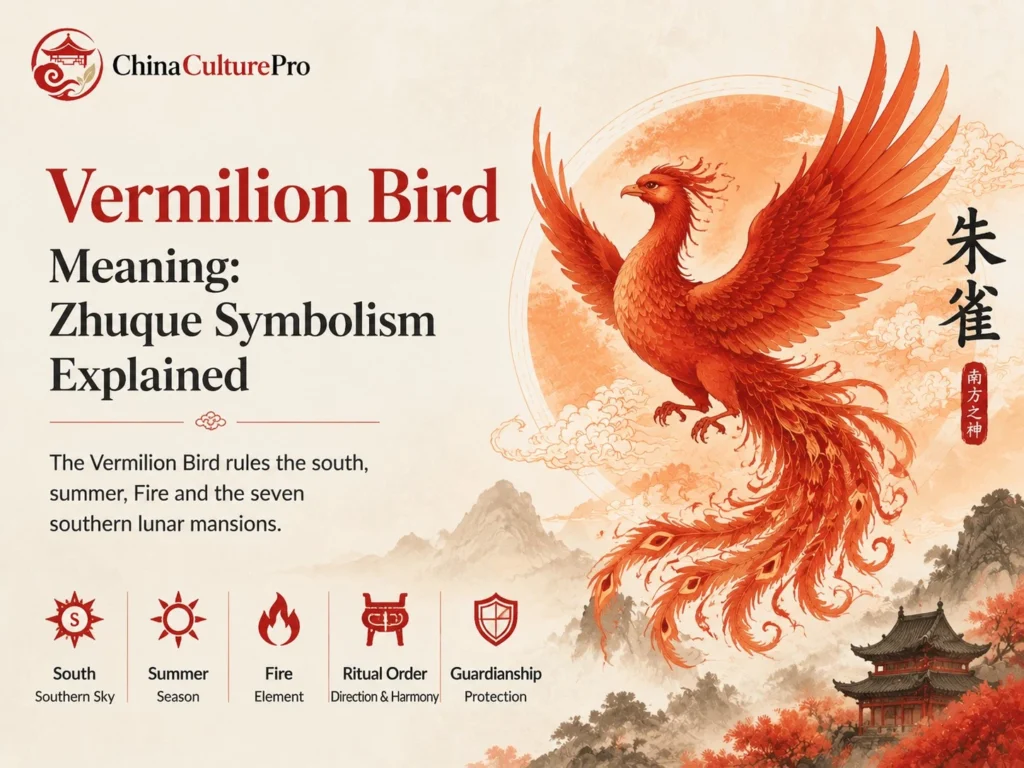
The Vermilion Bird (朱雀, Zhūquè) symbolizes the southern sky within the Four Symbols of Chinese mythology. Its foundation is astronomical: Zhuque gives visual form to the seven southern lunar mansions and connects south with summer, the Fire phase, and the season’s full expansion. Ritual, funerary, Daoist, and modern meanings developed later. It is neither the Chinese Fenghuang nor the Western phoenix that dies and rises from its ashes.
- South and the southern sky: Zhuque identifies the southern celestial quadrant.
- Summer and the Fire phase: It represents heat, brightness, expansion, and seasonal fullness within correlative cosmology—not literal burning.
- Directional and ritual order: It marks the south or front in conventional spatial and ceremonial layouts.
- Later guardianship: Tomb art and Daoist traditions developed protective and personified forms of the emblem.
- Modern cultural expression: Designers use Zhuque to evoke the south, summer, brilliance, and the visual language of the Four Symbols.
For the wider visual system, see Chinese symbols and their meanings.
The Vermilion Bird is often presented online as a red, flame-covered phoenix with powers of rebirth. Historical Chinese objects tell a different story. An eleventh-century Northern Song funerary model at The Metropolitan Museum of Art represents the Red Bird of the South in pale qingbai porcelain, without red plumage or a body engulfed in fire.[1] That restrained object points back to Zhuque’s central identity: not a fantasy fire bird, but the avian emblem of the southern quarter of an ordered cosmos. Its meanings changed as it moved from astronomy into ritual, tombs, Daoism, and modern design, so period and context matter more than color alone.
What Is the Vermilion Bird in Chinese Mythology?
The Vermilion Bird, written 朱雀 in both simplified and traditional Chinese and pronounced Zhūquè, is the southern member of the Four Symbols. It represents the seven southern lunar mansions within China’s traditional twenty-eight-mansion system. Zhuque is therefore a visual emblem for a broad region of the sky, not one star, a single modern constellation, or a real species.[2]
Vermilion Bird is the most precise standard English name because it preserves the cosmological color association in 朱. Museums also use Red Bird. Both names refer to Zhuque; they do not identify two different beings. Nor does 雀 require the image to be a literal sparrow. In this name, the bird supplies an emblematic form for the southern celestial group.
Zhuque belongs to the Chinese mythical-creature system in a broad visual sense, but its earliest function is cosmological rather than narrative. Early sources give it no canonical biography or set of magical abilities. Later religious and modern personifications do not define every historical image.
The most important boundary is between the Four Symbols and the Four Auspicious Creatures. Zhuque belongs to the directional set of Azure Dragon, Vermilion Bird, White Tiger, and Black Warrior. Fenghuang belongs to the auspicious set of Qilin, Fenghuang, tortoise, and dragon. Similar English labels such as “four sacred beasts” can blur this distinction, so the Chinese group name and the object’s context should always be checked.
What the Vermilion Bird Means in Different Contexts
No single definition covers every Zhuque image. A celestial diagram, palace layout, tomb figure, Daoist talisman, and video-game character activate different historical layers. The following matrix separates those layers before they are combined into a vague idea of “fire” or “good luck.”
| Context | Primary meaning | Typical carrier | Interpretation limit |
|---|---|---|---|
| Astronomy and the southern sky | The seven southern lunar mansions organized as one celestial emblem | Astronomical texts, star diagrams, cosmological art | Not one IAU constellation and not originally a personal-luck or moral symbol |
| Summer and the Fire phase | South, summer, vermilion, and Fire within a coordinated correlative system | Calendrical diagrams, Han ritual art, Five Phases texts | Fire is a cosmological category here, not proof of literal flames, destruction, or rebirth |
| Ritual, military, and spatial order | The south or front within a conventional south-facing formation | Banners, processions, court plans, military formations | A rule for orientation and ceremony, not a promise of supernatural protection |
| Tombs and protective space | The southern side of a tomb and the ordered cosmos surrounding the deceased | Han tiles and mirrors, tomb murals, Song funerary models | A funerary function that should not be imposed on every bird motif |
| Later Daoist religion | A southern guardian personified as Lingguang Shenjun | Daoist texts, ritual prints, and temple imagery | A later religious identity, not the original definition of pre-imperial astronomy |
| Traditional feng shui | The open southern or “Vermilion Bird” side in a site arrangement | Landscape and architectural interpretation | A traditional spatial model, not a verified method for changing wealth or destiny |
| Modern art and popular culture | Southern identity, brilliance, seasonal energy, or Chinese-inspired fantasy | Logos, tattoos, games, film, fashion, and cultural products | Flames, resurrection, combat ranks, and personality may be modern inventions |
These readings are historically connected without being interchangeable. Good interpretation names the active layer, explains when it developed, and avoids turning a cultural association into a deterministic claim.
Why Is Zhuque Associated With Vermilion, Summer, and Fire?
The “vermilion” in Vermilion Bird first identifies a place in a cosmological correspondence system; it does not require every artwork to show red feathers. In the mature Four Symbols framework, four directions are coordinated with seasons, colors, and Five Phases: east–spring–blue-green–Wood; south–summer–vermilion–Fire; west–autumn–white–Metal; and north–winter–dark–Water. Zhuque gathers the southern set into one memorable image.
Vermilion is more specific than generic “red” in this name. It evokes the traditional 朱 color category used in ritual and cosmological classification. For its wider historical and modern contexts, see what red means in Chinese culture. Later celebratory meanings should not be projected automatically onto celestial Zhuque.
Summer contributes ideas of warmth, brightness, growth at full extension, and a season reaching its expansive phase. Fire serves as the corresponding phase in the Five Phases model. It does not mean that an astronomical or funerary Zhuque literally burns, destroys itself, purifies souls, or returns from ashes. Those claims often import the Western phoenix story into a Chinese directional emblem.
Material evidence also warns against a pigment test. Western Han roof-tile ends present the Red Bird and White Tiger in the earthy tones of fired clay; Eastern Han mirrors render the four directional beings in bronze; and the Northern Song model at The Met has a bluish-white glaze.[1][3][4] An artwork can depict Zhuque without any surviving red paint. Identity is established through position, companions, inscription, object type, and documented function rather than hue alone.
The Vermilion Bird and the Seven Southern Lunar Mansions
Traditional Chinese astronomy divided a broad belt of the sky into twenty-eight lunar mansions and arranged them in four groups of seven. The southern group forms Zhuque: Well, Ghosts, Willow, Star, Extended Net, Wings, and Chariot.[2]
| Chinese | Pinyin | Standard English name | Position in the southern group | Approximate modern sky region |
|---|---|---|---|---|
| 井 | Jǐng | Well | First southern mansion | Gemini |
| 鬼 | Guǐ | Ghosts | Second southern mansion | Cancer |
| 柳 | Liǔ | Willow | Third southern mansion | Hydra |
| 星 | Xīng | Star | Fourth southern mansion | Hydra |
| 张 / 張 | Zhāng | Extended Net | Fifth southern mansion | Hydra |
| 翼 | Yì | Wings | Sixth southern mansion | Hydra and Crater |
| 轸 / 軫 | Zhěn | Chariot | Seventh southern mansion | Corvus |
The modern-region column is only a locating aid. Chinese lunar mansions and modern International Astronomical Union constellations divide the sky according to different boundaries and purposes. One mansion is not equivalent to one Western constellation, and several mansions can overlap regions that modern viewers place in the same constellation.
The English names are translations of the traditional mansion names, not summaries of fixed supernatural functions. Ghosts, for example, is a historical star-region name; it does not automatically make the mansion evil, haunted, or unlucky. Likewise, popular diagrams that assign each mansion an exact feather, organ, magical skill, or sphere of human destiny may reflect later commentary or modern synthesis rather than one stable ancient standard.
What can be stated securely is the ordered sequence and the membership of all seven in the southern group. Together, the mansions helped structure celestial observation and seasonal timekeeping, while the bird made that large sky region visually memorable. Zhuque’s association with summer and the south arises from this system-level relationship, not from the biology or behavior of a real red bird.
How Vermilion Bird Symbolism Developed Through History
From the Southern Red Bird to Han Standardization
Zhuque developed gradually. Isolated bird designs from prehistoric and early bronze-age art cannot be labeled Vermilion Birds simply because they are old or stylized. A secure identification requires directional, textual, or compositional evidence that connects a bird with the southern quarter.
The Book of Rites preserves a directional formation with the Red Bird in front, Black Warrior behind, Azure Dragon on the left, and White Tiger on the right.[5] In the conventional south-facing viewpoint, front corresponds to south, left to east, right to west, and rear to north. This record shows that the avian southern emblem already functioned within an organized ritual vocabulary; it is not a biography of a supernatural bird.
Han material culture made the system especially visible. Western Han roof-tile ends at The Met depict the White Tiger of the West and Red Bird of the South, showing that directional creatures could mark architectural space without the full set.[3] They represent west and south, not a north–south opposition.
By the Eastern Han, TLV or “game-board” mirrors could combine all four directional animals with a square center, circular outer field, and the twelve earthly branches. The Met’s example makes a compact cosmogram: the square evokes earth, the circle heaven, and the animals give the four quarters recognizable forms.[4] These objects show Zhuque as part of a system, not as an isolated lucky bird.
From Directional Emblem to Daoist Guardian
As Four Symbols imagery entered tombs, Zhuque acquired a protective spatial function. It could mark the southern wall or appear among objects that organized the burial chamber as a miniature cosmos. Protection in this setting means maintaining an ordered boundary and placing the deceased within a complete directional world. It does not mean that any Vermilion Bird decoration guarantees safety.
The Northern Song porcelain model at The Met demonstrates that the emblem could also appear alone in a tomb.[1] Its museum identification and funerary context establish the bird as Zhuque even though the other three symbols are absent. The object also shows why a fixed red-and-flame template fails: medium and ritual function can communicate identity without literal cosmological color.
Later Daoist traditions personified the four directional beings. The Yunji Qiqian names the Vermilion Bird Lingguang, alongside Mengzhang for the Azure Dragon, Jianbing for the White Tiger, and Zhiming for the Black Warrior.[6] Lingguang Shenjun can therefore be understood as a later divine title for the southern guardian, not as the original personality of every earlier Zhuque.
An early twentieth-century woodblock print in The Met, titled Paper Talisman with the Vermilion-bird God of the South, provides direct material evidence for this religious form.[7] The leap from celestial emblem to named god is a historical development. The astronomical, funerary, and religious layers can coexist, but the date and setting determine which one should lead an interpretation.
How to Recognize the Vermilion Bird in Chinese Art
Red pigment, flames, a crown, or an elaborate tail cannot identify Zhuque on their own. A plain ceramic bird can be Zhuque, while a red decorative bird may be a Fenghuang, ordinary bird, or modern fantasy creature. Use a context-first method:
- Check the larger composition: A bird within a complete Four Symbols set is the strongest starting clue.
- Reconstruct the orientation: In a conventional south-facing layout, Zhuque occupies the south or front. Determine whether the image uses the viewer’s, tomb occupant’s, wearer’s, or reflected viewpoint.
- Look for companion signs: The other three symbols, mansion names, earthly branches, directional labels, or a square-and-circle cosmogram strengthen the identification.
- Identify the medium and setting: Han tile ends and mirrors, tomb murals and models, ritual banners, and Daoist talismans each supply different contextual evidence.
- Check inscriptions: 朱雀, 朱鸟 / 朱鳥, or 陵光 can identify a celestial or religious form directly.
- Date the style: Han birds can be lean and linear; Tang and Song forms may be fuller; later religious images may look more personified. No one silhouette covers every period.
- Reject a color-only test: Clay, bronze, stone, ink, pale glaze, and multicolored paint can all carry Zhuque imagery.
This is the same evidence-based method used to read Chinese symbolism in art: identify the system, position, period, carrier, inscription, and companion motifs before assigning meaning.
Vermilion Bird vs. Fenghuang and the Western Phoenix
English pages often call all three beings “phoenix,” but they belong to different systems. Zhuque organizes the southern sky; Fenghuang expresses auspicious and moral order in Chinese tradition; the Western phoenix centers on a death-and-renewal cycle.
| Symbol | Cultural system | Core identity | Direction and season | Primary symbolism | Defining distinction |
|---|---|---|---|---|---|
| Vermilion Bird (Zhuque) | Chinese Four Symbols astronomy and ritual | Emblem of the seven southern lunar mansions | Fixed south; associated with summer and Fire | Cosmic direction, seasonal order, later guardianship | No original death-by-fire or rebirth cycle |
| Fenghuang | Chinese auspicious, ritual, court, and folk traditions | Composite auspicious bird associated with virtue and harmonious rule | No single fixed direction or season | Virtue, peace, noble status, and auspicious union in context | A dragon pairing can create marriage symbolism; it is not Zhuque |
| Western phoenix | Classical and later Western myth traditions | Long-lived bird renewed through fire and ashes | No Chinese Four Symbols position | Renewal, resurrection, continuity, and immortality | Rising from ashes is central to later Western symbolism |
The Met describes the phoenix as dying by fire and a new bird rising from the ashes, making it a symbol of eternal life and resurrection.[8]
The detailed Chinese Phoenix Fenghuang guide explains why Fenghuang is not merely a Chinese version of the Western bird. It also prevents another error: marriage symbolism belongs to a dragon–Fenghuang pairing, not to Zhuque by itself.
Modern artists may combine Zhuque with flames or rebirth imagery. Such fusion should be labeled modern interpretation rather than ancient meaning. If an explanation depends on death, ashes, and resurrection, it draws on Western phoenix lore, not the foundational Four Symbols system.
Vermilion Bird and Black Warrior: How the South–North Pair Works
Zhuque and the Black Tortoise–Snake, or Black Warrior, form the north–south axis of the Four Symbols. Their relationship is complementary: south and north, summer and winter, Fire and Water, seasonal expansion and seasonal stillness. Classical cosmology does not rank one above the other or describe them as combatants.
The Book of Rites places the Vermilion Bird in front and Black Warrior behind in a conventional formation.[5] This makes sense from a south-facing position: front is south and rear is north. The same layout puts the Azure Dragon to the east or left and the White Tiger to the west or right.
A mirror, mural, garment, or digital reproduction may appear reversed because of reflection, viewing direction, or the original user’s position. Do not diagnose an error from a cropped image alone. Reconstruct the full spatial frame and determine whose front, rear, left, and right the design represents. Claims that Zhuque defeats Xuanwu through elemental fire, or that the pair stages a permanent Fire–Water war, are modern narrative additions rather than a rule of the traditional directional system.
How to Interpret or Use a Vermilion Bird Symbol Correctly
For museum study, clothing, architecture, logos, tattoos, or other permanent designs, apply a short context-first check:
- Name the intended bird: Decide whether the design represents Zhuque, Fenghuang, a Western phoenix, or a generic bird motif.
- Choose the historical layer: Astronomy, ritual order, tomb guardianship, Daoist religion, and modern fantasy are connected but should not be collapsed into one claim.
- Match the message: Zhuque fits south, summer, Fire, seasonal brilliance, directional balance, or the Four Symbols more naturally than romance, generic wealth, or resurrection.
- Build identity through context: Use orientation, companion emblems, celestial references, or an accurate inscription instead of relying only on red feathers and flames.
- Separate inheritance from invention: Fire effects, combat abilities, rebirth, fixed gender, and personality can be creative choices, but they are not universal historical attributes.
- Review the entire composition: When all four symbols appear, check the intended viewing direction and keep their relationships coherent.
- Verify permanent or commercial work: Compare the design with museum objects, proofread Chinese text, and have the complete cultural claim reviewed before production. The guide to Chinese tattoo symbols and meanings provides additional safeguards.
Modern adaptation need not imitate one antique object. Responsible use distinguishes historical layers from newly invented elements and avoids suggesting that a logo, ornament, or tattoo guarantees protection, wealth, or transformation.
Final Takeaway
The Vermilion Bird is best understood as the avian form of an ancient southern sky map. Its foundation is the seven southern lunar mansions, coordinated with south, summer, vermilion, and the Fire phase. Ritual orientation, tomb guardianship, Daoist personification, and modern flame imagery are later layers. To read Zhuque accurately, check the date, medium, position, and companion symbols before relying on red color or phoenix lore.
FAQs About Vermilion Bird Meaning and Symbolism
How Do You Pronounce Zhuque?
In standard Mandarin, Zhūquè has a high, level first tone on zhū and a falling fourth tone on què. A rough English aid is “joo-chweh,” although English spelling cannot reproduce the consonants and tones precisely. Zhuque is the standard pinyin romanization, while “Vermilion Bird” is the usual descriptive English translation.
Is the Vermilion Bird Part of the Chinese Zodiac?
No. Zhuque belongs to the Four Symbols, a system of celestial directions and seasons. The Chinese zodiac is a separate twelve-animal cycle used to name years and structure calendrical folklore. The two systems have different members, functions, and histories; no Vermilion Bird year exists in the traditional zodiac.
Is the Vermilion Bird Male or Female?
Traditional astronomical descriptions do not give Zhuque a fixed biological sex. Its associations with summer, Fire, brightness, or yang qualities describe relationships in cosmology rather than anatomy or gender. A novel, game, tattoo, or illustration may portray the bird as male or female, but that is a creative choice, not a universal rule from classical tradition.
Is the Vermilion Bird the Strongest of the Four Symbols?
No traditional Four Symbols system ranks the beings by combat strength. Each governs a different celestial quarter and seasonal relationship, so Zhuque’s southern position does not make it superior to the Azure Dragon, White Tiger, or Black Warrior. Power tiers, elemental attacks, and battles among them generally belong to modern fantasy storytelling.
Are Zhuque, Japanese Suzaku, Korean Jujak, and Vietnamese Chu Tước Identical?
No. These traditions share historical roots in the East Asian transmission of directional astronomy and ritual imagery, but each culture developed localized names, religious roles, artistic conventions, and popular interpretations. Shared ancestry does not make every later image interchangeable. Identify the country, period, and setting before applying a Chinese Zhuque explanation to another regional form.
Does the Vermilion Bird Have One Fixed Myth or Personality?
No. Zhuque began as a celestial and directional emblem rather than the protagonist of one continuous myth. Classical and later sources add ritual, funerary, and Daoist layers, but they do not produce a single biography or temperament valid for every period. A named guardian such as Lingguang Shenjun belongs to a later religious context, while vivid personalities and supernatural skill sets are usually modern inventions.
Sources
[1] The Metropolitan Museum of Art. Model of Red Bird, Symbol of the South (Zhuque)
[2] Hong Kong Space Museum. Glossary of Chinese Star Regions, Asterisms and Star Names
[3] The Metropolitan Museum of Art. Roof Tile Ends Decorated with the White Tiger of the West and the Red Bird of the South
[4] The Metropolitan Museum of Art. Mirror with Game Board Design and Animals of the Four Directions
[5] Chinese Text Project. Book of Rites: Qu Li I
[6] Wikisource. Yunji Qiqian, Volume 14
[7] The Metropolitan Museum of Art. Paper Talisman with the Vermilion-bird God of the South
[8] The Metropolitan Museum of Art. Evening Dress with Phoenix Motif