
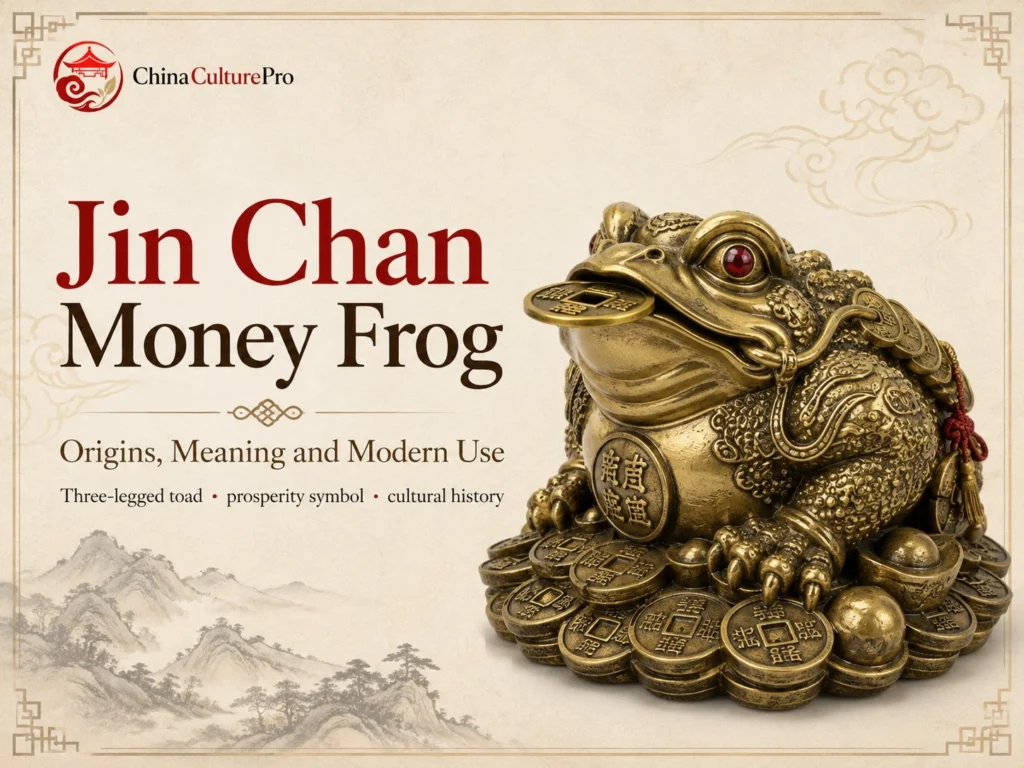

Quick Answer: What Does the Jin Chan Money Frog Symbolize?
Jin Chan (金蟾, Jīnchán) is a mythical three-legged toad in Chinese culture. It most often symbolizes prosperity, auspicious opportunity, and the circulation or retention of wealth, but its exact meaning depends on the period and object. “Money Frog” is the familiar English name. “Money Toad” identifies the animal more accurately, while “Golden Toad” translates the Chinese name more literally.
- Prosperity and material abundance: Historical objects connect the three-legged toad with prosperity and, in a scholar’s setting, examination success.
- Liu Hai and the coin-string motif: Images of Liu Haichan summoning the toad with cash express changing attitudes toward money and fortune.
- Lunar and immortality associations: Older toad imagery belongs to Chinese ideas about the moon, the otherworld, and transcendence.
- Modern wealth retention: Contemporary figurines use mouth coins, ingots, and cash piles to visualize attracting and keeping money.
These meanings do not apply simultaneously to every three-legged toad. Jin Chan is a cultural symbol, not a mechanism proven to create wealth.
The coin-holding, three-legged Jin Chan sold today is a recognizable Chinese wealth symbol. Yet a fourteenth-century copper-alloy water dropper shaped like a three-legged toad has no removable mouth coin or pile of ingots. It was a scholar’s tool that already represented prosperity and civil-service examination success.[1]
Jin Chan is older and more layered than the modern “money frog.” Its imagery grew from lunar mythology, stories about Liu Haichan, scholar’s objects, and late-imperial art before becoming a standardized commercial figurine.
What Is Jin Chan?
Jin Chan is written 金蟾 and pronounced Jīnchán. Jin (金) can mean gold or metal and can also suggest value and wealth. Chan (蟾) means toad. The longer word chanchu (蟾蜍, chánchú) also means toad. Golden Toad is therefore the closest literal translation; Money Toad is more zoologically accurate than the better-known label Money Frog.
“Golden” does not require the object to be made from gold or painted gold. Historical examples appear in copper alloy, porcelain, painting, textiles, jade, and other media.
Jin Chan is an imagined auspicious creature, not a real amphibian species or simply an independent God of Wealth. Its wealth identity often comes through Liu Haichan, a legendary Daoist immortal who became a prosperity figure. More broadly, Jin Chan belongs to the changing visual language of Chinese symbols and meanings.
Not every old three-legged toad should be labeled a modern Money Frog. The date, inscription, companion figures, object type, and museum identification matter.
What Jin Chan Means in Different Contexts
The same toad form can perform different cultural jobs. A lunar image, an ink-water vessel, a Liu Hai painting, and a shop figurine should not be interpreted with one universal “attract wealth” formula.
| Context | Primary Meaning | Typical Carrier | Interpretation Limit |
|---|---|---|---|
| Han-dynasty lunar imagery | The moon, the yin side of the cosmos, and an immortal realm | Funerary banner, mirror, pictorial art | An early moon toad is not automatically a wealth charm |
| Yuan-Ming scholar’s objects | Prosperity, examination success, and a learned reference to the lunar toad | Water dropper and scholar’s desk object | The object need not have a mouth coin, ingot pile, or modern placement rule |
| Liu Haichan imagery | The immortal’s encounter with a three-legged toad, money in motion, and later prosperity symbolism | Hanging scroll, print, porcelain, textile | The toad belongs to a narrative scene rather than acting as a standalone charm |
| Late-imperial auspicious art | Good fortune, prosperity, and well-wishing | Ming-Qing porcelain, jade, embroidery, carving | Meanings vary with the object and companion motifs |
| Modern feng-shui statuary | The wish to attract and retain money | Metal, stone, resin, or ceramic figurine | Mouth coins, red eyes, seven spots, and bagua designs are not universal ancient features |
| Modern jewelry and design | Wealth-themed identity and Chinese-inspired aesthetics | Pendant, bracelet, logo, tattoo, game art | Modern adaptation may simplify or reinvent the historic image |
Context is especially important because even a three-legged toad can appear in a non-wealth composition, such as a Qing image of the Five Poisons.[7]
Why Does Jin Chan Have Three Legs?
The safest historical answer begins with the moon, not with a story about a lost leg. A Han text describes a crow in the sun and a toad in the moon, and the second-century BCE funerary banner of Lady Dai visually pairs the solar crow with a lunar toad. Later lunar-palace art continued to place a toad beside figures such as the moon rabbit.[2]
Traditions about Chang’e (嫦娥) also became entangled with this imagery. In some versions, she lives on the moon with the toad; in another, she becomes a toad after taking the elixir of immortality. These are related story traditions, not one fixed biography of Jin Chan. Likewise, an ordinary moon toad, a specifically three-legged supernatural toad, and Chang’e are connected but not interchangeable identities.
The tripedal form became the clearest marker of the auspicious earthly toad associated with Liu Haichan and prosperity. Surviving evidence does not establish one accepted reason for exactly three legs.[1][2]
Popular explanations say a fourth leg was lost as punishment or that the legs represent heaven, earth, and humanity. These later interpretations should not be presented as the image’s proven origin.
The key correction is that the three-legged form is rooted in ancient lunar iconography, while stories explaining a missing fourth leg are later interpretations rather than verifiable origin records.
How Jin Chan Symbolism Developed Through History
Jin Chan did not appear fully formed as a coin-holding household charm. Its development is better understood as a sequence: lunar toad, auspicious three-legged creature, Liu Haichan companion, late-imperial prosperity motif, and modern standalone Money Frog.
The Toad in Ancient Lunar Imagery
The earliest layer is celestial. Han writings and funerary art associate the toad with the moon, while the crow belongs to the sun. On Lady Dai’s funerary banner, the two creatures help organize an image of the cosmos rather than advertise household fortune. Later mirrors of the lunar palace show a toad with the rabbit that prepares the elixir of immortality.[2]
This setting connected the toad with the moon, the otherworld, and traditions of transcendence. It did not yet establish the standard modern image of a three-legged animal holding a coin. Moon toads, three-legged auspicious toads, and later Money Frogs belong to an overlapping history, not one unchanged icon.
Liu Haichan and the Coin-String Motif
Tradition describes Liu Haichan (刘海蟾) as a tenth-century official who abandoned office and became a Daoist recluse. Later religious and folk traditions expanded his life story, so its details are not all settled history.
A Yuan-dynasty painting from the 1300s already shows Liu Haichan with a three-legged toad and a string of cash coins attached to his waist. The toad looks toward the money, establishing the basic visual language later called Liu Hai teasing the toad.[3]
The story has no single official version. In one version attached to a Qing textile, the toad carries Liu Hai but sometimes escapes down a well, so he retrieves it with a coin-baited line.[4] Others emphasize scattering money, renouncing attachment, or bringing prosperity. The historic coin string should not be confused with the removable coin used in many modern statues.
From Late-Imperial Auspicious Art to the Modern Money Frog
By the Ming dynasty, Liu Hai and his toad had become recognizable prosperity imagery. A Jiajing-period porcelain bowl from 1522–1566 places them inside its central medallion and identifies Liu Hai as a popular god of prosperity.[5] Qing textiles and carvings carried the motif into courtly and popular decorative art.
The image continued to change. An early-twentieth-century Shiwan ceramic scene shows Liu Hai luring a toad from a crevice with a string of gold coins. Its interpretation preserves both an older lesson about detachment from material wealth and the later view of Liu Hai and the toad as money-scattering auspicious figures.[6]
Modern commerce detached the creature from Liu Hai and standardized it as a self-contained wealth figurine. A mouth coin, cash bed, ingots, red eyes, seven marks, or bagua may make the product readable, but none identifies every historical Jin Chan.
How to Recognize Jin Chan in Chinese Art
Three legs matter, but identification requires the object and its setting.
- Start with date and context: A Han lunar image, Yuan scholar’s object, Ming-Qing Liu Hai scene, and modern retail statue belong to different interpretive layers.
- Count the legs carefully: Three legs identify a supernatural toad tradition, but they do not prove that the image is a wealth charm.
- Look for companion motifs: Liu Hai, a string of cash, a moon, a rabbit, loose coins, ingots, or Five Poisons imagery can reveal the subject’s cultural job.
- Separate narrative from standalone image: A toad responding to Liu Hai’s coin string is part of a story. A toad sitting alone on money is usually a later wealth-focused composition.
- Check the object type: A water dropper can connect the creature with scholarship and examinations; a moon mirror supports lunar interpretation; a household figurine may reflect modern feng-shui practice.
- Prefer collection evidence: An object’s inscription, excavated context, and museum catalog carry more weight than a retailer’s label.
- Reject rigid visual tests: Gold color, red eyes, seven dots, a bagua, and a mouth coin are common in current products but are not cross-dynastic requirements.
A three-legged toad inside the Five Poisons shows why shortcuts fail: there it belongs to seasonal ideas about expelling poison or illness, not a wealth scene.[7]
How Coins and Companion Motifs Change the Meaning
Companion motifs work like visual qualifiers. They narrow the possible meaning of the toad instead of merely decorating it.
| Motif Combination | Added Meaning | Typical Context | Interpretation Limit |
|---|---|---|---|
| Three-legged toad, Liu Hai, and coin string | Liu Hai teasing or summoning the toad; money in motion; later prosperity | Painting, print, porcelain, textile | The toad is part of a figure narrative, not necessarily a household charm |
| Standalone toad on coins or ingots | Acquiring and retaining material wealth | Modern commercial figurine, jewelry | This highly standardized arrangement should not be projected onto all ancient toad art |
| Toad with moon or jade rabbit | Lunar palace, immortality, and celestial order | Funerary image, mirror, painting | Wealth is not the default reading |
| Liu Hai with a coin line | The changing relationship between transcendence and worldly money | Daoist and folk art | Different versions stress detachment, generosity, travel, or prosperity |
| Three-legged toad among the Five Poisons | Seasonal protection against poison, disease, or harmful influences | Qing charm and festival-related imagery | It is not a wealth message merely because the toad has three legs |
Older Liu Hai art usually emphasizes a string of round cash coins with square holes. A mouth coin is familiar from modern merchandise, making the wealth message immediate even when Liu Hai is absent.
Jin Chan in Modern Feng Shui, Jewelry, and Design
Modern feng-shui practice often places Jin Chan near an entrance, desk, or cash register and turns it inward to symbolize incoming money. Other instructions name a “wealth corner,” forbid certain rooms, require a removable coin, or call for activation. These rules vary; they are not one system that governed Jin Chan throughout Chinese history.
Use the following checks when choosing or designing the symbol:
- Name the layer: Decide whether the design represents a lunar toad, Liu Hai’s companion, a late-imperial auspicious image, or a modern Money Frog.
- Treat placement as symbolism: If the figure faces inward, describe this as a modern visual metaphor for receiving wealth, not a proven financial mechanism.
- Do not require commercial features: Gold color, red eyes, seven marks, a bagua, a coin pile, and a removable mouth coin are optional modern choices.
- Preserve the essential identity: Three legs and a clearly toad-like body keep a standalone Jin Chan recognizable. Add coins only when wealth is the intended message.
- Use religious language carefully: Liu Haichan belongs to Daoist and folk traditions, while a standalone retail toad is not automatically a worship image.
- Avoid efficacy claims: Jewelry, statues, tattoos, and logos can express hopes for prosperity, but they cannot guarantee income, investment returns, or business success.
Modern adaptation is reasonable when labeled honestly. The problem is presenting a recent design rule as an unbroken ancient law.
Jin Chan vs. Related Chinese Symbols
Jin Chan shares imagery with lunar mythology and shares a wealth theme with other Chinese symbols, but those overlaps do not make the figures identical.
| Symbol | Core System | Core Identity | Wealth Connection | Key Difference |
|---|---|---|---|---|
| Jin Chan (金蟾) | Auspicious and mythic animal imagery | Supernatural three-legged toad | Historical prosperity association, later standardized as a wealth-retention figure | Not every three-legged toad is a Money Frog |
| Liu Haichan (刘海蟾) | Daoist and folk immortal traditions | Legendary human figure | Coin-string companion of the toad; later prosperity figure | He is the person in the scene, not the toad itself |
| Lunar toad | Chinese lunar cosmology and mythology | Toad dwelling in or representing the moon | Wealth is not its primary early meaning | Read through moon, immortality, and celestial context |
| Ordinary frog or toad | Animal and folk imagery | Real amphibian or general decorative motif | Depends on the composition | Four legs or a toad shape alone do not establish Jin Chan identity |
| Pixiu | Ancient fierce-beast and guardian imagery; later wealth folklore | Horned or winged hybrid beast | Later associated with attracting and retaining wealth | It is not an amphibian and has a separate historical development |
| Caishen (财神) | Popular religious deity traditions | Human-form God of Wealth or wealth office | Wealth is the deity’s defining religious function | Jin Chan is an animal motif, not simply another name for Caishen |
The clearest distinction is between image and religious identity. Liu Haichan and Caishen are personified figures; Jin Chan is a mythic toad. Pixiu is another wealth-associated animal, while the lunar toad belongs first to a celestial setting.
Final Takeaway
Jin Chan’s wealth symbolism has historical roots, but the symbol did not begin as today’s coin-holding feng-shui figurine. Lunar mythology, scholar’s objects, Liu Haichan narratives, and Ming-Qing art all shaped its meaning. The standardized toad on coins—and many placement or activation rules—belongs mainly to modern folk and commercial practice. Not every three-legged toad is a universal wealth charm.
FAQs About Jin Chan Money Frog Meaning
How Do You Pronounce Jin Chan?
Jin Chan is written Jīnchán in standard Mandarin pinyin. Jīn has the first tone and chán the second. “Jeen-chahn” is only an approximate English guide.
Is Jin Chan Part of the Chinese Zodiac?
No. Jin Chan belongs to Chinese mythic and auspicious animal imagery. The Chinese zodiac is a separate twelve-animal calendar cycle. Neither the frog nor the toad is one of its twelve members.
Is Jin Chan Traditionally Male or Female?
Classical and museum-documented Jin Chan imagery does not establish one universal biological sex. Modern sellers or feng-shui schools may assign a gender to a particular figure or pair, but that is not a rule that applies across Chinese history.
What Do the Characters on a Money Frog’s Coin Mean?
The inscription depends on the product. Some coins imitate historical cash; others use modern phrases about wealth or fortune. There is no single Jin Chan coin text, so the characters must be read from the object itself.
Can Jin Chan Be Given as a Gift?
Yes. In a modern secular setting, a Jin Chan can express a wish for prosperity, especially for a new business, office, or home. The recipient does not have to believe in feng shui, but it is considerate to explain that the object carries a symbolic wish rather than a promise of financial results.
Does Jin Chan Have the Same Meaning Across East Asia?
Not exactly. Chinese Liu Haichan and three-legged-toad imagery influenced art elsewhere in East Asia, but local traditions changed the figure’s name, stories, appearance, and religious setting. An eighteenth-century Japanese netsuke, for example, represents Gama Sennin, the localized Liu Hai figure, with a toad.[8] It should be read in its own context rather than automatically labeled a Chinese Money Frog.
Sources
[1] The Metropolitan Museum of Art. Water Dropper in the Shape of a Three-Legged Toad
[2] Cleveland Museum of Art. Fantastic Beasts in Chinese Culture and Where to Find Them
[3] Cleveland Museum of Art. Li Tieguai; Liu Haichan
[4] The Metropolitan Museum of Art. Medallion for Sleeve Band (One of a Pair)
[5] British Museum. Bowl with Liu Hai and the Three-Legged Toad
[6] Hong Kong Museum of Art. Chinese Antiquities: Liu Hai with a Three-Legged Toad, Shiwan Ware
[7] British Museum. Charm with Zhong Kui and the Five Poisons
[8] British Museum. Netsuke of Gama Sennin with a Toad