
Quick Answer: What Does the White Tiger Symbolize?
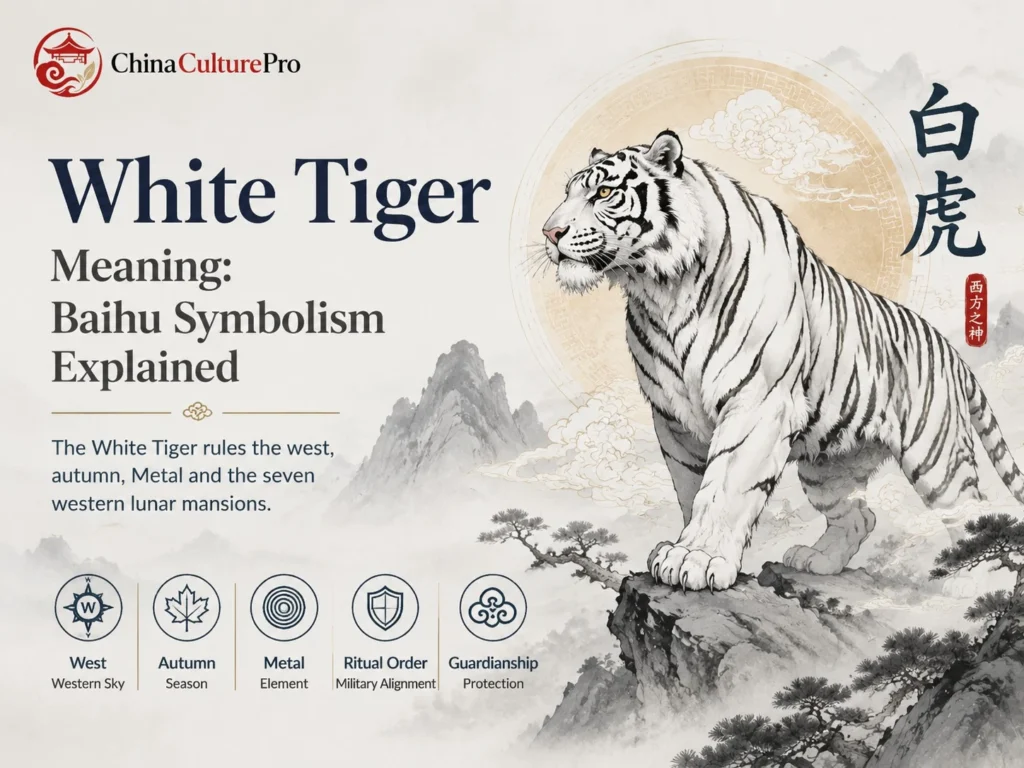
The White Tiger (白虎, Báihǔ) symbolizes the western sky within the Four Symbols of Chinese mythology. Its oldest role is cosmological: Baihu gives visual form to the seven western lunar mansions and links west with autumn, the Metal phase, and seasonal contraction. Military, funerary, Daoist, and modern meanings developed later, so the symbol is not simply a white animal that brings courage or wards off danger.
- West and the western sky: Baihu marks the western celestial quadrant.
- Autumn and Metal: It expresses seasonal gathering, restraint, and order after summer’s expansion.
- Ritual and military order: It identifies the west or right side in a conventional south-facing formation.
- Directional guardianship: Tomb and religious art later used Baihu as a protector of western space.
- Modern cultural expression: Designers use it for disciplined power, balance, and Chinese-inspired visual storytelling.
For the wider visual language, see Chinese symbols and their meanings.
On Han mirrors, tomb walls, and later funerary sculpture, the White Tiger is more than a fierce white beast. It is a coordinate in an ancient Chinese model of space and time. Formed from the seven western lunar mansions, Baihu organized the western sky and became associated with autumn and the Metal phase. An eleventh-century Northern Song tomb model at The Metropolitan Museum of Art shows the emblem alone as a compact, alert tiger rather than an exaggerated monster.[1] The object is a useful reminder: interpreting Baihu begins with astronomy, orientation, period, and medium—not with a generic list of lucky or dangerous powers.
What Is the White Tiger in Chinese Mythology?
The White Tiger, written 白虎 and pronounced Báihǔ, is one of the four directional beings in the broader Chinese mythical-creature system. It represents the western group of seven lunar mansions. These mansions form one quarter of the traditional twenty-eight-mansion sky system, so Baihu is not one star, one modern constellation, or a zoological white tiger.[2][3]
It is also not the zodiac Tiger or a universal tiger deity. The Year of the Tiger belongs to a repeating twelve-year calendar, while regional Tiger Gods belong to local religious traditions. A generic tiger motif can express courage, authority, or protection without any connection to the western sky.
Another essential boundary separates the Four Symbols from the Four Auspicious Creatures. The Four Symbols are the Azure Dragon, Vermilion Bird, White Tiger, and Black Warrior; they organize celestial direction and season. The Four Auspicious Creatures are Qilin, Fenghuang, tortoise, and dragon in a ritual system associated with virtue and harmonious rule. Baihu belongs only to the first group.
What the White Tiger Means in Different Contexts
Baihu has no single meaning that works for every object. A star map, military banner, tomb sculpture, Daoist image, and game character may all depict the White Tiger, yet each activates a different historical layer. Context should be identified before symbolism is assigned.
| Context | Primary meaning | Typical carrier | Interpretation limit |
|---|---|---|---|
| Astronomy and the western sky | The seven western lunar mansions organized as one celestial emblem | Star maps, astronomical texts, the Marquis Yi lacquer chest | Not an IAU constellation and not originally a luck, combat, or moral symbol |
| Autumn and the Metal phase | West, autumn, white, and Metal within a coordinated cosmological system | Han ritual art, calendrical diagrams, Five Phases texts | Describes seasonal order, not personal wealth, danger, or destiny |
| Ritual and military order | The west or right side within a conventional south-facing formation | Banners, processions, military formations, court layouts | A spatial and ceremonial rule, not proof of violent supernatural powers |
| Tombs and protective space | The western side of a tomb and the ordered cosmos surrounding the deceased | Han murals and reliefs, mirrors, Song tomb models | A funerary function that should not be imposed on every tiger image |
| Later Daoist religion | A western guardian personified as Jianbing Shenjun | Daoist texts, ritual images, and temple settings | A later religious identity, not the original meaning of early astronomical art |
| Traditional feng shui | The “White Tiger side” within a site’s idealized directional arrangement | Landscape and architectural interpretation | A traditional spatial framework, not a guaranteed method for changing luck |
| Modern art and popular culture | Disciplined strength, the west, Metal, or Chinese-inspired fantasy identity | Logos, tattoos, games, film, and cultural products | Powers, ranks, aggression, and moral alignments may be modern inventions |
These readings can coexist historically without becoming interchangeable. A museum may call one Baihu image a celestial emblem and another a tomb guardian because the two objects perform different functions. Accurate interpretation explains that shift instead of compressing every example into “strength” or “protection.”
Why Is the White Tiger Associated With White, Autumn, and Metal?
The “white” in White Tiger is first a cosmological correspondence, not a zoological description. In the mature Four Symbols system, directions, seasons, colors, and Five Phases form a linked set: east–spring–blue-green–Wood; south–summer–red–Fire; west–autumn–white–Metal; and north–winter–dark–Water. Baihu’s name identifies its place in that network.
Autumn does not make the White Tiger an evil or death symbol. It is the season when growth slows, crops are gathered, and the expanding energy of spring and summer turns toward consolidation. Metal contributes ideas of cutting, definition, discipline, and ordered restraint within the Five Phases model. These are patterned relationships in traditional cosmology, not objective forces that determine an individual’s fate.
Nor must historical Baihu art have white fur. The Met’s Northern Song model is porcelain with a bluish-white qingbai glaze, Han examples may survive as bronze reliefs or monochrome rubbings, and later paintings can use varied pigments.[1][5] The emblem’s identity comes from orientation, companions, inscription, object type, and historical context. Reading “white” only as coat color removes the symbol from the system that created it.
The White Tiger and the Seven Western Lunar Mansions
Traditional Chinese astronomy divided a broad belt of the sky into twenty-eight lunar mansions and grouped them into four sets of seven. The western set forms the White Tiger: Legs, Bond, Stomach, Hairy Head, Net, Turtle Beak, and Three Stars.[2][3]
| Chinese | Pinyin | Standard English name | What the name identifies | Approximate modern sky region |
|---|---|---|---|---|
| 奎 | Kuí | Legs | First mansion of the western group | Parts of Andromeda and Pisces |
| 娄 / 婁 | Lóu | Bond | Second western mansion | Mainly Aries |
| 胃 | Wèi | Stomach | Third western mansion | Mainly Aries |
| 昴 | Mǎo | Hairy Head | Fourth western mansion; includes the Pleiades region | Taurus |
| 毕 / 畢 | Bì | Net | Fifth western mansion; includes the Hyades region | Taurus |
| 觜 | Zī | Turtle Beak | Sixth western mansion | Part of Orion |
| 参 / 參 | Shēn | Three Stars | Seventh western mansion; associated with Orion’s Belt region | Orion |
The modern-region column is only a finding aid. Chinese mansions and International Astronomical Union constellations use different boundaries and were created for different observational systems. One mansion is not equivalent to one Western constellation, and the seven are not seven equal slices of sky.[3]
Some modern diagrams assign every mansion a precise tiger body part or an elaborate governing function. Those details vary among secondary sources and should not be treated as a single ancient standard. What can be stated securely is the sequence, the standard translated names, and their membership in the western group. Together they gave astronomers a structured way to follow the Moon, recognize seasonal sky changes, and organize celestial observations, while the tiger offered a memorable emblem for the whole western quarter.
How White Tiger Symbolism Developed Through History
From Early Tiger–Dragon Astronomy to Han Standardization
Baihu developed gradually rather than appearing as a complete mythological character at one moment. A key Warring States object from the tomb of Marquis Yi of Zeng places the names of the twenty-eight lunar mansions around a design that includes a dragon and a tiger. It demonstrates that dragon–tiger imagery had already been connected with celestial organization by the fifth century BCE, but it does not present the full later Four Symbols set in its standardized form.[4]
The system became visually stable and widely used during the Han dynasty. Mirrors, tomb murals, reliefs, and ritual objects arranged the Azure Dragon, White Tiger, Vermilion Bird, and Black Warrior around a central field. A Han “game board” mirror at The Met combines the four directional animals with a square-and-circle cosmological design, turning a personal object into a compact image of ordered space.[5]
At this stage, the White Tiger’s main identity was directional and cosmological. It marked the western quarter within a total pattern. Han tigers may appear lean, animated, striped, or highly stylized, but no anatomy or pigment rule applies to every workshop and medium. By the Northern Song dynasty, Baihu could also appear independently as a funerary model. The Met’s eleventh-century porcelain tiger was made for a tomb and identified as the Symbol of the West, showing that a standalone object can still belong to the Four Symbols system.[1]
From Western Emblem to Military and Daoist Guardian
Directional order also entered ritual and military language. The Book of Rites describes a formation with the Vermilion Bird in front, Black Warrior behind, Azure Dragon on the left, and White Tiger on the right.[6] This does not turn Baihu into a god of violence. It uses recognized celestial emblems to organize human movement, banners, and space.
In funerary settings, the four beings helped map the tomb as a complete cosmos. Baihu marked and guarded the west, while the other emblems structured the remaining directions. “Protection” here means maintaining the integrity and order of a defined space; it should not automatically be converted into a promise that any White Tiger image repels misfortune.
Over time, the celestial emblems became guardian beasts and acquired religious identities.[7] Later Daoist traditions personified the western guardian as Jianbing Shenjun (监兵神君), often translated as Lord Jianbing. A religious Baihu may therefore possess a divine title and ritual role that an early star diagram or Han mirror does not. The layers are historically connected, but later theology cannot be projected backward as the symbol’s original meaning.
How to Recognize the White Tiger in Chinese Art
White fur, bold stripes, fangs, or an aggressive pose do not prove that a tiger is Baihu. Conversely, a pale ceramic or minimally striped figure can still represent the western emblem. Use a context-first method:
- Check the larger composition: A tiger within a complete Four Symbols set or opposite a dragon is a strong Baihu candidate.
- Reconstruct the orientation: In a conventional south-facing frame, west is on the right. Confirm whether the object uses the viewer’s, wearer’s, tomb occupant’s, or reflected viewpoint.
- Look for companion signs: Mansion names, calendrical marks, directional labels, or a square-and-circle cosmic design strengthen the identification.
- Identify the medium and setting: Han mirrors, tomb walls, funerary models, military banners, and Daoist images each provide different clues.
- Check inscriptions: 白虎 can identify the emblem directly when an inscription survives.
- Date the style: Han examples may be lean and dynamic; Tang and Song figures may be fuller; later religious or decorative tigers can look more imposing.
- Avoid a color test: Bronze, stone, ink, pale glaze, or multicolored paint can all represent Baihu.
The same method helps with Chinese symbolism in art generally: identify the system, date, carrier, position, and companion motifs before assigning meaning.
White Tiger vs. Ordinary Tigers, Zodiac Tiger, and Tiger Gods
The English word “tiger” can hide several Chinese concepts that do not share one identity. Baihu is a celestial and directional emblem; other tiger images may belong to zoology, annual customs, general symbolism, or local religion.
| Symbol | Cultural system | Core role | Typical context | Key distinction |
|---|---|---|---|---|
| White Tiger (Baihu) | Four Symbols astronomy and ritual | Western sky, autumn, Metal, directional order, and later guardianship | Han mirrors, tombs, ritual formations, Daoist art | Not a real animal, zodiac sign, or generic courage emblem |
| Generic tiger symbolism | Broad folk and artistic tradition | Courage, authority, physical power, and protection | Textiles, children’s hats, prints, paintings, ornaments | No necessary link to the western sky, autumn, or Metal |
| Real white-coated tiger | Zoology | A tiger with a pale coat caused by inherited pigmentation | Zoos, wildlife science, natural-history media | White fur alone does not create sacred Baihu identity |
| Zodiac Tiger | Twelve-animal calendar | One sign in a repeating twelve-year cycle | New Year imagery, birth-year culture, zodiac media | No Four Symbols astronomical role |
| Tiger God or Hu Ye | Regional folk religion | A locally worshipped guardian with community-specific stories and rites | Temples and regional ritual practice | Not the standardized western celestial emblem |
For the broader animal image, see tiger symbolism in Chinese culture and the guide to Chinese animal symbolism. Those topics explain why an ordinary tiger may carry meanings that should not be transferred automatically to Baihu.
This distinction also prevents two opposite mistakes. Not every white tiger in a modern illustration is the celestial White Tiger, and not every historical Baihu must be painted white. Identification depends on cultural grammar rather than English naming alone.
Azure Dragon and White Tiger: How the East–West Pair Works
The Azure Dragon and White Tiger form the most familiar directional pair within the Four Symbols. Their relationship is complementary: east and west, spring and autumn, Wood and Metal, seasonal expansion and seasonal contraction. Traditional cosmology does not define them as heroes and villains or rank one above the other.
The Book of Rites places the Azure Dragon on the left and the White Tiger on the right within a south-facing formation.[6] Facing south makes east the left side and west the right. The complete layout also includes the Vermilion Bird in front or south and the Black Tortoise–Snake, or Black Warrior, behind or north.
A reproduced mirror, mural, garment, or digital image may appear reversed because of reflection, viewing direction, or the position of the original user. Do not diagnose an error from a cropped picture alone. Reconstruct the whole composition and ask whose left and right the object represents. Popular claims that the dragon must suppress the tiger, or that the pair depicts an eternal battle, are modern narrative additions rather than a rule of the classical directional system.
How to Interpret or Use a White Tiger Symbol Correctly
For museum study, clothing, architecture, logos, or tattoos, apply a short context-first check:
- Name the intended tiger: Decide whether the design represents Baihu, a generic cultural tiger, a zodiac Tiger, a real white-coated animal, or a local Tiger God.
- Choose the cultural layer: Astronomy, ritual order, tomb guardianship, Daoist religion, and modern fantasy are related historically but should not be collapsed into one claim.
- Match the message: Baihu fits west, autumn, Metal, disciplined strength, boundary, or the Four Symbols more naturally than generic wealth or romance.
- Build identity through context: Use orientation, companion emblems, inscriptions, or celestial references rather than depending only on white fur and stripes.
- Separate history from invention: Wings, elemental attacks, combat rankings, and ominous alignments may be creative choices, but they are not automatically traditional.
- Review permanent or commercial work: Compare a tattoo or logo with museum objects, check any Chinese text, and verify the complete directional layout before production. See Chinese tattoo symbols and meanings for additional checks.
Modern adaptation is not inherently wrong. Accurate use means making clear which historical layer is preserved, which choices are new, and whether the final image communicates the intended idea without claiming guaranteed protection or changed fortune.
Final Takeaway
The White Tiger is best understood as the western body of an ancient Chinese cosmic map. Its foundation is the seven western lunar mansions, joined with west, autumn, white, and Metal. Military order, tomb guardianship, Daoist personification, and modern strength imagery are later layers. To read Baihu accurately, identify the date, medium, orientation, and companion symbols before relying on coat color or generic tiger lore.
FAQs About White Tiger Meaning and Symbolism
How Do You Pronounce Baihu?
In standard Mandarin, Báihǔ has a rising second tone on bái and a dipping third tone on hǔ. A rough English aid is “bye-hoo,” although English spelling cannot reproduce the tones precisely. Baihu is the pinyin romanization, while “White Tiger” remains the standard descriptive English translation in cultural and academic writing.
Is the White Tiger One of the Four Auspicious Creatures?
No. Baihu belongs to the Four Symbols, the celestial-directional set of Azure Dragon, Vermilion Bird, White Tiger, and Black Warrior. The Four Auspicious Creatures are Qilin, Fenghuang, tortoise, and dragon in a different ritual tradition centered on virtue and harmonious rule. Similar English phrases such as “four sacred beasts” sometimes blur the distinction, so checking the Chinese name of the group is essential.
Is the White Tiger Male or Female?
Traditional astronomical descriptions do not give Baihu a fixed biological sex. Associations with autumn, Metal, firmness, or military order describe relationships in cosmology and ritual; they are not anatomical gender markers. A novel, game, tattoo, or illustration may portray the White Tiger as male or female, but that choice is a modern creative interpretation rather than a universal historical rule.
Can the White Tiger Appear Alone in Chinese Art?
Yes. Baihu can appear independently when a tomb position, inscription, object record, paired dragon, or other contextual evidence identifies it. The Northern Song porcelain model at The Met is a clear standalone example. A lone tiger without such evidence, however, should not automatically be labeled Baihu; it may instead be a generic tiger, zodiac image, or another protective motif.
Are Baihu and Japanese Byakko Exactly the Same?
No. Japanese Byakko derives historically from the Chinese White Tiger tradition, but Japanese religion, architecture, court culture, and popular media developed localized uses and imagery. Shared origins do not make every later interpretation interchangeable. Identify the country, period, and setting before applying a Chinese Baihu explanation to a Japanese object—or the reverse.
Does the White Tiger Always Represent Danger or Death?
No. Its link with autumn and Metal describes seasonal contraction, definition, and order, not an inherently evil force. In tombs, Baihu helps establish and guard the western side of an ordered cosmos; this does not make it a symbol of death in every setting. Dangerous, bloodthirsty, or ominous portrayals are often selective literary or modern entertainment interpretations rather than the emblem’s universal meaning.
Sources
[1] The Metropolitan Museum of Art. Model of White Tiger, Symbol of the West (Baihu)
[2] Hong Kong Space Museum. Glossary of Chinese Star Regions, Asterisms and Star Names
[3] Proceedings of the International Astronomical Union. Ancient Chinese Constellations
[4] Hubei Provincial Museum. The Marquis Yi of Zeng: Lacquer Objects
[5] The Metropolitan Museum of Art. Mirror with Game Board Design and Animals of the Four Directions
[6] Chinese Text Project. Book of Rites: Qu Li I
[7] National Palace Museum. What Powers Do Mythical Creatures Possess?