
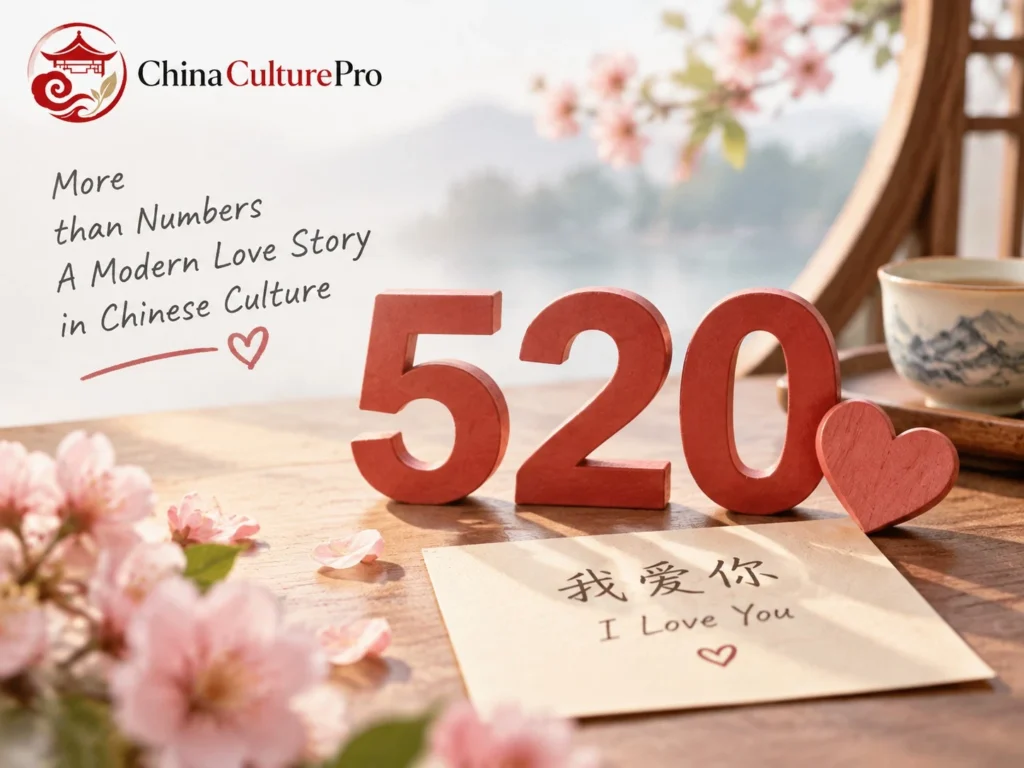

Quick Answer: What Does 520 Mean in Chinese Culture?
In modern Chinese digital culture, 520—五二零 (wǔ èr líng)—is a romantic number code for 我爱你 (wǒ ài nǐ), “I love you.” It is widely recognized in messages, social posts, digital red envelopes and May 20 promotions.
- Meaning: A casual or affectionate way to say “I love you.”
- Pronunciation: The two expressions sound only loosely similar; they are not exact homophones.
- Date: May 20, written 5/20, is an unofficial “Internet Valentine’s Day” in China.
- Common uses: Confessions, couple messages, symbolic gift amounts and romantic marketing.
- Cultural status: A modern internet convention, not an ancient custom or legal holiday.
520 expresses a social message, not a supernatural promise. Sending it cannot guarantee love, compatibility or a lasting relationship, and no etiquette rule requires a gift or a 520-yuan payment.
If a Chinese friend texts “520,” they are probably not talking about an address or a lucky calculation. They are using one of China’s best-known digital numeronyms. Unlike older number symbolism built around prosperity, longevity or taboo, 520 belongs to modern media and everyday online speech. It is best understood alongside other Chinese number combinations, not as an ancient lucky number.
Why Does 520 Mean “I Love You” in Chinese?
Wǔ Èr Líng and Wǒ Ài Nǐ Are Approximate, Not Exact, Homophones
The code works through resemblance and rhythm, not a dictionary-perfect sound match. Read individually, the three digits differ noticeably from the words they conventionally replace.
| Digit | Standard reading | Compared with | What actually matches |
|---|---|---|---|
| 5 | 五, wǔ | 我, wǒ | Same initial and tone; different vowel |
| 2 | 二, èr | 爱, ài | Same tone, but different vowel and syllable shape |
| 0 | 零, líng | 你, nǐ | No close standard phonetic match; this is conventional substitution |
Calling 520 an exact homophone therefore overstates the linguistic relationship. Research on Chinese internet homophones shows that online wordplay can use approximate sound, visual form and discourse context rather than strict one-to-one pronunciation.[1]
Why Social Convention Matters More Than Perfect Pronunciation
A code becomes useful when people recognize it quickly. Pagers, SMS and early chat services encouraged short numeric expressions because they were easy to type, display and remember. Once 520 repeatedly appeared beside romantic language, its intended meaning became clearer than its imperfect phonetics.
This also explains why the digits should not be decoded separately. Five does not always mean “I,” two does not generally mean “love,” and zero does not independently mean “you.” The meaning belongs to the complete sequence. Studies of Chinese internet neologisms likewise show that online forms can move into everyday language through repeated social use.[2]
How 520 Became China’s Internet Valentine’s Day
From Pagers and Early Internet Slang to May 20
There is no securely documented inventor or single birth date for 520. It developed within the wider culture of numerical messaging that accompanied pagers, mobile phones and early internet chat.
One useful early public marker is Mavis Fan’s 1998 song Digital Love, which explicitly connects “520” with “I love you.”[3] That makes the song evidence of early popular circulation, but not proof that the singer or songwriter invented the code. As texting, QQ, forums and social media expanded, the expression became widely legible beyond its original youth and technology circles.
The date followed naturally from the code: May 20 is written 5/20. Messages, couple activities and commercial campaigns then turned the calendar date into an annual romantic occasion. This was a gradual social process, so precise online timelines that name one platform or one year as the definitive beginning should be treated cautiously.
A Modern Romantic Occasion, Not an Ancient Festival
May 20 is often called Internet Valentine’s Day or Online Valentine’s Day. It is a popular cultural occasion, not a statutory holiday, a traditional festival or an officially designated auspicious date.
Its public visibility is nevertheless real. Civil-affairs offices in large cities may prepare for increased marriage-registration demand, and official local reporting has described May 20 as a date favored because “520” resembles “I love you.”[4] Shenzhen authorities have similarly extended registration services for the surge associated with “520 Day.”[5] Brands also build campaigns around the occasion, amplifying a social code through commerce.[6]
How 520 Is Used in Messages, Gifts and Red Envelopes
Texting, Confessing and Responding to 520
520 can stand alone, appear at the end of a message or accompany a more personal sentence. It ranges from a playful “love you” between established partners to a direct confession, so relationship context matters.
| Situation | Natural example | Practical note |
|---|---|---|
| Direct confession | “520. I’ve wanted to tell you for a long time.” | Clear but still informal |
| Couple message | “Happy 520—thank you for being with me.” | Common on May 20 |
| Social caption | “Love is in the ordinary days, not only 520.” | Suitable for public posting |
| Reply | “520 too,” “I love you too,” or a personal response | No mandatory formula |
An online claim sometimes assigns 520 to men and 521 to women. This is not a national convention or gender rule. Anyone may send 520, and the most natural response is simply the one that fits the relationship.
May 20 Gifts, Digital Red Envelopes and Marriage Registrations
Visible numbers make the code easy to turn into a small ritual. Couples may send digital red envelopes in amounts such as 5.20, 52 or 520, exchange flowers or small gifts, reserve a dinner, or choose May 20 for marriage registration.
These are options, not obligations. A 520-yuan transfer is not a standard fee for affection, and a smaller amount is not less sincere. Platform limits, local gift customs, personal finances and the couple’s preferences should take priority. Likewise, registering a marriage on May 20 gives the date a memorable story but has no legal or supernatural effect on the marriage.
What Do 521, 1314 and 5201314 Mean?
Related codes extend the romantic message, although not all are equally stable.
| Code | Conventional reading | Usual meaning | Important limit |
|---|---|---|---|
| 520 | 我爱你, wǒ ài nǐ | I love you | Most stable and widely recognized |
| 521 | Often linked to 我爱你 or 我愿意 | A romantic variant or affirmative reply | No single national definition or gender rule |
| 1314 | 一生一世, yīshēng yīshì | For a lifetime | Approximate whole-sequence reading |
| 5201314 | 我爱你一生一世 | I love you for a lifetime | More ceremonial than ordinary conversation |
The complete sequence controls the meaning. Although 1314 contains 4, its established romantic reading overrides the standalone death-related association discussed in the guide to number 4 in Chinese culture.
How 520 Differs from Qixi and Valentine’s Day
These three romantic occasions coexist in China, but they have different histories and calendars.
| Occasion | Date | Origin | Modern emphasis |
|---|---|---|---|
| 520 | May 20, Gregorian calendar | Modern Mandarin internet code | Messages, gifts, registration dates and campaigns |
| Qixi Festival—七夕节 (Qīxī Jié) | Seventh day of the seventh lunar month | Traditional star lore, weaving-skill customs and the Cowherd-Weaver Girl story | Traditional culture and modern romance |
| Valentine’s Day | February 14, Gregorian calendar | Western Christian and secular traditions | Globalized dating and gift-giving |
Qixi is the traditional Chinese occasion among the three, though its older customs involved qiqiao, or prayers for skill, as well as the famous lovers’ story. Calling 520 “China’s traditional Valentine’s Day” erases that distinction. “Unofficial Internet Valentine’s Day” is the more accurate label.
Does 520 Mean the Same Thing in Mandarin and Cantonese?
The code developed from a Mandarin-based reading. Cantonese pronunciations of the digits do not naturally approximate the Cantonese phrase for “I love you,” so 520 is not an indigenous Cantonese sound pun.
That does not mean Cantonese speakers cannot understand or use it. National media, social platforms and marketing have made 520 a cross-regional internet symbol. The careful distinction is that its social meaning travels across language communities even when its original phonetic explanation does not.
Common Misreadings of 520
- Misreading: 520 and “I love you” are exact homophones. Correction: they are a loose, conventional sound substitution. Boundary: recognition comes from usage, not phonetic identity.
- Misreading: 520 is an ancient Chinese love number. Correction: it belongs to modern telecommunications and internet culture. Boundary: it has no classical ritual or textual pedigree.
- Misreading: May 20 is an official Chinese Valentine’s Day. Correction: it is an unofficial popular occasion and a normal working day unless another calendar rule applies. Boundary: government offices may offer extra registration capacity without turning it into a public holiday.
- Misreading: 520 works as the same pun in every Chinese language variety. Correction: the sound association is Mandarin-based. Boundary: widespread cultural recognition is not the same as shared pronunciation.
- Misreading: men send 520 and women must answer 521. Correction: that is an optional online story, not a social rule. Boundary: gender does not determine which code someone may use.
- Misreading: a 520 gift or payment strengthens a relationship. Correction: the number adds symbolism and playfulness only. Boundary: communication, consent and practical care matter more than the code.
FAQs About 520 in Chinese Culture
What Does 520 Mean in Chinese?
520 is a modern number code for 我爱你 (wǒ ài nǐ), “I love you.” It appears in texts, social posts, red-envelope amounts, gifts and May 20 promotions. The association is modern, not an ancient Chinese love tradition.
Does 520 Sound Exactly Like “I Love You”?
No. 五二零 (wǔ èr líng) and 我爱你 (wǒ ài nǐ) differ in several consonants, vowels and tones. Their connection is an approximate, socially established reading rather than an exact homophone.
Is May 20 a Public Holiday in China?
No. May 20 is an unofficial internet romantic occasion, not a statutory public holiday. It can still be busy for marriage registration, restaurants, florists and online retailers because many couples choose to celebrate it.
What Is the Difference Between 520 and 521?
520 has the stable meaning “I love you.” 521 is a less fixed romantic variant that may repeat that message or represent an affirmative response such as “I’m willing.” There is no universal rule assigning the two codes to different genders.
What Does 5201314 Mean?
5201314 combines 520, “I love you,” with 1314, “for a lifetime.” Together it means “I love you for a lifetime.” It is an emphatic modern internet expression, not a traditional marriage formula or promise with legal force.
Sources
[1] Qian Tang, University of Alberta. A Study of Chinese Internet Homophones from the Systemic Functional Linguistics Perspective
[2] Weicheng Li, Lund University. The Integration of Chinese Internet Neologisms into Everyday Language
[3] Apple Music. Digital Love by Mavis Fan
[4] Shanghai Daily via the Information Office of Shanghai Municipality. May 20 Is an Auspicious Date; Marriage Registration Slots Across Shanghai Nearly Full
[5] Guangming District Government, Shenzhen. Extended Service for Marriage Registration on “520 Day”
[6] Vogue Business. Led by Gucci, China’s 520 Festival Overtakes Valentine’s Day