
Quick Answer: What Is Beigang Maojian Tea?
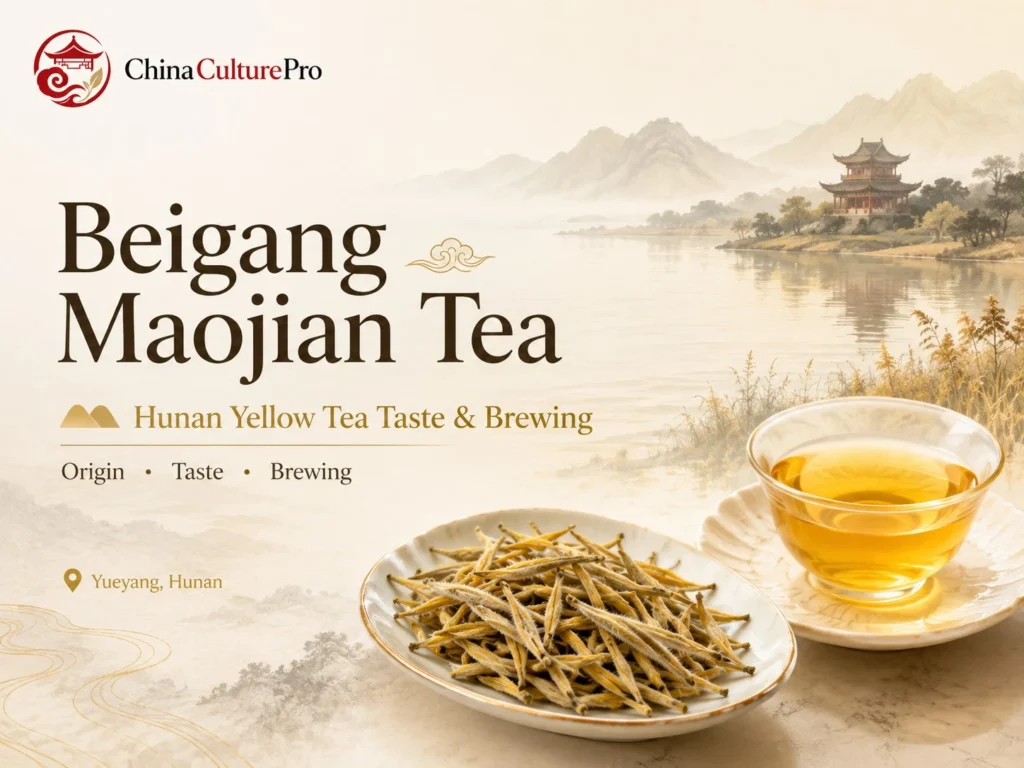
Beigang Maojian Tea, also written as Bei Gang Mao Jian or Beigang Mao Jian Yellow Tea, is a Chinese yellow tea from the Beigang and Kangwang Township area of Yueyang, Hunan Province.
It is not green tea. It is not the same as Xinyang Maojian, even though both names include “Maojian.” Beigang Maojian is a strip-shaped yellow tea, often understood within the Huang Xiao Cha style of Chinese yellow tea.
The basic identity is clear:
Tea Type: Chinese yellow tea, especially a strip-shaped yellow tea style.
Origin: Beigang, Yueyang, Hunan; also connected with Kangwang Township in Yueyang County.
Historical Name: Yonghu Tea, a name associated with the Tang dynasty.
Name Meaning: Beigang is the Yueyang place name; Maojian describes tender leaves with fine tips and visible hairs.
Not The Same As: Xinyang Maojian green tea, Taiwan Beigang, or all teas called Maojian.
Leaf Style: strong buds, plump leaves, visible hairy tips, often golden or yellow-green in appearance.
Processing Key: pot-firing, pot-rolling, Pai Han or “sweating,” re-firing, and drying.
Taste: mellow, thick but not heavy, sweet-refreshing, and smoother than many green teas.
Aroma: clear, lifted, elegant aroma, often with sweet, grain-like, or lightly mature yellow tea notes.
Liquor: orange-yellow, golden, or bright yellow.
Brewing: usually best around 80–85°C / 176–185°F, with lower temperature for more tender grades.
Key point: Beigang Maojian is not green tea Maojian. Its value lies in Yueyang’s moist lake-area environment, the local yellow tea process of Pai Han, and its golden appearance, orange-yellow liquor, clear high aroma, mellow sweet-refreshing taste, and plump yellow-bright leaf base.
To understand the broader category, read our [Chinese Yellow Tea] guide.
Name, Origin, and Tea Type
The name Beigang Maojian can confuse English readers. “Beigang” may suggest Taiwan’s Beigang in Yunlin, while “Maojian” may suggest Xinyang Maojian green tea. Here, Beigang means Beigang in Yueyang, Hunan, and the tea is yellow tea, not green tea.
| Aspect | Detail |
|---|---|
| Chinese Name | 北港毛尖 |
| Pinyin | Bei Gang Mao Jian |
| Common English Names | Beigang Maojian Tea, Bei Gang Mao Jian, Beigang Mao Jian Yellow Tea |
| “Beigang” | a place name in Yueyang, Hunan; not Taiwan Beigang |
| “Maojian” | describes tender leaves with visible hairs and pointed tips; it is not a tea category by itself |
| Origin | Beigang, Yueyang, Hunan; also linked with Kangwang Township in Yueyang County |
| Historical Name | Yonghu Tea, connected with the old Yonghu area near the Dongting Lake region |
| Tea Type | Chinese yellow tea; strip-shaped yellow tea / Huang Xiao Cha style |
| Easily Confused With | Xinyang Maojian green tea, Junshan Yinzhen yellow tea, or generic Maojian teas |
“Maojian” describes leaf shape, not tea category. Xinyang Maojian is green tea; Beigang Maojian is yellow tea. They share a leaf-style name, but their origins, processing, liquor color, and taste are different.
Beigang Maojian is also different from Junshan Yinzhen. Both are linked with Yueyang yellow tea, but Junshan Yinzhen is a needle-shaped yellow bud tea from Junshan Island, while Beigang Maojian is a strip-shaped yellow tea with stronger buds and plumper leaves.
To compare another Hunan yellow tea, read our Junshan Yinzhen Tea guide.
Why Yueyang and Beigang Matter
Beigang Maojian should be understood through its Yueyang origin. It is tied to Beigang, Kangwang Township, the old Yonghu tea area, and the moist lake-region environment around Dongting Lake.
Yueyang and Beigang matter for several reasons:
- Lake-Area Moisture: the Beigang and Yonghu area is traditionally connected with lake moisture, low mist, and humid air.
- Dongting Lake Influence: the broader Yueyang region is shaped by Dongting Lake and surrounding waters.
- Mild And Rainy Conditions: the local environment is often described as mild, moist, and suitable for tea growth.
- Rolling Hills And Tea Land: local tea gardens are connected with gentle slopes and suitable drainage.
- Tea Character: this environment is associated with a clean, moist, rounded tea character rather than a sharp or thin profile.
Chinese tea drinkers do not judge Beigang Maojian only by whether it looks yellow. They also look for the clear moist base of a Yueyang lake-area tea.
This section should not become a Yueyang travel guide. The important point is simple: the tea’s origin gives it a lake-area freshness and mellow depth that separate it from both green Maojian teas and other yellow teas.
History and Cultural Background
Beigang Maojian has an important cultural background because it is connected with Yonghu Tea. This older name gives the tea a historical identity before the modern product name became common.
| Period | Cultural Background |
|---|---|
| Tang Dynasty | Yuezhou, today’s Yueyang area, was known in early tea culture; Yonghu Tea is the older name linked with Beigang Maojian |
| Qing Dynasty | during the Qianlong period, Beigang tea had local reputation and was recorded in regional tea culture |
| Folklore | stories connect Yonghu Tea with Princess Wencheng entering Tibet; this should be treated as folklore, not confirmed history |
| 1964 | Beigang Maojian was recognized as a high-quality famous tea in Hunan |
| Present Day | it remains a representative Hunan yellow tea, especially as a strip-shaped counterpart to better-known Junshan Yinzhen |
The historical point should stay precise. Beigang Maojian is connected with the old Yonghu Tea line and Yueyang’s long yellow tea culture, but the modern commercial name should not be treated as unchanged since the Tang dynasty.
Its cultural value comes from two layers: the older Yonghu Tea identity and its modern position within Chinese tea culture as a Hunan yellow tea with its own shape, process, and taste. Compared with the more famous needle-shaped Junshan Yinzhen, Beigang Maojian is strip-shaped, more substantial, and closer to daily drinking.
How Beigang Maojian Is Made
Beigang Maojian is a yellow tea, and its most distinctive local processing term is Pai Han (拍汗), often translated loosely as “sweating.” It is the local Beigang expression of yellow tea’s yellowing logic.
The picking standards are also important:
- Beigang Maojian is usually picked about five or six days after Qingming.
- No. 1 Maojian often uses one bud with one leaf.
- No. 2 and No. 3 Maojian may use one bud with two or three leaves.
- Good picking favors sunny weather.
- In traditional standards, insect-damaged leaves, purple leaves, fish leaves, and stems are avoided.
| Step | Chinese Term | What It Does | Key Point |
|---|---|---|---|
| Pot-Firing | 锅炒 | heats the fresh leaves and stops strong enzymatic oxidation | creates the fresh base but prepares the leaves for yellow tea transformation |
| Pot-Rolling | 锅揉 | rolls and shapes the leaves while warm | helps form the strip shape and release internal juices |
| Pai Han / Sweating | 拍汗 | lets the tea mass regain moisture and begin yellowing | the key local step that supports yellow color and mellow taste |
| Re-Firing | 复炒 | further heats and stabilizes the tea after Pai Han | fixes aroma, shape, and yellow tea character |
| Drying | 烘干 | removes remaining moisture | locks in the golden appearance and clear aroma |
Pai Han allows the tea mass to soften, regain moisture, and move toward yellowing under warm, humid conditions. This helps reduce raw grassy sharpness and supports Beigang Maojian’s mellow, sweet-refreshing taste.
Different producers may vary the timing, pile thickness, heat, and humidity. But without a good Pai Han and yellowing effect, Beigang Maojian can taste too green, too sharp, or too close to ordinary green tea Maojian.
What Beigang Maojian Tastes Like
Beigang Maojian is known for clear aroma, orange-yellow liquor, mellow taste, and a sweet-refreshing finish. It is less sharply fresh than green tea, less delicate and needle-like than Junshan Yinzhen, and less coarse than large-leaf yellow tea.
| Tasting Point | Good Beigang Maojian |
|---|---|
| Dry Leaf | strong buds, plump leaves, visible hairy tips, golden or yellow-green color |
| Aroma | clear high aroma, clean sweetness, light mature yellow tea note, possible grain-like sweetness |
| Liquor Color | orange-yellow, golden, or bright yellow |
| Taste | mellow, thick but not coarse, sweet-refreshing, rounded |
| Mouthfeel | fuller than many green teas, but still clean and refreshing |
| Aftertaste | sweet, clean, and refreshing |
| Leaf Base | plump, tender, yellow-bright, soft, sometimes described as flower-like |
The phrase qing gao (清高) is important. It does not mean perfume-like intensity. It means a clean, lifted, elegant aroma that rises clearly from the cup. In English, it can be explained as a “clear high aroma.”
Beigang Maojian is also described through gan shuang (甘爽): sweet and refreshing. The best cup should feel thick but not coarse, sweet but not cloying. This balance is central to the tea.
English tasting words such as barley sugar, candied lemon, gentle citrus sweetness, or syrupy body can help readers imagine the cup. The Chinese core remains: clear aroma, orange-yellow liquor, mellow body, sweet-refreshing taste, and yellow-bright leaf base.
Possible quality problems include:
| Problem | What It May Suggest |
|---|---|
| strong grassy smell | Pai Han or yellowing may be insufficient |
| greenish liquor | the tea may be too close to green tea style |
| sour or stuffy aroma | Pai Han, drying, or storage may have gone wrong |
| dark and muddy liquor | poor storage, over-processing, or low freshness |
| rough astringency | coarse material or improper brewing |
| thin taste | weak leaf material or poor processing |
| moldy or stale smell | storage problem |
Good Beigang Maojian is not just “yellow.” Because the leaves are often more open than pure bud teas, the cup should feel fuller while still keeping the clean lift of yellow tea.
How to Taste Beigang Maojian Like a Tea Drinker
A good Beigang Maojian can be checked through the dry leaf, aroma, liquor, mouthfeel, aftertaste, and leaf base.
- Look At The Dry Leaf Check whether the dry tea shows strong buds, plump leaves, visible hairy tips, and a golden or yellow-green sheen. The strips should look fairly even, not broken or dull.
- Smell The Dry Aroma Look for a clear, lifted, fresh, or sweet aroma. Avoid tea that smells grassy, sour, stale, moldy, overly smoky, or burnt.
- Check The Liquor Color A good cup should show orange-yellow, golden, or bright yellow liquor. If the liquor is very green, the tea may be too green in process. If it is dark and dull, processing or storage may be the issue.
- Smell The Wet Leaf The wet aroma should stay clear and steady. It may show light grain sweetness, a gentle mature yellow tea note, or a sweet citrus-like lift.
- Taste The Liquor The taste should be mellow and sweet-refreshing. It should not be harsh, sour, rough, or thin.
- Feel The Mouthfeel Good Beigang Maojian should be rounded and substantial, but not heavy. A useful Chinese tasting idea is “thick but not coarse.”
- Notice The Aftertaste The finish should be clean and sweet. It should refresh the mouth rather than leave a bitter, sour, or stale feeling.
- Look At The Leaf Base The brewed leaves should look plump, tender, yellow-bright, soft, and lively. A dark, greenish, stiff, or rough leaf base is less ideal.
A practical rule: good Beigang Maojian should show clear aroma, bright yellow liquor, mellow sweet-refreshing taste, and a plump yellow-bright leaf base.
For aroma, mouthfeel, Hui Gan, and aftertaste, read our Chinese Tea Tasting guide.
How to Brew Beigang Maojian Tea
Beigang Maojian is usually made from one bud with one leaf to one bud with two or three leaves. It can often handle slightly more heat than pure bud yellow teas, but boiling water and long steeping can turn mellow thickness into rough astringency.
| Brewing Method | Teaware | Water Temperature | Leaf Amount | Steeping Time | Best For |
|---|---|---|---|---|---|
| Glass Cup | glass cup | 80–85°C / 176–185°F; 75–80°C for very tender No. 1 Maojian | 2–3g / 200–250ml | 2–3 minutes | daily brewing and watching the strips open |
| Gaiwan | 100–120ml gaiwan | 80–85°C / 176–185°F | 3–4g | 30–60 seconds for first infusion, then extend | aroma control and multiple infusions |
| Porcelain Pot | small porcelain teapot | 80–85°C / 176–185°F | 3–4g / 200ml | 2–3 minutes | sharing with others |
Brewing tips:
- Avoid boiling water: it can make the tea coarse and bitter.
- Warm the teaware first: this helps open Beigang Maojian’s clear high aroma.
- Do not oversteep: long steeping can make “mellow” become rough.
- Usually do not rinse: unless the tea has been stored for a long time or needs cleaning.
- Drink it plain: milk and sugar will cover the tea’s clear aroma and sweet-refreshing taste.
- Use clean water: soft, clean water helps preserve the orange-yellow liquor and gentle sweetness.
The best brewing style is not about strength. It is about bringing out clear aroma, orange-yellow liquor, mellow body, and a sweet-refreshing finish.
To learn more about brewing Chinese loose leaf tea, read our How to Brew Chinese Tea guide. For gaiwans, glass cups, and teapot choices, read our Chinese Teaware guide.
Beigang Maojian vs Green Tea
This comparison is essential because the word “Maojian” often makes English readers think of Xinyang Maojian, which is a green tea. Beigang Maojian is a different tea type.
| Point | Beigang Maojian | Green Tea / Xinyang Maojian |
|---|---|---|
| Tea Type | yellow tea; strip-shaped yellow tea / Huang Xiao Cha | green tea |
| Origin Example | Beigang, Yueyang, Hunan | Xinyang, Henan |
| Core Process | pot-firing, pot-rolling, Pai Han, re-firing, drying | fixation, rolling, drying; no Pai Han |
| Liquor Color | orange-yellow, golden, bright yellow | tender green, yellow-green, pale green |
| Aroma | clear high aroma, sweet, lightly mature, sometimes grain-like | fresh, sharp, chestnut-like, bean-like, or grassy |
| Taste | mellow, sweet-refreshing, rounded | brisk, fresh, sharper, sometimes more grassy |
| Mouthfeel | fuller and rounder | cleaner, sharper, more direct |
| Main Risk | too much or too little yellowing | excessive grassy sharpness or bitterness if mishandled |
The same word “Maojian” does not mean the same tea. In Xinyang Maojian, it appears in a green tea context. In Beigang Maojian, it describes leaf shape, while Pai Han and yellowing move the tea toward orange-yellow liquor and a mellow, sweet-refreshing taste.
To understand another Maojian tea with a different style, read our Xinyang Maojian Tea guide.
Beigang Maojian vs Other Yellow Teas
Beigang Maojian should also be separated from other yellow teas. It is part of the yellow tea family, but it has its own Hunan lake-area character and strip-shaped style.
| Tea | Origin | Shape / Type | Liquor | Aroma | Taste Style |
|---|---|---|---|---|---|
| Beigang Maojian | Beigang and Kangwang area, Yueyang, Hunan | strip-shaped yellow tea / Huang Xiao Cha | orange-yellow, golden | clear high aroma, sweet, light mature note | mellow, sweet-refreshing, thick but not coarse |
| Junshan Yinzhen | Junshan Island, Yueyang, Hunan | needle-shaped yellow bud tea | apricot-yellow or bright yellow | delicate, sweet, refined | sweet, soft, fine, highly delicate |
| Weishan Maojian | Weishan, Ningxiang, Hunan | Hunan Maojian-style yellow tea | deeper yellow or orange-yellow | sweeter, more mature, sometimes roasted or grain-like | fuller, sweeter, more rounded |
| Huo Shan Huang Ya | Huo Shan, Anhui | yellow bud tea | yellow-green or bright yellow | chestnut, tender nutty sweetness | fresh, mellow, sweet, brisk but rounded |
Junshan Yinzhen and Beigang Maojian are both associated with Yueyang, but they are not the same. Junshan Yinzhen is a more famous needle-shaped pure bud tea. Beigang Maojian is strip-shaped, usually fuller in body and more practical for daily drinking.
Weishan Maojian gives another Hunan comparison, while Huo Shan Huang Ya from Anhui is a useful outside reference for a chestnut or nutty yellow bud profile.
For a softer Sichuan yellow bud tea, see our Meng Ding Huang Ya Tea guide.
To compare major Chinese tea categories, read our Chinese Tea Types guide.
How to Choose Good Beigang Maojian
Good Beigang Maojian should match its identity: Yueyang origin, yellow tea processing, strong buds and plump leaves, clear high aroma, orange-yellow liquor, mellow taste, and yellow-bright leaf base.
| Checkpoint | What To Look For | Warning Signs |
|---|---|---|
| Origin | Yueyang, Beigang, Kangwang Township, Hunan | vague origin, or confusion with Taiwan Beigang |
| Tea Type | clearly sold as yellow tea | sold only as Maojian or green tea without yellow tea identity |
| Dry Leaf | strong buds, plump leaves, visible tips, golden or yellow-green color | weak strips, too many broken pieces, dark green or dull brown color |
| Aroma | clear high aroma, clean sweetness, natural maturity | grassy, sour, moldy, smoky, burnt, or stale smell |
| Liquor | orange-yellow, golden, bright yellow, clear | greenish, dark, cloudy, or muddy |
| Taste | mellow, sweet-refreshing, thick but not coarse | rough astringency, thin wateriness, sourness, burnt bitterness |
| Leaf Base | plump, tender, yellow-bright, soft, flower-like | dark, greenish, coarse, stiff, uneven |
| Freshness | current or recent season, well stored | old tea with unclear storage |
Three points matter most: origin, tea type, and yellow tea character. The origin should connect with Yueyang, Beigang, Kangwang Township, or Hunan. The tea should be clearly presented as yellow tea, not generic Maojian. The cup should show orange-yellow liquor, clear aroma, and mellow taste.
If the liquor is very green and the aroma is grassy, it may be too close to green tea. If the liquor is dark, sour, or stuffy, processing or storage may be the issue.
How to Store Beigang Maojian
Beigang Maojian is more stable than some fresh green teas, but its clear high aroma can still fade. Store it carefully and drink it while the aroma is lively.
Use these storage rules:
- Seal It Well: use a sealed pouch, tin, or jar to reduce air exposure.
- Avoid Light: strong light weakens aroma and speeds up quality loss.
- Keep It Dry: moisture can quickly damage yellow tea.
- Keep It Cool: a cool cabinet works for short-term storage; sealed refrigeration can be used for longer storage.
- Avoid Odors: keep it away from coffee, spices, smoke, incense, pu-erh, scented tea, and strong-smelling foods.
- Return Cold Tea To Room Temperature Before Opening: this helps avoid condensation after refrigeration.
- Drink After Opening: finish opened tea within 6–12 months for better aroma and taste.
- Do Not Age It Like Pu-Erh: Beigang Maojian is valued for clear aroma and mellow freshness, not long-term fermentation.
Benefits and Caffeine
Beigang Maojian contains common tea compounds such as tea polyphenols, amino acids, and caffeine. Because it goes through Pai Han and yellowing-related transformation, many drinkers find it mellower and less sharp than green tea.
It may suit people who want a fuller yellow tea than delicate bud teas, a mellower alternative to green Maojian tea, or a way to explore Hunan yellow tea beyond Junshan Yinzhen.
Important cautions:
- Beigang Maojian contains caffeine.
- Avoid drinking large amounts before sleep.
- People sensitive to caffeine should drink moderately.
- Pregnant people, people taking medication, or people with medical concerns should ask a qualified professional.
- Do not treat Beigang Maojian as medicine.
Enjoy this tea for its taste and cultural value. Do not treat it as a weight-loss, blood-pressure, cancer-prevention, or disease-treatment product.
Final Thoughts
Beigang Maojian is not green tea Maojian, and it is not a general name for all Maojian teas. It is a strip-shaped Chinese yellow tea from the Beigang and Kangwang Township area of Yueyang, Hunan.
Its value comes from the old Yonghu Tea background, the moist Yueyang lake-area environment, and the local Pai Han process that supports yellowing and mellow taste. A good Beigang Maojian should show strong buds and plump leaves, visible hairy tips, golden appearance, orange-yellow liquor, clear high aroma, mellow taste, and a yellow-bright leaf base.
The best way to understand it is through the phrase “thick but not coarse, sweet but not cloying.” It is less delicate and famous than Junshan Yinzhen, but it has a satisfying Hunan yellow tea character that deserves more attention.
FAQs About Beigang Maojian Tea
What is Beigang Maojian tea?
Beigang Maojian Tea is a Chinese yellow tea from the Beigang and Kangwang Township area of Yueyang, Hunan. It is historically connected with Yonghu Tea and is known for strong buds, plump leaves, orange-yellow liquor, clear high aroma, and mellow sweet-refreshing taste.
Is Beigang Maojian green tea or yellow tea?
Beigang Maojian is yellow tea, not green tea. Although “Maojian” may remind readers of Xinyang Maojian green tea, Beigang Maojian has Pai Han and yellowing-related processing, which gives it a more orange-yellow liquor and a mellower taste.
Where is Beigang Maojian tea from?
Beigang Maojian comes from Beigang in Yueyang, Hunan, and is also connected with Kangwang Township in Yueyang County. This Beigang is in Hunan, not Taiwan.
What does Beigang Maojian taste like?
Beigang Maojian tastes mellow, sweet-refreshing, rounded, and substantial. It usually has a clear high aroma, orange-yellow or golden liquor, and a clean finish. Some cups may show grain-like sweetness, light mature notes, or gentle citrus-like sweetness.
How do you brew Beigang Maojian tea?
Use 80–85°C / 176–185°F water. For glass cup brewing, use 2–3g of tea for 200–250ml water and steep for 2–3 minutes. For gaiwan brewing, use 3–4g for 100–120ml and start with 30–60 seconds.
Why is it called Maojian if it is not green tea?
“Maojian” describes the leaf appearance: visible hairs, pointed tips, and tender leaves. It does not define the tea category. Xinyang Maojian is green tea, but Beigang Maojian is yellow tea.
What makes Beigang Maojian different from green tea?
Beigang Maojian has Pai Han, a local processing step related to yellow tea yellowing. This gives it orange-yellow liquor, lower grassy sharpness, and a more mellow sweet-refreshing taste than many green teas.
Is Beigang Maojian the same as Junshan Yinzhen?
No. Both are associated with Yueyang and Hunan yellow tea, but Junshan Yinzhen is a needle-shaped pure bud tea from Junshan Island. Beigang Maojian is a strip-shaped yellow tea from the Beigang and Kangwang area, usually fuller and more practical for daily drinking.
Does Beigang Maojian have caffeine?
Yes. Beigang Maojian contains caffeine. It can be refreshing, but people sensitive to caffeine should drink it moderately and avoid large amounts before sleep.
How should I store Beigang Maojian tea?
Store Beigang Maojian in a sealed, dry, cool, dark place away from odors. If refrigerated, keep it sealed and let it return to room temperature before opening. After opening, drink it within 6–12 months for better aroma and taste.