

Quick Answer: What Does Number 3 Mean in Chinese Culture?
Three (三, sān) is usually neutral to positive in Chinese culture, but it is not a universally lucky number. Its meaning changes with the text, phrase, language variety and social setting.
- Generation and multiplicity: In classical thought, three can mark the stage at which a simple pair opens into a more complex world.
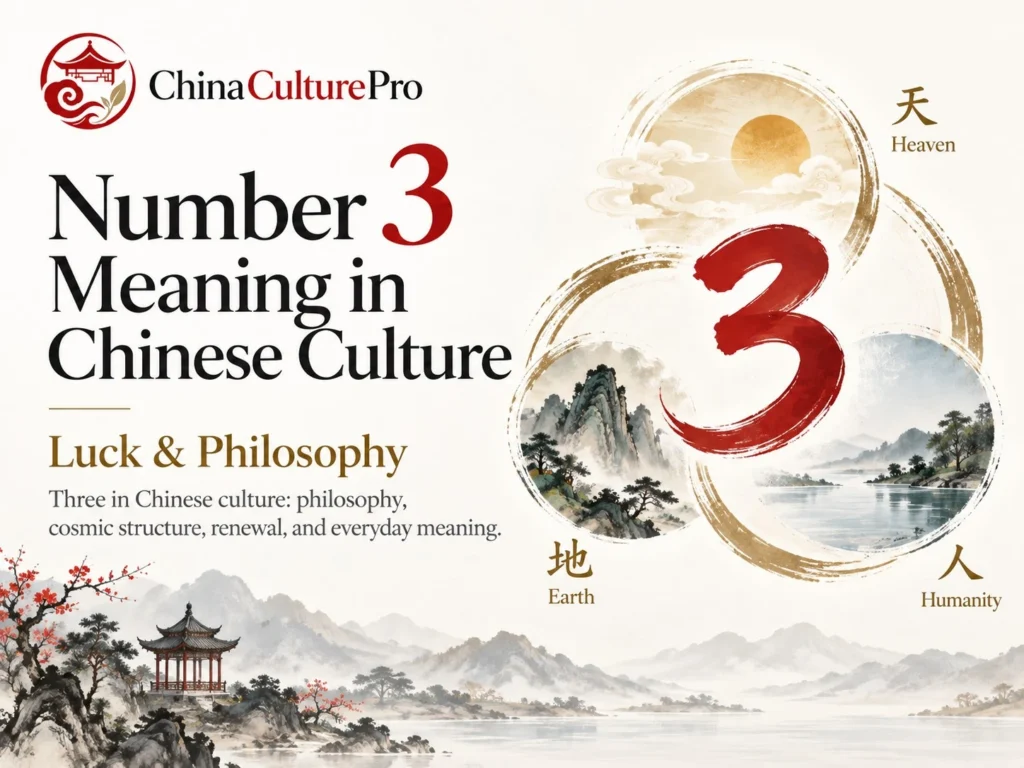
- Cosmic structure: The Three Powers (三才, sāncái)—Heaven, Earth and humanity—organize the world into a three-part relationship.
- Seasonal renewal: Three Yangs Bring Prosperity (三阳开泰, sān yáng kāi tài) is a New Year expression associated with the return of yang and favorable change.
- Ordinary modern use: Three is normally unremarkable in addresses, dates, quantities and gifts; regional puns do not create a nationwide taboo.
The key limit is context. These meanings belong to particular philosophical texts, cultural sets or expressions; they do not give the digit supernatural power over luck, wealth or fate.
Simple explanations often call 3 lucky because it appears in major philosophical texts and auspicious phrases, or unlucky because of loose wordplay about separation. Both approaches flatten unrelated systems into one label. In practice, 3 has greater intellectual and symbolic importance than commercial “luck” value. Each use must be read on its own terms.
Is Number 3 Lucky or Unlucky in Chinese Culture?
Number 3 is best described as context-dependent and mildly favorable, not inherently lucky or unlucky. It has positive associations in named structures such as the Three Powers and in the New Year phrase Three Yangs Bring Prosperity. In ordinary counting, addresses, dates and gifts, however, it is generally neutral.
This places 3 outside the strongest modern preference patterns. Numbers 6, 8 and 9 are more commonly chosen for smooth progress, prosperity or long duration; 4 is more widely avoided because of its resemblance to the word for death. The broader guide to Chinese number symbolism explains how sound, pairing, classical systems and digital slang create different kinds of meaning. Readers comparing present-day preferences can also see the separate guides to lucky numbers and unlucky numbers.
Calling 3 “lucky” is reasonable only when the specific phrase or tradition is positive. It should not be treated as a promise that a date, phone number or purchase will produce a better outcome.
Why Three Can Mean More Than an Exact Count
In Chinese, three can be an exact numeral or an indefinite number suggesting several, repeated or many. The Institute of Linguistics at the Chinese Academy of Social Sciences describes three as the beginning of plurality and notes that many early examples do not require an exact count of three.[3]
This rhetorical use appears in familiar expressions. Sānsī ér hòu xíng (三思而后行) means to think repeatedly and carefully before acting, while sānlìng-wǔshēn (三令五申) means to issue orders or warnings again and again. In some narratives, three repetitions also create an effective rhythm: a first attempt establishes the problem, a second builds tension and a third brings resolution.
That does not mean every three in a classical text is figurative. Sometimes it denotes exactly three people, objects or stages. The surrounding grammar, genre and subject determine the reading. The indefinite use is a feature of language and storytelling, not evidence that the number itself is sacred or magical.
Number 3 in the Dao De Jing
What “Two Gives Birth to Three” Means
Chapter 42 of the Dao De Jing (道德经, Dàodéjīng) states: “The Way gives birth to one; one gives birth to two; two gives birth to three; three gives birth to the myriad things.” It then says that the myriad things carry yin and embrace yang, and that their blending achieves harmony.[1]
The sequence is a model of generation, not ordinary arithmetic. A common interpretive line reads one as initial unity, two as yin and yang, and three as the relationship through which differentiation becomes productive. Other traditions identify the three more concretely—for example, as Heaven, Earth and humanity, or as kinds of vital breath. These readings need not be forced into one literal equation.
The safest conclusion is that three marks a transition. A simple polarity does not remain frozen as two opposing sides; interaction makes further differentiation and life possible. Here, three is philosophically important because of its place in a process.
Why “Three Gives Birth to the Myriad Things” Does Not Make 3 Magical
“Three gives birth to the myriad things” does not declare 3 a lucky charm, a creative personality type or a source of energy that can be applied to personal decisions. The passage explains a cosmological movement from the Way toward the diversity of the world. Its numbers work conceptually, not as fortune codes.
Projecting the line onto phone numbers, house numbers or personal destinies changes the genre of the claim. The Dao De Jing does not say that choosing the digit 3 attracts growth, improves fertility or guarantees success. Those are modern additions, not conclusions contained in the text.
The Three Powers: Heaven, Earth and Humanity
The Three Powers are a major Chinese cosmological triad: Heaven, Earth and humanity. The “Shuo Gua” section of the Book of Changes describes the way of Heaven through yin and yang, the way of Earth through yielding and firm qualities, and the human way through benevolence and righteousness.[2]
Heaven supplies cycles and temporal order; Earth provides the material field that supports life; humanity occupies an active ethical position between them. The model is relational: people respond to natural conditions and participate in an ordered world.
The Three Powers help explain why three-part structures can feel comprehensive in Chinese thought. Yet the doctrine does not make every group of three balanced, complete or auspicious. It is one formal cosmological model, not a universal property of the digit.
Why Chinese Culture Often Organizes Ideas in Groups of Three
Three is large enough to suggest variety but compact enough to remember. Chinese writing, art and popular religion therefore often organize related ideas into triads. The meanings come from the members of each set, not from an all-purpose symbolism of three.
| Group | Members | Cultural meaning | Interpretive limit |
|---|---|---|---|
| Three Friends of Winter (岁寒三友, suìhán sānyǒu) | Pine, bamboo and plum | Endurance, integrity and resilience in adversity | The plants and their literary histories create the symbolism. |
| Three Teachings (三教, sānjiào) | Confucianism, Buddhism and Daoism | A way of naming three major traditions in Chinese intellectual and religious life | It is a historical classification, not a lucky triad. |
| Fu Lu Shou (福禄寿, fú lù shòu), or the Three Stars | Blessing, status or emolument, and longevity | Popular wishes for a fortunate worldly life | The positive meaning comes from the three deities and their attributes. |
The Three Friends of Winter offer a particularly clear example: the set matters because pine, bamboo and plum each contribute a distinct moral and seasonal association. Simply placing any three objects together would not reproduce that meaning.
Three Yangs Bring Prosperity: Number 3 in New Year Art
What Sanyang Kaitai Originally Means
Three Yangs Bring Prosperity is a traditional expression of seasonal renewal. It is usually explained through a calendrical reading of the hexagrams in the Book of Changes: after yin reaches its height, yang lines return one by one, and the Peace hexagram has three unbroken yang lines below three broken yin lines. The image came to suggest that winter is receding, spring is beginning and conditions are turning favorable.[4]
The phrase is therefore well suited to Lunar New Year greetings, paintings and decorative objects. “Prosperity” here is a readable gloss for kāitài—an opening into peace, ease or favorable conditions—rather than a guarantee of financial gain.
Its auspicious meaning belongs to the complete phrase and seasonal framework. A bare digit 3, a third day or any random set of three objects does not automatically carry the same message.
Why Three Sheep Appear in the Motif
Three Sheep Bring Prosperity (三羊开泰, sān yáng kāi tài) turns the abstract expression into a visual rebus. Sheep, yáng (羊), is pronounced the same as yang, yáng (阳), so artists can represent the “three yangs” with three sheep.
A painting in the National Palace Museum collection shows a boy engaging three sheep and identifies the scene as an auspicious representation created through the sheep/yang homophone.[5] Such images are especially legible in New Year settings, where spring, renewal and favorable change are already expected themes.
The animals do not make the object work as a talisman. The image communicates a conventional blessing through wordplay, number, season and composition.
Does Three Sound Like “Birth” or “Separation” in Chinese?
In Standard Mandarin, three is sān (三), birth or life is shēng (生), and to disperse or separate is sàn (散). Sān and shēng have different initials and finals, so they are not homophones or close near-homophones. Sān and sàn share the same segmental syllable but differ in tone. That resemblance can support occasional wordplay, but it does not establish a nationwide taboo.[6]
Cantonese creates a different sound landscape. In common Jyutping forms, three is saam1, birth is saang1 and disperse is saan3. The first two are closer than their Mandarin equivalents, which helps explain regional positive associations with growth or life. Tone and final consonants still matter, and speakers do not automatically hear every use of 3 as a fixed message.[7]
Statements such as “3 always means birth” or “three gifts mean separation” are therefore too broad. A sound-based interpretation should identify the language variety, the full phrase and the community using it.
Number 3 in Gifts, Dates, Addresses and Everyday Etiquette
Three is normally safe in everyday Chinese life. There is no nationwide rule against giving three gifts, using an address with 3, choosing the third day of a month or sitting at table number 3. A host may prefer paired quantities for a wedding or opening because “good things come in pairs,” but that preference does not turn every odd number into an insult.
| Setting | Common reading | Practical guidance |
|---|---|---|
| Gifts | Usually neutral; celebratory presentations may favor pairs | Three items are acceptable unless a family or local custom says otherwise. |
| Red envelopes | Amount and relationship matter more than the digit 3 | For formal celebrations, familiar even or favorable amounts may feel more conventional. |
| Dates | No general lucky or unlucky status | Do not infer Sanyang Kaitai from an ordinary date containing 3. |
| Addresses and numbers | Generally neutral | No special action is needed for a room, floor, phone number or license plate containing 3. |
When etiquette matters, follow the recipient’s stated preference rather than a universal internet list. Deliberate symbolic choices deserve more attention than assigned or incidental numbers.
Three in Modern Expressions and Digital Language
Modern meanings attach to complete expressions, not to the digit alone. Xiǎosān (小三) is a colloquial and negative term for a third party in a romantic relationship. The older online shorthand 3Q plays on the English “thank you” and now feels dated in many contexts. Digital strings such as 1314 and 3344 are read by convention as romantic phrases about a lifetime or repeated lifetimes, although the phonetic matches are loose.
None of these usages rewrites the general cultural status of 3. Xiǎosān does not make 3 unlucky, just as 1314 does not make every appearance of 3 a promise of lasting love. Whole expressions take priority over isolated digits, and internet codes should not be projected backward onto classical texts or artifacts.[3]
Does Number 3 Represent Wood or a Wuxing Element?
Number 3 has no universal Wuxing (五行, wǔxíng), or Five Phases, assignment in everyday Chinese culture. The “Great Plan” chapter of the Book of Documents lists water first, fire second, wood third, metal fourth and earth fifth. In that passage, “third is wood” is part of an ordered enumeration; by itself, it does not prove that every 3 is intrinsically Wood.[8]
Later correlative and diagrammatic traditions, including commonly transmitted Hetu number arrangements, can pair 3 and 8 with the east and Wood. That correspondence is valid inside the particular system that defines it. It should not be exported into ordinary etiquette, personal numerology or claims that a date, address or object containing 3 has a fixed elemental effect.
Common Misreadings of Number 3
- Misreading: Three is a universal Chinese lucky number. Correction: It is neutral to positive and gains favorable meaning mainly from named texts, phrases and motifs.
- Misreading: Three and “birth” are homophones in Mandarin. Correction: Sān and shēng are clearly different; a closer association may occur in Cantonese.
- Misreading: Three sounds like “separation,” so three gifts are offensive. Correction: Mandarin sān and sàn differ in tone, and China has no nationwide ban on three gifts.
- Misreading: “Three gives birth to the myriad things” makes 3 magical. Correction: The line describes cosmological generation, not a practical method for changing fortune.
- Misreading: The Three Powers make every triad balanced and complete. Correction: Heaven, Earth and humanity form one specific classical model.
- Misreading: All Chinese groups of three share one origin. Correction: The Three Teachings, Three Friends of Winter and Fu Lu Shou developed in different intellectual, artistic and religious settings.
- Misreading: Three sheep make any object auspicious. Correction: The motif works through the Three Yangs phrase, the sheep/yang homophone and a New Year context.
- Misreading: Number 3 always belongs to Wood. Correction: Number-element correspondences are system-specific, not a universal cultural rule.
- Misreading: The negative word xiǎosān makes 3 unlucky. Correction: The judgment belongs to the complete modern expression, not the numeral.
FAQs About Number 3 in Chinese Culture
Is 3 a lucky number in Chinese culture?
Three is mildly favorable in some Chinese contexts, especially classical cosmology and the New Year expression Three Yangs Bring Prosperity. It is neutral in most everyday uses and is not as consistently preferred as 6, 8 or 9.
Why is 3 important in Chinese philosophy?
The Dao De Jing places three at the transition from yin-yang differentiation to the myriad things, while the Book of Changes uses Heaven, Earth and humanity as the Three Powers. These are distinct models, but both make triadic structure philosophically important.
Does three mean birth in Chinese?
Not in Standard Mandarin: sān, “three,” and shēng, “birth” or “life,” are not close homophones. Cantonese forms can sound more similar, so a positive birth or growth association is more plausible there, but it is not a nationwide rule.
What are the Three Powers in Chinese culture?
The Three Powers are Heaven, Earth and humanity. They organize cosmic cycles, the material world and human ethical action into a relational three-part model in the Book of Changes tradition.
Is it unlucky to give three gifts in China?
No nationwide custom makes three gifts unlucky. Pairs may be preferred at weddings and other celebrations, but three items are generally acceptable; the occasion, recipient and local family practice matter more than the digit.
Sources
[1] Chinese Text Project. Dao De Jing, Chapter 42
[2] Chinese Text Project. Book of Changes: Shuo Gua
[3] Institute of Linguistics, Chinese Academy of Social Sciences. The Mathematical and Cultural Meanings of Numbers
[4] People’s Daily Online. The Cultural Meaning of “Three Yangs Bring Prosperity”
[5] National Palace Museum, Taipei. Three Sheep, Symbol of Felicity
[6] Ministry of Education, Taiwan. Revised Mandarin Chinese Dictionary
[7] Linguistic Society of Hong Kong. Jyutping Romanization Scheme
[8] Chinese Text Project. Book of Documents: Great Plan