

Quick Answer: What Is Aged White Tea?
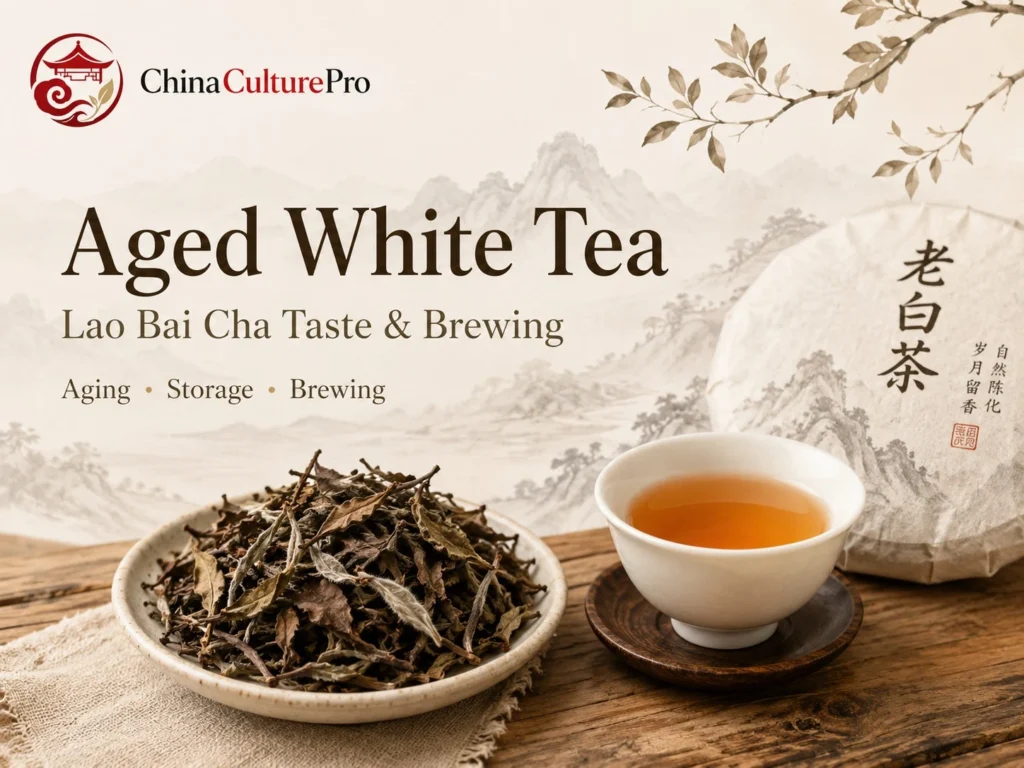
Aged White Tea, also called Lao Bai Cha in Chinese, is Chinese white tea that has slowly transformed under clean, dry, dark, odor-free storage. It may also be called Old White Tea or Chinese Aged White Tea, but Aged White Tea is the clearest English term.
It is not green tea, dark tea, Pu-erh tea, flower tea, or a simple story of “older is always better.” It remains white tea; “aged” describes storage and transformation over time, not a separate tea category.
The basic identity is clear:
Tea Type: Chinese white tea in an aged state.
Chinese Name: 老白茶.
Pinyin: Lao Bai Cha.
Common English Names: Aged White Tea, Lao Bai Cha, Old White Tea, Chinese Aged White Tea.
Base Tea: white tea made from tea buds, leaves, or tender stems.
Core Process Before Aging: withering, drying, and sorting.
Aging Condition: clean, dry, dark, odor-free storage.
Common Forms: loose aged white tea and aged white tea cake.
Most Common Base: aged Shou Mei, especially Shou Mei cake.
Other Possible Bases: Bai Mudan, Gong Mei, and Baihao Yinzhen can also age.
Aroma: clean aged aroma, jujube aroma, herbal aroma, honey-like sweetness, woody sweetness, lotus leaf aroma.
Liquor: orange-yellow, orange-red, amber, or deep golden, clear and bright.
Taste: sweet, mellow, smooth, thick, warm, and durable.
Brewing: usually best with 95–100°C / 203–212°F water; aged Shou Mei and aged white tea cakes are often suitable for simmering.
The core rule: good aged white tea depends on raw material, white tea processing, sufficient dryness, clean storage, and time. Age is only one factor; clean storage matters more than the year number.
To understand the broader category, read our [Chinese White Tea] guide.
Name, Tea Type, and Basic Identity
The Chinese name Lao Bai Cha means “old white tea” or “aged white tea.” In English, Aged White Tea is usually the best main term because it describes the tea more clearly than the direct translation “Old White Tea.”
| Identity Point | Aged White Tea |
|---|---|
| Chinese Name | 老白茶 |
| Pinyin | Lao Bai Cha |
| Best English Term | Aged White Tea |
| Other English Terms | Old White Tea, Chinese Aged White Tea |
| Tea Type | aged state of Chinese white tea |
| Not The Same As | green tea, dark tea, Pu-erh, artificially fermented tea |
| Base Process | withering, drying, sorting |
| Aging Logic | slow natural transformation under clean storage |
| Main Quality Standard | clean aroma, clear liquor, sweet mellow taste, soft natural leaf base |
The word “aged” does not mean the tea has changed into another tea category. Aged White Tea remains white tea, based on withering, drying, and sorting, with later transformation during storage.
This is why Aged White Tea should not be confused with Pu-erh or dark tea. It is not pile-fermented, artificially ripened, or made old through moisture, heat, wet storage, or forced aging.
Judge it through five points: raw material, white tea processing, dryness, storage condition, and age. A dark cake, old-looking wrapper, or high year number does not prove quality. For Chinese tea drinkers, the first question is usually not “How old is it?” but “Is it clean?”
Which White Teas Can Become Aged White Tea?
Aged White Tea is not the same as Shou Mei, although aged Shou Mei is the most common form on the market. Several Chinese white teas can age, but they do not age in exactly the same way.
| White Tea Type | Can It Age? | Common Aged Form | Aging Character |
|---|---|---|---|
| Shou Mei | Yes, most common | loose tea and pressed cakes | mature leaves, appropriate stems, strong aging potential, accessible price |
| Gong Mei | Yes | loose tea and some cakes | Qunti young shoots, sweet mellow transformation, more variation |
| Bai Mudan | Yes | mostly loose tea, some cakes | floral aroma may move toward honey-like and herbal notes |
| Baihao Yinzhen | Yes, less common | mostly loose tea | pekoe aroma may become softer, sweeter, and more honey-like |
Aged Shou Mei is common because Shou Mei has higher production, mature leaves, appropriate stems, accessible pricing, and good compatibility with pressing and storage. Many people first encounter Lao Bai Cha through a Shou Mei cake.
But Aged White Tea does not equal Shou Mei. Bai Mudan, Gong Mei, and Baihao Yinzhen can also age; they are simply less common because of price, production volume, market habits, and different flavor expectations. Shou Mei is often the most familiar aged white tea base, while Aged White Tea describes the aged state of white tea as a broader category.
To understand the most common aged white tea base, read our Shou Mei Tea guide.
Main Origins: Fujian White Tea Regions
Aged White Tea should be understood through the Chinese white tea regions of Fujian. The origin of the base tea matters, but for aged tea, processing and storage matter just as much.
| Origin / Region | Chinese | Location | Why It Matters |
|---|---|---|---|
| Fuding | 福鼎 | northeastern Fujian | the best-known white tea region in the aged white tea market, especially for Shou Mei cakes |
| Zhenghe | 政和 | northern Fujian / Minbei | traditional white tea area, often associated with fuller and steadier styles |
| Jianyang / Shuiji | 建阳 / 水吉 | northern Fujian | important in Fujian white tea history and Gong Mei / Shou Mei context |
| Songxi / Jian’ou | 松溪 / 建瓯 | northern Fujian | part of the broader Fujian white tea tradition |
Fuding White Tea has the strongest market recognition for aged white tea, especially aged Shou Mei cakes. Zhenghe White Tea may feel fuller and more settled, while Jianyang / Shuiji and Songxi belong to the deeper Fujian white tea context.
Still, origin alone does not make good aged white tea. Two teas from the same region can become very different after storage: one may show clean aged aroma, jujube sweetness, amber liquor, and smooth body; another may become sour, moldy, dull, or warehouse-like. Origin matters, processing matters, dryness matters, but storage can decide the final drinking quality.
How White Tea Ages
White tea can age because it is lightly processed and, when properly dried and stored, can continue to change slowly. This transformation should be natural, clean, and stable, not pile fermentation, artificial ripening, or “making tea old” through moisture or heat.
Aged White Tea changes through slow storage-driven transformation, including oxidation, polymerization, aroma integration, and gradual mellowing. The result depends on several factors.
| Factor | Why It Matters |
|---|---|
| Raw Material | good raw material gives the tea a foundation for sweetness, body, and later transformation |
| White Tea Processing | proper withering and drying help preserve clean aroma and aging potential |
| Dryness | sufficient dryness keeps the tea safe for storage and reduces the risk of mold |
| Loose Or Pressed Form | loose tea may transform more openly; cakes may transform in a more concentrated and stable way |
| Storage Cleanliness | odors, smoke, moisture, and dirty storage can ruin aged aroma |
| Temperature And Humidity | stable, moderate conditions are safer than high heat or high humidity |
| Light Exposure | light can dull aroma and damage the tea |
| Time | time allows transformation, but it cannot repair bad raw material or poor storage |
Good aged white tea is not created by time alone. Time only works when the earlier conditions are right: good tea becomes better in good storage, while poor raw material, flawed processing, insufficient drying, or wet and dirty storage will only expose problems more clearly.
Aged White Tea should also not be described like ripe Pu-erh. Ripe Pu-erh uses wo dui, or pile fermentation; Aged White Tea does not use pile fermentation or artificial ripening. Its transformation should be slow, dry, and clean. The best old white tea does not smell forced. It smells settled.
Aged White Tea Taste and Aroma
Good Aged White Tea is defined by clean aged aroma, mellow sweetness, clear liquor, smooth thickness, and comfortable aftertaste. It should not smell moldy, sour, smoky, wet, or dirty.
| Tasting Point | Good Aged White Tea |
|---|---|
| Dry Aroma | clean aged aroma, jujube, honey-like sweetness, herbal aroma, woody sweetness |
| Wet Aroma | warm, sweet, layered, clean, sometimes with lotus leaf or zongzi leaf-like notes |
| Liquor Color | orange-yellow, orange-red, amber, or deep golden, clear and bright |
| Taste | sweet, mellow, smooth, thick, warm, durable |
| Mouthfeel | rounder than fresh white tea, smoother than young white tea, thick but not rough |
| Aftertaste | clean, sweet, comfortable, not sour or irritating |
| Leaf Base | soft, bright, naturally opened, not blackened or rotten-looking |
Common aroma notes include clean aged aroma, jujube, herbal aroma, honey-like sweetness, woody sweetness, lotus leaf aroma, and subtle zongzi leaf-like warmth. “Herbal” is a sensory description similar to dried herbs or Chinese medicinal materials; it does not mean the tea has medical effects.
| Good Aged White Tea | Problem Aged White Tea |
|---|---|
| clean aged aroma, jujube, honey, herbal, woody sweetness | moldy, sour, smoky, warehouse-like, basement-like smell |
| clear orange-yellow, orange-red, amber, or deep golden liquor | cloudy, muddy, soy-sauce-like, dull liquor |
| sweet, mellow, smooth, thick taste | rough, sour, thin, harsh, irritating taste |
| warm and comfortable mouthfeel | throat irritation, dryness, discomfort |
| soft, naturally opened leaf base | blackened, stiff, rotten, or slimy leaf base |
| durable infusions with continuing sweetness | flavor drops sharply after a few infusions |
The two most important words are clean and warm. If an aged white tea smells unclean or makes the throat uncomfortable, the year number no longer matters.
For a broader framework for aroma, mouthfeel, Hui Gan, and aftertaste, read our Chinese Tea Tasting guide.
Fresh White Tea vs Aged White Tea
Fresh white tea and aged white tea are different drinking stages, not a quality ranking.
| Point | Fresh White Tea | Aged White Tea |
|---|---|---|
| Aroma | pekoe aroma, floral aroma, plant-like aroma, fresh sweetness | aged aroma, jujube, herbal aroma, honey-like sweetness, woody sweetness |
| Liquor | pale apricot, light golden, clear | orange-yellow, orange-red, amber, deep golden, clear |
| Taste | fresh, sweet, light, lively | sweet, mellow, smooth, thicker |
| Texture | lighter, brighter, more refreshing | rounder, warmer, more settled |
| Brewing | often uses slightly lower water temperature | usually handles higher water temperature |
| Best For | fresh fragrance and spring-like clarity | aged depth, smoothness, warmth, and slow drinking |
Fresh white tea is valued for clarity, floral aroma, pekoe aroma, and lively sweetness. Aged White Tea is valued for clean transformation, deeper aroma, rounder body, and smoother taste.
One is not automatically better. Fresh tea shows white tea’s brightness; aged tea shows time, storage, and transformation. A Chinese tea drinker may choose fresh white tea on a bright spring morning and aged white tea on a quiet autumn afternoon. Both can be correct.
Year Stages: 1 Year, 3 Years, 5 Years, 7+ Years
Many readers want to know how old white tea must be before it becomes aged white tea. There is no fixed rule; year stages are only a rough reference, not a quality guarantee.
| Stage | Approximate Age | Typical Character | Caution |
|---|---|---|---|
| Fresh Stage | within 1 year | fresh, floral, plant-like, sweet, light golden liquor | good for drinkers who like fresh white tea |
| Early Transition | 2–3 years | green edge softens, sweetness increases, aroma becomes more stable | may feel less bright than new tea but not fully aged |
| Medium Aging | 4–6 years | aged aroma, honey-like sweetness, woody sweetness, possible jujube notes, smoother body | poor storage problems often become more obvious |
| Well-Aged Stage | 7+ years | deeper aged aroma, more integrated sweetness, thicker body if storage is clean | older tea requires stricter storage quality |
A tea can be three years old and already show pleasant transformation, while a ten-year tea can still be unpleasant if storage was bad. The year number is only a reference.
The Chinese folk saying “one year tea, three years medicine, seven years treasure” can be mentioned as cultural language, but not as a scientific standard, buying rule, or medical promise. Aged White Tea is tea, not medicine.
Be careful with fake aged tea, artificially aged tea, and wet-storage tea. Some teas are made to look old through high temperature, high humidity, heavy baking, or poor storage. They may look dark but smell sour, moldy, smoky, or warehouse-like. A clean five-year tea can be better than a dirty fifteen-year tea.
How to Tell Good Aged White Tea from Bad Storage
Good aging and bad storage can look similar to beginners, but they do not smell or taste the same.
| Checkpoint | Good Aged White Tea | Bad Storage / Fake Aged Tea |
|---|---|---|
| Dry Aroma | clean aged aroma, jujube, honey, herbal, woody sweetness | moldy, sour, smoky, warehouse-like, stuffy |
| Wet Aroma | warm, sweet, layered, clean | stronger mold, sourness, dirty basement smell |
| Liquor Color | clear orange-yellow, orange-red, amber, or deep golden | cloudy, muddy, soy-sauce-like, dull |
| Taste | sweet, mellow, smooth, thick | sour, harsh, rough, watery, irritating |
| Mouthfeel | warm, smooth, comfortable | throat irritation, dryness, discomfort |
| Leaf Base | soft, bright, naturally opened | blackened, stiff, rotten, slimy |
| Aftertaste | clean, sweet, lingering | sour, moldy, dirty, uncomfortable |
Use the simple test: moldy smell is not aged aroma, sourness is usually a flaw, cloudy liquor is not richness, and blackened leaves are not proof of age. Good aged white tea should smell clean, brew clear, taste sweet, and feel comfortable.
Aged White Tea Cake and Loose Aged White Tea
Aged White Tea can appear as loose tea or pressed tea. Aged Shou Mei cake is the most common form, but not the only one.
| Point | Loose Aged White Tea | Aged White Tea Cake |
|---|---|---|
| Form | loose leaves | pressed cake, brick, or other compressed shape |
| Common Tea Types | Shou Mei, Gong Mei, Bai Mudan | mostly Shou Mei, sometimes Gong Mei or Bai Mudan |
| Storage Space | takes more space | compact and easier to store |
| Aroma Release | more open, aroma may release faster | more concentrated, often slower transformation |
| Convenience | easy to take and brew | needs careful prying |
| Risk | easier to absorb odors if poorly sealed | cake center may trap moisture if storage is poor |
| Brewing | direct brewing | pry gently before brewing |
Pressed white tea is usually made by softening loose tea with steam and pressing it into cakes, bricks, or other shapes. Pressing makes storage and transport easier and can make aging feel more concentrated, but a cake is not automatically better than loose tea.
When choosing aged white tea cake, check that the inside and outside material is relatively consistent, the cake is not mostly broken leaves or dust, the aroma is not moldy or sour, the liquor is clear, and the taste is sweet, mellow, and smooth.
When prying a cake, keep the leaves as intact as possible. Too many fragments can release too quickly and taste rough.
Cake tea and loose tea are different forms, not a high-low ranking. Loose tea may feel more open; cake tea may feel more settled and compact. Both can be good if raw material, processing, and storage are right.
How to Brew Aged White Tea
Aged White Tea usually handles high water temperature well. Compared with young white tea, it often needs hotter water to release aged aroma, thickness, and sweetness.
| Brewing Method | Teaware | Water Temperature | Leaf Amount | Steeping Time | Best For |
|---|---|---|---|---|---|
| Gaiwan | 100–120ml gaiwan | 95–100°C / 203–212°F | 5g | 15–30 seconds for the first infusion, then extend | tasting aroma, body, and layers |
| Glass Cup / Mug | glass cup or mug | about 95°C / 203°F | 3–4g / 250ml | 3–5 minutes | simple daily brewing |
| Porcelain Pot | small porcelain pot | 95–100°C / 203–212°F | 4–5g / 200ml | 3–5 minutes | sharing with others |
| Simmering / Boiling | kettle or pot | near boiling, then low heat | 3–5g / 500ml | simmer briefly | aged Shou Mei and aged white tea cakes |
Brewing tips:
- Use hot water: 95–100°C helps release aged aroma and body.
- Brew first, then simmer: for aged Shou Mei or aged white tea cake, brew several infusions first, then simmer the leaves.
- Do not crush cake tea: broken pieces can release too quickly and taste rough.
- Use a gaiwan for tasting: it shows the tea’s changing aroma and sweetness.
- Use a mug for convenience: aged white tea also works well as a daily warm drink.
- Use a thermos carefully: use less leaf and avoid steeping too strong for too long.
- Enjoy it plain: milk and sugar cover the natural aged sweetness.
- Do not force bitterness: old tea should be thick and warm, not bitter and muddy.
Boiling aged white tea can be excellent, especially for aged Shou Mei or aged white tea cakes. A common Chinese method is to brew the tea first, then simmer the brewed leaves: first the clear layered infusions from a gaiwan, later the deeper sweetness from simmering.
To learn practical brewing methods, read our How to Brew Chinese Tea guide.
For gaiwans, mugs, porcelain pots, and simmering vessels, read our Chinese Teaware guide.
Aged White Tea vs Shou Mei
Aged White Tea and Shou Mei are closely related in the market, but they are not the same thing.
| Point | Aged White Tea | Shou Mei |
|---|---|---|
| Basic Meaning | white tea in an aged state | one category of Chinese white tea |
| Tea Type | aged state, not a separate tea category | white tea category |
| Scope | can come from Shou Mei, Gong Mei, Bai Mudan, or Baihao Yinzhen | can be fresh or aged |
| Market Reality | most commonly seen as aged Shou Mei cake | the most common base for aged white tea |
| Main Confusion | people often equate aged white tea with aged Shou Mei | people often assume all Shou Mei is aged |
Aged Shou Mei is common because Shou Mei has mature leaves, appropriate stems, accessible price, higher production, and good compatibility with pressing and long storage. This makes it practical for aged white tea cakes.
But Aged White Tea is broader: it describes the aged condition of white tea, while Shou Mei is one white tea category. The two overlap, but they are not identical.
To understand Qunti white tea, read our Gong Mei Tea guide.
Aged White Tea vs Pu-erh Tea
Aged White Tea is sometimes confused with Pu-erh because both can be stored and aged. They are different tea systems.
| Point | Aged White Tea | Pu-erh Tea |
|---|---|---|
| Tea System | Chinese white tea in an aged state | Pu-erh tea, including raw Pu-erh and ripe Pu-erh |
| Main Region | Fujian white tea regions such as Fuding, Zhenghe, Jianyang | Yunnan regions such as Xishuangbanna, Lincang, Pu’er |
| Raw Material | white tea material: buds, leaves, tender stems from suitable tea varieties | Yunnan large-leaf sun-dried tea material |
| Core Process | withering, drying, sorting; no pile fermentation | raw Pu-erh: kill-green, rolling, sun-drying; ripe Pu-erh: pile fermentation |
| Aging Logic | slow natural transformation under clean dry storage | raw Pu-erh ages naturally; ripe Pu-erh uses wo dui pile fermentation |
| Flavor | aged aroma, jujube, herbal, honey-like, woody sweetness | varies widely; raw Pu-erh can be powerful and structured, ripe Pu-erh can be earthy and fermented |
| Mouthfeel | sweet, mellow, smooth, warm, thick | raw Pu-erh may be strong and astringent; ripe Pu-erh may be thick and earthy |
The key difference is process. Aged White Tea is not pile-fermented or artificially ripened. Ripe Pu-erh uses wo dui, a pile-fermentation process; raw Pu-erh has its own processing and aging logic. Aged White Tea belongs to the white tea system.
How to Choose Good Aged White Tea
Buying Aged White Tea requires more caution than buying young tea. Year, wrapper, and story are not enough; the tea itself must be clean.
| Checkpoint | What To Look For | Warning Signs |
|---|---|---|
| Product Name | clear type, such as Aged Shou Mei, Aged Bai Mudan, Aged Gong Mei | only “old tea” or vague “aged white tea” with no base type |
| Origin | Fujian, Fuding, Zhenghe, Jianyang, or credible white tea origin | vague origin or unrelated region marketed as classic Lao Bai Cha |
| Year | clear and reasonable year information | very old year with extremely low price or unclear proof |
| Form | loose tea or cake, clearly described | old-looking cake with no useful information |
| Dry Aroma | clean aged aroma, jujube, honey, herbal, woody sweetness | moldy, sour, smoky, warehouse-like, stuffy |
| Liquor | clear orange-yellow, orange-red, amber, or deep golden | cloudy, muddy, dark, soy-sauce-like |
| Taste | sweet, mellow, smooth, thick | sour, rough, thin, harsh, irritating |
| Leaf Base | soft, natural, not blackened | black, stiff, rotten-looking, slimy |
| Cake Quality | consistent inside and outside, not too broken | good surface material but broken poor material inside |
Watch for fake aged tea, artificially aged tea, wet-storage tea, wrapper stories, unrealistic prices, and dark color used as false proof of age. New tea may be sold as old tea; heat, humidity, heavy baking, or poor storage may be used to create an old appearance.
Three buying rules matter most: smell clean, brew clear, and taste sweet. If any one fails, the year number should not persuade you.
How to Store Aged White Tea
Use these storage rules:
- Seal It Well: use a sealed pouch, tin, jar, or clean storage bag.
- Keep It Dry: moisture is the biggest risk for mold and sourness.
- Avoid Light: strong light can dull aroma and darken the tea.
- Keep It Cool: normal cool room temperature is enough.
- Avoid Odors: keep it away from spices, coffee, smoke, incense, Pu-erh, and scented teas.
- Do Not Refrigerate: refrigerators often have moisture and food odors.
- Do Not Open Frequently: repeated opening brings oxygen, moisture, and odor exposure.
- Protect Cakes From Moisture: a cake can trap moisture inside if the environment is humid.
- Protect Loose Tea From Crushing: loose aged tea is easier to break and absorb odors.
- Keep Storage Stable: stable storage is better than constant moving and handling.
The core rule is simple: dry, dark, sealed, cool, odor-free. Aged White Tea should continue to change quietly, not be disturbed constantly.
Benefits and Caffeine
Aged White Tea still contains common tea compounds such as tea polyphenols, amino acids, and caffeine. Aging changes flavor and mouthfeel, but it does not remove caffeine. Many drinkers find aged white tea smoother, warmer, and gentler than young tea, but this is a drinking experience, not a medical conclusion.
Important cautions:
- Aged White Tea contains caffeine.
- A mellow taste does not mean it is caffeine-free.
- Avoid drinking large amounts before sleep.
- People sensitive to caffeine should drink moderately.
- People with stomach sensitivity should adjust amount and strength.
- Pregnant people, people taking medication, or people with medical concerns should ask a qualified professional.
- Herbal aroma is an aroma note, not a medical effect.
- Do not treat Aged White Tea as medicine.
The Chinese folk saying “one year tea, three years medicine, seven years treasure” is cultural language, not a scientific standard or health promise. Aged White Tea is tea, not medicine.
Final Thoughts
Aged White Tea is not green tea, dark tea, Pu-erh, or a story of “older is always better.” It is Chinese white tea that has slowly transformed under clean, dry, dark, odor-free storage.
Its value comes from five things: good raw material, proper white tea processing, sufficient dryness, clean storage, and time. If any of these is missing, age alone cannot create good tea.
A good Aged White Tea should show clean aged aroma, jujube aroma, herbal aroma, honey-like sweetness, woody sweetness, or lotus leaf aroma; clear orange-yellow, orange-red, amber, or deep golden liquor; sweet mellow taste; smooth thick body; and a soft, bright, naturally opened leaf base. To understand the sense of time in Chinese white tea, Aged White Tea is worth drinking carefully.
FAQs About Aged White Tea
What is aged white tea?
Aged White Tea is Chinese white tea that has slowly transformed over time under clean, dry, dark, odor-free storage. It is not a separate tea category; it is white tea in an aged state.
What is Lao Bai Cha?
Lao Bai Cha is the Chinese name for aged white tea. Lao means old or aged, Bai means white, and Cha means tea.
Is aged white tea the same as Shou Mei?
No. Aged White Tea is an aged state. Shou Mei is one white tea category. Many aged white teas on the market are aged Shou Mei, especially Shou Mei cakes, but Bai Mudan, Gong Mei, and Baihao Yinzhen can also age.
Is aged white tea the same as Pu-erh?
No. Aged White Tea belongs to the white tea system and is not pile-fermented or artificially ripened. Pu-erh has its own Yunnan raw material, processing, and aging logic.
What does aged white tea taste like?
Good Aged White Tea tastes sweet, mellow, smooth, and thick. It may show clean aged aroma, jujube, herbal aroma, honey-like sweetness, woody sweetness, lotus leaf aroma, and clear amber or deep golden liquor.
How old is aged white tea?
There is no single fixed rule. Around 2–3 years, white tea may begin to show early transformation. Around 4–6 years, aged aroma and sweetness may become clearer. After 7 years, a well-stored tea may become deeper and smoother. Storage quality matters more than the number.
Is older white tea always better?
No. Older white tea is not automatically better. Good aged white tea needs good raw material, proper processing, sufficient dryness, and clean storage. Poorly stored old tea can be worse than clean younger tea.
What is the difference between fresh white tea and aged white tea?
Fresh white tea is usually lighter, fresher, more floral, and more plant-like. Aged White Tea is usually deeper, smoother, warmer, and thicker, with aged aroma, jujube, herbal notes, honey-like sweetness, or woody sweetness.
What is aged white tea cake?
Aged white tea cake is white tea that has been pressed into a cake and stored over time. Aged Shou Mei cake is the most common form, but other white teas can also appear as cakes.
How do you brew aged white tea?
Use 95–100°C / 203–212°F water. For gaiwan brewing, use about 5g for 100–120ml and start with 15–30 seconds. For mug brewing, use 3–4g for 250ml and steep for 3–5 minutes.
Can you boil aged white tea?
Yes. Aged Shou Mei and aged white tea cakes are especially suitable for simmering. A good method is to brew the tea first, then simmer the brewed leaves.
How do you tell good aged white tea from bad storage?
Good Aged White Tea smells clean, brews clear, tastes sweet and mellow, and has a soft natural leaf base. Bad storage often shows moldy, sour, smoky, warehouse-like aroma, cloudy liquor, harsh taste, or blackened stiff leaves.
Does aged white tea have caffeine?
Yes. Aged White Tea contains caffeine. Aging changes flavor and mouthfeel, but it does not remove caffeine.
Is aged white tea medicinal?
No. Aged White Tea is tea, not medicine. Herbal aroma is only an aroma description. It should not be treated as a medical effect or health promise.
How should I store aged white tea?
Store Aged White Tea in a sealed, dry, dark, cool, odor-free place. Do not refrigerate it. Keep it away from moisture, smoke, spices, coffee, Pu-erh, and other strong odors.