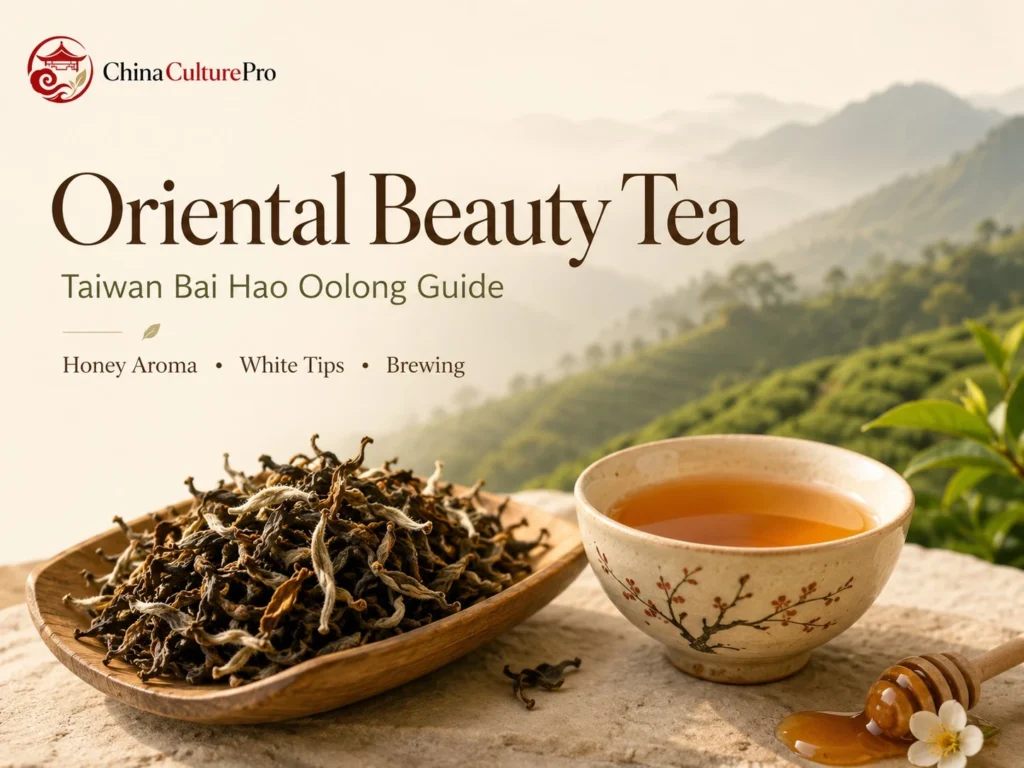

Quick Answer: What Is Oriental Beauty Tea?
Oriental Beauty Tea is a heavily oxidized Taiwanese oolong traditionally associated with Hsinchu and Miaoli in northern Taiwan. Also known as Dong Fang Mei Ren, Bai Hao Oolong, White-Tipped Oolong, Champagne Oolong, and Peng Feng Tea, it is made from tender shoots affected by tea green leafhoppers.
The plant’s defensive response, combined with selective picking and oolong processing, creates the tea’s natural honeyed, ripe-fruit, and muscat-like aromas. It is not honey-flavored tea, black tea, white tea, green tea, flower tea, or an alcoholic “champagne” drink.
Its basic identity is clear:
-
Tea Type: Taiwanese oolong tea.
-
Chinese Name: 東方美人.
-
Common Names: Oriental Beauty Tea, Dong Fang Mei Ren, Bai Hao Oolong, White-Tipped Oolong, Champagne Oolong, Peng Feng Tea.
-
Traditional Core Regions: Hsinchu and Miaoli, especially Beipu and Emei.
-
Representative Cultivar: Qingxin Dapan, although other suitable cultivars may also be used.
-
Picking Standard: Tender shoots, commonly one bud with one or two young leaves.
-
Key Ecological Feature: Tea green leafhoppers feed on the shoots while they are growing.
-
Appearance: Curved strips with visible white tips and mixed white, green, yellow, red, and brown tones.
-
Core Process: Substantial withering, repeated agitation, relatively high oxidation, heat fixation, moisture resting, rolling, and drying.
-
Aroma: Natural honey, ripe fruit, muscat grape, soft flowers, and occasional citrus or light spice.
-
Liquor: Clear amber, copper-gold, or orange-red.
-
Taste: Smooth, mellow, naturally sweet, and usually low in harsh bitterness.
-
Brewing: Generally 85–95°C with controlled infusion times.
Oriental Beauty’s honeyed character comes from leafhopper activity, plant response, cultivar, picking, and processing—not added honey, sugar, or flavoring. Quality is shown by visible white tips, natural honey and fruit aromas, bright liquor, sweetness within the tea soup, and a clean finish.
To place Oriental Beauty within the wider tea family, read our guide to [Chinese Oolong Tea].
Name, Tea Type, and Basic Identity
Oriental Beauty has several names, each reflecting a different aspect of its appearance, history, or market identity.
| Name | Chinese | Meaning |
|---|---|---|
| Oriental Beauty Tea | 東方美人茶 | The most widely recognized English name |
| Dong Fang Mei Ren | 東方美人 | A romanization of the Chinese name |
| Bai Hao Oolong | 白毫烏龍 | “White-Haired Oolong,” referring to the fine white hairs on the tender buds |
| White-Tipped Oolong | — | An English description of the visible white bud tips |
| Champagne Oolong | 香檳烏龍 | A market name inspired by its bright liquor and elegant fruit aroma; it contains no alcohol |
| Peng Feng Tea | 膨風茶 / 椪風茶 | A Taiwanese Hakka-associated nickname often interpreted as “boasting tea” |
| Five-Color Tea | 五色茶 | A reference to the mixed white, green, yellow, red, and brown dry leaves |
The term Bai Hao refers to the fine white hairs covering the tender tea buds. It does not make Oriental Beauty a white tea. The tea remains an oolong because its category is determined by its raw material and processing rather than the presence of white down.
| Identity Point | Oriental Beauty Tea |
|---|---|
| Tea Category | Taiwanese oolong tea |
| Oxidation Style | Heavily oxidized compared with many other Taiwanese oolongs |
| Main Form | Curved strips rather than tightly rolled balls |
| Representative Cultivar | Qingxin Dapan |
| Main Processing Logic | Oolong withering, agitation, controlled oxidation, heat fixation, rolling, and drying |
| Not The Same As | White tea, black tea, honey-flavored tea, herbal tea, or alcoholic champagne |
| Main Character | Leafhopper-influenced honey aroma, ripe fruit, white tips, amber liquor, and smooth sweetness |
Despite its names and dark liquor, Oriental Beauty remains an oolong: Bai Hao refers to bud hairs, Champagne Oolong contains no alcohol, bug-bitten does not mean insects remain in the tea, and its honeyed sweetness is neither added honey nor sugar. Its identity comes from ecology, tender picking, relatively high oxidation, and careful processing.
For an overview of the major processing families, see Chinese Tea Types.
Origin: Hsinchu, Miaoli, Beipu, and Emei
Oriental Beauty is closely associated with northern Taiwan, particularly the Hakka tea areas of Hsinchu and Miaoli.
| Origin | Chinese | Location | Importance |
|---|---|---|---|
| Hsinchu County | 新竹縣 | Northwestern Taiwan | One of the traditional centers of Oriental Beauty production |
| Beipu Township | 北埔鄉 | Hsinchu County | A major tea-producing Hakka community strongly associated with the tea |
| Emei Township | 峨眉鄉 | Hsinchu County | Another important production area near Beipu |
| Miaoli County | 苗栗縣 | South of Hsinchu | A major Hakka region producing high-quality Oriental Beauty |
| Other Northern Areas | — | Parts of Taoyuan and New Taipei | Smaller or regional production traditions |
Unlike many Taiwanese high-mountain oolongs, Oriental Beauty does not depend on extreme elevation. It is commonly produced in low- to mid-elevation hill country where warm, humid summers support leafhopper activity.
Traditional growing conditions may include well-drained hillsides, red or yellow soils, summer heat, and tea-garden management that allows leafhoppers to remain active. This does not mean every Oriental Beauty is certified organic or completely pesticide-free; such claims must be verified separately.
Beipu, Emei, and Miaoli provide the tea’s geographic and cultural context, but origin alone does not guarantee quality. The finished tea must still prove itself through its raw material, aroma, liquor, taste, and finish.
History, Hakka Tea Culture, and Peng Feng Tea
Oriental Beauty developed within northern Taiwan’s tea-growing and export culture, supported by Hakka farming communities in Hsinchu and Miaoli. Peng Feng Tea reflects its local Hakka identity, while Bai Hao Oolong and Oriental Beauty became broader commercial names.
| Historical Context | Significance |
|---|---|
| Northern Taiwan Tea Farming | Hsinchu and Miaoli developed established tea gardens and skilled Hakka tea-making communities |
| Leafhopper-Affected Summer Tea | Material once seen as insect-damaged became the basis of a distinctive high-value oolong |
| Peng Feng Tea | A local name connected with stories of boasting about the tea’s unusually high value |
| Export and International Naming | Oriental Beauty and Champagne Oolong became recognizable overseas names |
| Modern Identity | The tea is now valued for its ecology, white tips, honey-fruit aroma, and specialized processing |
A commonly told Hakka story says that a farmer who sold insect-affected tea at an unexpectedly high price was accused of peng feng—boasting. Popular claims that a British queen personally named the tea should likewise be treated as legend unless supported by reliable evidence.
The tea’s real cultural importance lies in how Taiwanese makers transformed leafhopper-affected summer shoots into a refined oolong. Consistent quality remains difficult because leafhopper activity, cultivar, weather, picking, oxidation, and the maker’s timing must align.
Its northern Taiwanese origins also reflect the wider history of Chinese Tea Culture.
What Makes Oriental Beauty “Bug-Bitten”?
The phrase bug-bitten tea refers to what happens to the tea plant before harvest.
Tea green leafhoppers, commonly identified in tea literature as Jacobiasca formosana, feed on the sap of tender buds and leaves. As they pierce the shoots, the plant activates natural defensive processes that change the aromatic potential of the leaf.
During withering, agitation, oxidation, and drying, aroma precursors in the affected shoots develop into the honeyed, ripe-fruit, floral, and muscat-like character associated with Oriental Beauty.
| Stage | What Happens | Why It Matters |
|---|---|---|
| Leafhopper Feeding | Leafhoppers pierce and feed on tender shoots | Triggers the tea plant’s defensive response |
| Plant Response | The affected shoots produce different aromatic compounds and precursors | Creates the potential for honeyed and fruity aromas |
| Selective Picking | Suitable tender shoots are harvested by hand | Preserves white tips and properly affected material |
| Controlled Processing | Withering, agitation, oxidation, and drying transform the aromatic precursors | Develops the finished honey, ripe-fruit, and muscat character |
What Bug-Bitten Does Not Mean
- It does not mean insects remain in the finished tea. Feeding occurs while the shoots are growing.
- It is not an insect-waste aroma. The fragrance comes from the plant’s response and later processing.
- It is not artificial flavoring. Honey, grape, peach, and floral aromas do not need to be added.
- It does not automatically mean certified organic. Farming and certification claims must be checked independently.
- More damage is not automatically better. Excessive damage can weaken shoot growth and reduce usable material.
Leafhopper activity is only one condition. Cultivar, season, shoot tenderness, weather, picking, oxidation, and drying still determine whether the finished tea is clean and balanced.
Why Production Is Limited
- Leafhopper activity varies by year, location, and weather.
- Affected shoots often grow more slowly and remain smaller.
- Suitable buds and leaves require selective hand picking.
- The harvest window can be narrow.
- Processing requires close control of moisture and oxidation.
- Not every affected batch develops a clean honeyed aroma.
Leafhoppers create aromatic potential, not guaranteed quality. Taiwanese tea makers judge whether the ecology and processing produced a clean, integrated cup—not merely whether the shoots were bitten.
White Tips, Cultivar, and Picking Standard
What Are the White Tips?
The white tips are young tea buds covered with fine natural hairs. These hairs are especially visible on tender material and give Bai Hao Oolong its name.
Good Oriental Beauty often displays a mixture of silver-white buds, green or olive sections, yellow-gold leaves, reddish oxidation tones, and brown finished leaves. This multicolored appearance is sometimes described as the five-color leaf.
White tips are important, but they are not a complete quality guarantee. Abundant white hairs cannot compensate for weak aroma, cloudy liquor, sourness, or a hollow taste.
Qingxin Dapan and Picking Standard
| Point | Traditional Oriental Beauty |
|---|---|
| Representative Cultivar | Qingxin Dapan |
| Typical Material | One bud with one or two young leaves |
| Main Harvest Period | Warm-season or summer production associated with active leafhoppers |
| Picking Method | Selective hand picking |
| Important Features | Intact buds, visible white hairs, suitable leafhopper influence, and tender leaves |
| Dry-Leaf Form | Curved strips rather than dense spherical rolls |
Qingxin Dapan is valued for its visible bud hairs, suitability for leafhopper-influenced production, and ability to develop honey and ripe-fruit aromas under high-oxidation processing.
Other suitable cultivars may also be used, but Qingxin Dapan remains the representative reference for classic Oriental Beauty. Cultivar alone does not determine quality; the garden environment, insect activity, picking, and processing must support it.
The small, affected shoots reduce yield and increase labor, but low production should not be treated as automatic proof of excellence. The dry leaf should look delicate and naturally varied rather than mechanically uniform.
How Oriental Beauty Tea Is Made
Oriental Beauty follows oolong processing but differs from lightly oxidized high-mountain tea and roast-driven Dong Ding. Its character depends on leafhopper-affected shoots, tender picking, substantial withering, repeated agitation, controlled oxidation, heat fixation, moisture resting, rolling, and drying.
- Leafhopper Activity This occurs in the tea garden rather than the factory. Leafhoppers feed on the young shoots and trigger the plant response that contributes to the tea’s aromatic potential.
- Plucking Tender shoots, commonly one bud with one or two young leaves, are selectively picked. The white-haired buds should remain intact.
- Sun and Indoor Withering The fresh leaves gradually lose moisture under controlled outdoor and indoor conditions. Withering softens the leaves, concentrates their internal components, and prepares them for agitation and oxidation.
- Repeated Agitation and Controlled Oxidation The leaves are gently turned, stirred, and rested. Oriental Beauty is more heavily oxidized than many Taiwanese oolongs, but it still follows oolong processing rather than the fully oxidized route used for black tea. Insufficient oxidation can leave the tea grassy, thin, or aromatically closed. Excessive or poorly controlled oxidation may produce sourness, dull fruit, fermented heaviness, or muddy liquor.
- Kill-Green Heat is applied to stop enzymatic oxidation once the desired aroma and structure have developed.
- Rehydration or Moisture Resting After heat fixation, the leaves may be allowed to regain or redistribute moisture before rolling. This makes the tender material more flexible and helps protect the buds and white hairs.
- Rolling and Shaping The leaves are rolled into curved strips rather than tightly compressed balls. The goal is to shape the tea while preserving the integrity of the tender shoots.
- Drying and Refining Drying stabilizes the tea and reduces its moisture. Refining methods vary by producer.
Oriental Beauty is not primarily roast-driven. Some makers apply light finishing heat, but the style should remain centered on honey, ripe fruit, white tips, and clean oxidation. The maker’s task is to develop the leafhopper-influenced aroma without allowing the tea to become sour, dull, or overripe.
What Does Oriental Beauty Tea Taste Like?
Oriental Beauty combines natural honey aroma, ripe fruit, muscat-like fragrance, bright amber liquor, smooth sweetness, and a clean finish—without tasting syrupy, perfumed, artificially grape-like, or over-fermented.
| Tasting Point | Good Oriental Beauty |
|---|---|
| Dry Leaf | Curved strips, visible white tips, and mixed white, green, yellow, red, and brown tones |
| Dry Aroma | Natural honey, ripe fruit, soft flowers, and a light muscat-like lift |
| Liquor | Clear amber, copper-gold, orange-red, or reddish gold |
| Main Aroma | Honey, peach, apricot, ripe pear, muscat grape, citrus, and delicate flowers |
| Taste | Smooth, mellow, naturally sweet, and low in harsh bitterness |
| Mouthfeel | Soft and rounded, light to medium in body but not empty |
| Aftertaste | Returning sweetness, gentle salivation, and a clean finish |
| Leaf Base | Soft, flexible, reddish-brown, and reasonably intact |
The honey aroma should feel integrated with the tea. It is generally lighter and more elegant than concentrated honey, and it should continue through the liquor rather than remaining only in the dry leaf or cup lid.
Common fruit associations include peach, apricot, ripe pear, muscat grape, citrus peel, and occasional tropical fruit. Soft orchid, gardenia, orange blossom, cinnamon, or clove suggestions may also appear, depending on cultivar and processing. These are sensory comparisons, not added ingredients.
The liquor is usually brighter and redder than that of lightly oxidized high-mountain oolong. It should feel soft, rounded, and naturally sweet, with enough structure to carry the aroma into the mouth. Smoothness should not become wateriness, and any astringency should remain fine rather than coarse.
| Good Oriental Beauty | Possible Quality Problem |
|---|---|
| Visible white tips and naturally varied leaves | Excessive dust, dull color, or no tender-shoot structure |
| Clean honey and ripe-fruit aroma | Artificial perfume, sourness, mustiness, or fermented odor |
| Clear amber or orange-red liquor | Cloudy, muddy, or lifeless liquor |
| Sweet, smooth liquor with aroma inside the tea | Sweet smell but empty or watery taste |
| Fine astringency that transforms | Rough bitterness, dry throat, or persistent harshness |
| Clean, refreshing finish | Sticky, sour, stale, or throat-locking finish |
| Soft and flexible infused leaves | Blackened, brittle, burnt, or rotten-looking leaves |
A useful Taiwanese standard is that the fragrance must enter the tea soup: impressive lid aroma cannot compensate for a hollow liquor. Good Oriental Beauty combines natural honey, clean fruit, bright liquor, smooth sweetness, and a refreshing finish.
How to Taste Oriental Beauty Like a Tea Drinker
- Examine the Dry Leaf Look for curved strips, tender shoots, visible white tips, and a natural mixture of white, green, yellow, red, and brown. The tea should not be dominated by dust or broken fragments.
- Smell the Dry Aroma Look for natural honey, ripe fruit, muscat grape, and soft flowers. Avoid artificial sweetness, perfume, sourness, mustiness, or stuffy odors.
- Check the Liquor The liquor should be clear and bright. Amber, copper-gold, and orange-red are all possible; dark color alone does not prove quality.
- Smell the Wet Leaves The wet leaves should retain clean honey and fruit aromas without sour fermentation, damp storage, or heavy cooked-fruit odors.
- Test Whether the Aroma Enters the Liquor The honey and fruit character should be noticeable while drinking, not only when smelling the lid. The tea should not feel like scented water with a hollow center.
- Evaluate the Texture Look for sweetness, smoothness, and sufficient body. Slight astringency is acceptable when it quickly transforms into sweetness and salivation.
- Notice the Finish The aftertaste should be clean, sweet, and refreshing rather than sticky, sour, or throat-drying.
- Inspect the Infused Leaf The leaves should be soft, flexible, reddish-brown, and reasonably intact, with tender buds and leaves still identifiable.
The practical rule is simple: good Oriental Beauty is not the sweetest-smelling tea, but the tea in which aroma, liquor, sweetness, and finish remain clean and coordinated.
For a broader framework for aroma, mouthfeel, hui gan, and aftertaste, read our Chinese Tea Tasting guide.
How to Brew Oriental Beauty Tea
Oriental Beauty benefits from controlled extraction. Its tender shoots and relatively high oxidation make it flexible, but long infusions can flatten the fruit aroma and pull out unnecessary astringency.
| Brewing Method | Teaware | Water Temperature | Leaf Amount | Starting Time | Best For |
|---|---|---|---|---|---|
| Gongfu Brewing | Porcelain gaiwan or small porcelain pot | 85–95°C | 4–6g / 100–120ml | 20–40 seconds | Following honey and fruit changes across infusions |
| Western Brewing | Porcelain pot or mug | 85–90°C | 3g / 250ml | 2–3 minutes | Simple daily preparation |
| Cold Brewing | Sealed cold-water bottle | Cold water | 4–5g / 500ml | 6–10 hours refrigerated | Emphasizing sweetness and refreshing fruit |
Gongfu Brewing
Begin around 85–90°C for a soft, fruit-forward result. Well-made tea can also handle 90–95°C when the first infusions are poured quickly.
The early cups may emphasize honey and muscat-like fragrance; later infusions can reveal ripe fruit, soft flowers, citrus, and cleaner tea-leaf sweetness.
Western and Cold Brewing
For Western brewing, use approximately 3 grams per 250ml and steep for two to three minutes. Avoid leaving the leaves in the water indefinitely.
For cold brewing, use 4–5 grams per 500ml and refrigerate for six to ten hours. This method can emphasize sweetness and clean fruit while reducing harsh extraction, although hot brewing remains more useful for evaluating the tea’s full aroma and structure.
Practical Adjustments
- Shorten the infusion before lowering the temperature if the tea becomes astringent.
- Increase the leaf amount before greatly extending the steep if the cup is weak.
- Fresh, clean tea usually needs no rinse; if you rinse it, pour immediately.
- Use clean, soft water and neutral porcelain when evaluating aroma and liquor.
- Drink it plain when assessing quality, since milk, sugar, and flavorings obscure the honey-fruit structure.
Use enough heat to release the aroma, but control the infusion closely enough to preserve clarity.
For general guidance on leaf ratios, water, and infusion control, see How to Brew Chinese Tea. For gaiwans, porcelain pots, mugs, and other brewing vessels, see our Chinese Teaware guide.
Oriental Beauty vs Dong Ding vs High Mountain Oolong
Oriental Beauty, Dong Ding, and high-mountain oolong represent three well-known directions within Taiwanese tea. They differ in raw material, oxidation, shaping, roasting, and sensory emphasis rather than forming a strict hierarchy.
| Comparison | Oriental Beauty | Dong Ding Oolong | High Mountain Oolong |
|---|---|---|---|
| Traditional Association | Hsinchu and Miaoli | Lugu, Nantou | Alishan, Lishan, Shanlinxi, and other high-elevation areas |
| Leaf Shape | Curved strips with white tips | Usually tightly rolled | Usually tightly rolled |
| Oxidation Style | Relatively high | Moderate, depending on producer | Usually lighter |
| Roast | Not primarily roast-driven | Often roasted | Commonly light or unroasted |
| Main Aroma | Honey, ripe fruit, muscat grape | Roast, nuts, ripe sweetness, warm flowers | Fresh flowers, cream, and green sweetness |
| Liquor | Amber to orange-red | Gold to amber | Pale gold to yellow-green |
| Body | Smooth, sweet, and soft | Rounded, substantial, and warm | Fresh, clear, and often creamy |
| Best For | Honey and ripe-fruit drinkers | Roast and fuller-body drinkers | Fresh floral tea drinkers |
Choose Oriental Beauty for leafhopper-influenced honey, ripe fruit, white tips, and an amber, smoothly sweet liquor. Choose Dong Ding for more obvious roasting, nutty warmth, and a rounder traditional structure; compare it with Dong Ding Oolong Tea. Choose high-mountain oolong for lighter oxidation, fresh floral fragrance, and a clearer or creamier mouthfeel.
These are common tendencies rather than fixed rules, since individual producers vary oxidation and roasting.
How to Choose Good Oriental Beauty Tea
Buying Oriental Beauty requires more than checking whether the package says bug-bitten, champagne, competition tea, or royal tea.
| Checkpoint | What to Look For | Warning Signs |
|---|---|---|
| Origin | Taiwan, with clear regional information such as Hsinchu, Miaoli, Beipu, or Emei | Vague origin or misleading use of famous regional names |
| Tea Name | Oriental Beauty, Dong Fang Mei Ren, or Bai Hao Oolong clearly identified | Generic “Taiwan honey tea” with no tea type |
| Cultivar or Production Information | Qingxin Dapan or another clearly identified suitable cultivar | No information beyond marketing stories |
| Dry Leaf | Curved strips, visible tender tips, and mixed natural colors | Excessive dust, dull uniform brown, or burnt appearance |
| White Tips | Visible bud hairs appropriate to the grade | No tender-shoot structure in a product marketed as top-grade Bai Hao Oolong |
| Aroma | Natural honey, ripe fruit, muscat, and soft flowers | Artificial honey perfume, sourness, mustiness, or heavy fermentation odor |
| Liquor | Clear amber, copper-gold, or orange-red | Cloudy, muddy, or flat liquor |
| Taste | Smooth, sweet, aromatic, and clean | Thin, sour, rough, sticky, or hollow |
| Finish | Refreshing sweetness and a comfortable throat | Dry throat, cloying sweetness, or lingering sourness |
| Leaf Base | Soft, flexible, reddish-brown buds and leaves | Blackened, brittle, burnt, or rotten-looking leaves |
Prioritize clear origin, visible tender shoots, natural honey-fruit aroma, bright liquor, and sweetness that finishes cleanly rather than cloyingly.
Labels That Require Caution
- Champion Tea: Competition claims should be traceable.
- Heavily Bug-Bitten: More damage does not automatically mean better tea.
- Queen’s Tea: Royal naming stories are not proof of quality.
- Top Beipu or Rare Handmade: Such terms need supporting producer, origin, harvest, and batch information.
- Extremely Low-Priced Competition Tea: The tender picking and limited leafhopper-affected material make implausibly cheap top-grade claims questionable.
Similar Teas Are Not Automatically Oriental Beauty
Other leafhopper-influenced teas, including some honey black teas and Gui Fei oolongs, may also develop honeyed aroma. They can be excellent, but they are not automatically Oriental Beauty; tea category, cultivar, picking, appearance, processing, origin, and finished style all matter.
Judge the cup before the story. A good seller should explain where the tea comes from, what it is, and how it was made without relying on romantic legends.
Storage, Freshness, and Aging
Oriental Beauty’s honey and ripe-fruit aromas are relatively delicate. Storage should focus on preserving clarity rather than chasing age.
- Airtight: Use a properly sealed multilayer pouch, tin, or suitable container.
- Dry: Moisture can make the honey aroma dull, sour, or musty.
- Dark: Protect the tea from sunlight and strong indoor light.
- Cool: Store it at a stable, moderate room temperature.
- Odor-Free: Keep it away from coffee, spices, smoke, perfume, incense, and scented teas.
- Stable: Avoid repeated opening and large temperature changes.
Refrigeration is usually unnecessary and can introduce moisture, condensation, and foreign odors unless the tea is exceptionally well sealed.
Fresh Oriental Beauty emphasizes lively honey, fruit, muscat, and clarity. Clean storage may make these aromas calmer and more integrated, but prolonged aging can also weaken them. A settled aroma may reflect normal development; sourness, dampness, mustiness, staleness, or fading fragrance indicates deterioration. Stable, clean storage matters more than age.
Benefits and Caffeine
Oriental Beauty comes from Camellia sinensis and naturally contains caffeine, tea polyphenols, amino acids, and aromatic compounds.
The amount of caffeine extracted depends on:
- Leaf quantity.
- Water temperature.
- Infusion time.
- Number of infusions consumed.
- Individual tea material and processing.
Caffeine-sensitive drinkers should avoid concentrated sessions late at night. Less leaf and shorter infusions may reduce extraction but will not make the tea caffeine-free.
Its smooth, low-bitter taste may feel gentle, but that is a sensory impression rather than evidence of lower caffeine or medical benefit. Pregnant people, those taking medication, and anyone with specific health concerns should seek professional guidance. Oriental Beauty should not be promoted as a treatment for disease.
Final Thoughts
Oriental Beauty is a distinctive northern Taiwanese oolong shaped by leafhopper activity, tender white-tipped shoots, suitable cultivars, substantial withering, controlled oxidation, and careful craftsmanship. Its quality is shown not by the most dramatic story, deepest color, or strongest sweetness, but by natural honey aroma, clean ripe fruit, bright liquor, sweetness within the tea soup, and a refreshing finish.
Rooted in the Hakka tea regions of Hsinchu and Miaoli, it expresses ecology and human skill together. For drinkers exploring the honeyed, fruit-driven side of Taiwanese oolong, Oriental Beauty is one of the clearest places to begin.
FAQs About Oriental Beauty Tea
What is Oriental Beauty Tea?
Oriental Beauty is a heavily oxidized Taiwanese oolong traditionally produced in Hsinchu and Miaoli. It is known for leafhopper-affected shoots, visible white tips, natural honey and ripe-fruit aromas, amber liquor, and smooth sweetness.
What other names does Oriental Beauty Tea have?
Common names include Dong Fang Mei Ren, Bai Hao Oolong, White-Tipped Oolong, Champagne Oolong, Peng Feng Tea, and Five-Color Tea.
Is Oriental Beauty the same as Bai Hao Oolong?
Yes. Bai Hao Oolong is one of the main names for Oriental Beauty. Bai Hao refers to the fine white hairs on the tender buds, not the white tea category.
Why is Oriental Beauty called bug-bitten tea?
Tea green leafhoppers feed on the tender shoots while they are growing. The tea plant responds to the damage, and the affected leaves develop aromatic potential that later becomes honeyed and fruity during processing.
Does Oriental Beauty Tea contain insects?
No. Leafhopper feeding takes place in the tea garden before harvest. Bug-bitten does not mean insects remain in the finished tea.
Is Oriental Beauty flavored with honey?
No. Its honey aroma develops naturally through leafhopper activity, the tea plant’s response, cultivar, picking, oxidation, and processing.
What does Oriental Beauty Tea taste like?
It commonly shows natural honey, ripe peach or apricot, muscat grape, soft flowers, and occasional citrus or light spice. The liquor is usually amber or orange-red, with a smooth, sweet, and clean finish.
Is Oriental Beauty black tea or oolong tea?
It is oolong tea. Oriental Beauty is more heavily oxidized than many oolongs, but its production still follows oolong processing, including controlled agitation and heat fixation.
Where is Oriental Beauty Tea produced?
Its best-known traditional areas are Hsinchu and Miaoli in northern Taiwan, especially Beipu and Emei. Other northern Taiwanese tea regions may also produce it.
How do you brew Oriental Beauty Tea?
Use approximately 4–6 grams per 100–120ml for gongfu brewing. Start around 85–90°C, or use hotter water with faster infusions. Begin with 20–40 seconds and adjust according to the tea.
Does Oriental Beauty Tea contain caffeine?
Yes. It is made from Camellia sinensis and contains caffeine. The amount in the cup depends on leaf quantity, water temperature, steeping time, and the number of infusions consumed.