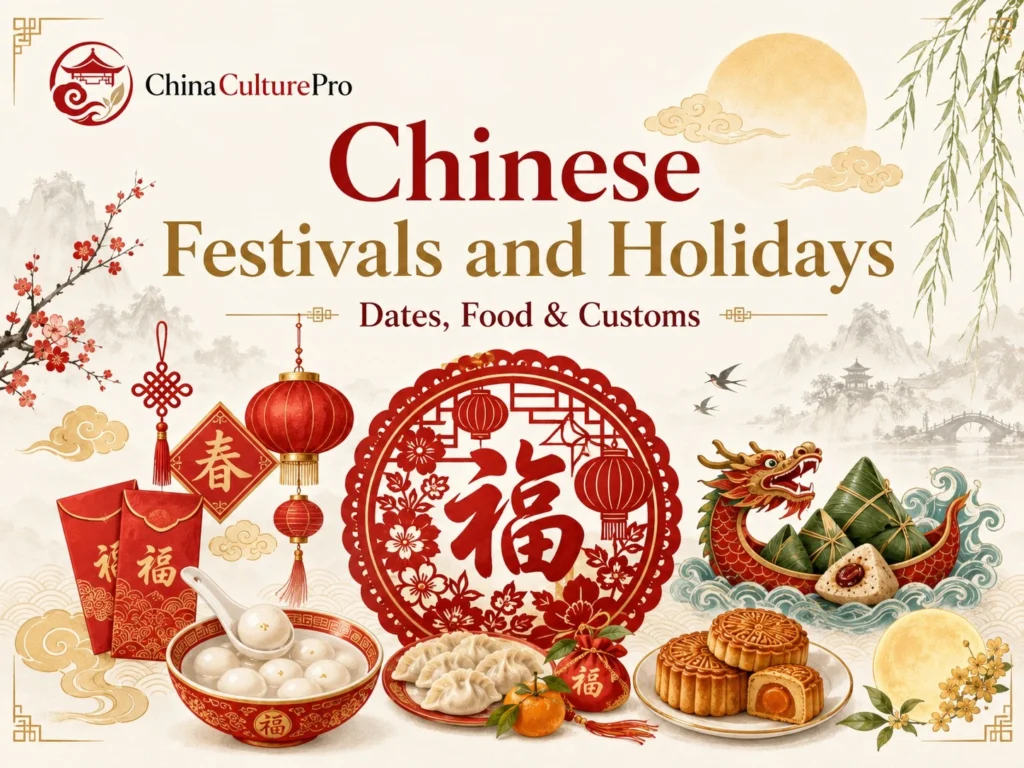

Quick Answer: What Are the Major Chinese Festivals and Holidays?
The most important Chinese festival is Chinese New Year, also called Spring Festival. It begins the traditional festival year, brings families home, and marks the change of the Chinese zodiac year for most general readers.
Other major traditional Chinese festivals include Lantern Festival, Qingming Festival, Dragon Boat Festival, Qixi Festival, Mid-Autumn Festival, Double Ninth Festival, Dongzhi Festival, and Laba Festival. Most of these follow the Chinese lunar calendar or solar terms, so their Gregorian dates change each year.
Mainland China also has official public holidays, including New Year’s Day, Labor Day, and National Day. Some traditional festivals are also public holidays, such as Spring Festival, Qingming, Dragon Boat Festival, and Mid-Autumn Festival.
| Type | Main Examples | What Readers Should Know |
|---|---|---|
| Traditional Festivals | Chinese New Year, Lantern Festival, Qingming, Dragon Boat, Mid-Autumn | Based on lunar dates, solar terms, family, ancestors, food, and seasonal meaning |
| Public Holidays | New Year’s Day, Labor Day, National Day | Modern legal holidays that affect work, travel, transport, and hotels |
| Cultural Observances | Qixi, Double Ninth, Dongzhi, Laba, Zhongyuan | Culturally important, but not always national public holidays |
In English, “festival” and “holiday” are often searched together. In Chinese culture, they are not the same. A festival carries ritual, memory, and seasonal meaning. A public holiday is an official day off. The two lines sometimes overlap, but their roots are different.
Chinese festivals are not only days off, parades, lanterns, or special foods. They are a cultural map of how Chinese people understand time, family, ancestors, land, season, and renewal.
Some festivals follow the lunar calendar. Some are tied to solar terms. Some are official public holidays. Some are not national days off, yet still carry deep cultural weight. Chinese New Year brings families back into place. Qingming opens a spring conversation with ancestors. Dragon Boat Festival pushes away midsummer heat, illness, and harmful energy. Mid-Autumn Festival places reunion under the full moon.
This guide explains the difference between Chinese festivals and Chinese public holidays, why festival dates change each year, which festivals matter most, what foods and symbols mean, and how to join Chinese festival events respectfully.
Chinese Festivals vs Chinese Public Holidays
Many English articles mix Chinese festivals and Chinese holidays into one list. That is useful for quick reading, but it can hide an important difference.
Chinese festivals come from traditional culture. Their roots are in the lunar calendar, the 24 solar terms, farming life, family structure, ancestor worship, seasonal change, and folk belief. A festival asks: What time of year is this? What should a family remember? What should people eat? Who should be honored? What blessing is being sent forward?
Chinese public holidays come from the modern national calendar. They are official days off arranged through the government holiday schedule. Their main concern is public time: work, school, travel, transportation, and services.
Some days belong to both systems. Spring Festival, Qingming Festival, Dragon Boat Festival, and Mid-Autumn Festival are traditional festivals and public holidays in Mainland China. Labor Day and National Day are important public holidays, but they are not old traditional festivals. Qixi, Double Ninth, Dongzhi, and Laba are culturally meaningful, but they are not always national days off.
| Question | Chinese Festivals | Chinese Public Holidays |
|---|---|---|
| Main Focus | Culture, ritual, family, ancestors, season | Official days off and public schedule |
| Calendar Basis | Lunar calendar, solar terms, folk tradition | Government holiday calendar |
| Examples | Lantern Festival, Qixi, Dongzhi, Laba | Labor Day, National Day |
| Overlap | Spring Festival, Qingming, Dragon Boat, Mid-Autumn | Same overlap for official holiday purposes |
This difference matters for readers. If you want to understand Chinese culture, search for the festival. If you need to book trains, hotels, or business meetings, check the public holiday calendar for that exact year.
Why Chinese Festival Dates Change Each Year
Many traditional Chinese festivals do not follow the Gregorian calendar. They follow the Chinese lunar calendar or the solar terms.
The Chinese lunar calendar is a lunisolar calendar. Months follow the moon. A lunar month is about 29.5 days, so 12 lunar months are shorter than a solar year. To keep the calendar aligned with the seasons, an extra leap month is added in some years. This is why festivals fixed to a lunar date move around on the Gregorian calendar.
Some festivals are tied to solar terms instead. These are more stable in the Gregorian calendar. Qingming usually falls around April 4 or 5. Dongzhi, or Winter Solstice, usually falls around December 21 or 22.
Here are the most important date rules:
- Chinese New Year: 1st day of the 1st lunar month
- Lantern Festival: 15th day of the 1st lunar month
- Dragon Boat Festival: 5th day of the 5th lunar month
- Qixi Festival: 7th day of the 7th lunar month
- Zhongyuan Festival: 15th day of the 7th lunar month
- Mid-Autumn Festival: 15th day of the 8th lunar month
- Double Ninth Festival: 9th day of the 9th lunar month
- Laba Festival: 8th day of the 12th lunar month
- Qingming Festival: around April 4 or 5
- Dongzhi Festival: around December 21 or 22
Important note: Most traditional Chinese festivals do not follow the Gregorian calendar. Always check the exact year before booking travel, planning greetings, or buying gifts.
Chinese zodiac years are also tied to the Chinese New Year season for most general readers. In more technical traditions, some calculations use Lichun, the Beginning of Spring, as the boundary. For everyday zodiac checking, readers born in January or February should confirm the exact boundary with a reliable zodiac calculator.
Major Chinese Festivals at a Glance
The table below gives a quick map of the major Chinese festivals, their Chinese names, date rules, main meanings, and common foods or customs.
| Festival | Chinese Name | Date Rule | Main Meaning | Common Foods / Customs |
|---|---|---|---|---|
| Chinese New Year | 春节 | 1st day of the 1st lunar month | Renewal, family return, zodiac transition | Reunion dinner, red envelopes, couplets |
| Lantern Festival | 元宵节 | 15th day of the 1st lunar month | Closing of New Year, light, reunion | Tangyuan, lanterns, riddles |
| Qingming Festival | 清明节 | Around April 4–5 | Ancestors, memory, spring renewal | Tomb sweeping, spring outing, qingtuan |
| Dragon Boat Festival | 端午节 | 5th day of the 5th lunar month | Protection, remembrance, midsummer cleansing | Zongzi, dragon boats, mugwort |
| Qixi Festival | 七夕节 | 7th day of the 7th lunar month | Love, stars, women’s skills | Qiaoguo, skill-praying customs |
| Zhongyuan Festival | 中元节 | 15th day of the 7th lunar month | Spirits, offerings, peace for the dead | Offerings, water lanterns |
| Mid-Autumn Festival | 中秋节 | 15th day of the 8th lunar month | Moon, reunion, harvest | Mooncakes, moon viewing, pomelos |
| Double Ninth Festival | 重阳节 | 9th day of the 9th lunar month | Climbing, elders, protection | Chongyang cake, chrysanthemum wine |
| Dongzhi Festival | 冬至 | Around Dec. 21–22 | Winter turning point, nourishment | Dumplings, tangyuan, lamb soup |
| Laba Festival | 腊八节 | 8th day of the 12th lunar month | Start of New Year preparation | Laba porridge |
Seen together, these festivals form a Chinese year-wheel. Spring remembers ancestors. Summer seeks protection. Autumn gives thanks and looks at the moon. Winter nourishes the body and prepares for the next year. Behind the calendar are several deep lines: family, ancestors, love, aging, protection, harvest, and renewal.
The Most Important Traditional Chinese Festivals
Chinese New Year / Spring Festival
Chinese New Year is not only one day. It is a season that begins before New Year’s Eve and continues through Lantern Festival.
In many families, the rhythm starts around Little New Year, when people prepare goods, clean homes, and begin the serious work of getting ready. New Year’s Eve is the emotional center. Families gather for reunion dinner, elders prepare red envelopes, doors receive spring couplets, and the house becomes a place of return.
The heart of Spring Festival is not noise or decoration. It is returning to one’s place. People working far from home try to return. Elders set the table, remember the ancestors, and hold the family line together. Children receive red envelopes, also called lucky money, not because the money itself is the point, but because elders are passing peace, protection, and blessing down to the next generation.
Chinese New Year also connects directly with the Chinese zodiac. For most readers, the zodiac year changes at Chinese New Year, which makes Spring Festival the natural starting point for understanding zodiac years.
For a full guide to the date, customs, and zodiac meaning, read our Chinese New Year guide. Chinese New Year is also the natural starting point for understanding the Chinese Zodiac.
Lantern Festival
Lantern Festival falls on the 15th day of the first lunar month. It marks the bright closing chapter of the Chinese New Year season.
This is the day of lanterns, tangyuan, riddles, dragon dances, and lion dances. Tangyuan are round glutinous rice balls that symbolize reunion and completeness. Lanterns bring light into the first full moon of the new year. Riddles written on lanterns make the festival playful, public, and lively.
If New Year’s Eve belongs mainly to the family table, Lantern Festival belongs more to the street and the community. People come out, look at lights, solve riddles, watch performances, and let the New Year season end in brightness.
The Lantern Festival marks the bright closing chapter of the Chinese New Year season.
Qingming Festival / Tomb-Sweeping Day
Qingming is often translated as Tomb-Sweeping Day, but that name only gives half the meaning.
One side of Qingming is solemn. Families visit ancestral graves, clear weeds, sweep tombs, add fresh earth, place flowers, and make offerings. It is a regular report from descendants to ancestors: the family still remembers where it came from.
The other side is alive and green. Qingming falls in spring, when grass returns and the air softens. After tomb sweeping, people may go for spring outings, fly kites, or enjoy the open air. In Jiangnan and nearby regions, qingtuan, a green glutinous rice dumpling often made with mugwort or other spring greens, is a strong seasonal flavor.
Qingming shows a Chinese way of holding grief and life together. Death is not pushed into a dark corner. Ancestors and living people share the same spring.
Our Qingming Festival guide explains the ancestor rituals, spring customs, and seasonal foods in more detail.
Dragon Boat Festival
Dragon Boat Festival falls on the 5th day of the 5th lunar month. Many readers know it through Qu Yuan, zongzi, and dragon boat races. Those are important, but the older layer is even deeper.
Before it became strongly tied to Qu Yuan, Dragon Boat Festival carried the meaning of midsummer protection. The fifth lunar month was traditionally seen as a difficult time. Heat, dampness, insects, snakes, and illness became more active. People hung mugwort and calamus on doors, wore scented sachets, tied five-color threads around the wrist, and used strong herbs to guard the body and home.
Zongzi, the pyramid-shaped sticky rice dumpling, carries several layers of meaning. It is linked to offerings, water, dragons, and later the story of Qu Yuan. Dragon boat races turn water into movement and sound, pushing away harmful forces and remembering loyalty.
Qu Yuan’s story added a powerful moral layer: loyalty, integrity, and sorrow for one’s country. That is why Dragon Boat Festival still feels strong, serious, and energetic.
The Dragon Boat Festival guide covers zongzi, dragon boat races, Qu Yuan, and midsummer protection customs.
Mid-Autumn Festival
The heart of Mid-Autumn Festival is roundness. The moon is round. Mooncakes are round. Families seek wholeness, even when people cannot sit at the same table.
Mid-Autumn falls on the 15th day of the 8th lunar month, when the autumn moon is traditionally seen as especially bright and full. In farming life, this is also close to harvest time. Families eat mooncakes, share fruit such as pomelos, look at the moon, and send blessings to people far away.
Stories of Chang’e, Wu Gang, and the Jade Rabbit give the festival a mythic surface, especially for children. But the deeper feeling belongs to adults who understand distance. Mid-Autumn is a festival for reunion, and also for those who cannot reunite. People under different skies look at the same moon and think of the same family bond.
Mooncakes differ by region: Cantonese, Suzhou-style, Beijing-style, Yunnan-style, and more. But the act of cutting and sharing mooncakes carries the same message: the full moon should be shared.
For mooncakes, moon viewing, and reunion customs, see our Mid-Autumn Festival guide.
Dongzhi Festival / Winter Solstice
Dongzhi, or Winter Solstice, has great weight in traditional Chinese timekeeping. It falls around December 21 or 22, when the night is longest in the Northern Hemisphere.
In Chinese thought, this is the point where yin reaches its depth and yang begins to return. The world is still cold, but the first movement of warmth has already begun. This is why Dongzhi is not only a cold day. It is a turning point.
A traditional saying says, “Dongzhi is greater than the New Year.” Not every modern family treats it that strongly now, but the saying shows how important the day once was.
Food depends on region. In the north, people eat dumplings, with the folk saying that if you do not eat dumplings at Dongzhi, your ears may freeze. In the south, many families eat tangyuan to mark reunion and the adding of age. In some regions, lamb soup is used to warm and nourish the body.
Dongzhi often feels like a small rehearsal before Chinese New Year: the family gathers, eats warming food, and prepares to pass through deep winter.
Other Chinese Festivals Worth Knowing
Not every meaningful Chinese festival is a national public holiday. Some are smaller, more regional, or more focused on folk practice. They still help complete the cultural year.
| Festival | Date Rule | Main Theme | Why It Matters |
|---|---|---|---|
| Qixi Festival | 7th day of the 7th lunar month | Love, stars, women’s skills | Often called Chinese Valentine’s Day, but originally centered on skill-praying to the Weaver Girl |
| Zhongyuan Festival | 15th day of the 7th lunar month | Spirits, offerings, peace for the dead | Combines Buddhist and Daoist layers in popular practice |
| Double Ninth Festival | 9th day of the 9th lunar month | Climbing, elders, protection | The double nine suggests long life and lasting blessing |
| Laba Festival | 8th day of the 12th lunar month | New Year preparation, porridge, giving | After Laba, the New Year feeling begins |
| Xiaonian / Little New Year | 23rd or 24th day of the 12th lunar month | Kitchen God, cleaning, preparation | Marks the start of serious New Year preparations |
| Dragon Raises Its Head | 2nd day of the 2nd lunar month | Spring farming, renewal | Haircuts and spring foods mark the “dragon rising” |
China also has many regional and ethnic festivals, including the Dai Water-Splashing Festival, Tibetan New Year, Naadam, and the Yi Torch Festival. These should be treated as separate cultural topics, not squeezed into one short list. Each has its own calendar, ritual world, food, music, clothing, and local memory.
Chinese Public Holidays and Golden Weeks
This section is for readers who need travel or planning information. Public holidays affect trains, flights, hotels, attractions, schools, offices, and business schedules.
Mainland China has seven main public holidays. Some are traditional festivals. Some are modern state holidays.
| Public Holiday | Traditional or Modern? | Usual Timing | What It Means for Visitors |
|---|---|---|---|
| New Year’s Day | Modern | January 1 | Short break, limited cultural impact |
| Spring Festival | Traditional + Public | Around Chinese New Year | Biggest travel season, strongest festive atmosphere |
| Qingming Festival | Traditional + Public | Around April 4–5 | Tomb-sweeping travel and short trips |
| Labor Day / May Day | Modern | May 1 | Major travel peak in recent years |
| Dragon Boat Festival | Traditional + Public | 5th day of 5th lunar month | Short trips and dragon boat events |
| Mid-Autumn Festival | Traditional + Public | 15th day of 8th lunar month | Family-focused holiday |
| National Day | Modern | October 1 | Major Golden Week travel peak |
Spring Festival and National Day are the two largest travel periods. They are often arranged as Golden Week holidays, and they can create heavy demand for high-speed rail tickets, flights, hotels, and popular attractions.
Planning note: Official holiday windows and make-up workdays are announced year by year. A “seven-day holiday” may include adjusted weekends, which means some Saturdays or Sundays become workdays before or after the break.
Travel note: Golden Week travel is crowded and expensive. If you want festival atmosphere with less pressure, plan carefully. For Chinese New Year, arriving a few days before New Year’s Eve and leaving after the first rush can be more comfortable than moving during the busiest dates.
Food, Symbols, and Seasonal Meaning in Chinese Festivals
Chinese festivals are not only celebrations. They are a cultural clock. They tell people when to return home, honor ancestors, seek protection, give thanks, nourish the body, and begin again.
Food plays a central role in this system. It is never just decoration. In Chinese festivals, food is often an edible form of blessing. Shape, sound, color, season, and ingredient all carry meaning.
| Symbolic Theme | Festival Examples | How It Appears |
|---|---|---|
| Reunion | Chinese New Year, Mid-Autumn, Lantern Festival | Reunion dinner, mooncakes, tangyuan |
| Ancestors | Qingming, Zhongyuan, Dongzhi | Tomb sweeping, offerings, family rites |
| Protection | Dragon Boat, Chinese New Year | Zongzi, herbs, red couplets, firecrackers |
| Harvest and Moon | Mid-Autumn | Mooncakes, pomelos, moon viewing |
| Seasonal Turning Points | Qingming, Dragon Boat, Dongzhi, Laba | Spring growth, summer protection, winter nourishment, New Year preparation |
This is why Chinese festivals almost always involve a special food. Dumplings, tangyuan, mooncakes, zongzi, qingtuan, Laba porridge, and Dongzhi dumplings are not random seasonal snacks. They make a wish visible and edible.
Few Chinese festivals are pure carnival. Even when the festival is bright and lively, such as Lantern Festival or Dragon Boat Festival, the deeper line is still tied to blessing, protection, memory, or seasonal order. The joy is real, but it is usually attached to something older than entertainment.
How to Understand and Join Chinese Festivals Respectfully
Chinese festivals are often open, generous, and welcoming. Public lantern fairs, dragon boat races, temple fairs, mooncake markets, and community celebrations are good ways to join. The key is to understand the boundary between public celebration and private family ritual.
- Do not treat all East Asian festivals as the same. Chinese New Year, Korean Seollal, Vietnamese Tết, Japanese Obon, and Korean Chuseok each have their own logic.
- Search “festival” when you want cultural meaning. Search “public holiday calendar” when you need travel dates or office schedules.
- Public events are usually fine to attend. Private family dinners, tomb sweeping, ancestral hall rites, and home rituals need invitation and respect.
- Learn simple greetings accurately. “Xīnnián hǎo” works for Chinese New Year. “Zhōngqiū kuàilè” works for Mid-Autumn Festival.
- For Dragon Boat Festival, many Chinese people prefer “Duānwǔ ānkāng,” meaning peace and health at Dragon Boat Festival, rather than a loud “Happy Dragon Boat Festival.”
- Do not mock folk customs as superstition. Also do not over-mystify them. Most are ordinary people’s ritual anchors in the long river of time.
- Try the festival food without judging regional differences too quickly. Chinese people themselves still debate sweet vs. savory zongzi, northern vs. southern customs, and which mooncake style is best.
Respect does not require performance. You do not need to dress up, exaggerate, or pretend to understand everything. It is enough to be informed, careful, and sincere.
How This Guide Connects to Chinese Zodiac and New Year Content
In the Chinese festival system, Chinese New Year is the central bridge. It connects traditional family customs with the zodiac year, and it opens the door to a deeper Chinese view of time.
From Spring Festival, readers can move into zodiac years, the Five Elements, Heavenly Stems and Earthly Branches, and the 60-year cycle. These systems do not explain every Chinese festival, but they are strongly connected with Chinese New Year.
Use this path to explore more:
- Use our Chinese Zodiac & Lunar Birthday Calculator to check your correct zodiac sign.
- See our Chinese Zodiac guide for animal signs and year structure.
- Learn why each zodiac year also has an element in our Five Elements Chinese Zodiac guide.
This page works as the overview. Chinese New Year and Chinese Zodiac are the hub topics. Individual festival pages, such as Lantern Festival, Qingming, Dragon Boat Festival, and Mid-Autumn Festival, can then explain each tradition in full.
FAQs About Chinese Festivals and Holidays
What is the most important Chinese festival?
The most important Chinese festival is Chinese New Year, also called Spring Festival. It is the central family festival of the year, the start of the traditional New Year season, and the point where the zodiac year changes for most general readers.
What is the biggest holiday in China?
The biggest holidays in China are Spring Festival and National Day. Both are major travel periods and are often arranged as Golden Week holidays. Spring Festival has the strongest cultural meaning, while National Day has major public travel impact.
Are Chinese festivals based on the lunar calendar?
Many Chinese festivals are based on the lunar calendar, including Chinese New Year, Lantern Festival, Dragon Boat Festival, Qixi, Mid-Autumn Festival, Double Ninth Festival, and Laba. Qingming and Dongzhi follow solar terms, so their Gregorian dates are more stable.
Which Chinese festivals are public holidays?
In Mainland China, the traditional festivals that are also public holidays include Spring Festival, Qingming Festival, Dragon Boat Festival, and Mid-Autumn Festival. Other public holidays include New Year’s Day, Labor Day, and National Day.
Are Chinese New Year and Spring Festival the same?
For most English readers, Chinese New Year and Spring Festival refer to the same holiday. Spring Festival is the common English name for 春节 in China. Chinese New Year is the more familiar international name for the start of the Chinese lunar year.
Is Mid-Autumn Festival a public holiday?
Yes. Mid-Autumn Festival is a public holiday in Mainland China. The official holiday window can vary by year, especially when it is arranged with nearby weekends, so travelers should check the public holiday calendar for the exact year.
Why do Chinese festivals have special foods?
Chinese festival foods carry symbolic meaning. Their shapes, sounds, ingredients, and seasons often express wishes for reunion, protection, abundance, health, long life, or renewal. Food is one of the most direct ways Chinese festivals turn blessings into daily life.
What is the difference between Chinese festivals and Lunar New Year?
Chinese festivals include many celebrations across the year, such as Qingming, Dragon Boat Festival, Mid-Autumn Festival, and Dongzhi. Lunar New Year refers specifically to the New Year period based on the lunar calendar. Chinese New Year is China’s version of Lunar New Year.
Which Chinese festival has dragon boat races?
Dragon Boat Festival has dragon boat races. It falls on the 5th day of the 5th lunar month and is linked with zongzi, Qu Yuan, midsummer protection customs, herbs, sachets, and water-based rituals.
Which Chinese festival is about mooncakes?
Mid-Autumn Festival is the Chinese festival most closely linked with mooncakes. It falls on the 15th day of the 8th lunar month and centers on the full moon, reunion, harvest, moon viewing, and sharing food with family.