
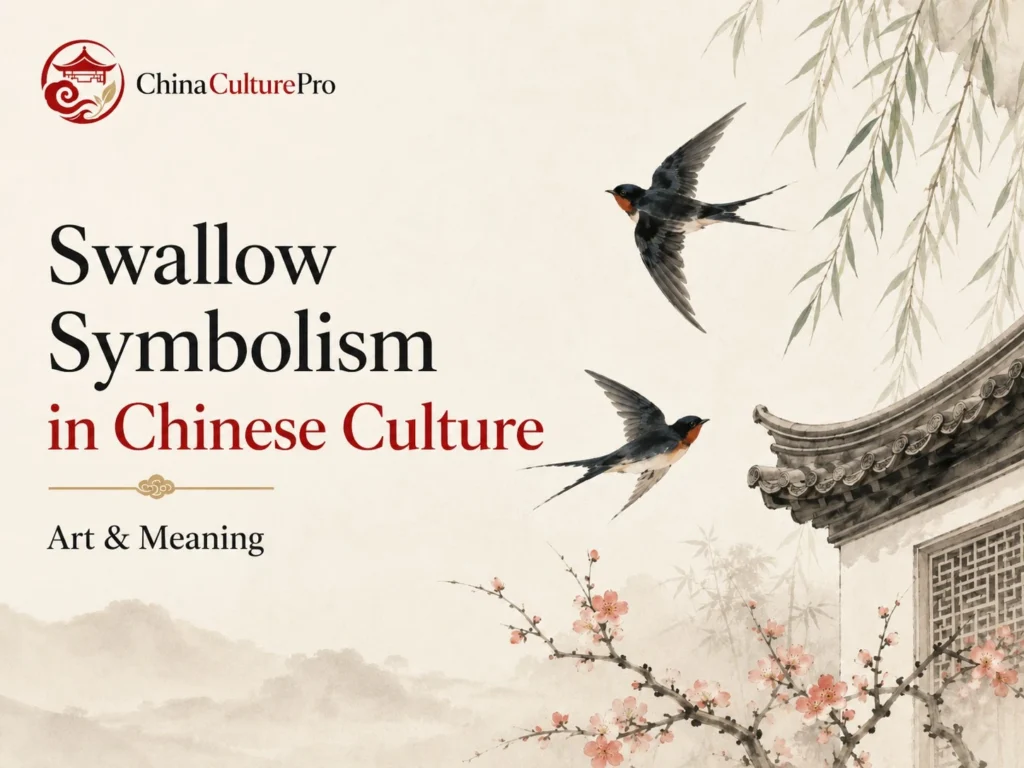

Quick Answer: What Does the Swallow Symbolize in Chinese Culture?
In Chinese culture, swallows can symbolize seasonal return, home, family continuity, partnership, or the passage of time—but none of these meanings applies to every image. Interpretation depends on the period, setting, accompanying plants, inscription, and object type.
- Spring and return: Migrating swallows recur in seasonal writing and willow-and-swallow paintings as signs of spring’s arrival and cyclical return.
- Home and family: Birds nesting near roofs and beams can evoke dwelling, homecoming, and household life. This is a cultural association, not a promise of good fortune.
- Partnership: Paired swallows may suggest companionship or marital harmony when a wedding context, paired object, or appropriate flowers support that reading. Two birds alone do not prove romance.
- Myth and literature: Xuanniao belongs to a Shang origin tradition, while poetic swallows can convey farewell, nostalgia, social change, or time’s return.
The motif expresses human ideas and wishes; it does not bring luck, protect a house, or alter relationships.
Mao Yi’s twelfth-century Swallows and Willow Tree places several birds among willow branches, but its museum record does not assign the image a universal meaning such as romance or luck.[7] Muqi’s thirteenth-century Swallow and Lotus likewise shows how a swallow can function as a naturalistic bird-and-flower subject rather than a fixed omen.[8] The contrast matters: a swallow can be a seasonal marker, a literary allusion, or one part of an auspicious design.
That is why swallow imagery should be read through context rather than reduced to a fixed definition. The broader guides to Chinese animal symbolism and Chinese symbols and meanings explain the same principle across other motifs: period, medium, use, and surrounding imagery establish the most defensible interpretation.
Why Did Swallows Become Symbols of Spring, Return, and Home?
The most durable swallow associations began with observable behavior. Seasonal texts record the arrival and departure of xuanniao as signs within the agricultural calendar. The Monthly Ordinances in the Book of Rites places “the dark bird arrives” in spring and “the dark bird returns” in autumn.[4] Whatever species a particular ancient writer intended by xuanniao, later readers commonly connected these passages with migratory swallows.
Swallows also live unusually close to people. They build mud nests around roofs, beams, and other structures, making their annual presence visible within household space. Historical environmental research shows how often swallows appeared in local Chinese records and how closely writers associated them with homes, seasons, marriage, and family formation.[6] These observations encouraged three related but distinct cultural readings:
| Observed feature | Possible cultural reading | Important limit |
|---|---|---|
| Seasonal arrival and departure | Spring, return, cyclical time | Not automatically joy or marriage |
| Nesting around dwellings | Home, settlement, family continuity | Not supernatural household protection |
| Birds appearing in pairs | Companionship or partnership | Romance requires supporting context |
The meanings were not produced by biology alone. Calendrical observation entered poetry; poetry shaped painting; and later decorative arts could turn a bird, flower, and wordplay into a specific visual message. A willow may emphasize spring movement, a roof or nest may foreground domestic life, and a documented wedding textile may make partnership the primary reading. The same swallow without those clues may simply be a bird-and-flower subject.
How Swallow Symbolism Changed Across Chinese History
Swallow imagery accumulated meanings rather than carrying one definition unchanged through time. The Shang origin story, early seasonal records, medieval poetry, Song bird painting, and Qing decorative rebuses belong to overlapping but distinguishable traditions.
Xuanniao and the Shang Origin Tradition
The Book of Songs opens the “Xuanniao” hymn with the line, “Heaven commanded the dark bird, which descended and gave birth to Shang.”[1] The Records of the Grand Historian develops the story: Jiandi swallowed an egg dropped by a xuanniao and later gave birth to Xie, an ancestral figure of the Shang lineage.[2] In this setting, the bird serves a dynastic origin narrative about sacred descent and political ancestry. It is not an ordinary nesting bird or a later household emblem.
Traditional commentators commonly gloss xuanniao as a swallow, and that remains the conventional translation. Yet “dark bird” is a textual name, not a modern zoological specimen. Scholarly discussions have proposed several identifications and have also cautioned against treating received literary texts as straightforward proof of a single Shang bird cult.[3] It is therefore accurate to say that Xuanniao is traditionally identified with a swallow, but inaccurate to declare that its biological species is settled or that oracle bones conclusively prove a universal Shang swallow totem.
Seasonal Swallows in Calendars and Early Poetry
Early calendrical literature uses the arrival and departure of xuanniao to organize seasonal time.[4] This is a phenological function: the bird marks change in the year. It is not yet the full springtime, wedding, or domestic symbolism found in later images.
The poem “Yan Yan” in the Book of Songs begins with swallows in flight and then follows a person being escorted away.[5] Its emotional center is parting, distance, and remembrance. Later readers connected the poem with sending a woman to marriage, but it should not be flattened into a generic love poem. This early example already shows that a swallow can carry sorrow and separation as readily as cheerful return.
Swallows in Song–Qing Painting and Decorative Art
Song painters developed swallows as naturalistic subjects within bird-and-flower painting. Mao Yi’s Swallows and Willow Tree and the painting attributed to Muqi, Swallow and Lotus, differ in setting and composition, but both can be appreciated first as close observations of birds in a landscape of branches, leaves, and flowers.[7][8] They do not need an added fortune-telling meaning.
Later decorative arts expanded the available visual vocabulary. A British Museum porcelain bowl combines flowering apricot, willow, and a pair of swallows; the museum explains that yàn, “swallow,” sounds like yàn, “banquet,” helping the design evoke the spring banquet in the apricot grove.[9] Qing embroidery also preserves “apricot grove and spring swallows” as a named bird-and-flower subject, while the museum description focuses on naturalistic stitching and composition rather than assigning every swallow a wedding meaning.[10]
By the Ming and Qing periods, naturalistic, seasonal, literary, festive, and marital readings could coexist. A late object may use a rebus, but that does not authorize projecting the rebus backward onto every Song painting or early poem. For a broader account of how objects build meaning from image, inscription, and use, see Chinese symbolism in art.
Xuanniao, Ordinary Swallows, Paired Swallows, and Literary Swallows
The following categories are interpretive tools, not rigid species labels. More than one layer may be present, but each layer needs evidence from the object or text.
| Swallow form | Identifying clues | Primary context | Possible meaning | Do not assume |
|---|---|---|---|---|
| Naturalistic swallow | One or more birds with plants; no mythic or celebratory inscription | Bird-and-flower painting | Nature, season, brushwork, observed movement | Luck, romance, or Xuanniao |
| Seasonal swallow | Willow, spring plants, calendrical text, arrival or departure | Seasonal art and literature | Spring, return, changing time | Marriage or household fortune |
| Nesting swallow | Eaves, rafters, nest, chicks, domestic setting | Folk observation and household imagery | Homecoming, dwelling, family continuity | A house-protection charm |
| Paired swallow | Two birds, sometimes with flowers or on paired objects | Naturalistic or festive art | Visual balance; possibly companionship | Marriage without further evidence |
| Xuanniao | Shang hymn, Jiandi, egg, dynastic ancestry | Origin myth | Sacred descent and Shang beginnings | A settled biological species or ordinary house swallow |
| Literary swallow | Inscription or recognizable poetic quotation | Poetry and literati art | Farewell, nostalgia, decline, return, passing time | A single auspicious meaning |
These distinctions also prevent confusion with other birds. A swallow is not the Vermilion Bird, phoenix, sparrow, or swift simply because a stylized image is small, dark, or shown in flight. Museum cataloguing, inscriptions, and established iconography should outweigh guesses based on silhouette alone.
Common Swallow Motifs and Their Meanings in Chinese Art
Chinese swallow designs work as visual grammar. The bird contributes one possible association, while the plant, setting, number of birds, inscription, and object function narrow the interpretation. Porcelain and textile designs can therefore be more specific than an uninscribed painting, but they still require evidence. Useful introductions to the relevant media include Chinese porcelain patterns and Chinese embroidery symbols.
Swallows and Willow Trees: Spring, Movement, and Renewal
Willow-and-swallow imagery is one of the most coherent seasonal pairings. Flexible willow branches imply wind and early growth; returning swallows add quick movement and the sense of a season becoming active. Mao Yi’s late-twelfth-century Swallows and Willow Tree shows birds moving around a willow, but the museum record identifies its subject and date without declaring a mandatory auspicious message.[7]
The safest reading is therefore spring, seasonal movement, or poetic return—not automatic romance, wealth, or luck. A particular inscription may introduce departure or homesickness, since willows also carry their own literary associations. The full cultural range of that plant belongs to the guide to willow symbolism in Chinese culture.
Swallows with Peach, Apricot, Lotus, or Other Flowers
Flowers do not merely decorate a swallow image; they establish season and sometimes activate wordplay.
| Pairing | Priority reading | When a second meaning is plausible | Boundary |
|---|---|---|---|
| Swallow and willow | Spring, wind, return | An inscription may add farewell or homecoming | Not automatically romantic |
| Swallow and peach blossom | Spring and flowering life | A wedding or love context may emphasize courtship | Peach does not make every bird image a love charm |
| Swallow and apricot blossom | Spring; “apricot grove spring banquet” rebus in documented designs | Examination celebration or festive court context | Yàn “swallow” = yàn “banquet” is context-dependent |
| Swallow and lotus | Bird-and-flower observation, warm-season nature | An inscription may add a literary layer | Not automatically spring, love, or luck |
| Swallow and miscellaneous flowers | Seasonal beauty or decorative abundance | Object use and title may support a festive reading | Flowers alone do not prove auspicious intent |
The British Museum bowl offers unusually strong evidence for the apricot-and-swallow rebus because the museum identifies the design and explains its language mechanism.[9] By contrast, Muqi’s swallow and lotus can remain a spare ink study without romance or good-fortune symbolism.[8] Likewise, peach blossom has its own changing meanings, discussed in peach symbolism in Chinese culture; it should not be treated as a universal switch that turns every paired bird into a wedding emblem.
Paired Swallows, Nests, and Domestic Life
Two swallows may evoke companionship because viewers observed the birds around nests and family spaces. Historical texts and later commentary connect swallows with matchmaking, marriage, and household formation, but these associations developed within particular social and literary settings.[6] A pair on a documented wedding object can therefore support a wish for marital harmony. A pair in an uninscribed nature study may simply balance the composition.
Nests under eaves or beams more readily foreground home, return, and the continuity of domestic life. These ideas can complement guides to Chinese symbols for family, Chinese symbols for love, and Chinese wedding symbols. They remain cultural associations, not deterministic rules. A single swallow does not foretell loneliness, and a pair does not guarantee a lasting relationship. Nor does a nest attract wealth or protect a building through supernatural force.
What Do Swallows Mean in Chinese Poetry and Language?
Poetic swallows often carry more emotional complexity than decorative summaries suggest. A bird returning to an old place can evoke spring, but it can also expose how people, families, and social worlds have changed.
| Text or expression | Core image | Literary meaning | Tone |
|---|---|---|---|
| “Yan Yan” in the Book of Songs | Swallows flying as someone departs | Farewell, distance, remembrance | Sorrowful |
| Liu Yuxi’s “Wuyi Lane” | Swallows once seen by elite Wang and Xie households enter ordinary homes | Dynastic and social decline, historical change | Nostalgic |
| Yan Shu’s “Huanxisha” | A seemingly familiar swallow returns as flowers fall | Recurrence, time passing, recognition amid loss | Reflective |
| “Swallows return to the beams” | Birds reappearing around a dwelling | Spring, homecoming, familiar domestic life | Warm or neutral |
| “Apricot grove spring banquet” | Apricot blossom and swallow/banquet wordplay | Examination celebration or festive gathering | Celebratory |
“Yan Yan” is grounded in departure rather than a simple love message.[5] Liu Yuxi’s old swallows became witnesses to the decline of once-powerful families, a reading discussed in environmental and literary history.[6] Yan Shu’s famous returning swallow appears beside falling flowers, making cyclical return inseparable from loss and passing time.[11]
These textual meanings should not be projected onto every object. A porcelain swallow does not automatically signify political decline because a poem once used the bird that way. Conversely, an inscribed painting that quotes one of these poems may legitimately activate the poem’s emotional world. This variety is why the swallow can appear among Chinese symbols for happiness in one festive design yet communicate farewell or impermanence in another work.
What a Chinese Swallow Symbol Does Not Automatically Mean
| Common claim | More accurate interpretation |
|---|---|
| Every swallow means good luck | Many swallows are naturalistic or seasonal; poetry also uses them for farewell, decline, and loss. |
| Two swallows always mean love or marriage | A pair may be compositional. Wedding use, appropriate plants, an inscription, or object provenance is needed for a marital reading. |
| A swallow nest brings wealth or protects a house | Nesting near homes supports folk associations with settlement and domestic calm, not a proven supernatural effect. |
| Xuanniao is certainly a modern barn swallow | “Swallow” is the conventional traditional gloss, but the text does not settle a modern zoological identification. |
| Swallows belong to the zodiac or are forms of the phoenix | Swallows are not among the twelve zodiac animals and are distinct from Chinese mythic birds. |
| Color, number, or flight direction forms a fixed luck code | No consistent system governs all periods, regions, and media; many online charts are modern inventions. |
| A swallow image can attract love or change fortune | A motif can express a wish or personal meaning, but it has no demonstrated power to alter events. |
The practical correction is simple: replace “the swallow always means” with “in this work, the swallow may suggest.” Then identify the evidence that makes the interpretation plausible.
How to Interpret or Use a Chinese Swallow Symbol Correctly
Use this six-step method for museum objects, antiques, tattoos, logos, textiles, or contemporary illustrations:
- Identify the category. Decide whether the image is primarily naturalistic, seasonal, domestic, marital, mythic, or literary.
- Check the period. Separate Shang origin literature, early calendrical writing, Song naturalism, later decorative rebuses, and modern design.
- Identify the medium and use. A poem, album leaf, porcelain bowl, wedding textile, and household decoration do not carry identical assumptions.
- Read the full composition. Look for willow, peach, apricot, lotus, a nest, an ancestral figure, a quotation, or evidence of ceremonial use.
- Prefer object-specific evidence. Museum catalogues, inscriptions, provenance, and primary texts are stronger than generic symbol lists.
- Separate tradition from redesign. A modern artist may assign homecoming, memory, travel, or partnership to a swallow, but should label that meaning as a contemporary choice.
For a tattoo, a lone swallow with willow can emphasize return or memory; paired birds with an explicitly marital composition can express partnership. Neither choice follows an ancient tattoo canon. The broader guide to Chinese tattoo symbols and meanings explains how to distinguish historical references from personal reinterpretation.
FAQs About Swallow Symbolism in Chinese Culture
Is Xuanniao Definitely a Swallow?
No. Traditional Chinese commentaries commonly identify Xuanniao, literally the “dark bird,” as a swallow. However, the received texts describe a mythic agent in the Shang origin story rather than a zoological specimen, and scholars have debated the identification. It is safest to call “swallow” the conventional interpretation, not a settled biological fact. Xuanniao also belongs to dynastic origin mythology, not ordinary bird-and-flower imagery.
Do Two Swallows Always Symbolize Love or Marriage?
No. Two swallows can create visual balance in a naturalistic composition. They support a partnership or marriage reading only when other evidence—such as wedding use, paired objects, an appropriate floral setting, an inscription, or documented provenance—points in that direction. Without such clues, “paired swallows” describes what is shown but does not prove a romantic message.
Does a Swallow Nest Bring Good Luck?
Swallows nesting under eaves are positively associated in folk culture with seasonal return, settled domestic life, and household continuity. That association reflects close human observation of the birds and a cultural preference for peaceful cohabitation. It is not evidence that a nest attracts money, protects a building, predicts future events, or changes a family’s fortune.
What Does a Chinese Swallow Tattoo Mean?
A modern swallow tattoo may express homecoming, spring, memory, travel, family, or partnership. Its meaning comes from the wearer’s intent and the complete design. Willow can reinforce seasonal return; a documented marital composition can emphasize partnership. There is no ancient Chinese swallow-tattoo canon and no traditional universal code based on color, number, or flight direction.
Sources
[1] Chinese Text Project. Book of Songs: Xuan Niao
[2] Chinese Text Project. Records of the Grand Historian: Yin Ben Ji
[3] Zhi Chen. A Study of the Bird Cult of the Shang People
[4] Chinese Text Project. Book of Rites: Yue Ling
[5] Chinese Text Project. Book of Songs: Yan Yan
[6] Yan Gao. Finding Swallows
[7] Smithsonian National Museum of Asian Art. Swallows and Willow Tree
[8] Cleveland Museum of Art. Swallow and Lotus
[9] British Museum. Porcelain Bowl with Apricot, Willow, and Swallows
[10] Palace Museum. Album of Flowers, Birds, Grasses, and Insects in Gu Embroidery
[11] Chinese Wikisource. Yan Shu, Huanxisha