
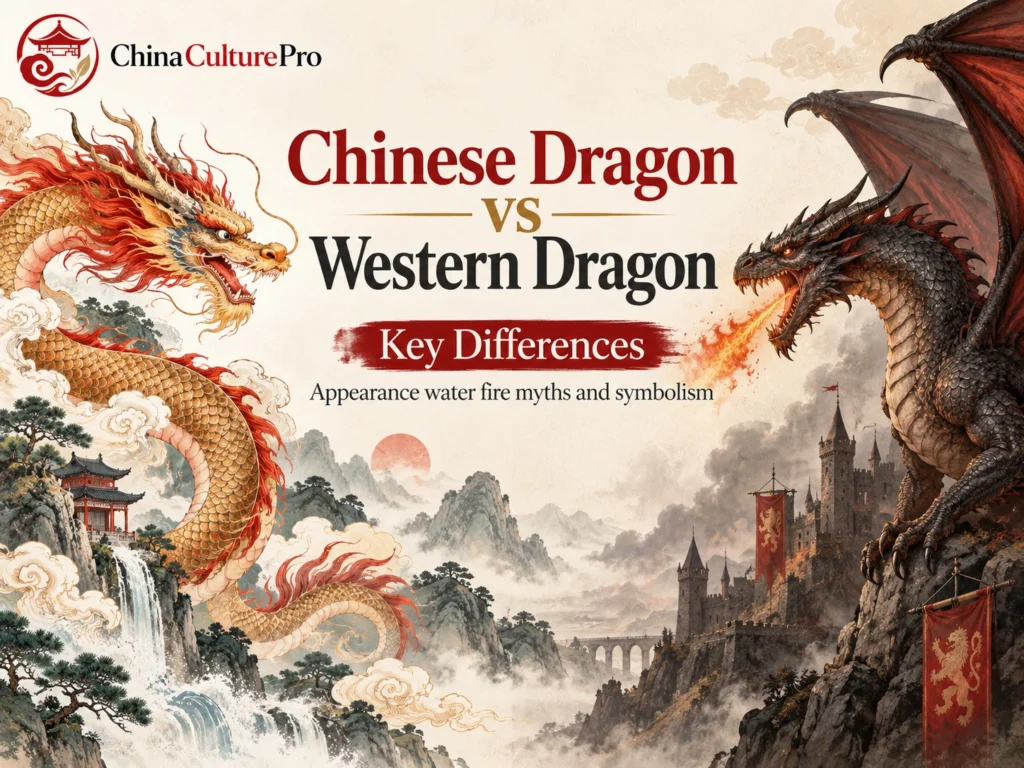

Quick Answer: What Is the Difference Between Chinese and Western Dragons?
The Chinese dragon (龙/龍, lóng) is commonly associated with rain, supernatural power and auspicious authority. Familiar European dragons often appear as dangerous opponents. Four comparisons help explain the difference:
- Appearance: Chinese imagery often favors a long, serpentine body; later European depictions frequently feature heavier reptilian forms and wings.
- Natural associations: Water, rain and clouds are prominent in China; fire, caves and treasure feature in influential European stories.
- Cultural roles: Dragons can express sacred or imperial power in China, while European heroes and saints often confront them.
- Exceptions: Chinese art includes winged dragons, and European dragons can represent honorable identities.
Here, “Western” mainly means European traditions. These are recurring patterns, not fixed species or a universal division between good and evil.[1][2]
A creature winding through clouds on porcelain and a monster confronting a knight may both be called a dragon. Understanding the difference means looking beyond their outlines to the stories, beliefs and uses that give each image its place in a particular tradition.
Chinese Dragon vs Western Dragon at a Glance
The table compares common representations. Its final column matters when identifying a particular object or story.
| Feature | Chinese traditions | European traditions | Interpretive limit |
|---|---|---|---|
| Body | Often elongated, scaled and composite, with horns, whiskers and claws. | Serpentine forms coexist with heavier reptilian creatures. | Period and artist affect anatomy. |
| Wings and flight | Wingless flight is familiar; winged variants also occur. | Wings are common in later imagery, but are not universal. | Wings alone do not identify cultural origin. |
| Natural associations | Rain, rivers, seas, clouds and weather. | Fire and lairs feature prominently in some stories. | Neither tradition has one compulsory element. |
| Human relationships | Petition, reverence, auspicious display, fear or confrontation. | Combat in famous legends; also heraldic identification. | Respect and hostility are contextual. |
| Power and identity | Courtly status and auspicious authority in appropriate settings. | Family, military or national emblems, alongside threatening monsters. | A motif does not establish its owner’s identity. |
| Story setting | Rainmaking, transformation and encounters with supernatural power. | Saints’ legends, heroic contests and treasure guardians. | No single tale represents the whole tradition. |
| Modern reuse | Cultural mascots and fantasy reinterpretations. | Villains, companions and mixed fantasy designs. | A creator’s choices do not establish ancient meanings. |
How Do Their Bodies, Wings and Flight Differ?
The familiar Chinese form combines a winding body with features such as antlers, scales, whiskers and claws. Traditional descriptions assemble parts from several animals, but the lists vary. They are ways of imagining a composite creature, rather than a permanent anatomical specification.[1]
Artists also adapt a dragon to its surface. A long body can curve around a vessel, cross a robe or disappear behind painted clouds. Before counting limbs, check whether the composition hides part of the figure. A partial view is not evidence that the creature lacks the parts you cannot see.
European imagery varies too. Early serpent-like forms differ from the winged, more heavily built creatures familiar from later art and fantasy. A label such as “European dragon” therefore describes a family of traditions, not one stable body plan.[2]
Winglessness is especially easy to overstate in Chinese examples. Yinglong (应龙/應龍, Yìnglóng) is a winged dragon; a documented Ming porcelain example appears below. Its wings belong within Chinese imagery and do not automatically indicate a borrowed European creature.[3]
Likewise, three, four or five claws cannot independently identify a country. Claw counts may matter within a particular court convention, but require the object’s period and function. Modern distinctions between a four-legged dragon and a two-legged wyvern also need a named fictional or heraldic convention; they are not universal biological rules for historical art.
Why Are Chinese Dragons Linked with Water and Western Dragons with Fire?
Rain explains much of the Chinese dragon’s importance. Water supports crops and travel, but can also threaten communities. A being associated with rain and rivers can consequently be welcomed, petitioned and feared. These are religious and narrative relationships with the environment, rather than evidence that such beings control real weather.[9]
The Dragon King (龙王, Lóngwáng) makes this connection particularly clear. Dragon kings inhabit watery realms in traditional belief, and their worship includes wishes for needed rain or safe passage. This role differs from a creature whose main purpose in a story is to guard something a hero seeks.[2]
In Beowulf, the hero’s final adversary guards a treasure hoard. That dragon is a separate creature from Grendel, whom Beowulf confronts earlier in the poem. The poem gives the treasure guardian a different narrative role from its earlier adversaries.[4]
Fire-breathing is familiar in European dragon imagery, but neither fire nor treasure defines every European example. Chinese art and literature also include fiery variants. A flaming pearl beside a dragon requires its own reading: flames surrounding an object do not, by themselves, show breath coming from the creature’s mouth.[2][5]
Power, Worship and Dragon-Slaying: How Their Roles Differ
Chinese dragons can communicate several kinds of power. In religious settings, a dragon may belong to a sacred narrative or receive petitions. On court objects, it can participate in rank and authority. In celebratory decoration, it can convey an auspicious wish. These uses overlap, but identifying one does not automatically establish the others. The broader Chinese dragon meaning guide follows these associations within the Chinese tradition.
Court costume illustrates the importance of detail. An eighteenth-century Qing festival robe in the Metropolitan Museum of Art, accession 30.75.79, carries five-clawed dragons. Their form supports an imperial-family association, yet the garment lacks the full emblem group identifying an emperor’s robe. Five claws therefore do not prove that the emperor personally wore it.[5] Reading symbolism in Chinese clothing requires the whole garment and its historical system.
Many influential European legends give a dragon another role: an adversary whose defeat tests a hero or saint. In the Saint George legend, the rescue and confrontation belong to a Christian story. That background helps identify the action, but it does not mean every later painting gives equal weight to a religious message.[7]
European dragons also express positive identities. The Welsh Red Dragon is a heraldic and national emblem; its use cannot be reduced to a monster awaiting defeat.[6] Here, both Chinese court imagery and European heraldry demonstrate that a dragon can mark power or belonging, although the surrounding institutions differ.
Nor should Chinese auspiciousness be mistaken for universal gentleness: Chinese traditions contain threatening dragons and dragon-slaying stories too.[2] The useful question is what this dragon does here. Modern fiction can further change its allegiance or personality without rewriting the older tradition.
Did Chinese and Western Dragons Have the Same Origin?
A similar body does not establish a shared origin. Scales, long tails and serpentine movement occur across many imagined creatures. To demonstrate a historical connection, similarities must be accompanied by evidence of when, where and how an image or story traveled. Resemblance alone cannot identify a direction of borrowing.
Within Chinese mythical-creature traditions, dragon imagery developed across different objects, texts, rituals and periods. European traditions likewise include earlier serpent-like figures and later heroic, religious and heraldic uses. The familiar comparison therefore brings together material from different historical settings. It is not a comparison between two creatures invented at a single known moment.[2][9]
One safeguard is to distinguish an object’s date from a tradition’s supposed beginning. A dated cup shows that a form existed by that period; it does not identify the first person to imagine it. A surviving text similarly records a version without necessarily preserving the story’s original creation.
Historical contact remains relevant, but a specific transmission claim needs specific evidence. Neither a shared English label nor a modern resemblance proves one common ancestor. Equally, recognizing distinct traditions does not establish that their makers never exchanged images or ideas.
Two Art Examples: Read the Context, Not Just the Wings
A Ming Winged Dragon on a Porcelain Stem Cup
Stem cup with dragons is a Jingdezhen porcelain vessel painted in underglaze cobalt blue, bearing a Xuande reign mark and dated 1426–1435. The Metropolitan Museum of Art holds it as accession 1991.253.40.[3]
- Observation: The stemmed vessel carries a winged dragon design.
- Context: Its Chinese catalogue title identifies the motif as Yinglong. The object belongs to the refined porcelain production of imperial Ming China.
- Interpretation: A winged dragon fits this Chinese artistic setting. Wings therefore cannot serve as an automatic marker of a European dragon.
- Limit: The motif does not establish fire-breathing, a particular borrowing route or the identity of the person who used the cup.
The object supplies a concrete exception to a familiar visual shorthand. It supports that limited conclusion without making every Chinese dragon winged or giving this one a complete fictional biography.
Uccello’s Saint George and the Dragon
Paolo Uccello’s Saint George and the Dragon, about 1470, is an oil painting on canvas in London’s National Gallery, inventory NG6294.[7]
- Observation: A mounted knight attacks a winged dragon near a cave; the princess already holds the creature on a leash.
- Context: The Renaissance painting combines moments from a medieval saint’s legend.
- Interpretation: The dragon is an opponent within this story. The gallery interprets the scene as a magical adventure rather than a straightforward illustration of Christian virtue.
- Limit: Its patron and intended setting remain uncertain. The painting does not represent every European dragon, and wings do not prove fire-breathing.
The comparison joins visible form to a documented setting. Neither the cup nor the painting can be fully understood by selecting one anatomical feature and assigning it a universal meaning. Chinese symbolism in art explains this contextual approach across other subjects.
Long, Loong and Dragon: What Do the Names Mean?
The Chinese word is written 龙 in simplified characters and 龍 in traditional characters, pronounced lóng in Mandarin. Its pinyin spelling is long when the tone mark is omitted. The spelling should not be confused with the unrelated English adjective “long.”
Loong is an alternative spelling used in English-language cultural material to distinguish the Chinese creature. It is not standard pinyin. Chinese dragon remains a conventional English expression; official English-language reporting can use both loong and Chinese dragon for the same subject.[8]
The label helps readers find the intended tradition. It does not prescribe one interpretation of every image. In a caption or explanation, Chinese dragon followed by the source word and context is usually clearer than expecting an unfamiliar spelling to communicate all the differences by itself.
FAQs About Chinese and Western Dragons
Do Chinese Dragons Have Wings?
The familiar Chinese dragon is often wingless, even in flight. Winged forms such as Yinglong also occur. Flight belongs to mythology, so the creature does not need to follow the anatomy of a real flying animal.
Do Chinese Dragons Breathe Fire?
Fire-breathing is not a defining feature of the traditional Chinese dragon. Rain and water are more prominent associations. Particular stories, artworks and modern adaptations can differ, so “Chinese dragons never breathe fire” is too absolute.
Are Western Dragons Always Evil?
No. Dragons often oppose heroes or saints in influential European stories, but heraldic and national examples can express pride or identity. The Welsh Red Dragon shows why a universal evil label misrepresents the tradition.
Are Chinese Dragons and Eastern Dragons the Same?
Chinese dragons belong within a wider field of related Asian imagery. Japanese, Korean and other traditions have their own histories and uses. “Eastern dragon” is a broad grouping, not a guarantee of identical cultural rules.
Which Is Stronger: a Chinese Dragon or a Western Dragon?
There is no shared cross-cultural scale of strength. Abilities depend on a particular story, author or game. A fictional contest can compare chosen versions, but its result cannot rank entire traditions as a cultural fact.
Sources
[1] Natural History Museum of Los Angeles County. Year of the Dragon
[2] Peabody Essex Museum. Celebrating the Year of the Dragon, one gallery at a time
[3] Metropolitan Museum of Art. Stem cup with dragons
[4] British Library. Hwæt! Beowulf online
[5] Metropolitan Museum of Art. Peacocks and Dragons, Oh My!
[6] Amgueddfa Cymru—Museum Wales. National emblems (FAQ)
[7] National Gallery, London. Saint George and the Dragon
[8] State Council of the People’s Republic of China, English website. Beijing cultural sites expect loong to spark tourism boom
[9] Smithsonian’s National Museum of Asian Art. Eleven Dragons