

Quick Answer: Which Numbers Are Lucky and Unlucky in Chinese Culture?
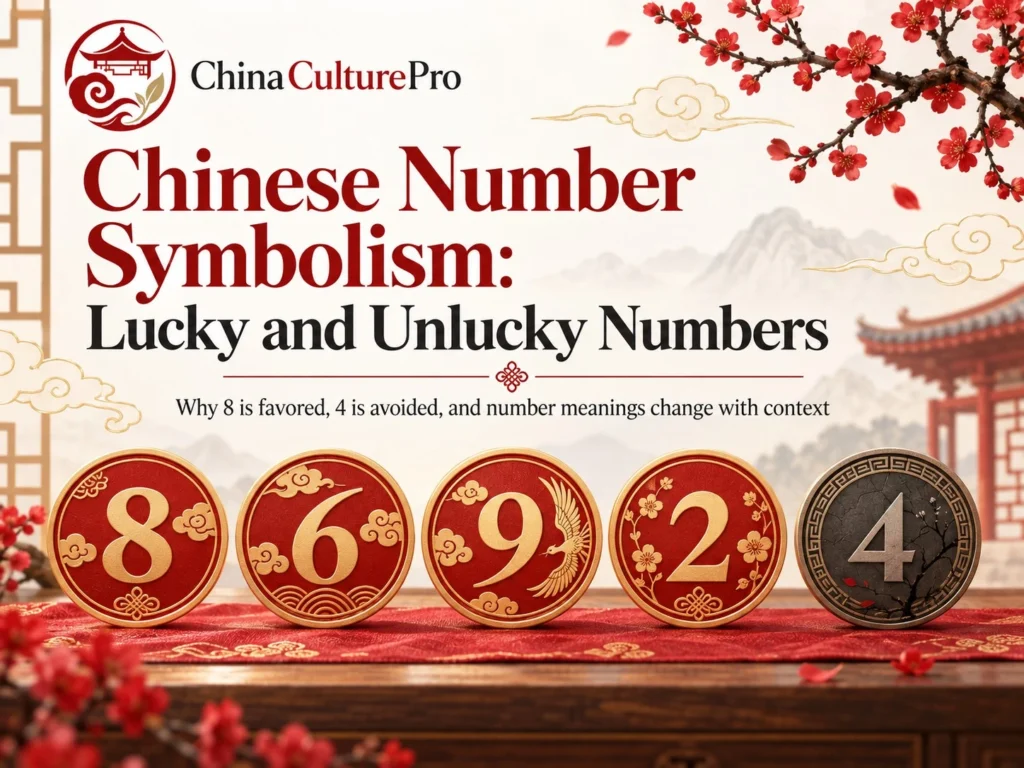
In contemporary Chinese culture, 8, 6, 9 and 2 are often treated favorably, while 4 is the most widely avoided number. These associations are conventions shaped by pronunciation, pairing, repetition and context—not universal rules.
- 8 and prosperity: Eight is associated with “prosper” or “become wealthy,” especially through Cantonese sound resemblance.
- 6 and smooth progress: Six is linked with the expression “everything goes smoothly” and is common in celebratory or commercial number strings.
- 9 and long duration: Nine is exactly homophonous with “long-lasting” in Mandarin and also appears in some imperial designs.
- 2 and pairs: Two benefits from the preference for matched pairs, symmetry and the saying that good things come in twos.
- 4 and avoidance: Four resembles the word for “death” in Mandarin and Cantonese, so some people avoid it in phone numbers, room numbers and gifts.
- Other numbers depend on context: 1, 3, 5, 7 and 10 can carry philosophical, calendrical or idiomatic meanings without being consistently lucky or unlucky.
The boundary is important: number preferences vary by language variety, region, generation and setting. They can influence social etiquette and prices, but they do not objectively change health, wealth or fate.
Ask about Chinese number symbolism and two answers usually appear first: eight is lucky and four is unlucky. Both are recognizable conventions, but neither explains the system as a whole. Number meanings in China emerge from several different sources—classical cosmology, the sounds of Chinese words, a preference for balanced structures, and recent digital slang.
Those sources must be kept separate. A number used to organize directions in an ancient text is not automatically a lucky number. A pun that works in Cantonese may be weaker in Mandarin. A code such as 520 belongs to modern communication, not to an old ritual tradition. This article treats number symbolism as one branch of broader Chinese symbols and meanings, with language, period and setting always taking priority over a fixed good-or-bad label.
How Chinese Number Symbolism Actually Works
Sound Resemblance Depends on the Language Variety
Sound association is the most visible mechanism behind modern number preferences. It is often called a homophone system, but many examples are only near-homophones. In Mandarin, eight, bā, and “prosper,” fā, do not have the same initial consonant. Four, sì, and “death,” sǐ, differ in tone. Nine, jiǔ, and “long-lasting,” jiǔ, provide a much closer match.
The picture changes across Cantonese, Hokkien, Shanghainese and other Chinese language varieties. These varieties have distinct sound systems and are not always mutually intelligible, so one pun cannot be assumed to work everywhere.[1] In Cantonese, for example, baat3, “eight,” resembles faat3 in the word for prosper, while sei3, “four,” resembles sei2, “death.” The same string can therefore produce a different association when speakers apply another variety’s pronunciation.
Pairing, Repetition and Sequence Can Add Meaning
Not every favorable number depends on sound. Chinese ritual and visual culture often values pairs, symmetry and balanced repetition. The familiar idea that “good things come in pairs” helps explain why wedding decorations, gifts and celebratory objects are often arranged in twos. A Chinese Academy of Social Sciences discussion of numerical culture connects this preference with paired language, symmetrical forms and social customs.[2]
Repetition can intensify an existing association: 88 visually and rhythmically feels stronger than a single 8, while 999 extends the sound of “long-lasting.” That does not mean luck is mathematically multiplied. Repetition is a rhetorical and decorative device. Even numbers are also not uniformly positive: 4 is even but often avoided, and some mourning customs favor odd rather than paired quantities.
Classical Number Systems and Internet Codes Are Different
Classical Chinese texts use numbers to organize relationships: yin and yang (阴阳, yīnyáng), the Five Phases or Wuxing (五行, wǔxíng), the Three Powers (三才, sāncái), the four directions and the Nine Palaces (九宫, jiǔgōng). These are models of order, sequence or correspondence. They are not simply lists of lucky digits. Chapter 42 of the Dao De Jing, for example, presents one, two and three in a generative sequence—“the Way gives birth to one; one gives birth to two; two gives birth to three”—rather than as a fortune code.[3]
Internet numeronyms work differently. They compress spoken phrases into memorable strings, often through loose sound resemblance and shared online convention. Research on Chinese internet homophones shows that these forms rely on context as well as phonetic substitution.[8] A person reading 520 as “I love you” is using modern digital language, not decoding an ancient numerical doctrine.
Lucky and Unlucky Chinese Numbers at a Glance
The table below summarizes common contemporary readings while preserving their limits. “Favorable” means culturally preferred in some settings, not objectively lucky.
| Number | Chinese and pinyin | Common association | Main source | Interpretive limit |
|---|---|---|---|---|
| 1 | 一 (yī) | Beginning, unity or first place | Word meaning and classical philosophy | Can also suggest being alone; no stable luck status |
| 2 | 二 (èr) | Pairs, balance and togetherness | Pairing and symmetry | Most positive in gifts, weddings and paired designs |
| 3 | 三 (sān) | Generation, multiplicity or a complete triad | Classical texts and idioms | Meaning is phrase-specific; some regional puns are negative |
| 4 | 四 (sì) | Commonly avoided in modern numbering | Near-homophone of “death” | Still neutral and important in four directions, seasons and other classical sets |
| 5 | 五 (wǔ) | Ordered sets such as the Five Phases | Classical classification | Structurally important, but not inherently lucky |
| 6 | 六 (liù) | Smooth progress and success | Idioms, sound play and modern slang | Current favorable reading should not be projected onto every ancient use |
| 7 | 七 (qī) | Love in Qixi; ritual cycles in other settings | Calendar and ritual context | Mixed and context-dependent rather than intrinsically lucky |
| 8 | 八 (bā) | Prosperity and commercial success | Sound resemblance, especially in Cantonese | A strong modern preference, not an ancient universal rule |
| 9 | 九 (jiǔ) | Long duration; high status in some court contexts | Exact Mandarin homophone and historical design | Imperial meaning requires period, object and motif evidence |
| 10 | 十 (shí) | Completeness and perfection | Idioms such as “perfect in every way” | Usually a descriptive idea, not a number chosen for luck |
Why 8, 6, 9 and 2 Are Often Considered Lucky
Eight and Prosperity
Eight (八, bā) is probably the most marketable lucky number in contemporary Chinese-speaking communities. The standard explanation links it to words for prospering or becoming wealthy, with a particularly strong sound resemblance in Cantonese. Educational material from the Smithsonian presents 8 and 4 as well-known examples of favorable and unfavorable sound association.[4]
The preference is visible in phone numbers, license plates, business openings and real estate. It also has measurable economic effects. Research on Hong Kong license-plate auctions found premiums for plates containing 8 and discounts for those containing 4.[5] A separate transaction-level study of apartments in Chengdu found a price premium for units on floors ending in 8.[6] These findings show that beliefs can shape demand and price; they do not show that 8 causes prosperity.
Six and Smooth Progress
Six (六, liù) is commonly associated with smooth progress. The fixed expression liùliù dàshùn (六六大顺), roughly “may everything go smoothly,” reinforces that reading, while the near-sound of liù and liū in words suggesting smooth or skillful movement supports modern wordplay. Official-language commentary notes that several origin explanations circulate for the expression, so it is safer to describe the current convention than to assign it one proven ancient source.[2]
A single 6 is favorable in many commercial or celebratory settings, but the meaning is not identical to 8. Six suggests that a process goes well; eight more often evokes prosperity. The online exclamation 666 is newer still and should be read as internet praise rather than as a classical blessing.
Nine, Long Duration and Imperial Association
Nine (九, jiǔ) benefits from an exact Mandarin homophone: 久 (jiǔ), “long-lasting.” It therefore works naturally in wishes for a durable relationship, friendship or life. Repetition in 99 or 999 strengthens the sound-based message.
Nine also appears in elite and imperial visual culture, but color, garment type and motifs must be read together. A Qing court robe discussed by The Metropolitan Museum of Art has nine dragons, including one concealed inside; the museum also uses claws, materials and construction to discuss rank.[7] Nine can therefore contribute to an imperial reading in the right historical object, but an isolated 9 on a modern gift does not claim royal status.
Two and the Preference for Pairs
Two (二, èr) receives its strongest positive meaning from structure rather than pronunciation. A pair can suggest balance, reciprocity and completion. Weddings make the logic especially visible through paired candles, paired gifts and the Double Happiness character, 囍 (shuāngxǐ).
This preference is contextual. An even cash gift may suit a wedding, while other rituals can follow different counting conventions. Two is best understood as a favorable form in paired social and visual arrangements, not as a universally lucky digit.
Why 4 Is Often Avoided—and Why the Rule Is Not Absolute
Four and the Word for Death
Four (四, sì) is often avoided because it resembles 死 (sǐ), “death,” in Mandarin; the parallel resemblance between Cantonese sei3 and sei2 is also close. This is tonal or near-homophonic wordplay, not complete identity across every Chinese language variety. The degree of discomfort therefore varies by speaker and region.[5]
The rule should not be projected backward as an all-purpose ancient taboo. Four is fundamental to traditional classifications such as the four directions, four seasons and four directional animals. These established systems show that the numeral could express spatial and calendrical completeness without carrying an automatic death meaning. The exact historical emergence of widespread avoidance is difficult to date, so claims that one event or decade created it should be treated cautiously.
Buildings, Numbers and Everyday Variation
The modern preference appears most clearly where numbers are chosen or marketed: apartment floors, hospital rooms, hotels, phone numbers and license plates. Some buildings omit 4, 14 or other numbers containing 4, especially in markets where Cantonese conventions are influential. Others use ordinary sequential numbering. There is no national rule requiring a building to remove the fourth floor.
Practical etiquette is similarly flexible. Avoid giving four identical gifts if the recipient is likely to notice the association, but there is no reason to avoid writing the number in a date, citing chapter four or using a four-part explanation. The cultural convention is strongest in celebratory choices and consumer-facing identifiers, not in neutral counting.
Chinese Number Combinations and Internet Slang
How Number Codes Acquire Meaning
Chinese numeric slang expanded through pagers, text messages, chat rooms and social media. Short strings were cheap to type and easy to recognize. Their readings depend on approximate sound, visual rhythm and community agreement; few are perfect phonetic matches. The University of Alberta study of internet homophones documents how sound substitution works together with context and textual cohesion.[8]
Because these codes are part of a living register, their stability differs. 520 and 666 are widely recognized, while other sequences may be restricted to a platform, generation or subculture. Current learner resources are useful for documenting common usage, but they should not be mistaken for evidence of ancient tradition.[9]
Common Combinations: 168, 520, 521, 666, 888, 999, 1314 and 250
| Combination | Common reading | Typical meaning | Register and limit |
|---|---|---|---|
| 168 | Yīlù fā (一路发) | “Prosper all the way” | Commercial rebus; approximate rather than exact Mandarin sound |
| 520 | Wǒ ài nǐ (我爱你) | “I love you” | Modern romantic code; conventional, not phonetically exact |
| 521 | Romantic variant of 520 | “I love you” or a positive reply | Glosses vary; “I am willing” is one popular interpretation, not a fixed linguistic equation |
| 666 | Liùliùliù / liūliūliū | Skilled, impressive or smooth | Gaming and social-media slang; can also be ironic |
| 888 | Fāfāfā (发发发) | Repeated prosperity wish | Commercial and celebratory; does not create wealth |
| 999 | Jiǔjiǔjiǔ (久久久) | Long-lasting affection or well-being | Extends the jiǔ/久 homophone; not “triple imperial power” |
| 1314 | Yīshēng yīshì (一生一世) | “For a lifetime” | Modern romantic code, often combined with 520 |
| 250 | Èrbǎiwǔ (二百五) | A foolish or reckless person | Older colloquial insult, not originally an internet numeronym; its historical origin is disputed |
Chinese 666 has no historical connection to the “number of the beast” in Christian tradition. The identical digits belong to unrelated cultural systems. Likewise, 250 should not be treated as a lucky-number combination at all: it is a spoken insult and can offend outside friendly joking.
Where Number Preferences Appear in Everyday Chinese Life
Number symbolism matters most when people have a choice and want the choice to feel socially appropriate. The following patterns are common, but relationship, locality and budget remain more important than any digit.
| Setting | Common preference | Practical boundary |
|---|---|---|
| Red envelopes and cash gifts | Even amounts or figures containing 6, 8 or 9 | Follow local and family custom; avoid treating a token amount as more important than generosity |
| Weddings and celebrations | Pairs, repeating digits and dates containing 6, 8 or 9 | Traditional date selection involves calendars and family schedules, not digit preference alone |
| Property, floors and rooms | Premium interest in 8; occasional avoidance of 4 | Market practice varies by city and building; no universal construction rule |
| Phone numbers and license plates | Repeated 8, 6 or 9; fewer 4s | Scarcity and conspicuous display can drive prices as much as belief |
| Business names and openings | 8, 168, 888 and repeated favorable digits | Branding convention only; it cannot determine commercial success |
| Online chat | 520, 1314, 666 and other numeronyms | Informal and generation-sensitive; plain language is clearer in formal communication |
How to Interpret a Chinese Number Correctly
- Identify the language variety: Ask whether the sound association comes from Mandarin, Cantonese or another variety rather than assuming one nationwide pronunciation.
- Separate the historical layer: Distinguish classical cosmology and ritual classification from modern commerce and internet slang.
- Check the setting: A number in a wedding gift, a tomb, an apartment listing and a text message can follow different conventions.
- Find the mechanism: Decide whether the meaning comes from sound resemblance, pairing, repetition, sequence, an idiom or a formal historical system.
- Limit the claim: Describe the cultural preference without claiming that the number changes fate, health, wealth or relationships.
Common Misreadings of Chinese Number Symbolism
- Every number has one fixed meaning: Most digits are neutral or mixed, and their readings vary by context, period and language variety.
- All Chinese people believe numbers control fate: Many people follow number customs as etiquette, humor or consumer preference without holding a literal supernatural belief.
- Eight and “prosper” are identical in Mandarin: Bā and fā resemble one another, but they have different initial consonants; the association is especially close in Cantonese.
- Four was always forbidden: Four remains central to classical sets such as directions and seasons, so its modern death association cannot explain every historical use.
- All even numbers are lucky: Pairing is often favorable, yet 4 is commonly avoided and ritual counting rules vary.
- Ancient numbers and internet codes form one system: A classical sequence such as one-two-three and a code such as 520 come from different periods and communicative purposes.
- Chinese 666 carries the Western religious meaning: In Chinese online speech it usually praises skill or smooth performance, although tone can make it sarcastic.
- A lucky number guarantees a result: Research can measure preferences and price effects, not supernatural causation.
FAQs About Chinese Number Symbolism
What is the luckiest number in Chinese culture?
Eight is the most widely favored number in contemporary Chinese commercial and social settings because it resembles words associated with prosperity, especially in Cantonese. It is better described as a strong cultural preference than as a universal or objectively lucky number.
Why is the number 4 considered unlucky in China?
Four resembles the word for “death” in Mandarin and Cantonese, so some people avoid it in gifts, phone numbers, room numbers and property marketing. The convention varies by region and setting, and four remains completely normal in neutral counting and classical four-part systems.
Are lucky numbers the same in Mandarin and Cantonese?
No. Some associations overlap, but Mandarin and Cantonese have different sound systems, so a number string can produce different puns or even opposite readings. Always identify the language variety before explaining a sound-based meaning.
Is 13 an unlucky number in Chinese culture?
Thirteen is not a traditional nationwide Chinese taboo comparable to 4. Avoidance of 13 in some modern buildings or businesses usually reflects international or Western conventions, although individual and local preferences can still differ.
What do 520, 666 and 888 mean in Chinese?
In modern informal usage, 520 means “I love you,” 666 praises something skillful or impressive, and 888 repeats the prosperity association of 8. These are contemporary codes and wishes, not ancient doctrines or promises of real-world results.
Sources
[1] University of Texas at Austin. Chinese Language Overview
[2] Institute of Linguistics, Chinese Academy of Social Sciences. The Mathematical and Cultural Meanings of Numbers
[3] Chinese Text Project. Dao De Jing, Chapter 42
[4] Smithsonian National Museum of Asian Art. Designing with Numbers
[5] Ng, Chong and Du. The Value of Superstitions
[6] Shum, Sun and Ye. Superstition and “Lucky” Apartments: Evidence from Transaction-Level Data
[7] The Metropolitan Museum of Art. Peacocks and Dragons, Oh My!
[8] Qian Tang, University of Alberta. A Study of Chinese Internet Homophones from the Systemic Functional Perspectives
[9] The Chairman’s Bao. Chinese Number Slang