
Quick Answer: What Is Baozhong Tea?
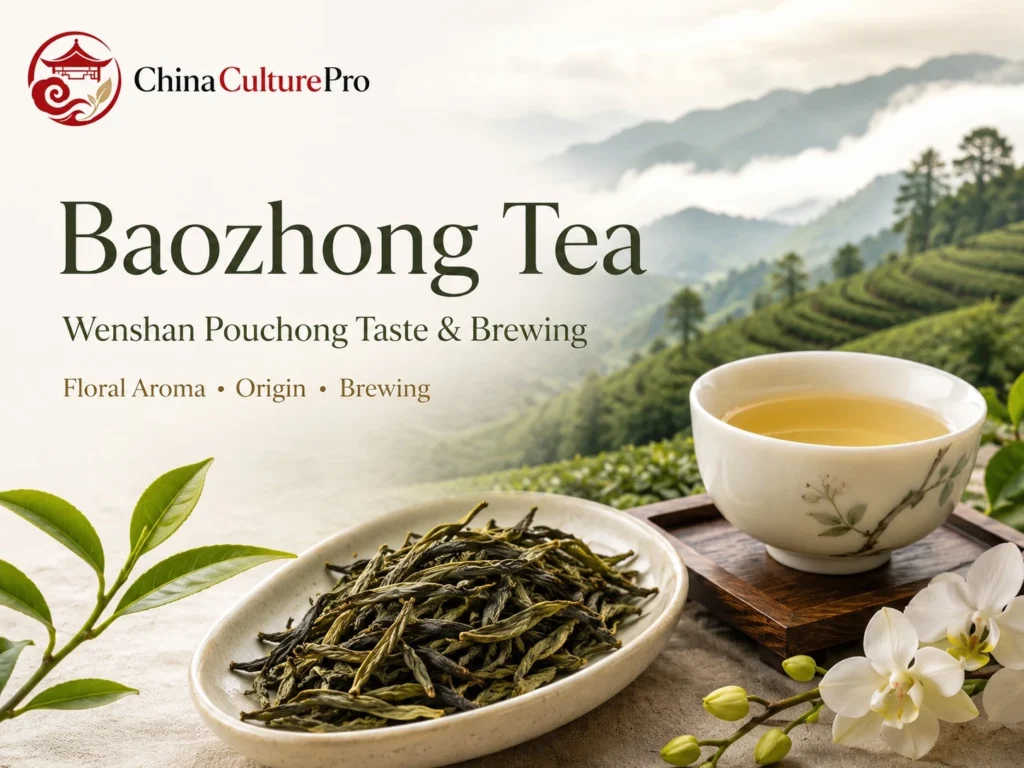
Baozhong Tea, also written as Bao Zhong Tea or Pouchong Tea, is a lightly oxidized, strip-shaped Taiwanese oolong from the historical Wenshan tea region of northern Taiwan. Pinglin is now its best-known production center.
Modern Wenshan Baozhong is neither green tea nor flower-scented tea. Its natural floral fragrance develops from suitable cultivars, correctly matured leaves, withering, light agitation, partial oxidation, heat fixation, rolling, and drying.
Its basic identity is:
Tea Type: Taiwanese oolong tea.
Chinese Name: 包種茶.
Common English Names: Baozhong Tea, Bao Zhong Tea, Pouchong Tea, Wenshan Baozhong, Wenshan Pouchong.
Traditional Region: Wenshan and other northern Taiwan tea areas.
Representative Production Center: Pinglin, New Taipei City.
Representative Cultivar: Qingxin Oolong.
Other Suitable Cultivars: TTES No. 12, also known as Jinxuan, and several other Taiwanese cultivars.
Leaf Form: Naturally twisted strips rather than tightly rolled balls.
Oxidation Style: Lightly oxidized compared with most other oolongs.
Core Aroma: Natural orchid, gardenia, lily, and other delicate floral notes.
Liquor: Clear honey-yellow, sometimes with a pale green tone.
Taste: Fresh, sweet, rounded, lively, and more substantial than its pale color may suggest.
Brewing: Usually 85–95°C with short, controlled infusions.
Although its green leaves and light oxidation may resemble green tea, Baozhong undergoes oolong-style withering and agitation, producing a more floral, rounded liquor. Quality is not defined by the greenest color, strongest aroma, or youngest leaves, but by natural fragrance within the liquor, a fresh yet complete body, and clean returning sweetness.
To place Baozhong within the wider tea family, read our guide to [Chinese Oolong Tea].
Name, Tea Type, and Basic Identity
Baozhong, Bao Zhong, and Pouchong are different English renderings of 包種. Pouchong reflects an older romanization that remains common in the tea trade, while Baozhong is now widely used in Taiwan-related tea writing.
| Identity Point | Baozhong Tea |
|---|---|
| Chinese Name | 包種茶 |
| Common English Names | Baozhong Tea, Bao Zhong Tea, Pouchong Tea |
| Representative Style | Wenshan Baozhong |
| Tea Category | Lightly oxidized Taiwanese oolong |
| Leaf Form | Naturally twisted strip-shaped leaves |
| Main Region | Northern Taiwan, especially Pinglin and the historical Wenshan area |
| Representative Cultivar | Qingxin Oolong |
| Main Character | Natural floral aroma, clear honey-yellow liquor, fresh sweetness, rounded body, and delicate aftertaste |
| Not The Same As | Green tea, black tea, modern flower-scented tea, or a lower-grade oolong |
The name is commonly linked to an early practice of wrapping flower-scented tea in square paper printed with the merchant’s name and product details. Modern Wenshan Baozhong is normally unscented: its orchid, gardenia, lily, and sweet floral impressions develop naturally from the leaves and processing.
Its light oxidation and green appearance are deliberate characteristics, not signs of an incomplete oolong. Unlike green tea, which is heat-fixed before meaningful oxidation develops, Baozhong undergoes withering, agitation, and partial oxidation before heat fixation. These stages create its floral aroma, rounded texture, and changing infusions.
For an overview of the main processing categories, see Chinese Tea Types.
Origin: Wenshan, Pinglin, and Northern Taiwan
Wenshan Baozhong belongs to the tea culture of northern Taiwan. Wenshan is a historical regional name rather than a reference only to the present-day Wenshan District of Taipei.
| Tea Area | Chinese | Present Location | Role in Baozhong |
|---|---|---|---|
| Wenshan Area | 文山地區 | Historical northern Taiwan tea region | The broader geographic and commercial identity behind Wenshan Baozhong |
| Pinglin | 坪林 | New Taipei City | Today’s most representative production and competition center |
| Shiding | 石碇 | New Taipei City | A traditional neighboring Baozhong area |
| Shenkeng | 深坑 | New Taipei City | Historically connected with northern Taiwan Baozhong production |
| Nangang | 南港 | Taipei City | An important early center in the development of modern unscented Baozhong |
| Other Areas | — | Pingxi, Xizhi, Xindian, Sanxia, Muzha, and nearby districts | Part of the wider northern Taiwan production network |
Pinglin is now the area most closely associated with Wenshan Baozhong. Tea gardens spread across humid hills and valleys around the Beishi River system, while competitions, local education, and commercial production maintain an active tea-evaluation culture.
Northern Taiwan’s frequent rain, cloud, and changing sunlight make moisture control critical. Wet leaves may wither slowly, while strong sun can remove water too quickly. Makers must adjust outdoor and indoor handling to the condition of each batch rather than follow a fixed timetable.
Floral clarity therefore depends as much on fresh-leaf condition and moisture movement as on altitude or origin. A Pinglin label provides useful context, but it cannot guarantee clean fragrance, lively liquor, or a sweet finish.
Baozhong also holds an important place within the wider tradition of Chinese Oolong Tea.
History and the Development of Modern Baozhong
Baozhong developed through the interaction of Fujian oolong techniques, the Fuzhou scented-tea trade, northern Taiwan’s tea districts, and overseas Chinese markets. Production and packaging methods reached northern Taiwan around the early 1880s.
From Scented Tea to Paper-Wrapped Baozhong
Early Baozhong was often scented with fresh flowers such as jasmine, gardenia, or magnolia before being wrapped in square paper printed with the merchant’s name and product information.
The packaging:
- Protected a measured quantity of tea.
- Made transport and retail easier.
- Functioned as an early brand label.
- Became closely associated with the product name.
Baozhong should therefore not be translated simply as “wrapped tea variety” without its scented-tea and commercial history.
The Development of Natural Floral Baozhong
In the early twentieth century, northern Taiwanese makers developed an unscented style whose floral aroma came from the tea itself. Suitable cultivars, properly matured leaves, controlled solar and indoor withering, and refined light agitation produced a clear natural fragrance without added flowers.
Emerging around Nangang, Neihu, Shenkeng, and nearby districts, this method became the foundation of modern Wenshan Baozhong. Removing flowers raised the technical standard because weaknesses in cultivar, leaf maturity, weather, withering, or agitation could no longer be hidden by scenting.
From Nangang to Pinglin
As urban development reduced Nangang’s tea gardens, mountain districts such as Pinglin and Shiding became more central to production. Competitions, tea education, museums, and sustained commercial activity later established Pinglin as the most representative modern home of Wenshan Baozhong, though its historical production network remains broader.
The transition from scented tea to naturally floral oolong shows how Taiwanese makers adapted inherited techniques into an independent regional style.
Its development also forms part of the wider history of Chinese Tea Culture.
Cultivars, Picking Standard, and Seasons
The quality of Baozhong begins before processing. Cultivar, leaf maturity, season, weather, and picking condition determine how much natural floral aroma and tea-body structure the maker can develop.
Main Cultivars
| Cultivar | Chinese | Typical Role in Baozhong |
|---|---|---|
| Qingxin Oolong | 青心烏龍 | The traditional reference cultivar, valued for elegant fragrance, fine liquor, and suitability for Baozhong processing |
| TTES No. 12 / Jinxuan | 台茶12號/金萱 | May produce softer floral sweetness, rounder texture, and occasional creamy impressions |
| TTES No. 13 / Tsui Yu | 台茶13號/翠玉 | Can show a brighter, more direct aromatic style |
| Other Cultivars | — | Used according to local farming, maker preference, and desired cup profile |
Qingxin Oolong remains the classic cultivar for traditional and competition-oriented Wenshan Baozhong, valued for fine, penetrating fragrance and delicate liquor. TTES No. 12 can produce a softer, rounder style, but “milk aroma” is neither mandatory nor a reliable test of the cultivar.
Cultivar creates potential rather than a fixed flavor. Garden conditions, harvest timing, and processing can make batches from the same cultivar taste very different.
Why Baozhong Is Not Picked as Young as Possible
Baozhong does not pursue the smallest unopened buds prized in some green and white teas. Its oolong process requires leaves mature enough to withstand withering, agitation, and rolling while remaining soft and aromatic.
A traditional standard uses shoots whose terminal bud has slowed or stopped growth and whose upper leaves have opened. This stage may be described as banjhi, paired-leaf maturity, or open-face plucking.
Suitable material should be:
- Flexible rather than leathery.
- Thick enough to support body and aroma.
- Healthy pale to medium green.
- Mature enough for agitation.
- Young enough to avoid coarse fiber.
Overly tender leaves may produce more bitterness and less expressive floral aroma. Overmature material can become coarse, dull, and difficult to process evenly.
Taiwanese makers therefore judge flexibility, thickness, moisture, and overall maturity rather than follow a single fixed leaf count.
Spring and Winter Baozhong
Spring and winter are both important production seasons.
| Season | Common Style Tendency |
|---|---|
| Spring Tea | Brighter freshness, lifted fragrance, lively liquor, and clear returning sweetness |
| Winter Tea | Finer aroma, rounder sweetness, calmer liquor, and good fragrance persistence |
These are tendencies rather than guarantees. Rain during harvest, cultivar, leaf maturity, and maker skill may matter more than the season printed on the package.
How Baozhong Tea Is Made
Baozhong follows a complete oolong process. Its light oxidation leaves little room to hide defects in raw material, moisture control, agitation, or drying.
1. Plucking
Leaves are harvested at suitable maturity, commonly after the terminal bud has slowed or stopped active growth and the upper leaves have opened.
The material should be soft, substantial, and neither extremely tender nor coarse.
2. Solar Withering
Fresh leaves are spread in a thin layer under controlled sunlight.
Solar withering removes part of their moisture, softens the leaves, and begins the transformation of aroma. Strong sunlight requires shorter exposure, while cloudy weather may demand more careful indoor compensation.
3. Indoor Withering
The leaves are moved indoors to continue losing and redistributing moisture.
Stems, leaf surfaces, and edges do not dry at the same speed. Resting allows internal moisture to move through the leaf so it can respond more evenly to later agitation.
4. Stirring and Zuo Qing
The leaves are gently stirred, lifted, or tossed, then allowed to rest. The cycle is repeated according to the condition of the material.
This movement lightly affects the leaf edges and encourages controlled oxidation. Baozhong uses gentler treatment than more heavily oxidized oolongs, but the step remains essential.
Proper agitation helps create:
- Natural floral fragrance.
- A rounded rather than purely vegetal liquor.
- Better sweetness.
- Greater depth and aftertaste.
- A clear distinction from green tea.
Insufficient treatment can leave the tea grassy, thin, or aromatically closed. Excessive handling may create roughness, too much red transformation, or a heavier style that loses Baozhong’s clarity.
5. Kill-Green
Heat is applied to stop enzymatic oxidation once the desired fragrance and leaf condition have developed.
This fixes the aromatic direction created during withering and agitation.
6. Rolling
The leaves are rolled into naturally twisted strips rather than tightly compressed balls.
Rolling shapes the tea and helps its soluble components release during brewing.
7. Mass Breaking
Rolled leaves may cling together in compact masses. They are loosened so that drying can proceed evenly.
8. Primary and Final Drying
The tea is dried in stages to stabilize its aroma and reduce moisture to a safe level.
Modern Wenshan Baozhong is not primarily roast-driven. Finishing heat may vary, but it should support rather than dominate the natural floral character. The aim is a lightly transformed tea that remains fresh without tasting raw, full without heaviness, and fragrant without a floating or perfumed quality.
What Does Baozhong Tea Taste Like?
Baozhong is known for natural floral fragrance, honey-yellow liquor, fresh sweetness, rounded texture, and a delicate but persistent aftertaste.
| Tasting Point | Good Baozhong Tea |
|---|---|
| Dry Leaf | Naturally twisted strips, dark green to blue-green, reasonably even, with a subtle sheen |
| Dry Aroma | Clean orchid, gardenia, lily, sweet vegetation, and occasional soft fruit |
| Liquor | Clear honey-yellow, sometimes with a pale green or golden tone |
| Taste | Fresh, sweet, rounded, lively, and free from coarse bitterness |
| Mouthfeel | Smooth and moderately full rather than thin |
| Floral Character | Natural fragrance that continues into the liquor |
| Aftertaste | Clean returning sweetness, salivation, and a comfortable throat |
| Leaf Base | Soft, complete, yellow-green to green, with controlled edge transformation |
Natural Floral Aroma
Orchid is the most familiar description, but Baozhong should not be reduced to one flower. Depending on cultivar, season, weather, and processing, its fragrance may suggest:
- Orchid.
- Gardenia.
- Lily.
- Magnolia.
- Sweet fresh leaves.
- Melon or soft fruit.
- A light creamy or buttery impression.
- Delicate honeyed sweetness.
These are sensory comparisons, not added ingredients. The best fragrance is clear but not aggressive. It should rise from the warm leaves and cup lid, enter the liquor, and remain after swallowing.
Liquor and Texture
The liquor is pale compared with more oxidized or roasted oolongs, but it should not be weak. Good Baozhong is fresh without tasting raw, clear without becoming watery, rounded without heaviness, and floral without resembling perfume.
Any bitterness or astringency should remain fine and quickly transform into sweetness or salivation rather than dry the mouth or throat.
Fragrance, Strength, Mellowness, Rhyme, and Beauty
Taiwanese Baozhong evaluation is sometimes summarized through five interconnected ideas:
| Quality | What It Means |
|---|---|
| Fragrance | Clean, natural, distinctive, and persistent aroma |
| Strength | Enough flavor and structure to avoid thinness |
| Mellowness | Smooth, coordinated liquor without rough edges |
| Rhyme | Lingering aroma, sweetness, salivation, and throat sensation |
| Beauty | Balance across appearance, aroma, liquor, taste, and infused leaf |
A tea with dramatic fragrance but no liquor strength is incomplete. A thick tea with dull aroma also misses the central Baozhong character.
| Good Baozhong | Possible Quality Problem |
|---|---|
| Clean, natural floral aroma | Artificial perfume, sharp aroma, mustiness, or stuffiness |
| Fragrance enters the liquor | Strong lid aroma but hollow tea soup |
| Clear honey-yellow liquor | Cloudy, dull, unnaturally green, or heavily red liquor |
| Fresh, sweet, rounded taste | Thinness, raw grass, persistent bitterness, sourness, or heavy roast |
| Fine astringency that transforms | Dry throat, locking sensation, or bitterness that remains |
| Clean returning sweetness | Flat finish or lingering unpleasant taste |
| Soft, complete infused leaves | Brittle, burnt, overly broken, or excessively red leaves |
The practical Taiwanese standard is whether the fragrance enters the tea soup and remains supported by freshness, body, and a clean aftertaste—not how strongly the dry leaves or lid smell.
How to Taste Baozhong Like a Tea Drinker
Baozhong should be evaluated across several infusions. Its quality often becomes clearer after the first strong fragrance begins to settle.
- Examine the Dry Leaf Look for naturally twisted strips with a dark green, blue-green, or olive-green appearance. The tea should not be dominated by dust, fragments, or unnaturally bright color.
- Smell the Dry Aroma The fragrance should be clean, floral, and fresh, without artificial perfume, raw grass, smoke, mustiness, sourness, or stuffiness.
- Check the Liquor Good Baozhong normally produces clear honey-yellow or pale golden liquor, sometimes with a light green tone. Clarity matters more than exact color.
- Compare Lid, Liquor, and Leaf Aroma Smell the gaiwan lid, taste the liquor, and then smell the infused leaves. The fragrance should remain connected across all three.
- Evaluate Freshness and Body The liquor should feel lively and sweet while retaining enough structure to avoid wateriness.
- Observe Bitterness and Astringency Light astringency can add shape, but it should soften quickly and lead to salivation or returning sweetness.
- Follow the Later Infusions The floral notes may become quieter, but the tea should retain sweetness, clarity, and life rather than collapse after one aromatic cup.
- Inspect the Infused Leaves The leaf base should be soft, reasonably complete, and yellow-green to green. Controlled reddish edges may appear, but heavily blackened or brittle leaves are undesirable.
A good Baozhong is not simply the tea with the strongest first aroma. It remains fragrant, lively, and clean after the novelty of the first cup has passed.
For a broader framework for aroma, mouthfeel, hui gan, and aftertaste, read our Chinese Tea Tasting guide.
How to Brew Baozhong Tea
Baozhong can be brewed with moderately hot or hot water. Temperature should be adjusted together with leaf maturity, teaware, and infusion time rather than treated as a fixed rule.
| Brewing Method | Teaware | Water Temperature | Leaf Amount | Starting Time | Best For |
|---|---|---|---|---|---|
| Gongfu Brewing | Porcelain gaiwan or small porcelain pot | 85–95°C | 5–7g / 100–120ml | 15–30 seconds | Following floral aroma and texture over several infusions |
| Western Brewing | Porcelain pot or mug | 85–90°C | 3g / 250ml | 2–3 minutes | Simple daily brewing |
| Cold Brewing | Sealed bottle | Cold water | 4–5g / 500ml | 6–10 hours refrigerated | A refreshing floral and sweet profile |
Gongfu Brewing
Use a porcelain gaiwan or pot with enough room for the long leaves to open. Begin around 85–90°C for delicate, very fresh tea; mature-leaf, winter, or more firmly made Baozhong may respond well to 90–95°C with faster pouring.
Keep the early infusions short and extend them as the leaves unfold. Porcelain presents the fragrance more neutrally than unglazed clay, which may soften a highly aromatic tea.
Western Brewing
Use approximately 3 grams per 250ml and steep for two to three minutes, then remove the leaves. Prolonged immersion can increase bitterness and flatten floral clarity.
Cold Brewing
Use 4–5 grams per 500ml and refrigerate for six to ten hours. Cold brewing emphasizes sweetness and soft floral notes, while hot brewing reveals aroma development, texture, and aftertaste more completely.
Practical Adjustments
- Shorten the infusion before lowering the temperature if the tea becomes bitter or dry.
- Increase the leaf amount before steeping much longer if the liquor is weak.
- Use slightly hotter water with a faster pour if the aroma feels closed.
- Avoid extremely low temperatures if the tea tastes raw or grassy.
- Fresh, clean Baozhong usually does not require rinsing.
- Drink it plain when evaluating quality because milk, sugar, and added flavorings hide its floral structure.
Good brewing should allow the long leaves to open, the fragrance to enter the liquor, and the tea to remain lively across multiple infusions.
For broader advice on water, leaf ratios, and infusion control, see How to Brew Chinese Tea. For gaiwans, porcelain pots, mugs, and other brewing vessels, see our Chinese Teaware guide.
Baozhong vs Green Tea, High Mountain Oolong, and Dong Ding
Baozhong can resemble green tea or high-mountain oolong at first glance, but its origin, shape, processing, and cup structure give it a distinct identity.
| Comparison | Baozhong | Green Tea | High Mountain Oolong | Dong Ding Oolong |
|---|---|---|---|---|
| Tea Category | Oolong tea | Green tea | Oolong tea | Oolong tea |
| Leaf Shape | Naturally twisted strips | Flat, twisted, curled, or needle-like | Usually tightly rolled balls | Usually tightly rolled balls |
| Processing | Withering, light agitation, partial oxidation, heat fixation, rolling | Early heat fixation without oolong-style agitation | Light oxidation and compact rolling | Oolong processing, commonly with more roasting |
| Oxidation Style | Light | Minimal enzymatic oxidation | Usually light | Often moderate, but varies |
| Roast Tendency | Not primarily roast-driven | Generally not roast-driven | Often light or unroasted | Commonly more roast-forward |
| Main Aroma | Orchid, gardenia, lily, and fresh sweetness | Vegetal, bean, chestnut, marine, or grassy notes | Fresh flowers, cream, and sweet greens | Toasted nuts, warm flowers, caramel, honey, or roast |
| Liquor | Honey-yellow, sometimes greenish | Pale green to yellow | Pale gold to yellow-green | Gold to amber |
| Body | Fresh, rounded, floral, and moderately full | Fresh and brisk, often lighter or sharper | Clear, smooth, and sometimes creamy | Rounder, warmer, and fuller |
| Best For | Natural floral aroma with strip-shaped oolong texture | Fresh vegetal or nutty profiles | High-elevation floral freshness | Roast, warmth, and fuller body |
Choose Baozhong for natural floral fragrance, strip-shaped leaves, fresh sweetness, and a rounded yet lively cup. Readers who prefer compact rolled leaves and high-elevation floral styles can explore High Mountain Oolong, while those seeking greater roast, warmth, and body can compare it with Dong Ding Oolong Tea.
These are common style tendencies rather than fixed rules; individual teas vary by cultivar, origin, season, oxidation, and roasting.
How to Choose Good Baozhong Tea
Buying good Baozhong requires more than checking whether the leaves are green or whether the package mentions Pinglin.
| Checkpoint | What to Look For | Warning Signs |
|---|---|---|
| Origin | Taiwan, with clear information such as Wenshan, Pinglin, Shiding, or another northern tea area | Vague origin or misuse of famous place names |
| Tea Name | Baozhong, Pouchong, or Wenshan Baozhong clearly stated | Generic “Taiwan floral oolong” with no style information |
| Cultivar and Season | Qingxin Oolong, TTES No. 12, or another identified cultivar; harvest information when available | Claims based only on vague luxury language |
| Dry Leaf | Naturally twisted strips, dark green to blue-green, reasonably even | Excessive fragments, unnaturally vivid green, or burnt dark leaves |
| Aroma | Clean, natural, persistent floral fragrance | Perfume, raw grass, mustiness, smoke, or stuffiness |
| Liquor | Clear honey-yellow or pale gold | Cloudy, muddy, or lifeless liquor |
| Taste | Fresh, rounded, sweet, and sufficiently full | Thin, sour, coarse, persistently bitter, or throat-drying |
| Aroma in the Liquor | Floral character remains noticeable while drinking | Strong dry or lid aroma but hollow liquor |
| Aftertaste | Clean returning sweetness and comfortable throat | Flat finish, locking throat, or lingering unpleasant taste |
| Leaf Base | Soft, complete, yellow-green to green | Brittle, burnt, overly broken, or heavily reddened leaves |
Labels That Need Context
- Competition Tea: The competition, year, category, and award should be verifiable.
- Top Pinglin Tea: Pinglin is important, but location cannot guarantee good processing.
- Spring or Winter Tea: Season describes a harvest, not an automatic quality grade.
- Qingxin Oolong: A respected cultivar cannot compensate for poor weather or weak craftsmanship.
- Very Green Tea: Bright color does not prove freshness, fragrance, or authenticity.
- Extremely Fragrant Tea: Sharp perfume may be less desirable than quieter fragrance that enters the liquor.
Historical Scented Baozhong vs Modern Wenshan Baozhong
Flower-scented Baozhong has a legitimate historical place, but it should not be confused with modern Wenshan Baozhong, whose floral aroma is normally produced naturally through cultivar and oolong processing.
Other lightly oxidized floral oolongs may taste similar, but resemblance alone does not make them Wenshan Baozhong. Origin, leaf shape, processing tradition, and finished style all matter.
A practical buying standard is straightforward: clear origin, naturally twisted leaves, pure fragrance, bright liquor, fresh but substantial tea body, and a clean aftertaste.
Storage and Freshness
Baozhong’s natural floral fragrance and fresh character are sensitive to air, moisture, heat, light, and foreign odors.
- Airtight: Keep the tea in a sealed multilayer pouch, tin, or suitable container.
- Dry: Moisture can make the fragrance dull, grassy, sour, or musty.
- Dark: Protect the tea from sunlight and strong artificial light.
- Cool: Maintain a stable, moderate temperature.
- Odor-Free: Keep it away from coffee, spices, smoke, perfume, incense, and scented teas.
- Stable: Avoid repeatedly opening a large package; divide it into smaller portions when practical.
Well-sealed Baozhong can usually be stored at a cool room temperature. Refrigeration may help in consistently hot environments or during longer unopened storage, but the package must resist moisture and remain sealed until it returns to room temperature.
Baozhong is primarily valued for fresh floral aroma and lively liquor. Aging may change the tea but does not automatically improve it; fading fragrance, staleness, dampness, sourness, or renewed raw-green odors indicate storage problems rather than desirable maturity.
Benefits and Caffeine
Baozhong is made from Camellia sinensis and naturally contains caffeine, tea polyphenols, amino acids, and aromatic compounds.
Its pale liquor and light fragrance do not mean it is low in caffeine. Extraction depends on:
- Leaf quantity.
- Water temperature.
- Infusion time.
- Number of infusions consumed.
- The individual tea material.
Caffeine-sensitive drinkers should avoid concentrated sessions late in the day. Less leaf and shorter infusions may reduce extraction but will not make the tea caffeine-free.
Baozhong should not be promoted as a treatment for weight loss, diabetes, cancer, high blood pressure, digestive disorders, or other medical conditions. People who are pregnant, taking medication, or managing specific health concerns should seek appropriate professional advice.
Final Thoughts
Baozhong is a lightly oxidized, strip-shaped Taiwanese oolong—not green tea or, in its modern Wenshan form, flower-scented tea. Its development from scented, paper-wrapped tea to a naturally floral style reflects the independent evolution of Taiwanese oolong craftsmanship.
Although Pinglin now provides its strongest regional identity, quality is proved in the cup: natural fragrance within the liquor, fresh but complete texture, clean returning sweetness, and clarity across several infusions—not the greenest leaves, youngest picking, or strongest aroma.
FAQs About Baozhong Tea
What is Baozhong Tea?
Baozhong is a lightly oxidized, strip-shaped Taiwanese oolong traditionally associated with the Wenshan tea region and modern production in Pinglin. It is known for natural floral aroma, clear honey-yellow liquor, fresh sweetness, and a delicate aftertaste.
Are Baozhong and Pouchong the same tea?
Yes. Baozhong, Bao Zhong, and Pouchong are different English renderings of 包種. Pouchong is an older romanization that remains common in the tea trade.
What does Baozhong mean?
The name is commonly associated with the early practice of wrapping measured tea in square paper printed with merchant and product information. Historical Baozhong was also connected with flower-scented tea before modern naturally floral production developed.
Is Baozhong green tea or oolong tea?
Baozhong is oolong tea. Its leaves undergo withering, agitation, partial oxidation, heat fixation, rolling, and drying. Green tea is normally heat-fixed before meaningful oxidation and does not use the same oolong-style agitation.
Is modern Baozhong scented with flowers?
Modern high-quality Wenshan Baozhong is normally unscented. Its orchid, gardenia, lily, and other floral impressions arise naturally from cultivar, leaf maturity, withering, agitation, and processing. Historically, some Baozhong was scented with fresh flowers.
Where is Wenshan Baozhong produced?
It is produced in northern Taiwan. Pinglin is now the best-known center, while Shiding, Shenkeng, Nangang, Pingxi, Xizhi, Xindian, Sanxia, Muzha, and nearby areas form part of its broader historical production network.
What does Baozhong Tea taste like?
Baozhong commonly shows natural orchid, gardenia, lily, sweet-leaf, and occasional melon or creamy notes. Its liquor is usually clear honey-yellow, with a fresh, rounded, sweet taste and a clean floral aftertaste.
Why is Baozhong strip-shaped?
Baozhong leaves are rolled into naturally twisted strips rather than tightly compressed balls. This reflects its traditional processing style and allows the long leaves to open gradually during brewing.
How do you brew Baozhong Tea?
Use approximately 5–7 grams per 100–120ml for gongfu brewing. Start around 85–90°C for delicate tea or use 90–95°C with faster infusions for more mature material. Begin with 15–30 seconds and adjust according to taste.
How is Baozhong different from High Mountain Oolong?
Baozhong is usually strip-shaped and associated with northern Taiwan’s low- to mid-elevation tea districts. High-mountain oolong is commonly rolled into compact balls and produced at higher elevations. Both may be floral, but their leaf form, regional identity, processing, and liquor structure differ.
Does Baozhong Tea contain caffeine?
Yes. Baozhong is made from Camellia sinensis and naturally contains caffeine. The amount in the cup depends on leaf quantity, water temperature, steeping time, and the number of infusions consumed.