

Quick Answer: What Does Number 5 Mean in Chinese Culture?
Five (五, wǔ) is one of the most important organizing numbers in classical Chinese thought, but it is not one of the strongest lucky numbers in everyday life. Its meaning depends on the system or object in which it appears.
- Classical structure: Groups of five helped organize space, time, ritual, knowledge and the natural world.
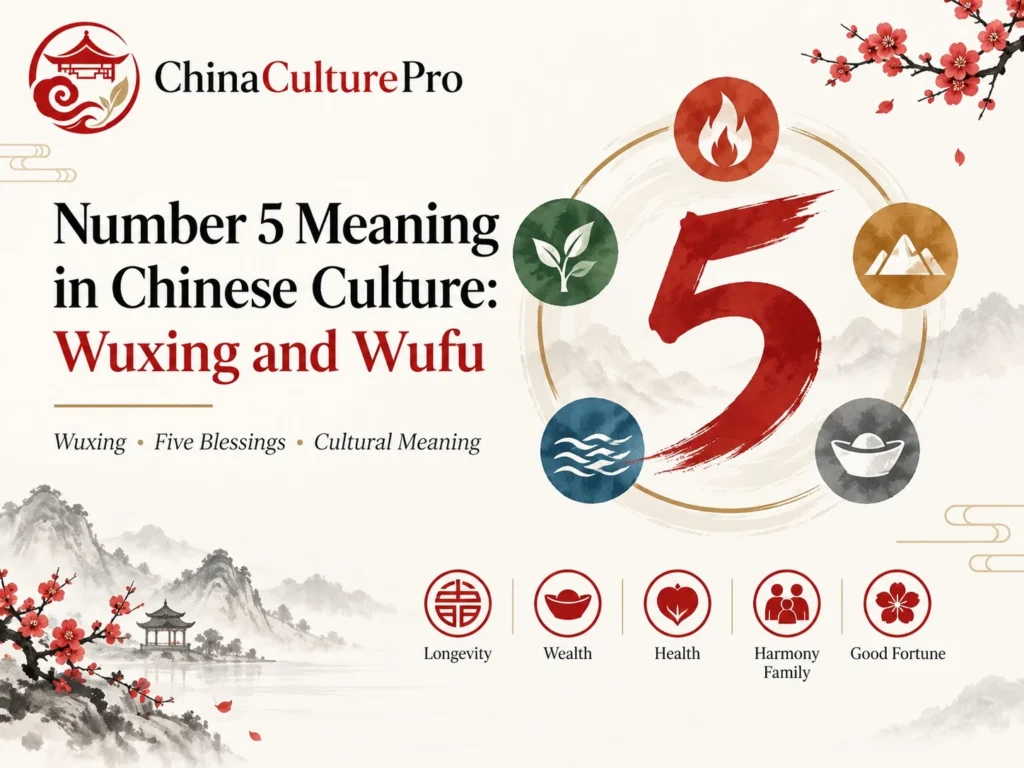
- Five Phases: Wuxing (五行, wǔxíng) describes five interacting processes—wood, fire, earth, metal and water—not five lucky substances.
- Ordered space: The Five Directions (五方, wǔfāng) combine east, south, west and north with a center.
- Auspicious art: The Five Blessings (五福, wǔfú) and five-bat designs can express a complete set of well-being and good fortune.
- Modern use: A standalone 5 is generally neutral in gifts, addresses, dates and phone numbers. It is neither widely prized like 8 nor commonly avoided like 4.
The key distinction is between structural importance and good luck. Five is culturally powerful because it organizes relationships; it does not automatically make an object, date or decision auspicious.
Chinese discussions of number symbolism often collapse philosophy, ritual and modern wordplay into one lucky-number chart. That approach is especially misleading for five. The number appears everywhere in classical classification, yet it has little independent force in contemporary number preferences.
The clearest way to read it is to identify the complete expression. Five in Wuxing explains a model of change. Five in Wufu names a set of blessings. Five bats on a textile form an auspicious visual pun. A 5 in an apartment number is ordinarily just a digit. These uses share a count, not a single meaning.
This article follows the same context-first method used in our guide to Chinese number symbolism: identify the language, period, medium and full combination before assigning a positive or negative association.
Is Number 5 Lucky or Unlucky in Chinese Culture?
In contemporary China, 5 is best described as neutral with several conditionally positive uses. It does not have the broad commercial appeal associated with 6, 8 and 9, discussed in our guide to lucky numbers in Chinese culture. It also lacks a widespread taboo comparable to 4.
Its strongest positive meanings occur inside established phrases and images. Wufu names five desirable forms of well-being. A five-bat motif can visualize that set through a homophonic pun. By contrast, an isolated 5 on a door, ticket or license plate usually carries no special message.
When interpreting an unfamiliar use, first ask whether five is naming a recognized set, counting visible objects or functioning as an ordinary identifier. Then check the period and medium. A manuscript discussing five categories, a Qing textile showing five bats and a modern hotel room numbered 505 do not share one symbolic message. If no title, inscription, established motif or historical rule connects the number to a known system, the most accurate reading is usually simple quantity or decoration rather than luck.
| Setting | Typical interpretation | Practical guidance | Limit |
|---|---|---|---|
| Everyday counting | Neutral quantity | Use normally | No luck or taboo is implied |
| Gifts and cash amounts | Usually neutral | Follow the occasion and local etiquette | Five items are not nationally prohibited |
| Floors and room numbers | Broadly accepted | No routine need to avoid them | There is no well-known skipping practice comparable to 4 |
| Phone numbers and license plates | Neutral to personal | Choose by preference | Five has no broadly recognized premium comparable to 6, 8 or 9 |
| Art with Wufu or five bats | Conditionally auspicious | Read the entire phrase or composition | The blessing belongs to the complete motif, not the digit alone |
Why Five Became an Organizing Number in Chinese Culture
Four Directions Plus the Center
One influential five-part model adds a center to the four cardinal directions. East, south, west and north define the surrounding field; the center supplies a fifth position from which the whole can be ordered. In later correlative systems, these positions could be matched with colors, seasons, phases and ritual roles.
This spatial model helps explain why five was useful, but it should not be treated as the single origin of every Chinese group of five. Literary canons, sacred mountains, tastes and moral categories developed for different purposes. Some were later connected through correlative thought; others simply used five as a convenient classificatory number.
The familiar Five Colors (五色, wǔsè) system illustrates the difference. Qing, red, yellow, white and black form a ritual and cosmological set, but that does not make every five-color object a Wuxing diagram. Evidence from layout, inscription, function or historical context is still needed.
Major Fivefold Systems Compared
| System | Members or scope | Main function | What not to infer |
|---|---|---|---|
| Wuxing (五行, wǔxíng) | Wood, fire, earth, metal and water | Models recurring processes and correspondences | It is not a list of lucky materials |
| Five Directions (五方, wǔfāng) | East, south, west, north and center | Orders ritual and cosmological space | It does not make the numeral 5 a compass charm |
| Five Colors (五色, wǔsè) | Qing, red, yellow, white and black | Classifies canonical ritual colors | It is not a fixed modern palette or luck chart |
| Five Classics (五经, wǔjīng) | A canonical Confucian textual grouping | Organizes learning and scholarship | Its fivefold form is not a Wuxing prediction |
| Five Sacred Peaks (五岳, wǔyuè) | A state and religious geography | Connects mountains, territory and sacrifice | The mountains are not interchangeable “five-element” symbols |
| Five Flavors (五味, wǔwèi) | Sour, bitter, sweet, pungent and salty | Classifies taste and related correspondences | The list is not evidence that all groups of five share one origin |
Five therefore signals an organizing habit more reliably than a symbolic message. The exact members and purpose of the set matter more than the count.
Number 5 and the Five Phases
What Wuxing Actually Means
Wuxing is often translated as “Five Elements,” but “Five Phases,” “Five Agents” or “Five Processes” better conveys its dynamic character. Wood, fire, earth, metal and water are not merely five static substances. They name patterns of activity, transformation and correspondence that were applied to cosmology, government, medicine, seasons and ritual.
The received Great Plan chapter of the Book of Documents lists water, fire, wood, metal and earth and describes characteristic tendencies of each.[1] Later thinkers developed increasingly elaborate relations among them. Modern scholarship accordingly treats Wuxing as a changing, correlative model rather than a primitive periodic table.[2]
Calling Wuxing a five-part system does not make the numeral 5 lucky. The number identifies how many categories the model contains. Its cultural importance comes from the model’s reach and influence, not from an independent power assigned to the digit.
Does Number 5 Belong to Earth in Wuxing?
Not as a universal rule. In the Great Plan, the wording “fifth, earth” occurs in an enumerated list.[1] That sequence alone does not prove that every occurrence of the number 5 possesses an earth attribute.
Some later numerological diagrams and technical traditions do associate central numbers, including 5, with earth. Those correspondences are real within their own systems, but they are system-specific. They should not be projected onto everyday addresses, gifts, art or every classical text.
For general cultural interpretation, the safe rule is simple: a bare 5 has no fixed Wuxing affiliation. Apply an earth reading only when the source clearly belongs to a tradition that defines that mapping. This article describes the historical idea rather than using it for fortune-telling, personal compatibility or design prescriptions.
The Five Blessings and the Five-Bat Motif
What Are the Five Blessings?
The received Great Plan chapter provides the best-known classical list of the Five Blessings:[1]
- Longevity (寿): living a long life.
- Wealth (富): having sufficient material resources.
- Health and tranquility (康宁): physical well-being and peace.
- Love of virtue (攸好德): valuing and practicing good conduct.
- Completing one’s allotted life (考终命): reaching life’s natural completion rather than meeting an untimely end.
This list is broader than the modern idea of “five kinds of luck.” It includes material security, physical condition, ethical character and the shape of a completed life. Translating the fifth item simply as “death” misses its emphasis on a natural and fulfilled conclusion.
Wufu is auspicious because the five named benefits form a comprehensive ideal of human well-being. The logic does not run in reverse: seeing a standalone 5 does not automatically invoke longevity, wealth or virtue. The full term, inscription or visual program must supply that connection.
Why Five Bats Represent Wufu
Chinese decorative art often turns Wufu into an image through a homophone. Bat is 蝠 (fú), pronounced like 福 (fú), “blessing” or “good fortune.” Five bats can therefore stand for the Five Blessings. In one Qing textile panel at the Metropolitan Museum of Art, five bats appear within an auspicious composition whose meanings are built through visual and verbal wordplay.[4]
Designs vary. Five bats may surround a longevity character, a peach, a roundel or another central motif. A single bat can already suggest blessing through the same pun; the group of five makes the Wufu reading more explicit. This is why the imagery must be read as a composition rather than as five identical units carrying generic luck.
For a fuller account of how the animal became auspicious, see our guide to bat symbolism in Chinese culture. The crucial point here is that the blessing comes from the fú homophone and the recognized motif, not from a magical property of the number.
Was Five an Imperial Number in China?
Five participated in imperial symbolism, but it was never a universally exclusive imperial digit. Two examples are often overgeneralized.
The first is “Nine-Five” (九五, jiǔwǔ). In the Qian hexagram of the Book of Changes, “Nine in the fifth place” names a particular line position; its text includes the image of a flying dragon in heaven.[3] Later political language associated this elevated, central line with the ruler. The prestige belongs to the hexagram, line position and interpretive tradition—not to the isolated number 5.
The second is the five-clawed dragon (五爪龙, wǔzhǎo lóng). In specific imperial dress systems, claw count helped distinguish ranks. A Metropolitan Museum of Art catalogue note explains that mid-Qing regulations reserved five-clawed dragons for the emperor and heir apparent, while also observing that enforcement became less consistent in the nineteenth century.[5] Rules varied by period, object and recipient, including authorized gifts.
Color, garment type, dragon form, other emblems and provenance all matter. As our guide to imperial colors in Chinese history also shows, court rank cannot be identified from one isolated feature. Five may contribute to an imperial code without becoming an all-purpose royal number.
Does Five Sound Like “Nothing” in Chinese?
In Standard Mandarin, five is wǔ and “not have” or “without,” 无, is wú. The syllables share consonant and vowel sounds but have different tones: third tone versus second tone.[6] That resemblance has not produced a widespread taboo comparable to 四 (sì), “four,” and 死 (sǐ), “death.”
The comparison also changes across Chinese language varieties. In Cantonese, for example, the usual readings for five and “without” are not the same close pair found in Mandarin. Statements such as “5 means nothing in Chinese” therefore erase both tone and regional variation.
Occasional jokes can exploit the Mandarin resemblance, but they do not make 5 unlucky. There is no common practice of skipping fifth floors, rejecting five-item gifts or discounting numbers merely because they contain 5.
Number 5 in Modern Chinese Internet Language
Online number codes follow whole-sequence conventions rather than classical number symbolism. They are useful examples of living language, but they should not be projected backward into traditional culture. Research on Chinese internet homophones shows how sound approximation, typing convenience and community convention combine to create such expressions.[7]
| Code | Conventional reading | Typical use | Limit |
|---|---|---|---|
| 555 | 呜呜呜, wūwūwū | Written crying; sadness, mock distress or playful cuteness | A loose sound imitation, not proof that 5 is unlucky |
| 520 | 我爱你, wǒ ài nǐ | “I love you” in romantic messaging and online culture | The meaning belongs to the full code; 5 alone does not mean “I” |
| 530 | Often read as 我想你, wǒ xiǎng nǐ | “I miss you” in some online lists and messages | Less standardized and less widely recognized than 520 |
These codes are modern, informal and sensitive to generation and platform. In formal writing or intercultural communication, spelling out the intended message is safer than assuming every reader recognizes the sequence.
Common Misreadings of Number 5
- Misreading: Five is one of China’s strongest lucky numbers. Correction: it is structurally important but generally neutral in current number preferences. Limit: Wufu and established motifs can be auspicious without making every 5 lucky.
- Misreading: Wuxing proves that 5 always belongs to earth. Correction: “fifth, earth” in the Great Plan is an item in a list. Limit: later systems may define an earth correspondence, but only inside those systems.
- Misreading: Every Chinese group of five came from Wuxing. Correction: the Five Classics, Five Sacred Peaks, Five Flavors and other sets have different functions and histories. Limit: later correlative traditions sometimes connected originally distinct classifications.
- Misreading: The Five Blessings mean the digit itself carries five kinds of luck. Correction: Wufu is a named set of human goods. Limit: the association requires the full term, inscription or motif.
- Misreading: Five bats are lucky because five is magical. Correction: 蝠 and 福 are homophones, and five bats can represent Wufu. Limit: the visual pun and composition carry the meaning.
- Misreading: Nine-Five and five-clawed dragons make 5 an imperial monopoly. Correction: both belong to specific textual or dress codes. Limit: period, medium, rank and provenance determine the imperial reading.
- Misreading: Five sounds like “nothing,” so Chinese people avoid it. Correction: wǔ and wú differ in tone, and the resemblance has not produced a broad taboo. Limit: local jokes and internet wordplay are not national etiquette.
FAQs About Number 5 in Chinese Culture
Is 5 a lucky number in Chinese culture?
Number 5 is generally neutral in everyday Chinese life. It is not a core lucky number comparable to 6, 8 or 9, and it is not widely avoided. It becomes auspicious in complete expressions such as the Five Blessings or recognized five-bat motifs, where context supplies the meaning.
Why is number 5 important in Chinese culture?
Five is important because many classical systems use five-part classifications. Wuxing organizes patterns of change, the Five Directions add a center to four cardinal directions, and other fivefold sets classify colors, texts, mountains and tastes. These systems make five structurally influential, not automatically lucky.
Does number 5 represent Earth in Wuxing?
Not universally. The Great Plan lists earth fifth, but an enumerated position is not a rule that every 5 has an earth property. Some later numerological systems associate 5 and the center with earth; that mapping applies only when the specific system defines it.
What do five bats mean in Chinese art?
Five bats commonly represent the Five Blessings. The image works because 蝠 (fú), “bat,” sounds like 福 (fú), “blessing.” Their arrangement and surrounding motifs may add longevity or other wishes. The meaning belongs to the visual pun and complete design, not to the number alone.
What does 555 mean in Chinese texting?
In Chinese online writing, 555 imitates 呜呜呜 (wūwūwū), the sound of crying. It can show real disappointment, exaggerated distress or playful cuteness. It is a modern informal convention and does not make the standalone number 5 sad or unlucky.
Sources
[1] Chinese Text Project. Book of Documents: Great Plan
[2] Stanford Encyclopedia of Philosophy. Chinese Philosophy and Chinese Medicine
[3] Chinese Text Project. Book of Changes: Qian
[4] The Metropolitan Museum of Art. Panel with Fish, Bats, and Clouds
[5] The Metropolitan Museum of Art. Man’s Audience Robe (Chaofu)
[6] Ministry of Education, Taiwan. Revised Mandarin Chinese Dictionary
[7] Qian Tang, University of Alberta. A Study of Chinese Internet Homophones