
Quick Answer: What Is Zhongyuan Festival 2027?
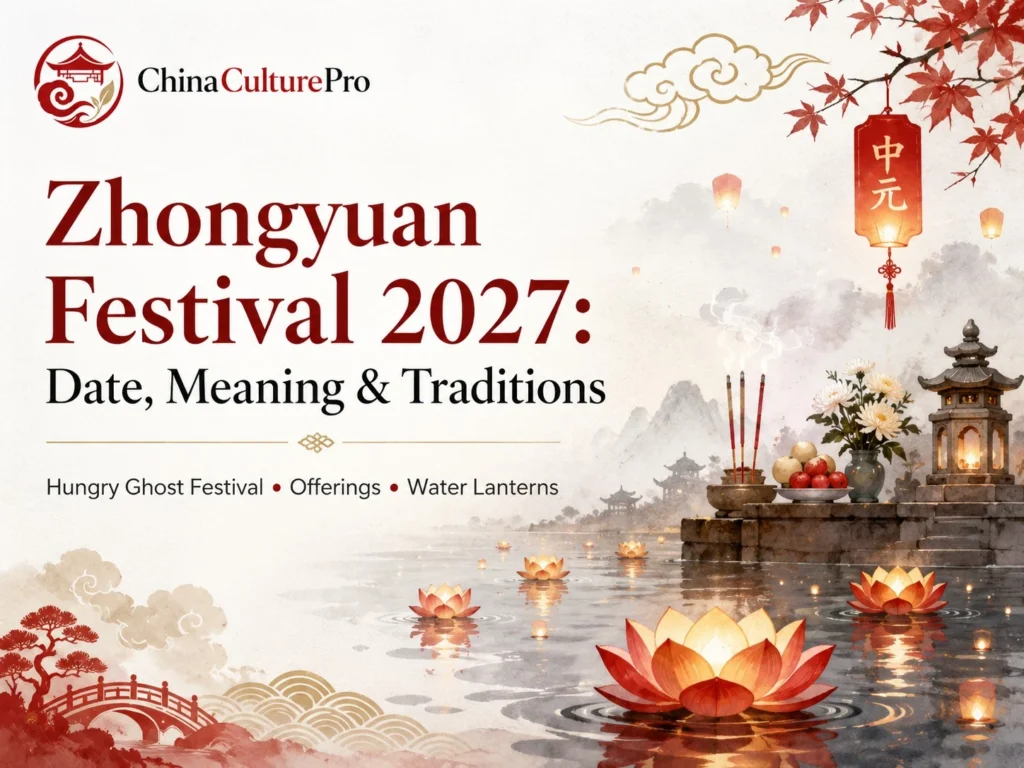
Zhongyuan Festival 2027 falls on Monday, August 16, 2027. It is observed on the 15th day of the 7th lunar month.
In Chinese, the festival is called Zhongyuan Jie (中元节). It is widely known in English as the Hungry Ghost Festival, Ghost Festival, or Chinese Ghost Festival. In Buddhist contexts, it may be called Yulanpen Festival or Ullambana Festival. In folk speech, it is often called Qiyueban, meaning the middle of the seventh lunar month.
Zhongyuan is the central day of Ghost Month, the 7th lunar month, when folk belief says spirits return to the human world. Main customs include ancestor offerings, food offerings, incense, joss paper, rituals for wandering spirits, water lanterns, and temple ceremonies.
The heart of Zhongyuan is not horror. It is reverence, compassion, feeding, appeasement, and restoring order between the living and the dead.
| Item | Detail |
|---|---|
| 2027 Date | August 16, 2027 |
| Day of Week | Monday |
| Chinese Name | Zhongyuan Jie / 中元节 |
| Also Called | Hungry Ghost Festival, Ghost Festival |
| Buddhist Name | Yulanpen Festival / Ullambana Festival |
| Lunar Date | 15th day of the 7th lunar month |
| Related Period | Ghost Month |
| Main Meaning | Ancestor care, compassion, appeasing wandering spirits |
What Is Zhongyuan Festival?
Zhongyuan Festival is one of the most misunderstood Chinese festivals in English. Because it is often called the Hungry Ghost Festival, many descriptions make it sound like a frightening or spooky event. That misses the deeper meaning.
Zhongyuan is not mainly a day for fear. It is a ritual system for facing ancestors, wandering spirits, forgotten dead, and the unseen boundary between the living and the dead.
The festival carries three major layers. In Taoist tradition, Zhongyuan is connected with the Earth Official, forgiveness, judgment, and the ordering of the underworld. In Buddhist tradition, it is linked with Yulanpen, the story of Mulian saving his mother, and the power of offerings and merit. In folk belief, it is part of Ghost Month, when spirits return and the living prepare food, incense, money, lights, and rituals to settle them.
This is why Zhongyuan feels different from Qingming Festival. Qingming is usually about visiting ancestral graves and remembering one’s own family line. Zhongyuan also includes ancestors, but it reaches further. It gives attention to wandering spirits, hungry ghosts, and those who have no descendants to feed or remember them.
The most moving part of Zhongyuan is not whether ghosts come back. It is that the living are willing to leave a place for the dead who have nowhere to go and no one to feed them. Fear is not the center. Settling the unseen is the center.
When Is Zhongyuan Festival? Date Rule and Upcoming Dates
Zhongyuan Festival is observed on the 15th day of the 7th lunar month. Because it follows the Chinese lunar calendar, its Gregorian date changes every year.
It usually falls in August or September. The whole 7th lunar month is commonly known as Ghost Month, while Zhongyuan Festival is the central day within that month.
In some southern Chinese, Hong Kong, Taiwan, and Southeast Asian Chinese communities, related rituals may begin on the 14th night of the 7th lunar month or continue across the entire month. Local dates and customs can vary. Zhongyuan is culturally important, but it is not a public holiday in Mainland China.
| Year | Zhongyuan Festival Date | Day of Week | Zodiac Year |
|---|---|---|---|
| 2026 | August 27, 2026 | Thursday | Fire Horse |
| 2027 | August 16, 2027 | Monday | Fire Goat |
| 2028 | September 3, 2028 | Sunday | Earth Monkey |
| 2029 | August 24, 2029 | Friday | Earth Rooster |
| 2030 | August 13, 2030 | Tuesday | Metal Dog |
Date note: Zhongyuan Festival is not fixed on the Gregorian calendar and is not Halloween. If you are checking events, offerings, temple ceremonies, or community rituals, use the date of the 15th day of the 7th lunar month for that year and also check local observance.
Why Zhongyuan Is More Than “Chinese Halloween”
Calling Zhongyuan “Chinese Halloween” is understandable, but it is not accurate. The phrase gives English readers a quick idea that ghosts are involved, but it can lead the article in the wrong direction.
Halloween is often associated with costumes, trick-or-treating, haunted images, parties, and playful fear. Zhongyuan is different. It is built around offerings, ritual care, respect, appeasement, and compassion.
| Common English Label | Traditional Zhongyuan Meaning |
|---|---|
| Chinese Halloween | Zhongyuan / Hungry Ghost Festival |
| Spooky entertainment | Ritual care for spirits |
| Costumes and parties | Offerings, incense, joss paper, water lanterns |
| Fear of ghosts | Respect, appeasement, compassion |
| One-night celebration | Often part of the wider Ghost Month |
The ghosts of Zhongyuan are not simply monsters for entertainment. They may be ancestors, hungry ghosts, wandering spirits, or the forgotten dead. Some are feared, but fear is not the whole point. The rituals exist because disorder must be answered with order.
Food is placed. Incense is lit. Joss paper is burned where allowed. Water lanterns guide the way. Temples chant. Families make offerings. Communities hold ceremonies. Each action tells the unseen world: you are not ignored.
“Chinese Halloween” is an entrance, not an explanation. Zhongyuan does not turn ghosts into entertainment. It brings the forgotten dead back into a world with food, light, money, ritual, and order.
Zhongyuan, Ghost Month, and the Seventh Lunar Month
Many readers confuse Ghost Month and Zhongyuan Festival. They are related, but they are not the same.
Ghost Month refers to the whole 7th lunar month. In folk belief, the gates between the underworld and the human world open during this month, allowing spirits to return. Zhongyuan Festival, on the 15th day of that month, is the main ritual point.
| Lunar Date / Period | Folk Meaning |
|---|---|
| 7th lunar month begins | Ghost Month starts |
| 1st–14th days | Offerings and caution begin in some regions |
| 15th day | Zhongyuan / main Hungry Ghost Festival |
| Late 7th month | Some communities send spirits back |
| End of 7th lunar month | Ghost Month closes in folk belief |
In some places, people begin preparing offerings from the first day of the 7th lunar month. In other places, the strongest observance happens on the 14th night or the 15th day. Some communities hold ceremonies through the entire month, especially in temples, clan groups, neighborhoods, and overseas Chinese communities.
Ghost Month is also surrounded by taboos and cautions in folk culture. People may avoid certain activities, speak more carefully, or show extra respect around roadside offerings. These practices vary widely. Not every modern Chinese person follows all Ghost Month taboos, and many younger people know the ideas without strictly observing them.
The best way to understand Ghost Month is not as a month of panic. It is a period when the living become more careful around the boundary between seen and unseen worlds.
Zhongyuan Festival Origins: Taoism, Buddhism, and Folk Belief
Zhongyuan Festival does not come from one single source. Its depth comes from three overlapping traditions: Taoist Zhongyuan, Buddhist Yulanpen, and folk Ghost Month customs.
Taoist Zhongyuan and the Earth Official
In Taoist tradition, Zhongyuan belongs to the Three Yuan system: Shangyuan, Zhongyuan, and Xiayuan. Shangyuan falls on the 15th day of the 1st lunar month and is associated with the Heavenly Official. Zhongyuan falls on the 15th day of the 7th lunar month and is associated with the Earth Official. Xiayuan falls on the 15th day of the 10th lunar month and is associated with the Water Official.
The Taoist meaning of Zhongyuan is connected with the Earth Official examining sins, granting forgiveness, and easing suffering. In this layer, the festival is not about ghosts running loose. It is about judgment, release, and the reordering of the unseen world.
Buddhist Yulanpen and Mulian Saves His Mother
In Buddhist tradition, the festival is linked with Yulanpen, also called Ullambana. The central story is Mulian saving his mother.
In the story, Mulian sees that his mother has fallen into the realm of hungry ghosts. She suffers from terrible hunger and cannot receive food properly. Mulian asks the Buddha how to save her. The Buddha teaches him to make offerings to the monastic community on the 15th day of the 7th lunar month, gathering merit to relieve his mother’s suffering.
This layer gives Zhongyuan a strong meaning of filial piety, offering, merit-making, salvation, and compassion. It explains why temple rituals, chanting, and offerings are important in many Buddhist-influenced observances.
Folk Ghost Month and Wandering Spirits
The folk layer is closest to daily life. It focuses on Ghost Month, wandering spirits, hungry ghosts, and the dead who have no descendants to worship them.
This is where many everyday customs appear: food placed outside, incense on the roadside, joss paper, public offerings, temple ceremonies, water lanterns, opera stages, getai performances, and seats left for invisible guests in some communities.
| Origin Layer | What It Adds |
|---|---|
| Taoist Zhongyuan | Earth Official, forgiveness, underworld order |
| Buddhist Yulanpen | Mulian, filial piety, merit, salvation |
| Folk Ghost Month | Wandering spirits, offerings, community appeasement |
| Later Local Customs | Opera, lanterns, joss paper, public rituals |
Zhongyuan is powerful because these layers do not cancel one another. They stand together. The result is a festival that is religious, moral, communal, and emotional at the same time.
Zhongyuan Festival Traditions and Customs
Zhongyuan customs vary by region, religion, family, and local community. Some are private family rites. Others are temple rituals or public community ceremonies.
| Custom | What People Do | Meaning |
|---|---|---|
| Ancestor Offerings | Prepare food, incense, flowers, tea, wine | Remember and care for family dead |
| Food for Wandering Spirits | Place food outdoors or at altars | Compassion and appeasement |
| Burning Joss Paper | Burn paper money or goods where allowed | Sending symbolic resources |
| Water Lanterns | Float lanterns on rivers or water | Guide spirits and light the way |
| Temple Rituals | Chanting, prayers, merit-making | Relief and salvation |
| Opera / Getai | Perform for spirits and community | Entertainment, offering, public ritual |
Ancestor offerings connect Zhongyuan with family duty. Food, tea, wine, incense, flowers, and other offerings may be placed at home, in ancestral halls, or at temples.
Food for wandering spirits is a key difference. These offerings are not only for one’s own family dead. They may be placed outdoors, at roadside altars, temple grounds, or community ritual spaces for spirits who have no one to care for them.
Burning joss paper or paper goods is common in many communities, but it must be handled carefully. Modern readers should follow local laws, fire rules, temple guidance, cemetery rules, and environmental regulations. Never burn joss paper in prohibited areas.
Water lanterns are used in some traditions to guide spirits and send them away. Temple rituals may include chanting, prayers, merit-making, and rites for relief from suffering.
In some Hong Kong, Taiwan, Singapore, Malaysia, and Southeast Asian Chinese communities, performances may be staged for both spirits and people. The first rows may be left empty for unseen guests. These customs should be understood as public ritual, not as a spectacle for mockery.
Food Offerings, Joss Paper, and the Logic of “Feeding”
The English name Hungry Ghost Festival makes one word stand out: hungry. This hunger is not only physical. It points to a state of being unsettled, unfed, unsupported, and unable to receive care.
Zhongyuan rituals answer that hunger.
For ancestors, offerings express filial duty. The family remembers its own dead and gives them a proper place. For wandering spirits, offerings express compassion. The living give food and symbolic resources to those who may have no descendants, no home altar, and no one to call their name.
Rice, dishes, water, tea, wine, fruit, and incense treat the dead like guests. Joss paper, paper money, paper clothing, and other paper goods symbolically send resources to the afterlife. The deeper logic is care: you should not lack what you need on the other side.
| Offering | Cultural Logic |
|---|---|
| Rice and Food | Feeding and respect |
| Water / Tea / Wine | Hospitality and care |
| Fruit | Freshness and sincerity |
| Joss Paper | Symbolic resources for the afterlife |
| Lanterns | Guidance and safe return |
| Chanting / Merit | Relief from suffering |
Modern readers do not need to imitate every practice. But they should understand the emotional logic. The living use visible things to settle invisible relationships.
The real “feeding” of Zhongyuan is not only giving ghosts a meal. It is giving the forgotten dead a place. When the human world leaves one table open, the unseen world has a little less hunger and cold.
Water Lanterns and Guiding the Spirits Home
Water lanterns, also called river lanterns in some contexts, are one of the most meaningful Zhongyuan images. They are not the same as lanterns in Lantern Festival or Mid-Autumn Festival.
In Zhongyuan, water can suggest a passage or boundary between worlds. Light gives direction. A lantern floating away on water becomes a gentle act of guiding, sending off, and settling.
Some water lanterns are shaped like lotus flowers. In Buddhist-influenced settings, the lotus can suggest purity, release, and relief from suffering. When a lantern drifts farther away or goes out, it can carry the feeling of farewell.
| Festival Lantern | Main Meaning |
|---|---|
| Zhongyuan Water Lantern | Guiding and sending spirits |
| Lantern Festival Lantern | New Year celebration and riddles |
| Mid-Autumn Lantern | Moon-night joy and children’s play |
This is why Zhongyuan lanterns should not be confused with public lantern displays during Lantern Festival. Zhongyuan lanterns are not mainly decorative. They are directional and ritual.
Modern environmental and safety rules matter. Do not release floating lanterns unless local regulations allow it and the materials are safe. Many cities restrict or ban lantern release to protect waterways and prevent pollution.
How Zhongyuan Festival Is Observed Today
Zhongyuan Festival is still observed across Chinese communities, but its public visibility differs by region.
In Mainland China, some families and regions still keep Qiyueban customs such as ancestor offerings, food offerings, incense, and joss paper. Public burning and roadside offerings may be limited by urban rules, fire safety, and local management. In rural areas, older customs may remain more visible.
In Hong Kong, Yulan ceremonies can be large and community-based. Some communities prepare offerings, burn incense, stage performances, and maintain ritual spaces. Chiu Chow community Yulan events are especially well known.
In Taiwan, Zhongyuan is important in folk religious life. Temples hold Pudu ceremonies, businesses may place offerings outside their doors, and communities prepare food and joss paper to seek peace for the living and the dead.
In Singapore and Malaysia, Hungry Ghost Month is highly visible in many Chinese communities. Offerings, burning areas, temple events, and getai performances may appear during the 7th lunar month. In getai, performances are offered to spirits as well as living audiences, and front-row seats may be left empty for unseen guests.
Overseas Chinese communities observe Zhongyuan in different ways. Some hold temple rituals or community ceremonies. Others keep simple family offerings. Some younger people may not follow every taboo, but they still understand that the 7th lunar month deserves respect.
Zhongyuan today can be a full community ritual, a family offering, a temple ceremony, or simply a quiet awareness that this is Qiyueban. These forms differ, but they all come from the same root: settling the dead and calming the living.
How to Understand and Join Zhongyuan Respectfully
Zhongyuan should not be approached like a Halloween party or a spooky tourist event. It is a festival of reverence, ritual care, and caution.
- Do not step over, move, or mock roadside offerings.
- Do not take food offerings, even if they look untouched.
- Ask before photographing rituals, offerings, incense, or joss paper.
- Follow temple, community, cemetery, or local rules.
- Do not burn joss paper unless it is legal and guided by people who know the practice.
- Do not release water lanterns unless the site allows it and the materials are safe.
- Do not treat Ghost Month taboos as jokes.
- If you attend a ritual, quiet respect is enough.
- Avoid saying “Happy Hungry Ghost Festival.”
If you want to express respect, use gentler phrases such as “May the departed be at peace,” or “Wishing peace to your family and ancestors.” If you are unsure what to say, silence and respectful behavior are better than forced festival greetings.
You do not need to be afraid of Zhongyuan to respect it. The correct tone is not panic. It is care.
How This Guide Connects to Chinese Festivals and Zodiac Content
Zhongyuan Festival is one of the most distinctive festivals in the Chinese festival year. It belongs inside the larger map of ancestor rites, seasonal customs, folk religion, Buddhist practice, Taoist tradition, and community ritual.
For the full festival calendar, start with our Chinese Festivals and Holidays guide.
Zhongyuan and Qingming Festival both concern the dead, but their emotional positions are different. Qingming is a spring festival of tomb sweeping and family roots. Zhongyuan is a 7th-month festival of offerings, wandering spirits, and ritual appeasement. To understand the spring festival of tomb sweeping and family roots, read our Qingming Festival guide.
Zhongyuan and Lantern Festival both use lanterns, but their meaning is not the same. Zhongyuan water lanterns guide and send spirits; Lantern Festival lanterns celebrate the first full moon of the New Year season. To see how Zhongyuan water lanterns differ from New Year lantern displays, read our Lantern Festival guide.
Zhongyuan is also different from Chinese New Year. It is not a family reunion festival or a zodiac-year transition point. To compare Zhongyuan with China’s largest family festival, read our Chinese New Year guide.
If you came from zodiac content, note that Zhongyuan belongs to Taoist, Buddhist, and folk-religion systems, not the Chinese Zodiac system. In 2027, it falls in the Fire Goat year, but the festival itself is not a zodiac festival.
FAQs About Zhongyuan Festival
When is Zhongyuan Festival 2027?
Zhongyuan Festival 2027 is on Monday, August 16, 2027. It falls on the 15th day of the 7th lunar month. Because it follows the Chinese lunar calendar, its Gregorian date changes every year.
What is Zhongyuan Festival?
Zhongyuan Festival is a Chinese traditional festival held on the 15th day of the 7th lunar month. It is also called Hungry Ghost Festival or Ghost Festival. Its customs include ancestor offerings, food offerings, incense, joss paper, water lanterns, temple rituals, and ceremonies for wandering spirits.
Why is it called Hungry Ghost Festival?
It is called Hungry Ghost Festival because folk belief says hungry ghosts and wandering spirits return during the 7th lunar month. “Hungry” does not only mean physical hunger. It also means being unfed, unsettled, forgotten, and without descendants to make offerings.
Is Zhongyuan Festival the same as Ghost Month?
No. Ghost Month refers to the whole 7th lunar month. Zhongyuan Festival is the main festival day on the 15th day of that month. Some communities observe rituals throughout the month, not only on Zhongyuan day.
Is Zhongyuan Festival the same as Halloween?
No. Zhongyuan Festival is not Chinese Halloween. Halloween is often centered on costumes, parties, and playful fear. Zhongyuan centers on offerings, respect, compassion, joss paper, water lanterns, and rituals to settle ancestors and wandering spirits.
What do people offer during Zhongyuan Festival?
Offerings may include rice, cooked dishes, fruit, tea, wine, incense, candles, flowers, and joss paper. Some offerings are for ancestors, while others are for wandering spirits or hungry ghosts who have no family to feed them.
Why do people burn joss paper?
Joss paper is burned as a symbolic way to send money, clothing, houses, or other resources to the dead. The deeper meaning is care: the living express that the dead should not lack what they need in the unseen world. Burning should only happen where local rules allow it.
What is Yulanpen Festival?
Yulanpen Festival, or Ullambana Festival, is the Buddhist layer of Zhongyuan. It is linked with the story of Mulian saving his mother from the hungry ghost realm through offerings and merit. This gives the festival meanings of filial piety, rescue, compassion, and relief from suffering.
Is Zhongyuan Festival a public holiday in China?
No. Zhongyuan Festival is culturally important, but it is not a public holiday in Mainland China. People usually work or study as usual, though families, temples, and local communities may still observe the festival.
What should I say during Zhongyuan Festival?
It is better not to say “Happy Hungry Ghost Festival.” Zhongyuan is not a cheerful holiday. A respectful phrase such as “May the departed be at peace” or “Wishing peace to your family and ancestors” is more appropriate. Quiet respect is also enough.