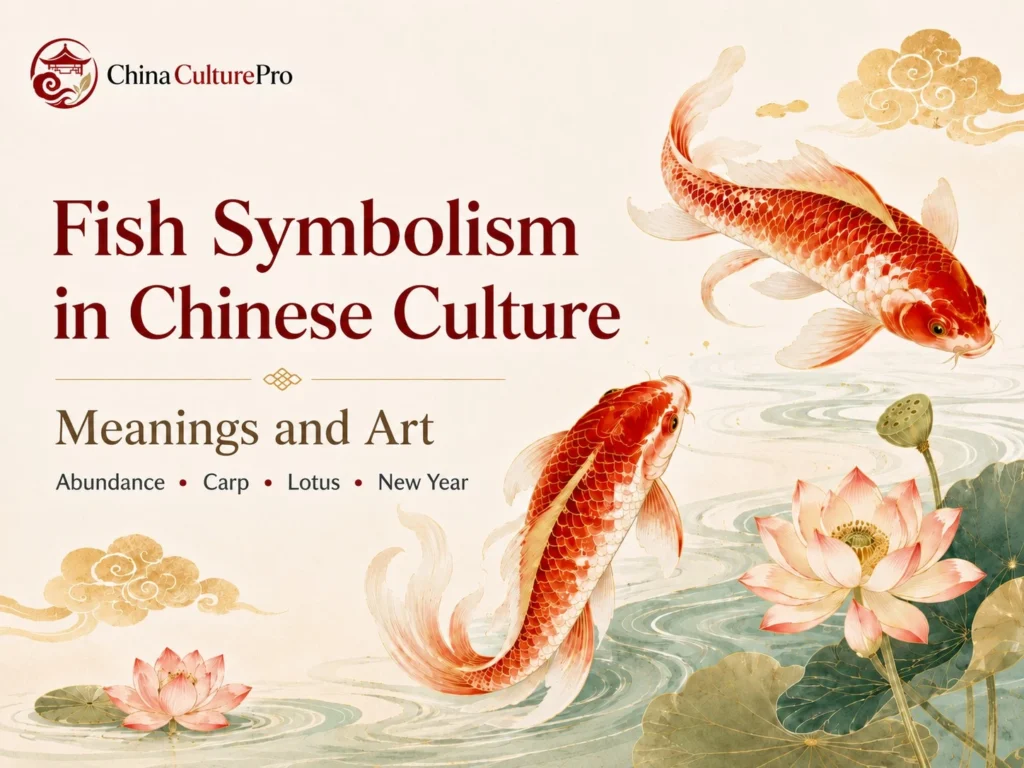

Quick Answer: What Does the Fish Symbolize in Chinese Culture?
In Chinese culture, a fish can symbolize abundance, advancement, contentment, or a religious idea, but it does not have one permanent meaning. The correct interpretation depends on the species, period, medium, inscription, companion motifs, and cultural system.
- Surplus and abundance: Fish, 鱼/魚 (yú), sounds the same as surplus, 余/餘 (yú), in Modern Standard Mandarin. This makes fish a common image for having resources left over.
- Advancement and transformation: A carp approaching the Dragon Gate can evoke examination success, rising status, perseverance, or major change.
- Contentment and freedom: Swimming fish in paintings may recall the Zhuangzi and the philosophical “pleasure of fishes.”
- Buddhist auspice: Paired golden fish can belong to the Eight Auspicious Symbols rather than a secular wealth design.
These are traditional ideas and artistic wishes. A fish image cannot guarantee wealth, examination success, protection, or a change in fortune.
Many introductions to Chinese fish symbolism reduce the image to “wealth.” That works for some New Year prints and decorative objects, but not for every fish. Lotus and fish can form a rebus for continuing abundance; freely swimming minnows may carry a philosophical allusion; paired fish on a Buddhist dish belong to a religious set.
The animal is therefore only the beginning of the interpretation. As with other forms of Chinese animal symbolism, the period, object, composition, and cultural system determine which meaning is active.
Why Does Fish Mean Abundance in Chinese Culture?
The most familiar association comes from language. Fish is 鱼 in simplified Chinese and 魚 in traditional Chinese; both are pronounced yú in Modern Standard Mandarin. Surplus or remainder is 余 in simplified writing and commonly 餘 in traditional writing, also pronounced yú. An image of a fish can therefore stand for the idea of having something left after present needs have been met.
That distinction matters. “Surplus” can refer to food, household resources, harvest, income, or general material sufficiency. It is broader than money, so “fish always means wealth” is too narrow and too absolute. In a suitable auspicious composition, wealth may be one part of the wish, but the fish begins with the idea of abundance or having enough and more.
| Term | Chinese and pinyin | Role in the rebus |
|---|---|---|
| Fish | 鱼/魚, yú | The visible animal or motif |
| Surplus | 余/餘, yú | The abstract wish suggested by the sound |
| Abundance year after year | 年年有余/年年有餘, niánnián yǒuyú | A familiar blessing that fish imagery can visualize |
This visual wordplay is similar to the 蝠/福 mechanism behind bat symbolism in Chinese culture.[3] It should not, however, be projected automatically across every historical Chinese language or regional pronunciation. The strongest interpretation still comes from a dated object and its full composition.
How Fish Symbolism Changed Across Chinese History
Fish appeared in Chinese material culture long before surviving objects document the familiar surplus rebus. Later artists also used fish for philosophy, political reflection, natural observation, and religious ornament. The history is an accumulation of different meanings, not one unbroken definition.
Early Fish Images Before the Auspicious Rebus
The Yangshao-period Painted Pottery Basin with Fish and Human Face Design was excavated at Banpo in Xi’an in 1955. Similar basins were used as lids for children’s burial urns, and the fish and net designs have been related to Banpo economic life and possible ritual or totemic ideas. The exact interpretation remains debated.[1]
What the basin does not establish is “abundance year after year.” It predates the mature decorative rebus by millennia. Reading a Neolithic burial object through a Qing New Year formula would replace archaeological context with a much later convention.
Fish in Classical Philosophy and Literati Painting
In the Zhuangzi, the famous exchange between Zhuangzi and Huizi at the Hao River asks how one person can know the pleasure of fish. Later painting could use swimming fish to explore perception, contentment, natural spontaneity, and the artist’s own state of mind rather than material prosperity.
Zhou Dongqing’s 1291 handscroll The Pleasures of Fishes, object 47.18.10, makes the connection unusually clear. The work was inspired by the Zhuangzi passage, while its inscription reflects on using painting to express feelings that are difficult to describe. Its restrained treatment has also been associated with detachment and withdrawal.[2] An ordinary pond scene, however, should not receive this reading without a title, inscription, artist context, or another supporting clue.
The Rise of Auspicious Fish Rebuses
The exact starting date of the fish-surplus rebus cannot be reduced to one surviving object. What can be documented clearly is its flourishing in late imperial decorative and popular art. Ming and Qing ceramics, paintings, textiles, prints, and household objects gave artists many surfaces on which to combine fish with words, plants, children, or other auspicious images.
Carp and goldfish became especially prominent in popular prints because their names, forms, stories, and observed movement could support different wishes.[3] This later visual grammar should be understood on its own terms. It does not replace the ritual uncertainty of Neolithic fish designs or the philosophical work of Yuan fish painting.
Fish, Carp, Goldfish, Koi, and Buddhist Golden Fish: What Is the Difference?
“Fish” is an umbrella category. A reader must still identify the creature, the visual system, and the object’s use. The comparison below prevents several frequent cross-cultural and cross-religious mistakes.
| Form | Primary mechanism | Common reading | Typical context | Do not assume |
|---|---|---|---|---|
| Generic fish | 鱼/余 sound play or natural observation | Surplus and abundance, or simply aquatic life | Painting, porcelain, prints, textiles | Every fish is a money symbol. |
| Carp, 鲤鱼/鯉魚 (lǐyú) | Dragon Gate narrative and energetic movement | Advancement, examination success, perseverance, transformation | New Year prints, painting, porcelain | The meaning comes from an exact 鲤/利 homophone; the tones differ. |
| Goldfish, 金鱼/金魚 (jīnyú) | The word “gold” and a near-sound association with 金玉 (jīnyù), gold and jade | Material plenty, refinement, domestic prosperity | Popular prints, painting, decorative objects | Goldfish and gold-jade are exact tonal homophones. |
| Modern koi | Ornamental carp breeding and modern cross-cultural design | Perseverance or personal success in many current designs | Ponds, tattoos, logos, contemporary art | Modern koi color charts are ancient Chinese rules. |
| Buddhist golden fish | Membership in the Eight Auspicious Symbols | A religious auspicious emblem within a complete Buddhist system | Buddhist textiles, ritual art, imperial porcelain | They are automatically a secular marriage or wealth sign. |
| Whole fish as food | 鱼/余 sound play within a festive meal | Abundance and family wishes for the coming year | Lunar New Year reunion dinner | Every region follows the same serving rules. |
A late fifteenth-century Chinese dish, object 51.85, places fish among the Wheel of the Law, conch, canopy, umbrella, lotus, vase, and endless knot. Its meaning comes from the complete Buddhist set, explained in the guide to the Eight Auspicious Symbols in Chinese Buddhism, not from the secular fish-surplus pun alone.[7] Modern Japanese koi require another distinction: colorful ornamental koi were developed in early nineteenth-century Japan, although carp domestication has a much older history in China.[8] The dedicated guide to carp and koi symbolism examines that boundary in greater depth.
Common Fish Motifs and Their Meanings in Chinese Art
Chinese decorative combinations work like visual grammar. A companion image can narrow a broad fish association, turn several pictures into a phrase, or move the fish into a religious or literary narrative. The same principle appears throughout Chinese symbolism in art and on historical Chinese porcelain patterns.
Fish and Lotus: Continuous Abundance Year After Year
The lotus-fish composition depends on two sound substitutions. Lotus, 莲/蓮 (lián), evokes continuous, 连/連 (lián); fish, 鱼/魚 (yú), evokes surplus, 余/餘 (yú). Together they can visualize 连年有余/連年有餘, “may you have continuing abundance year after year.” The lotus does not form an exact homophone with year, 年 (nián).
A Kangxi-period fish bowl from Jiangxi, object B62P89, combines lotus plants and fish in precisely this way. Its museum interpretation identifies the design as a rebus for continuous plenty year after year.[5] A Qing hanging scroll, Red lotus and fish, object 2017.327.3, likewise carries an auspicious New Year message.[4]
Context still matters. Lotus has its own seasonal, Buddhist, and artistic histories, discussed in the guide to lotus meaning in Chinese culture. An uninscribed study of a lotus pond may describe summer or observed nature rather than state a New Year blessing.
Carp and the Dragon Gate
In the Dragon Gate story, fish gather beneath a difficult passage and those that cross it become dragons. Later art and language associated the successful leap with civil examination selection, rapid advancement, reputation, and a major change in status. A nineteenth- to mid-twentieth-century Sichuan woodblock print, object 969.168.24, shows a carp rising through waves toward a gate marked 龙门/龍門 and connects the image to New Year ambitions.[6]
The motif can therefore express perseverance, but its complete meaning belongs to the carp, waves or waterfall, gate, and transformation narrative together. A decorative carp swimming calmly in a pond is not automatically “leaping the Dragon Gate.” The Chinese dragon also has many roles unrelated to this fish transformation story.
Paired Fish, Goldfish, and Other Combinations
Several popular combinations require similar caution:
| Combination | Possible meaning | Interpretation boundary |
|---|---|---|
| Two fish | Pairing, harmony, a Buddhist emblem, or simple symmetry | Marriage requires a wedding context or other evidence; two fish alone do not prove it. |
| Fish in water | Contentment, compatibility, natural freedom, or ordinary aquatic life | A title, inscription, narrative, or object use should decide among these readings. |
| Child holding a fish | A folk wish joining descendants with abundance | This is a secular popular-art theme, not a Buddhist rule. |
| Goldfish | Material abundance and the phrase “gold and jade fill the hall” in suitable compositions | 金鱼 (jīnyú) and 金玉 (jīnyù) are a near-sound association, not an exact tonal match. |
| Nine fish | Long duration may be suggested when nine, 九 (jiǔ), evokes long-lasting, 久 (jiǔ) | The count needs a documented composition; it is not a universal prosperity formula. |
These combinations can lead readers toward broader guides to Chinese symbols for wealth or Chinese symbols for success, but possible meanings should not simply be stacked until every fish represents prosperity, marriage, children, and achievement at once.
Why Is Fish Important at Chinese New Year?
At the Lunar New Year reunion dinner, a whole fish can turn the fish-surplus pun into food. The dish expresses a wish that the household will enter the new year with resources to spare. Its intact form may also support ideas of completeness and family gathering, but the abundance rebus remains the most widely documented explanation.[9]
The central idea is shared more widely than the serving details. Some families leave part of the fish uneaten so that “surplus” passes into the next day or year. Others finish it. Rules about which direction the head should face, who eats first, which species must be served, or when the dish can be touched vary by region and household.
Fish at a festival meal is therefore a custom, not a national test of etiquette. The broader guide to Chinese New Year symbols places it beside other foods, images, colors, and spoken blessings. Eating the dish does not itself produce wealth or alter fortune.
What a Chinese Fish Symbol Does Not Automatically Mean
| Common misreading | More accurate interpretation |
|---|---|
| Every fish means money | Fish can evoke surplus, but it can also serve naturalistic, philosophical, religious, narrative, or culinary roles. |
| Every carp is a koi | Carp is a broad fish and cultural subject; modern Japanese koi are selectively bred ornamental carp. |
| Two fish always mean romantic love | Paired fish may belong to Buddhist art, visual symmetry, a natural scene, or a suitable marriage design. |
| Every fish-and-water image is feng shui | Many examples are paintings, porcelain designs, literary allusions, or observed nature without a placement system. |
| Banpo fish designs mean “abundance year after year” | The Neolithic burial context predates the mature late imperial rebus and must be interpreted independently. |
| Color, number, and direction form one ancient code | Specific compositions can use these features, but no single code governs every period, region, medium, and fish type. |
| A fish image attracts wealth or helps someone pass an examination | The image communicates a traditional wish or modern personal value; it cannot guarantee a real result. |
The broader guide to Chinese symbols and meanings uses the same context-first rule: identify the system before translating an image into one English keyword.
How to Interpret or Use a Chinese Fish Symbol Correctly
Use this sequence when examining museum objects, antiques, porcelain, tattoos, logos, or home decoration:
- Identify the image precisely. Decide whether it shows an unidentified fish, carp, goldfish, modern koi, paired Buddhist fish, or fish served as food. Do not identify a species from color alone.
- Date the object and name its medium. A Neolithic burial basin, Yuan handscroll, Qing porcelain bowl, New Year print, and modern tattoo were created for different audiences and purposes.
- Read the full composition. Record lotus, water plants, waves, a gate, a dragon, a child, Buddhist emblems, inscriptions, numbers, colors, and the fish’s movement. These features often supply the sentence around the fish.
- Determine the cultural system. Ask whether the image belongs to natural observation, literati painting, an auspicious rebus, a religious set, a festival meal, or contemporary design. Prefer an inscription, museum catalogue, or documented historical comparison over a generic symbol list.
- Separate historical meaning from personal adaptation. A modern artist may use fish for resilience, identity, balance, or family without claiming an ancient rule. State that modern layer openly.
For a tattoo, a clear brief might be “a lotus and fish composition inspired by continuing abundance” or “a carp approaching the Dragon Gate as a personal image of perseverance.” That is more accurate than requesting a universal “Chinese lucky fish.” The guide to Chinese tattoo symbols and meanings explains why characters, directions, religious emblems, and official motifs should also be checked before permanent use.
FAQs About Fish Symbolism in Chinese Culture
Does the Number or Direction of Fish Have a Fixed Meaning?
No single traditional code assigns one fixed meaning to every fish count or direction. A number such as nine can participate in wordplay, and movement toward a gate can matter in a Dragon Gate scene, but the composition must supply that context. Online rules about eight or nine fish, head direction, or universal lucky placement should not be treated as historical facts without evidence from a dated tradition or object.
Is a Yin-Yang Koi Design a Traditional Chinese Symbol?
The traditional taijitu diagrams the relationship between yin and yang rather than requiring two literal fish. Arranging black and white koi in its circular form is best described as a modern artistic adaptation unless a specific historical object supports another reading. Such a design can express personal ideas of balance, but it should not be presented as the one original form of the Chinese diagram.
Sources
[1] National Museum of China. Painted Pottery Basin with Fish and Human Face Design
[2] The Metropolitan Museum of Art. The Pleasures of Fishes
[3] Ellen Johnston Laing. Carp and Goldfish as Auspicious Symbols and their Representation in Chinese Popular Prints
[4] The Metropolitan Museum of Art. Red Lotus and Fish
[5] Asian Art Museum. Fish Bowl with Lotus Plants
[6] Royal Ontario Museum. Carp Leaping over the Dragon’s Gate
[7] Seattle Art Museum. Dish with the Eight Auspicious Buddhist Symbols
[8] Smithsonian’s National Zoo and Conservation Biology Institute. Japanese Koi
[9] Smithsonian National Museum of Asian Art. Lunar New Year