
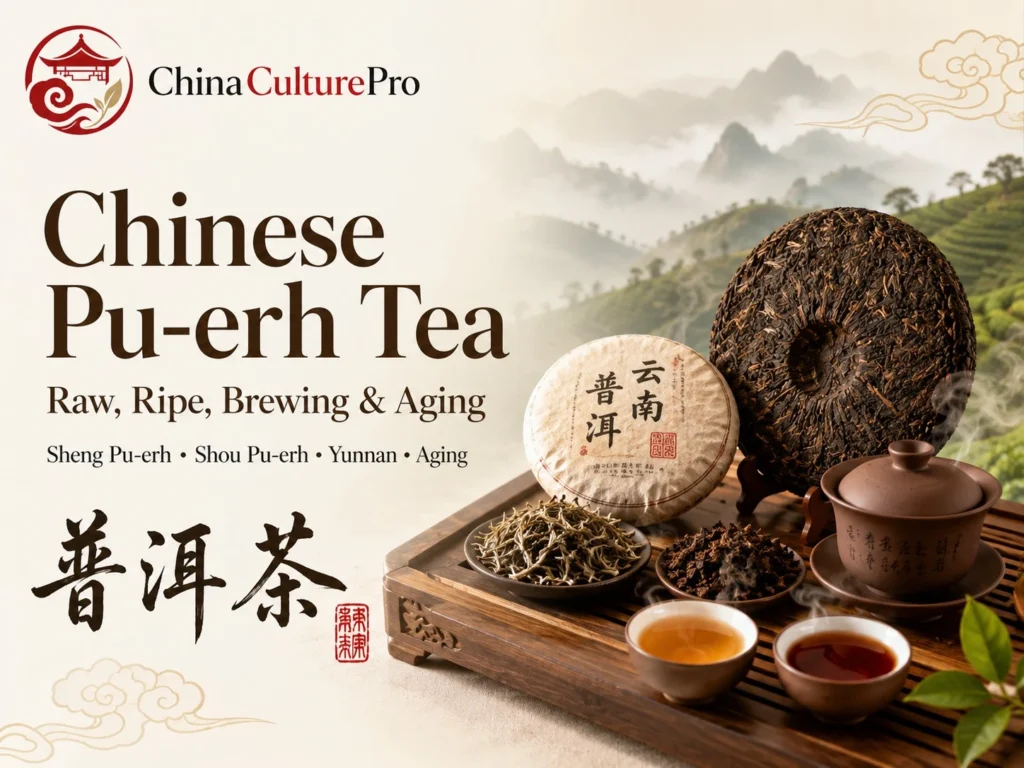

Quick Answer: What Is Chinese Pu-erh Tea?
Chinese Pu-erh tea, also written as Pu’er Tea or Puer Tea, is one of the most complex tea systems in Chinese tea culture. It is strongly tied to Yunnan, Yunnan large-leaf tea material, sun-dried maocha, storage, aging, and transformation.
Pu-erh is often discussed within the Dark Tea / Hei Cha system, but it deserves separate attention because of its Yunnan origin, Sheng and Shou paths, compressed tea culture, storage logic, and market complexity.
| Item | Detail |
|---|---|
| Main Topic | Chinese Pu-erh Tea / 普洱茶 |
| Main Origin | Yunnan |
| Base Material | Yunnan large-leaf tea, sun-dried maocha |
| Main Types | Sheng Pu-erh and Shou Pu-erh |
| Core Character | Aging, storage, microbial transformation |
| Common Forms | Cake, brick, tuo cha, loose tea |
| Best Brewing Style | Gaiwan, clay teapot, Gongfu-style infusions |
Key Point: Pu-erh tea is special not because it is simply old, but because it can transform. Good material, correct processing, clean storage, and time can work together. Poor material, poor processing, or dirty storage will not become good just because the tea is old.
Why Pu-erh Tea Matters in Chinese Tea Culture
Pu-erh tea matters because it is one of the Chinese teas most closely connected with time, storage, mountains, and transformation.
Green tea is often valued for freshness. Oolong tea is valued for aroma, roast, rhythm, and layered infusions. Chinese black tea is valued for full oxidation, red liquor, sweetness, and warmth. Pu-erh asks the drinker to consider material, processing, storage, age, and whether the tea keeps changing in the cup and over time.
Pu-erh is also tied to Yunnan tea mountains, ethnic minority tea traditions, old tea routes, border tea culture, and modern collecting markets. These backgrounds matter, but the final test is still the tea liquor.
In Chinese Pu-erh practice, experienced drinkers often judge the tea through several layers:
- Mountain origin: Famous names such as Yiwu, Bulang, Lao Banzhang, Bingdao, Xigui, and Jingmai can suggest style, but they are not proof of quality by themselves.
- Tree material: Gushu, Qiao Mu, small tree, and terrace tea can matter, but tree age alone does not guarantee good tea.
- Maocha quality: Sun-dried maocha is the base. If the base material is weak, time cannot turn it into great Pu-erh.
- Hui Gan / returning sweetness: Bitterness should transform into sweetness in the mouth.
- Sheng Jin / saliva production: Good Sheng Pu-erh often makes the mouth feel active, moist, and refreshed.
- Hou Yun / throat feeling: The tea should pass through the throat comfortably, not leave dryness or tightness.
- Cha Qi / body feeling: Some drinkers describe warmth, openness, or body sensation after drinking Pu-erh. This is subjective, but it is part of traditional Pu-erh language.
- Storage cleanliness: Clean aging is more important than an impressive year on the wrapper.
- Infusion stamina: Good Pu-erh should still have sweetness, body, or strength in later infusions.
Pu-erh tea is also one of the easiest tea categories to over-market. Words such as ancient tree, Lao Banzhang, Bingdao, Yiwu, dry storage, single tree, old tea, pure material, and aged cake can be meaningful, but they can also be abused.
A Pu-erh drinker might say: stories can be heard, mountain names can be noted, and age can be checked, but the tea must return to the liquor. Is it clean? Is it smooth? Does bitterness transform? Does the throat feel comfortable? Is there sweetness in later brews?
This is the real discipline of Pu-erh.
Sheng Pu-erh vs Shou Pu-erh: Raw and Ripe Pu-erh
Sheng Pu-erh and Shou Pu-erh are not higher and lower grades. They are two different processing paths.
| Type | Chinese Name | Processing Path | Taste Direction | Beginner Note |
|---|---|---|---|---|
| Sheng Pu-erh | 生普 / 生茶 | sun-dried maocha, compressed or stored loose, then naturally aged | young tea can be fresh, floral, bitter-sweet, astringent, and lively; aged tea can become honeyed, woody, smoother, and deeper | more variable, stronger aging potential, but young Sheng can be intense |
| Shou Pu-erh | 熟普 / 熟茶 | maocha plus Wo Dui fermentation, then dried and often compressed | earthy, woody, jujube-like, sweet, thick, smooth, dark liquor | easier to drink young, but must be clean; poor Shou may have fishy, musty, sour, or dirty notes |
The practical difference is simple: Sheng changes slowly; Shou is accelerated by Wo Dui fermentation. Beginners often find clean Shou easier to drink, but anyone who wants to understand mountain character, aging potential, and the transformation of Pu-erh must eventually taste Sheng.
Good Sheng and good Shou both have value. They express Pu-erh through different paths.
How Pu-erh Tea Is Made
Pu-erh tea is built on Yunnan tea material and sun-dried maocha. Its production should not be confused with green tea, black tea, or oolong tea.
| Step | Chinese Term | What It Does | Key Point |
|---|---|---|---|
| Picking | 采摘 | decides raw material grade | often uses Yunnan large-leaf material, commonly one bud with two or three leaves |
| Withering / Spreading | 摊晾 | reduces moisture and softens leaves | prepares leaves for fixing and rolling |
| Sha Qing | 杀青 | controls enzyme activity | different from green tea fixation; it prepares the leaf for later transformation |
| Rolling | 揉捻 | shapes leaves and breaks cells | affects liquor release and later transformation |
| Sun-drying | 晒干 | dries leaves under sun | creates sun-dried maocha, the base of Pu-erh |
| Maocha | 晒青毛茶 | unfinished base tea | can be drunk, compressed, aged, or used for Shou processing |
| Compression | 蒸压 | forms cake, brick, or tuo cha | affects storage, transport, and transformation speed |
| Aging / Storage | 陈化 / 仓储 | allows slow transformation | depends on material, processing, environment, and time |
| Wo Dui | 渥堆 | added for Shou Pu-erh | pile fermentation creates ripe Pu-erh character |
Sun-dried maocha is the foundation. This is why Pu-erh cannot be understood only as “aged tea.” The tea must first have the right material and processing character before storage can do anything useful.
Compression is also not a quality grade by itself. A cake, brick, or tuo cha is a form. The quality still depends on material, processing, storage, and drinking performance.
Pu-erh Tea vs Other Chinese Tea Types
Pu-erh tea is easiest to understand when compared with other Chinese tea types.
| Tea Type | Difference From Pu-erh | Main Character |
|---|---|---|
| Green Tea | fresh, unaged, fixed early | fresh and clear |
| Black Tea / Hong Cha | fully oxidized | sweet and red-bright |
| Oolong Tea | partially oxidized and often roasted | aromatic and layered |
| White Tea | withered and dried, can age gently | soft and sweet |
| Dark Tea / Hei Cha | broader post-fermented tea category | earthy, aged, microbial |
Pu-erh is often discussed within dark tea, but it has its own Yunnan origin, large-leaf material, sun-dried maocha base, Sheng / Shou paths, and storage culture. It should not be confused with Chinese black tea, which is Hong Cha and fully oxidized.
Main Pu-erh Tea Regions and Mountain Families
Pu-erh tea is tied to Yunnan. Mountain names matter, but they should be treated as clues, not final proof of quality.
| Region | Famous Mountains / Areas | General Style Direction | Caution |
|---|---|---|---|
| Xishuangbanna | Yiwu, Bulang, Lao Banzhang, Nannuo, Mengsong | Yiwu can be softer and sweeter; Bulang and Lao Banzhang can be stronger, more bitter-sweet, and more forceful | famous names are often overused in the market |
| Pu’er / Simao | Jingmai, Kunlu, Bangwei | floral, honey-like, gentle, old tea garden character | do not reduce the whole region to one flavor |
| Lincang | Bingdao, Xigui, Fengqing | sweet, aromatic, strong returning sweetness, sometimes powerful body feeling | famous names are frequently copied |
| Baoshan | several smaller tea areas | less famous, but still part of the Yunnan tea map | lower fame does not mean no value |
For a real drinking decision, return to the liquor: clarity, body, cleanliness, returning sweetness, saliva production, throat comfort, and endurance over many infusions. A famous mountain name may start the conversation, but it cannot finish it.
Famous Pu-erh Tea Names and Forms
This section explains the terms and forms that beginners often meet. These are not brand recommendations.
| Term / Form | Chinese Name | What It Means | Caution |
|---|---|---|---|
| Sheng Pu-erh | 生普 / 生茶 | raw Pu-erh that ages naturally | young tea can be bitter, astringent, and strong |
| Shou Pu-erh | 熟普 / 熟茶 | ripe Pu-erh made with Wo Dui | poor tea may have pile, fishy, musty, or sour notes |
| Cake / Bing Cha | 饼茶 | compressed round cake | shape does not equal grade |
| Brick / Zhuan Cha | 砖茶 | compressed brick | often denser; can transform slowly |
| Tuo Cha | 沱茶 | bowl-shaped compressed tea | tight compression affects brewing |
| Loose Pu-erh | 散茶 | uncompressed Pu-erh | releases faster than cake tea |
| Lao Cha Tou | 老茶头 | clumps formed during Shou fermentation | distinctive, but should not be mythologized |
| Xiao Qing Gan | 小青柑 | ripe Pu-erh inside small green mandarin | processed combination, not all Pu-erh |
| Gushu | 古树 | ancient tree material | not a quality guarantee by itself |
| Qiao Mu | 乔木 | arbor tea tree | not always ancient tree |
| Tai Di Cha | 台地茶 | terrace tea | common; not automatically bad |
| Chun Liao | 纯料 | single-origin or pure material | not always better than blends |
| Pin Pei | 拼配 | blended material | good blending can be stable and balanced |
A simple rule: form, tree name, and marketing term are not the same as quality. A good blend can be better than a weak “pure material” tea. A clean terrace tea can be more enjoyable than poorly processed ancient-tree tea.
Young Sheng, Aged Sheng, and Shou: Three Beginner Anchors
Beginners can feel lost in Pu-erh names, regions, years, and shapes. A useful way to begin is to use three anchors: young Sheng, aged Sheng, and Shou.
| Beginner Anchor | Taste Direction | What It Teaches | Beginner Note |
|---|---|---|---|
| Young Sheng Pu-erh | fresh, bitter-sweet, floral, astringent, strong saliva production | raw material, mountain character, bitterness-to-sweetness | can be intense for beginners |
| Aged Sheng Pu-erh | smoother, deeper, woody, honeyed, aged aroma | time, storage, aged aroma, softened texture | quality depends heavily on storage |
| Shou Pu-erh | earthy, smooth, thick, sweet, dark liquor | Wo Dui fermentation and daily drinkability | easiest entry if clean |
Young Sheng teaches material and mountain character. Aged Sheng teaches time and storage. Shou teaches fermentation, thickness, sweetness, and easy daily drinking.
A beginner does not need to chase expensive old tea, Lao Banzhang, Bingdao, or full tongs at the beginning. Start with reliable samples and build a taste standard first.
What Pu-erh Tea Tastes Like
Pu-erh tea does not have one single taste. Sheng, aged Sheng, and Shou can taste very different.
Young Sheng Pu-erh may show:
- Fresh or vegetal notes: especially in very young tea.
- Floral aroma: often linked with mountain character and clean processing.
- Honey-like sweetness: sometimes present in the aroma or aftertaste.
- Bitter-sweet structure: bitterness should transform, not stay harsh.
- Astringency: normal in some young Sheng, but it should not stay rough or dry for too long.
- Strong saliva production: the mouth may feel active and refreshed.
- Mountain or wild character: a common way drinkers describe certain Yunnan teas.
Aged Sheng Pu-erh may show:
- Woody notes: common as the tea softens.
- Honeyed depth: sweetness may become deeper and rounder.
- Herbal or camphor-like notes: possible in some aged Sheng.
- Dried fruit character: found in some cleanly stored teas.
- Aged aroma: should feel clean, not moldy.
- Smoother body: harshness should soften with good aging.
Shou Pu-erh may show:
- Clean earthy notes: acceptable when smooth and balanced.
- Woody aroma: common in ripe Pu-erh.
- Jujube-like sweetness: a good sign in many clean Shou teas.
- Mushroom-like depth: can appear in ripe tea, but should not smell dirty.
- Thick body: one of Shou Pu-erh’s main pleasures.
- Smooth liquor: good Shou should feel rounded and easy to drink.
- Dark liquor: the color is often deep red-brown or dark reddish.
Important tasting dimensions include:
- Hui Gan / returning sweetness: sweetness returns after bitterness or after swallowing.
- Sheng Jin / saliva production: the tea makes the mouth feel moist and active.
- Hou Yun / throat feeling: the throat feels comfortable, open, or lightly cooling.
- Cha Qi / body feeling: warmth, openness, or physical sensation after drinking; subjective but important in Pu-erh language.
- Body: the liquor feels full rather than thin.
- Smoothness: the tea passes through the mouth comfortably.
- Cleanliness: no moldy, fishy, sour, dirty, or chemical notes.
- Pile smell: a Wo Dui smell sometimes found in young Shou, but it should fade and should not dominate.
- Storage aroma: can be clean and aged, or unpleasant if storage was poor.
- Throat tightness: a negative sign when the tea makes the throat dry, tight, or uncomfortable.
Good Pu-erh should not taste only earthy. Sheng can be bitter, but the bitterness should transform into sweetness and saliva production. Shou can be earthy and woody, but it should not be fishy, moldy, sour, or dirty. Aged tea should not be only storage smell; it should be clean, smooth, and layered.
How to Brew Pu-erh Tea
Pu-erh tea is well suited to high-temperature, small-vessel, multi-infusion brewing. Gongfu-style brewing is usually the best way to understand it.
| Pu-erh Type | Water Temperature | Brewing Note |
|---|---|---|
| Young Sheng | 90–95°C or near boiling, quick pour | reduce harsh bitterness |
| Aged Sheng | 95–100°C | open aged aroma and body |
| Shou Pu-erh | 95–100°C | high heat brings thickness and sweetness |
| Loose Pu-erh | around 95°C | releases faster than compressed tea |
| Compressed Cake | 95–100°C | rinse and let leaves open |
Practical brewing rules:
- Use Gongfu brewing: a gaiwan or clay teapot, small cups, short infusions, and many rounds.
- Start around 5–8g per 100–120ml: adjust by tea strength, leaf size, and personal taste.
- Rinse compressed tea: a quick rinse helps wake the leaves and remove loose dust.
- Rinse Shou once or twice if needed: this can reduce loose surface notes and help the tea open.
- Pour young Sheng quickly: long steeping can bring too much bitterness and astringency.
- Use high heat for aged Sheng and Shou: hotter water helps open body, sweetness, and aged aroma.
- Do not crush the cake into powder: broken tea releases too fast and can become rough.
- Extend later brews gradually: Pu-erh should unfold over time.
Pu-erh is not a tea to extract all at once. In a good session, early brews show aroma and strength, middle brews show body and returning sweetness, and later brews reveal endurance. If the final infusions are still sweet, the tea has a good foundation.
Best Teaware for Pu-erh Tea
The best Pu-erh teaware should help control heat, infusion speed, liquor clarity, and leaf separation.
| Teaware | Best Use | Why It Works / Caution |
|---|---|---|
| Gaiwan | testing all Pu-erh types | neutral, flexible, best for comparison |
| Yixing Teapot | aged Sheng, Shou Pu-erh | holds heat and can round texture; avoid mixing too many tea types |
| Jianshui Pot | daily Pu-erh brewing | dense clay, good heat retention, common Yunnan pairing |
| Glass Fairness Cup | observing liquor clarity | helps judge cleanliness |
| Pu-erh Pick / Tea Knife | compressed cakes | pry along layers, avoid crushing leaves |
| Storage Jar | short-term resting | helps opened tea breathe; not a full long-term storage system |
A gaiwan is the safest tool for comparison because it does not hide aroma or texture. Clay teapots can be useful for aged Sheng and Shou, but they should not be used carelessly for every tea. A glass fairness cup is especially helpful with Pu-erh because liquor clarity often reveals processing, storage, and brewing quality.
Aging, Storage, and Pu-erh Tea Value
Pu-erh tea can age, but age alone does not create value. Time works only when the tea has the right foundation.
| Factor | Why It Matters |
|---|---|
| Raw Material | weak material will not become great just because it ages |
| Processing | poor Sha Qing, rolling, drying, or Wo Dui leaves defects |
| Storage | clean storage supports transformation; dirty storage ruins tea |
| Time | helps good tea transform, but cannot fix bad tea |
Storage style also matters.
| Storage Style | General Character | Risk |
|---|---|---|
| Dry Storage | slower, cleaner, clearer aroma | transformation may be slower |
| Wet Storage | faster transformation | storage odor, mold risk, throat tightness |
Practical storage rules:
- Keep away from direct sunlight.
- Avoid strong odors: Pu-erh absorbs smells from kitchens, incense, perfume, and storage rooms.
- Allow limited air exchange: do not trap tea in completely dead, airtight storage for long periods.
- Avoid excessive humidity: mold is not aging.
- Avoid extreme dryness: tea can become flat and slow to transform.
- Store Sheng and Shou separately: they can exchange smells.
- Rest opened cakes for daily drinking: a jar can help short-term airing, but it is not a full storage system.
- Do not buy old tea only by story: age, wrapper, and seller claims are not enough.
A Pu-erh tea master might say: time is not magic. Time only magnifies the base. Good material, good processing, and clean storage can become better with time. Poor material, poor processing, and dirty storage usually become more obvious with time.
This is why old tea is not automatically good tea. A clean young tea with strong material may be more valuable to drink than an old cake with muddy storage. A famous mountain name does not rescue poor processing. A high price does not prove authenticity.
The drinking standard is direct: Is the liquor clean? Is the throat comfortable? Does sweetness return? Does saliva production continue? Does the tea still have strength in later infusions?
Pu-erh Tea Benefits: What to Say Carefully
Many people search for Pu-erh tea benefits, but this topic should be handled carefully. Pu-erh can be part of a healthy lifestyle, but it is not medicine.
- After-meal comfort: Many Chinese drinkers enjoy Pu-erh, especially Shou, after meals because it feels warm, smooth, and satisfying. This is a daily experience, not a treatment claim.
- Focus and alertness: Pu-erh contains caffeine, which may support alertness depending on strength and personal sensitivity.
- Rich and satisfying drink: The thick body of Shou or aged Sheng can feel more substantial than lighter teas.
- Antioxidant compounds: Pu-erh contains tea polyphenols and related compounds often discussed for antioxidant activity.
- Caffeine caution: People sensitive to caffeine should drink moderately and avoid strong Pu-erh on an empty stomach.
- Not a weight-loss medicine: Pu-erh is not a substitute for diet, exercise, sleep, and overall lifestyle.
Pu-erh should not be presented as a guaranteed weight-loss drink, lipid-lowering treatment, blood-sugar treatment, detox drink, or cure. Many people drink Pu-erh because it feels warm, smooth, and comfortable. That is enough.
Common Mistakes About Pu-erh Tea
Pu-erh tea is easy to misunderstand because it combines origin, processing, aging, storage, and marketing. These are the most common mistakes.
- Thinking all Pu-erh is Shou Pu-erh: Sheng and Shou are two different paths. Sheng ages naturally; Shou goes through Wo Dui fermentation.
- Confusing Pu-erh with black tea: Pu-erh is not Chinese black tea. Chinese black tea is Hong Cha and fully oxidized. Pu-erh is usually discussed within dark tea but has its own system.
- Thinking older is always better: Only good material, good processing, and clean storage can improve with age.
- Thinking more expensive means more authentic: Price does not prove origin, age, tree material, or quality.
- Thinking Gushu always means good tea: Ancient tree material can matter, but it is not a guarantee.
- Trusting famous mountain names too easily: Lao Banzhang, Bingdao, and Yiwu are meaningful names, but they are also heavily copied.
- Accepting fishy, moldy, or sour Shou as normal: Clean Shou Pu-erh should not smell dirty, rotten, or moldy.
- Confusing storage odor with aged aroma: Clean aged aroma is different from heavy, unpleasant warehouse odor.
- Thinking wet storage is automatically better: Faster transformation can come with storage risk.
- Calling harsh bitterness “power”: Bitterness that never transforms is not strength. It is a problem.
- Buying by cake face and packaging only: A beautiful cake surface or wrapper does not prove good inner material.
- Breaking the cake too finely: Crushed tea releases too fast and can become bitter or muddy.
- Stewing young Sheng in a thermos: Young Sheng can become harsh when trapped in high heat for too long.
- Storing Sheng and Shou together: They can exchange aromas and affect each other.
- Treating Xiao Qing Gan as all Pu-erh: Xiao Qing Gan is a processed combination of small green mandarin and Pu-erh, not the whole Pu-erh category.
- Confusing investment value with drinking value: Market value and drinking value are not the same.
The better rule is simple: Pu-erh is most easily ruined by believing stories without drinking the tea. Stories can be heard, wrappers can be checked, and mountain names can be noted. But the final answer is in the liquor.
How to Choose Pu-erh Tea for Beginners
Beginners should not start by asking, “Which mountain is the best?” A better question is: “What kind of Pu-erh experience do I want first?”
- For an easy first cup: Start with clean Shou Pu-erh. It is usually smooth, thick, sweet, and easier to accept.
- For understanding transformation: Compare young Sheng with aged Sheng. This teaches how time and storage change aroma, body, bitterness, and smoothness.
- For a softer sweet profile: Try Yiwu-style Sheng or some sweet Lincang profiles.
- For stronger mountain character: Try the Bulang / Lao Banzhang direction, but do not chase expensive claims first.
- For aroma and old tea garden character: Try Jingmai-style teas.
- For daily drinking: Choose loose Shou or an ordinary ripe cake from a reliable source.
- For storage interest: Learn storage and authenticity before buying high-priced old tea.
- For limited budget: Start with reliable basic cakes, clean ripe tea, or sample sets.
- For risk control: Buy samples before full cakes or tongs.
Pu-erh entry is about direction: sweet and soft, thick and smooth, bitter then sweet, aromatic, aged, daily-drinking, or long-term storage. Once the direction is clear, buying becomes safer.
How Pu-erh Tea Connects to Chinese Tea Culture
Chinese Pu-erh tea is a key tea-type page under the Chinese Tea Culture core guide. It connects the six-type tea system with Yunnan tea, Dark Tea, Gongfu brewing, storage, aging, and Pu-erh-specific tasting language.
- To understand the full tea system first, read our Chinese Tea Culture guide.
- To compare Pu-erh with green, white, yellow, oolong, black, and dark tea, read our Chinese Tea Types guide.
- To understand Pu-erh within the dark tea system, read our Chinese Dark Tea guide.
- To avoid confusing Pu-erh with Hong Cha, read our Chinese Black Tea guide.
- To compare Pu-erh with aromatic partially oxidized tea, read our Chinese Oolong Tea guide.
- For small-vessel brewing, read our Gongfu Cha guide.
- For gaiwans, clay teapots, and fairness cups, read our Chinese Teaware guide.
- For raw Pu-erh, see the Sheng Pu-erh sections above.
- For ripe Pu-erh, see the Shou Pu-erh sections above.
- For Yunnan tea regions, see the mountain and regional overview above.
- For storage and aging, see the Aging, Storage, and Pu-erh Tea Value section above.
- For cautious wellness wording, see the Pu-erh Tea Benefits section above.
Final Thoughts
Chinese Pu-erh tea is special not because it is simply old, but because it can transform.
Built on Yunnan large-leaf tea and sun-dried maocha, Pu-erh develops through the natural aging of Sheng Pu-erh or the Wo Dui fermentation of Shou Pu-erh. This creates a tea world shaped by material, mountain, processing, storage, body, returning sweetness, saliva production, throat feeling, and time.
Good Pu-erh should not be judged only by age, mountain name, packaging, or price. It should be judged by the tea liquor.
Is it clean? Does bitterness transform? Does sweetness return? Does saliva production continue? Does the throat feel comfortable? Does the tea still have strength and sweetness in later infusions?
To understand Pu-erh, readers must return to the cup, not the story.
That is the Pu-erh tea aesthetic: mountain, storage, time, body, and transformation.
FAQs About Pu-erh Tea
What is Pu-erh tea?
Pu-erh tea is a Chinese tea from Yunnan, made from Yunnan large-leaf tea and sun-dried maocha. It is known for aging, storage, and transformation. The two main types are Sheng Pu-erh, which ages naturally, and Shou Pu-erh, which goes through Wo Dui fermentation.
Is Pu-erh tea black tea or dark tea?
Pu-erh tea is not Chinese black tea. Chinese black tea is Hong Cha and is fully oxidized. Pu-erh is usually discussed within Dark Tea / Hei Cha, but it has its own Yunnan origin, large-leaf material, sun-dried maocha base, Sheng / Shou system, and storage culture.
What is the difference between Sheng and Shou Pu-erh?
Sheng Pu-erh is raw Pu-erh made from sun-dried maocha and transformed through natural aging. Young Sheng can be fresh, bitter, floral, and astringent. Shou Pu-erh is ripe Pu-erh made with Wo Dui fermentation. It is usually darker, smoother, thicker, and easier to drink young.
What does Pu-erh tea taste like?
Pu-erh taste depends on type and age. Young Sheng can be fresh, floral, bitter-sweet, and astringent. Aged Sheng can become woody, honeyed, herbal, and smooth. Shou Pu-erh can be earthy, woody, jujube-like, thick, sweet, and dark. Good Pu-erh should be clean and comfortable.
Why is Pu-erh tea from Yunnan?
Pu-erh tea is closely tied to Yunnan because of its large-leaf tea material, mountain regions, sun-dried maocha tradition, and storage culture. Important Pu-erh regions include Xishuangbanna, Pu’er / Simao, Lincang, and Baoshan. Yunnan origin is central to the identity of Pu-erh tea.
What is maocha in Pu-erh tea?
Maocha is the unfinished base tea used for Pu-erh. In Pu-erh, this usually means sun-dried maocha made after picking, spreading, Sha Qing, rolling, and sun-drying. Maocha can be compressed into Sheng Pu-erh, stored loose, or used as the base material for Shou Pu-erh fermentation.
What is Wo Dui fermentation?
Wo Dui is the pile fermentation process used to make Shou Pu-erh. Maocha is piled under controlled moisture and heat so microbial activity can create a darker, smoother, ripe profile. Good Wo Dui should produce sweet, thick, clean tea, not fishy, moldy, sour, or dirty notes.
Does Pu-erh tea get better with age?
Not always. Pu-erh can improve with age only when the raw material, processing, and storage are good. Time cannot fix weak material, poor processing, or dirty storage. Good aging should bring cleaner depth, smoother body, returning sweetness, and comfortable throat feeling.
How should Pu-erh tea be stored?
Pu-erh should be stored away from sunlight, strong odors, excessive humidity, and mold risk. It needs some air exchange, but not dirty or unstable storage. Sheng and Shou should usually be stored separately because they can exchange aromas. Clean storage matters more than age alone.
How do you brew Pu-erh tea?
Pu-erh is usually best brewed Gongfu style with a gaiwan or clay teapot, hot water, short infusions, and multiple rounds. Compressed tea should be pried carefully, not crushed. Sheng can be rinsed quickly once, while Shou can be rinsed once or twice if needed.
What water temperature is best for Pu-erh tea?
Most Pu-erh brews well with hot water around 95–100°C. Young Sheng can sometimes use 90–95°C or very quick pouring to reduce harsh bitterness. Aged Sheng and Shou usually benefit from near-boiling water to open body, aroma, and sweetness.
Can Pu-erh tea be brewed many times?
Yes. Pu-erh is one of the best teas for multiple infusions. A good Pu-erh may brew 10–20 times, depending on material, compression, storage, and brewing method. Early brews show aroma and strength, middle brews show body and sweetness, and later brews reveal stamina.
Is Pu-erh tea caffeinated?
Yes. Pu-erh tea contains caffeine. The amount depends on leaf material, tea type, age, tea amount, water temperature, and infusion time. People sensitive to caffeine should drink moderately and avoid strong Pu-erh late in the day or on an empty stomach.
Is Pu-erh tea good for weight loss?
Pu-erh tea may be part of a healthy lifestyle, but it is not a standalone weight-loss solution. It contains caffeine and tea compounds, but body weight depends on diet, activity, sleep, metabolism, and overall habits. Pu-erh should not be treated as a diet medicine.
What is the best Pu-erh tea for beginners?
Clean Shou Pu-erh is often the easiest starting point because it is smooth, thick, sweet, and less sharp. Beginners who want to understand transformation should compare young Sheng with aged Sheng. It is better to buy samples first instead of expensive old cakes or famous mountain claims.
What is the difference between Pu-erh cake, brick, and tuo cha?
Cake, brick, and tuo cha are different compressed forms of Pu-erh tea. A cake is round and flat, a brick is rectangular, and a tuo cha is bowl-shaped. These forms affect storage, transport, prying, and brewing, but shape alone does not prove quality or grade.