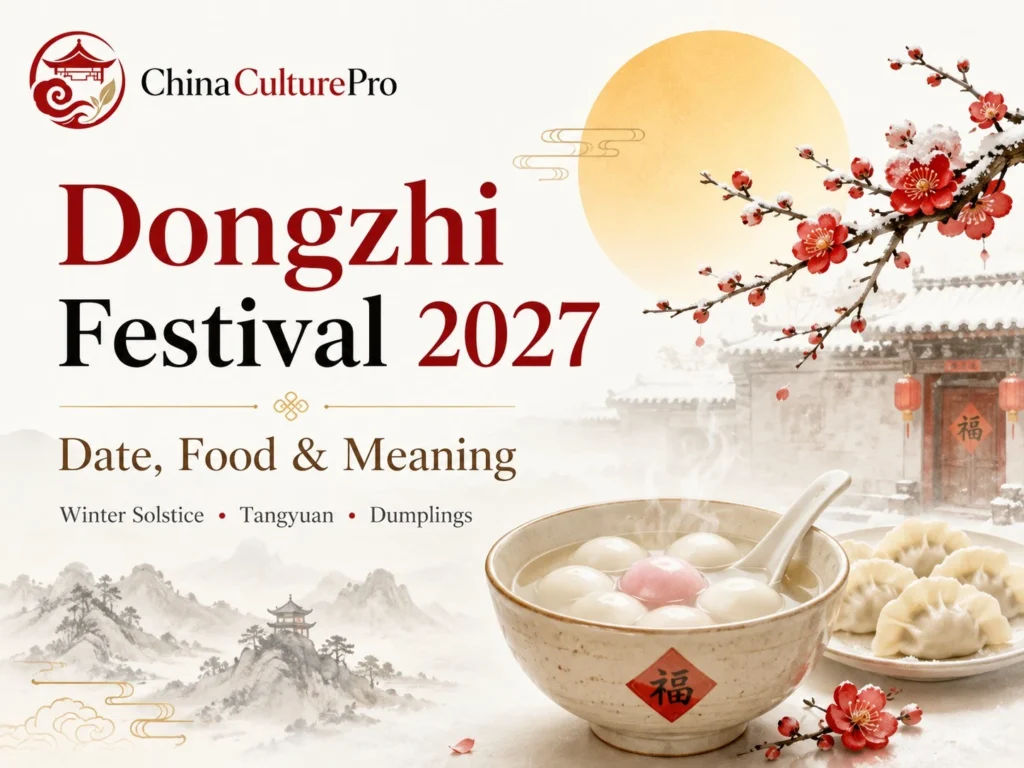

Quick Answer: What Is Dongzhi Festival 2027?
Dongzhi Festival 2027 falls on Wednesday, December 22, 2027. It is the Chinese Winter Solstice Festival and one of the 24 Solar Terms.
In Chinese, the festival is called Dongzhi (冬至). “Dong” means winter, and “zhi” means arrival, reaching, or extreme point. Dongzhi marks the time when winter reaches its deepest point: the shortest day and longest night of the year in the Northern Hemisphere.
Its cultural meaning is deeper than astronomy. In traditional Chinese thought, Dongzhi is the moment when yin reaches its extreme and yang begins to return. The night is longest, but after this point, daylight slowly grows again.
Main customs include family meals, ancestor worship, eating tangyuan in southern China, eating dumplings in northern China, warming foods, and counting nine-day periods to wait for spring. A folk saying also describes Dongzhi as once being “as important as New Year.”
| Item | Detail |
|---|---|
| 2027 Date | December 22, 2027 |
| Day of Week | Wednesday |
| Chinese Name | Dongzhi / 冬至 |
| Also Called | Chinese Winter Solstice Festival |
| Calendar System | One of the 24 Solar Terms |
| Astronomical Meaning | Shortest day and longest night |
| Main Foods | Tangyuan in the south, dumplings in the north |
| Main Meaning | Yin reaches its extreme, yang begins to return |
What Is Dongzhi Festival?
Dongzhi Festival is not only a winter solar term, and it is not simply a day for eating tangyuan or dumplings. It is a Chinese way of understanding winter, returning light, family reunion, ancestor memory, and the long wait for spring.
Dongzhi has a double identity. First, it is one of the 24 Solar Terms, so its date is determined by the sun rather than by a fixed lunar-calendar day. It usually falls on December 21, 22, or 23. Second, it is also a traditional festival with food customs, family meaning, ancestor rites, and old seasonal beliefs.
Astronomically, Dongzhi marks the shortest day and longest night of the year. Culturally, it marks a turning point. In Chinese yin-yang thinking, yin reaches its deepest point, and yang begins to rise again. Darkness is at its strongest, but that also means light has started to return.
This is why Dongzhi is different from Chinese New Year. Chinese New Year is the formal beginning of the new lunar year. Dongzhi is the hidden beginning of returning yang in the depth of winter. One belongs to calendar renewal; the other belongs to the seasonal rhythm of light and darkness.
Dongzhi’s most moving point is not how long the night is. It is that after the longest night, light begins to return little by little. It is not spring, but it tells people that spring is already on the way.
When Is Dongzhi Festival? Date Rule and Upcoming Dates
Dongzhi Festival is based on the winter solstice solar term. It is not fixed on a lunar month and day. Instead, it is determined by the sun’s position and usually falls between December 21 and December 23.
In 2027, Dongzhi Festival falls on Wednesday, December 22.
In Mainland China, Dongzhi is usually not a statutory public holiday. People normally work or study as usual, though many families, restaurants, schools, and communities still observe it through food and family customs.
| Year | Dongzhi Festival Date | Day of Week | Calendar Basis |
|---|---|---|---|
| 2026 | December 22, 2026 | Tuesday | Winter solstice solar term |
| 2027 | December 22, 2027 | Wednesday | Winter solstice solar term |
| 2028 | December 21, 2028 | Thursday | Winter solstice solar term |
| 2029 | December 21, 2029 | Friday | Winter solstice solar term |
| 2030 | December 22, 2030 | Sunday | Winter solstice solar term |
Date note: Dongzhi is not a fixed lunar-date festival and is not Chinese New Year. If you are checking family meals, temple rites, ancestor offerings, school activities, or community events, use the Gregorian winter solstice date for that year.
Dongzhi is also not a Chinese zodiac-year transition point. It belongs to the solar-term system, not the zodiac-year system.
What Does “Dongzhi” Mean?
The name Dongzhi is simple but powerful. “Dong” means winter. “Zhi” means arrival, reaching, extreme point, or turning point.
Dongzhi does not mean winter is beginning. Winter has already arrived by this time. Dongzhi means winter has reached its deepest point.
On this day, the Northern Hemisphere has its shortest daylight and longest night. From an astronomical view, this is the winter solstice. From a traditional Chinese cultural view, this is the deepest point of yin.
But the deepest point is also the beginning of change. This is the idea behind the phrase “Dongzhi, one yang is born.” Yin has reached its extreme, so yang begins to return. After this day, daylight slowly becomes longer. The change is small at first, but it has already started.
| Term / Image | Cultural Meaning |
|---|---|
| Dong / 冬 | Winter, cold season |
| Zhi / 至 | Arrival, extreme point, turning point |
| Longest Night | Yin reaches its deepest point |
| Longer Days Afterward | Yang begins to return |
| Dongzhi | The hidden beginning of new light |
Dongzhi is not the victory of darkness. It is darkness reaching its end. Chinese culture does not only see “the coldest and darkest point.” It also sees that from this day onward, light begins to return.
That is the emotional center of Dongzhi. It does not deny winter. It stands inside winter and says: the turn has already begun.
Why Dongzhi Was Once “As Important as New Year”
A well-known saying says, “Dongzhi is as important as New Year.” Today, this may sound surprising. Dongzhi is not a major public holiday in Mainland China, and it is much quieter than Chinese New Year. But historically, Dongzhi once carried strong ritual and family importance.
In earlier periods, Dongzhi was treated as a major seasonal turning point. It was connected with court rituals, heaven worship, ancestor worship, official observances, family gatherings, and seasonal meals. During some historical periods, officials had time off, emperors performed heaven worship, and ordinary households marked the day with offerings and reunion.
This does not mean Dongzhi is the same as Chinese New Year. It means Dongzhi once carried a time-marking weight close to the New Year. For an agricultural society, the winter solstice was not only an astronomical fact. It confirmed that the darkest point had passed and the new cycle of yang had begun.
Chinese New Year is the formal calendar beginning of the new year. Dongzhi is the natural turning point inside winter. One starts the new year openly; the other starts the return of light quietly.
| Festival Idea | Meaning |
|---|---|
| Chinese New Year | Formal start of the calendar new year |
| Dongzhi | Turning point of winter and yang return |
| New Year Reunion | Grand family reunion |
| Dongzhi Meal | Smaller but meaningful winter gathering |
| “As Important as New Year” | Old importance of the seasonal turning point |
Chinese New Year invites the new year in with noise, color, and ceremony. Dongzhi listens for the first returning steps of yang in the coldest night. It is quieter, but it begins earlier.
Dongzhi Festival Traditions and Customs
Dongzhi customs vary by region, family, and generation. Some people still prepare a family meal and make ancestor offerings. Others simply eat tangyuan or dumplings and send a greeting. The customs are not uniform across China, but they share the same winter logic: warmth, reunion, protection, and waiting for light.
| Custom | What People Do | Meaning |
|---|---|---|
| Family Meal | Gather for dinner | Warmth and reunion |
| Tangyuan | Eat glutinous rice balls | Reunion and completeness |
| Dumplings | Eat jiaozi in the north | Warmth, protection, winter nourishment |
| Ancestor Worship | Make offerings at home or ancestral halls | Remember family roots |
| Warming Foods | Eat lamb soup or nourishing dishes | Strengthening the body in winter |
| Counting Nine | Count nine-day periods after Dongzhi | Waiting for spring |
Family meals are one of the most important Dongzhi customs. The meal is not usually as grand as Chinese New Year’s Eve dinner, but it carries real emotional weight. In the longest night of the year, eating together means the family is present and warm.
Tangyuan is especially common in southern China, Taiwan, and many overseas Chinese communities. Its round shape expresses reunion and completeness.
Dumplings are common in northern China. They are linked with warmth, winter nourishment, and a famous story about protecting people’s ears from frostbite.
Ancestor worship also appears in many families and local traditions. Some households prepare food, incense, tea, wine, or simple offerings to remember family roots.
Warming foods such as lamb soup, nourishing stews, wontons, rice cakes, or local winter-solstice foods may appear depending on region. Dongzhi food is not one fixed national menu. It is a winter meal shaped by local climate and family memory.
Tangyuan and Dumplings: Dongzhi Festival Food
Food is one of the easiest ways to understand Dongzhi. But the goal is not to decide which food is the “correct” Dongzhi food. Southern and northern customs are different, and both are meaningful.
Tangyuan in Southern China
In southern China, tangyuan is one of the most important Dongzhi foods. Tangyuan are glutinous rice balls served in a warm soup. They may be sweet or savory, filled or unfilled. Common sweet fillings include black sesame, peanut, and red bean paste. Some regions also have savory versions.
The round shape is the key. Roundness suggests reunion, completeness, and family harmony. The sound of tangyuan is also close to tuanyuan, meaning reunion. This makes tangyuan especially suitable for Dongzhi, a day when family members gather in the deep winter night.
In parts of southern China, Taiwan, Jiangnan, Fujian, Guangdong, and overseas Chinese communities, eating tangyuan on Dongzhi remains an important custom. Some families say that after eating Dongzhi tangyuan, a person becomes one year older. This is not a universal rule, but it shows how Dongzhi once carried a strong sense of time passing.
Dumplings in Northern China
In northern China, dumplings, or jiaozi, are the more common Dongzhi food. They are warm, filling, and suited to cold weather.
A well-known story connects Dongzhi dumplings with Zhang Zhongjing, a famous physician of the Eastern Han period. According to folk legend, he saw that poor villagers had frostbitten ears in winter. He used mutton, warming herbs, and dough wrappers to make ear-shaped food, cooked it in soup, and distributed it to help people warm their bodies. Later, this story became linked with the custom of eating dumplings on Dongzhi.
Whether the story is historically exact is less important than the meaning it carries. Dongzhi dumplings represent warmth, protection, and care in the coldest season.
| Food | Common Region | Meaning |
|---|---|---|
| Tangyuan | Southern China, Taiwan, many overseas communities | Reunion, roundness, family wholeness |
| Dumplings / Jiaozi | Northern China | Warmth, protection, winter nourishment |
| Lamb Soup | Some northern / western regions | Warming yang, strengthening body |
| Rice Cakes / Winter Solstice Balls | Some regions | Local seasonal blessing |
Dongzhi food is not about which dish is the only authentic one. In the deepest winter, the point is to gather around hot food and warm both body and heart. A southern bowl of tangyuan is roundness; a northern plate of dumplings is warmth. The forms differ, but the intention is the same.
Ancestor Worship and Family Reunion on Dongzhi
Dongzhi has long been connected with ritual. In history, it was associated with heaven worship, ancestor worship, and important family observances. The imperial side of this tradition was large and formal; the family side was quieter and closer to daily life.
At home or in ancestral halls, families may prepare offerings such as rice, dishes, fruit, tea, wine, candles, and incense. They bow or stand respectfully before ancestral tablets, portraits, or family altars. In some places, this is understood as a winter year-end report: the family has passed another year, winter has reached its deepest point, and the ancestors are still remembered.
Dongzhi ancestor worship is not the same as Qingming Festival. Qingming is strongly associated with visiting graves, cleaning tombs, and confirming family roots in spring. Dongzhi is more often tied to home, family dinner, ancestral halls, and winter reunion, though actual practice varies by region.
| Festival | Family / Ancestor Meaning |
|---|---|
| Qingming Festival | Tomb sweeping and family roots |
| Dongzhi Festival | Home reunion and ancestor offerings in winter |
| Chinese New Year | Grand annual reunion and renewal |
Dongzhi reunion is also different from Chinese New Year reunion. The New Year meal is grand, noisy, and full of ceremony. Dongzhi dinner is usually quieter. A family may simply sit down, eat tangyuan or dumplings, and share a warm meal.
Dongzhi reunion is not for noise. It is to confirm, in the longest night of the year, that the family is still here, the ancestors are still remembered, and the stove is still warm.
Counting Nine: How Dongzhi Begins the Coldest Days
Dongzhi does not mean the weather becomes warm immediately. In many parts of China, the coldest days come after Dongzhi. This is why Chinese folk tradition developed a way to count through the cold: shujiu, or counting nine.
Counting nine begins from Dongzhi. Every nine days is one “nine,” and there are nine periods in total. Nine times nine gives eighty-one days. By the end of the ninth nine, spring warmth is close.
A famous folk counting-nine song has many versions. One common version says:
“One nine and two nine, hands stay inside sleeves.
Three nine and four nine, people walk on ice.
Five nine and six nine, willows appear along the river.
Seven nine, the river opens; eight nine, wild geese return.
After nine nine, plowing oxen fill the fields.”
The song traces winter from deep cold to spring work. At first, hands are too cold to take out. Then rivers freeze. Later, willows show signs of life, ice melts, birds return, and farming begins again.
| Period | Approximate Time | Seasonal Meaning |
|---|---|---|
| First Nine | Late December | Cold begins after Dongzhi |
| Second Nine | Late December to early January | Cold deepens |
| Third and Fourth Nine | January | Often the coldest period |
| Fifth and Sixth Nine | Late January to February | Signs of change begin |
| Seventh and Eighth Nine | February | Ice melts, birds return |
| Ninth Nine | Early March | Spring warmth is near |
The wisdom of counting nine is this: winter will not pass immediately, but if people can count it, they can wait through it. After Dongzhi, Chinese people do not say the weather is already warm. They say, from today, we know how far spring is.
This gives Dongzhi its special time feeling. The darkest day does not end the cold, but it begins the countdown.
How Dongzhi Festival Is Celebrated Today
Today, Dongzhi is still widely recognized, even though it is usually not a public holiday in Mainland China. Its modern form is often simple: eat the right food, send a greeting, gather with family if possible, and remember that the longest night has passed.
Common modern ways to observe Dongzhi include:
- Eating tangyuan in southern Chinese families.
- Eating dumplings in northern Chinese families.
- Having a family dinner at home.
- Preparing ancestor offerings in some households.
- Eating warming foods such as lamb soup, wontons, stews, or local winter dishes.
- Joining school, community, or cultural-center activities such as making dumplings or rolling tangyuan.
- Buying frozen tangyuan or dumplings from supermarkets.
- Sending “Happy Dongzhi” messages on social media.
Restaurants and food businesses often promote dumplings, tangyuan, and winter dishes around Dongzhi. In schools and communities, Dongzhi may be used as a cultural education moment: children learn about the 24 Solar Terms, make rice balls, wrap dumplings, or hear stories about winter solstice customs.
Overseas Chinese communities may observe Dongzhi more quietly than Chinese New Year or Mid-Autumn Festival, but the food memory remains strong. In Chinese supermarkets, tangyuan and dumplings become easy ways to keep the festival alive.
For many modern people, Dongzhi no longer means a full ritual day. But eating one hot meal on the longest night still carries the old message: winter is deep, family matters, and light is returning.
How to Celebrate Dongzhi Festival Respectfully
Dongzhi is easy to join, but it helps to understand what kind of festival it is. It is not Christmas, and it is not Chinese New Year. It is a solar term and a traditional festival built around the winter solstice, returning yang, family warmth, and seasonal food.
- Eat tangyuan or dumplings according to local or family custom.
- Do not argue that tangyuan or dumplings are the only authentic Dongzhi food.
- If you are invited to a family Dongzhi meal, follow the host’s arrangement.
- Bring simple food, fruit, or a small seasonal gift if appropriate.
- If there is an ancestor offering, stay quiet and respectful.
- Do not move offerings unless invited to help.
- Use Dongzhi as a time for warmth, not heavy commercial display.
- Send a simple greeting to Chinese friends or family.
A common greeting is “Happy Dongzhi Festival.” In Chinese, you can say Dongzhi Kuai Le, written as 冬至快乐.
A warmer festival wish would be: “Wishing you warmth and the return of light in the darkest time of the year.”
How This Guide Connects to Chinese Festivals and Zodiac Content
Dongzhi Festival is one of the most important winter solar-term festivals in the Chinese festival year. It belongs to the 24 Solar Terms, but it also carries family, food, ancestor, and seasonal meanings.
For the full festival calendar, start with our Chinese Festivals and Holidays guide.
Dongzhi and Chinese New Year are closely connected, but they are not the same. Dongzhi marks the natural return of yang after the longest night. Chinese New Year marks the formal beginning of the new lunar year. To compare Dongzhi with China’s largest family reunion festival, read our Chinese New Year guide.
Dongzhi also leads into the deeper winter festival sequence. After Dongzhi comes colder weather, counting nine, and then Laba, when New Year preparation becomes more visible. To understand the next major winter festival before Chinese New Year, read our Laba Festival guide.
The New Year season later closes with the first full moon. To follow the New Year season to its final full-moon celebration, read our Lantern Festival guide.
Dongzhi also shares one idea with Mid-Autumn Festival: round food and family reunion. But Mid-Autumn centers on the moon and autumn longing, while Dongzhi centers on winter warmth and returning light. For another festival built around round food and family reunion, read our Mid-Autumn Festival guide.
If you came from zodiac content, note that Dongzhi belongs to the solar-term system, not the Chinese Zodiac system. It is not a zodiac-year transition point, and this guide does not expand into zodiac personality or Five Elements readings.
FAQs About Dongzhi Festival
When is Dongzhi Festival 2027?
Dongzhi Festival 2027 is on Wednesday, December 22, 2027. It is the Chinese Winter Solstice Festival and one of the 24 Solar Terms. Its date is based on the solar year, not a fixed lunar date.
What is Dongzhi Festival?
Dongzhi Festival is the Chinese festival and solar term built around the winter solstice. It marks the shortest day and longest night of the year. Its cultural meaning is that yin reaches its extreme and yang begins to return. Customs include family meals, tangyuan, dumplings, ancestor worship, and counting nine.
Is Dongzhi Festival the same as Winter Solstice?
Astronomically, Dongzhi corresponds to the winter solstice. Culturally, Dongzhi is more than the astronomical event. It includes Chinese solar-term meaning, yin-yang interpretation, food customs, family reunion, ancestor worship, and folk ways of waiting for spring.
Why do Chinese people eat tangyuan on Dongzhi?
Tangyuan are round glutinous rice balls, common in southern China, Taiwan, and many overseas Chinese communities. Their round shape symbolizes reunion, completeness, and family harmony. The sound of tangyuan is also close to tuanyuan, meaning reunion.
Why do northern Chinese people eat dumplings on Dongzhi?
Northern Chinese people often eat dumplings on Dongzhi because dumplings are warming and suited to winter. A folk story links the custom with Zhang Zhongjing, who made ear-shaped food to help people with frostbitten ears. Today, dumplings symbolize warmth, protection, and winter nourishment.
Is Dongzhi Festival a public holiday in China?
Dongzhi Festival is usually not a statutory public holiday in Mainland China. People generally work or study as usual. However, many families and communities still observe it through food, family meals, ancestor offerings, or cultural activities.
What does Dongzhi mean?
Dongzhi means “winter reaches its extreme” or “the arrival of winter’s deepest point.” “Dong” means winter, and “zhi” means arrival, reaching, or extreme point. It does not mean winter begins. It means winter has reached a turning point.
What is counting nine after Dongzhi?
Counting nine is a folk way to mark the cold period after Dongzhi. Starting from Dongzhi, every nine days form one period. After nine periods, or eighty-one days, spring warmth is near. It turns the long winter into stages people can count through.
Is Dongzhi Festival related to Chinese New Year?
Dongzhi is not Chinese New Year, but both are connected with renewal and family reunion. Dongzhi marks the natural return of yang after the longest night. Chinese New Year marks the formal start of the new lunar year. Dongzhi comes earlier and is quieter.
What should I say during Dongzhi Festival?
You can say “Happy Dongzhi Festival” or Dongzhi Kuai Le (冬至快乐). A warmer greeting is: “Wishing you warmth and the return of light in the darkest time of the year.”