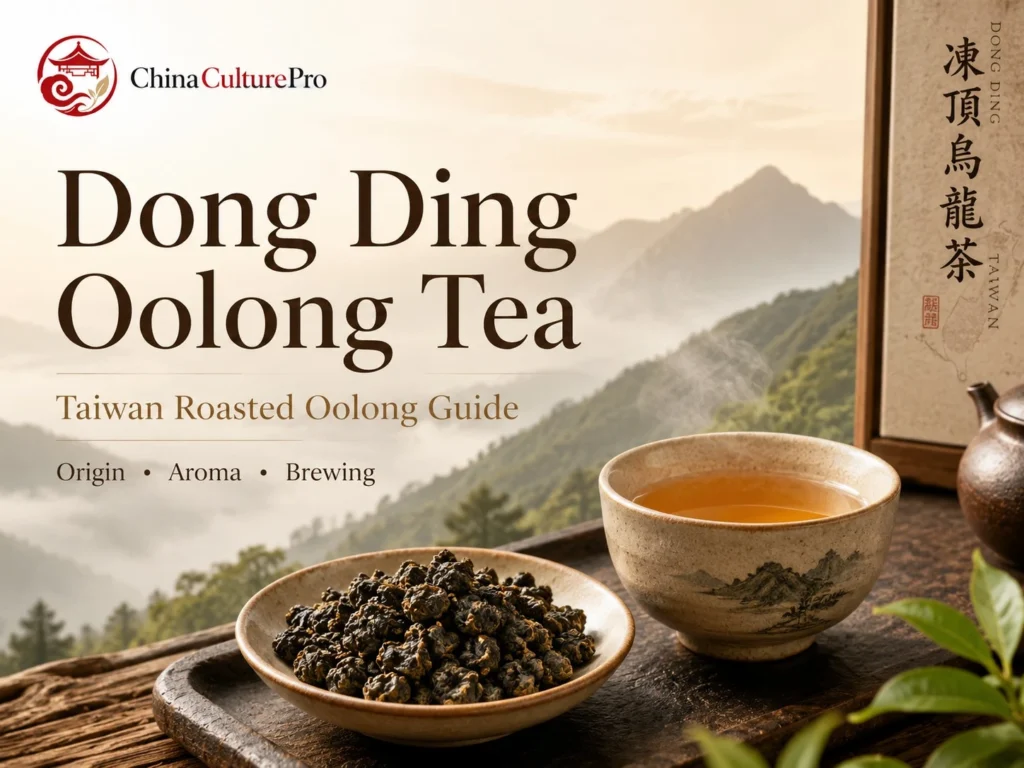

Quick Answer: What Is Dong Ding Oolong Tea?
Dong Ding Oolong Tea, also written as Dongding Oolong, Tung Ting Oolong, or Tung-Ting Tea, is one of Taiwan’s classic traditional oolongs from Lugu Township in Nantou County, closely associated with Dong Ding Mountain.
It is not green tea, black tea, flower tea, or ordinary green-style Taiwanese high mountain oolong. It is known for ball-rolled leaves, medium oxidation, careful roasting, roasted nutty aroma, ripe fruit sweetness, honey notes, mellow body, and long hui gan.
Its basic identity is clear:
-
Tea Type: Taiwanese oolong tea.
-
Chinese Name: 凍頂烏龍 / 冻顶乌龙.
-
Common English Names: Dong Ding Oolong Tea, Dongding Oolong, Tung Ting Oolong, Tung-Ting Tea.
-
Core Region: Lugu Township, Nantou County, Taiwan.
-
Traditional Mountain Name: Dong Ding Mountain.
-
Common Cultivar Background: Qing Xin Oolong, also written Qingxin Oolong or Chin Shin Oolong.
-
Leaf Shape: ball-rolled or semi-ball oolong.
-
Processing Style: medium oxidation and medium or traditional roasting.
-
Core Aroma: roasted nut, honey, ripe fruit, caramel, toasted grain, sometimes light floral or osmanthus notes.
-
Core Taste: mellow, smooth, rounded, sweet, full but not heavy.
-
Key Quality: clean roast, integrated aroma, sweet body, hui gan, and stable layers across infusions.
-
Brewing: best brewed gongfu style with 90–95°C water and repeated short infusions.
A simple comparison helps place it: Taiwanese High Mountain Oolong is usually greener, lighter, and more floral; Dong Ding Oolong is more traditionally roasted, nutty, honeyed, mellow, and grounded; Tie Guan Yin belongs to the Anxi oolong tradition in Fujian.
Good Dong Ding is not “greener is better” or “heavier roast is better.” A good cup should be roasted but not burnt, mellow but not flat, sweet but not thin, and clean in the finish.
To understand oolong as a category, read our [Chinese Oolong Tea] guide.
Name, Tea Type, and Basic Identity
The name Dong Ding means Frozen Summit or Icy Peak in English. The name comes from Dong Ding Mountain in Taiwan, not from freezing the tea. Dong Ding Oolong is not frozen tea, iced tea, or cold-processed tea.
| Identity Point | What It Means |
|---|---|
| Chinese Name | 凍頂烏龍 / 冻顶乌龙 |
| Pinyin | Dong Ding Oolong |
| Other English Names | Dongding Oolong, Tung Ting Oolong, Tung-Ting Tea |
| Literal Meaning | Frozen Summit or Icy Peak |
| Tea Type | Taiwanese oolong tea |
| Processing Style | partially oxidized, ball-rolled, and roasted oolong |
| Core Region | Lugu Township, Nantou County, Taiwan |
| Traditional Mountain Name | Dong Ding Mountain |
| Common Cultivar Background | Qing Xin Oolong / Qingxin Oolong / Chin Shin Oolong |
| Not The Same As | green tea, black tea, flower tea, flavored tea, or all Taiwanese oolong tea |
| Core Identity | traditional roasted Taiwanese oolong with mellow body, roasted sweetness, and hui gan |
Two misunderstandings need to be cleared up early. Dong Ding does not mean the tea is frozen; it is a mountain name, not a processing method. And not every Taiwanese oolong is Dong Ding. Dong Ding Oolong has a specific connection with Lugu, Nantou, Qing Xin Oolong, ball-rolled processing, medium oxidation, and roasting. In the broader market, some teas may be made in a Dong Ding style, but origin and production style still matter. For the broader category, see our Chinese Oolong Tea guide.
To compare major Chinese tea categories, read our Chinese Tea Types guide.
Origin: Lugu, Nantou, and Dong Ding Mountain
Dong Ding Oolong is traditionally associated with Lugu Township in Nantou County, central Taiwan. Dong Ding Mountain gives the tea its name, while Lugu provides the broader tea culture, production base, and traditional identity.
| Origin / Area | Chinese | What To Know |
|---|---|---|
| Taiwan | 台湾 | the island home of Dong Ding Oolong and many famous Taiwanese oolongs |
| Nantou County | 南投县 | one of Taiwan’s major tea-producing regions |
| Lugu Township | 鹿谷乡 | the traditional core area for Dong Ding Oolong |
| Dong Ding Mountain | 冻顶山 / 凍頂山 | the mountain name behind Dong Ding Oolong |
| Traditional Tea Villages | 彰雅村、永隆村、凤凰村等 | village areas often associated with Lugu tea culture |
| Surrounding Areas | 周边产区 | nearby areas around Lugu may also produce Dong Ding-style oolong |
| Qing Xin Oolong | 青心乌龙 | an important cultivar background for traditional Dong Ding production |
Dong Ding Mountain is often described as a mid-elevation tea area, commonly around 700–800 meters in the traditional context. Dong Ding is not famous because it is the highest tea; many Taiwanese high mountain teas grow higher. Its identity comes from place, cultivar, oxidation, rolling, roasting, and tea-making tradition, not altitude alone.
The local environment is often described through mist, warm and humid weather, moderate day-night temperature differences, sloped tea gardens, and well-drained yellow or reddish soils. These conditions support tea growth, but the final Dong Ding style depends heavily on processing.
A widely repeated cultural story says Lin Fengchi, a Lugu scholar during the Qing dynasty, brought tea plants back from Fujian and helped establish the Dong Ding tea tradition. This is best treated as tea-culture background, not a long historical proof section.
The useful distinction is simple: Dong Ding is both a place-linked tea name and a traditional Taiwanese oolong style. When buying, origin clarity and production style both matter.
Dong Ding Oolong in Taiwanese Tea Culture
Dong Ding Oolong is one of the key representatives of traditional roasted Taiwanese oolong. It reflects a tea aesthetic different from very green, lightly oxidized high mountain oolong.
| Tea Culture Point | What It Means |
|---|---|
| Traditional Taiwanese Oolong | Dong Ding represents a roasted, rounded, more mature oolong style |
| Oxidation | usually more developed than many modern green high mountain oolongs |
| Roast | an important part of the traditional Dong Ding profile |
| Tea Body | valued for smoothness, thickness, and stability |
| Sweetness | honey, ripe fruit, caramel, and roasted sweetness are important |
| Hui Gan | returning sweetness after swallowing is a key quality |
| Stability | good Dong Ding should remain balanced across multiple infusions |
In Taiwan tea culture, Dong Ding is not an outdated style. It represents a traditional oolong aesthetic where oxidation, roast, tea body, sweetness, throat comfort, and steady aftertaste all matter.
Modern Taiwanese high mountain oolong is often loved for freshness, green floral aroma, and a lighter body. Traditional Dong Ding is more grounded: roasted but not burnt, ripe but not dull, mellow but not flat.
Taiwanese tea drinkers often use a practical standard for good Dong Ding: clean roast without burnt flavor, ripe aroma without dullness, thick sweet liquor, and stable hui gan. In Chinese tea language, this is close to saying: 火香不焦,熟香不闷,汤厚而甜,回甘稳定.
Lugu tea competitions are also part of Dong Ding culture, and award-winning teas can influence market prices. But a label only signals reputation; the cup still needs clean roast, sweet body, and a comfortable finish.
What Does Dong Ding Oolong Tea Taste Like?
Good Dong Ding Oolong is known for roasted nutty aroma, honey sweetness, ripe fruit notes, caramel, mellow body, and long hui gan. It should feel smooth, rounded, and sweet—not burnt, sour, thin, or harsh.
| Tasting Point | Good Dong Ding Oolong Tea |
|---|---|
| Dry Leaf | tightly rolled semi-ball or ball-shaped leaves; dark green, brown-green, or roasted sheen |
| Dry Aroma | clean roast, roasted nuts, ripe fruit, honey, light floral notes |
| Main Aroma | almond, chestnut, sesame, honey, caramel, toasted grain, dried longan, dried lychee, sometimes osmanthus |
| Liquor | golden, honey-gold, amber, or light bronze; clear and bright |
| Taste | mellow, rounded, sweet, full but not heavy |
| Mouthfeel | smooth, warm, and integrated, with roast and tea body working together |
| Hui Gan | lingering sweetness after swallowing, often with salivation |
| Throat Feel | comfortable and open, not dry or rough |
| Leaf Base | soft, elastic, red-edged, not charred or broken |
The key is balance. Dong Ding roast should bring warmth, nutty sweetness, and depth; the tea soup should feel rounded and sweet, not burnt or hollow.
Different roast levels create different Dong Ding expressions:
| Roast / Style | Flavor Direction | Best For |
|---|---|---|
| Light Roast Dong Ding | more floral, lighter roast, cleaner and brighter body | drinkers who like some high mountain freshness with Dong Ding structure |
| Medium Roast / Traditional Dong Ding | roasted nut, honey, ripe fruit, caramel, mellow body, clear hui gan | most drinkers looking for the classic Dong Ding profile |
| Heavier Roast Dong Ding | deeper roast, thicker liquor, more settled aroma, stronger storage potential when well made | drinkers who like mature, traditional roasted oolong |
Good Dong Ding is not about being as green as possible or pushing roast as heavy as possible. The best examples show clean fire, ripe aroma, mellow sweetness, steady body, and a clean finish.
How Dong Ding Oolong Tea Is Made
Dong Ding Oolong is made as oolong tea, not green tea or black tea. Its traditional character comes from controlled oxidation, ball-rolled shaping, and careful roasting.
The process usually follows this sequence:
- Plucking / 采摘 Dong Ding is commonly made from Qing Xin Oolong in the Lugu tradition. Leaves are usually picked at a mature stage suitable for oolong making, often around one bud with two or three leaves, or one bud with three or four leaves, depending on the producer and season.
- Withering / 萎凋 Fresh leaves lose moisture under sunlight or indoors. This softens the leaves and begins the transformation toward oolong aroma.
- Shaking And Zuo Qing / 做青、摇青 Leaves are shaken and rested repeatedly. Their edges are lightly bruised, allowing partial oxidation. Dong Ding is often described as medium oxidized, deeper than many modern green-style high mountain oolongs. This step helps form ripe fruit aroma, tea body, and structure.
- Kill-Green / Sha Qing / 杀青 Heat stops enzymatic oxidation and fixes the tea’s partially oxidized character.
- Rolling Into Semi-Ball Shape / 半球形揉捻 The leaves are wrapped and rolled into a semi-ball or ball shape. This is one of Dong Ding’s visual signatures. The tightly rolled leaves slowly open during brewing, which is part of the pleasure of drinking ball-rolled oolong.
- Drying / 干燥 Moisture is reduced and the tea becomes stable enough for further refinement.
- Roasting And Re-Roasting / 焙火、复焙 Roasting is central to traditional Dong Ding character. It creates roasted nutty aroma, honey sweetness, caramel depth, mellow body, and better stability. A good roast should make the tea rounder and sweeter, not burnt, bitter, or dull.
Two steps define Dong Ding most clearly: zuo qing and roasting. Zuo qing builds the ripe aroma and tea body; roasting shapes the traditional Dong Ding sweetness, warmth, and stability.
Traditional Dong Ding cannot be roast-free, but roast should never cover weak tea. Good processing lets ripe fruit, nutty aroma, honey sweetness, and mellow body work as one.
Roast, Body, and Traditional Dong Ding Character
Roasting is part of Dong Ding’s traditional identity, but it should support the tea rather than become the whole tea.
| Roast Quality | What It Should Do |
|---|---|
| Clean Roast | gives warmth without burnt flavor |
| Nutty Aroma | brings almond, chestnut, sesame, or toasted-grain notes |
| Honey / Caramel Sweetness | adds rounded sweetness to the liquor |
| Mellow Body | makes the tea soup smoother and fuller |
| Stability | helps the tea stay balanced across infusions and storage |
| Finish | supports hui gan and a clean aftertaste |
Several distinctions matter: roast aroma is not burnt taste, dark liquor is not automatically quality, bitterness is not depth, green fragrance is not always better, and heavy roast is not automatically traditional.
Traditional Dong Ding is often steadier and thicker than many green high mountain oolongs. It may not be the most explosive first sip, but good Dong Ding becomes smoother, sweeter, and more convincing through repeated infusions.
A useful tea-drinker standard is: fire skill without burnt flavor, ripe aroma without dullness, thickness without roughness. In Chinese, this is close to: 有火功,但不焦;有熟香,但不闷;有厚度,但不粗.
How to Taste Dong Ding Oolong Like a Tea Drinker
Tasting Dong Ding is not about finding the strongest roast. The real question is whether roast, sweetness, body, hui gan, and finish work together.
- Look At The Dry Tea The leaves should be tightly rolled into semi-ball or ball shapes. The color may be dark green, brown-green, or roasted brown, depending on the roast level. Avoid excessive broken pieces, dust, mold, or lifeless black leaves.
- Smell The Dry Aroma Good Dong Ding may show clean roast, roasted nuts, ripe fruit, honey, caramel, toasted grain, or light floral notes. Avoid burnt smell, sourness, mold, smoke, or stale roast.
- Check The Liquor The liquor should be golden, honey-gold, amber, or light bronze. It should be clear and bright. Cloudiness is a warning sign.
- Smell The Wet Aroma The wet aroma should show clean roast and tea character together. Look for nutty sweetness, honey sweetness, ripe fruit, and warmth. If fire covers everything, the tea may be over-roasted or weak underneath.
- Taste The Liquor Good Dong Ding should feel rounded, sweet, mellow, and full. It should not be thin, harsh, or burnt. Some astringency can appear, but it should not become rough bitterness.
- Feel The Hui Gan And Throat Look for returning sweetness, salivation, and a comfortable throat. Dryness, roughness, or bitterness that does not transform is a flaw.
- Look At The Leaf Base The brewed leaves should be soft, elastic, and alive-looking, often with red-edged signs of oolong oxidation. Avoid charred, stiff, broken, or dead-looking leaf base.
The core tasting standard is simple: clean roast, mellow body, honeyed sweetness, hui gan, and no burnt or sour finish. Good Dong Ding is not the strongest-smelling tea; it is smooth, sweet, steady, and durable.
For aroma, mouthfeel, hui gan, and aftertaste, read our Chinese Tea Tasting guide.
How to Brew Dong Ding Oolong Tea
Dong Ding Oolong works especially well with gongfu brewing because the ball-rolled leaves open gradually and the roast, sweetness, and body change across infusions.
| Brewing Method | Teaware | Water Temperature | Leaf Amount | Steeping Time | Notes |
|---|---|---|---|---|---|
| Gongfu Brewing | gaiwan or small teapot | 90–95°C / 194–203°F | 5–7g / 100–120ml | quick rinse optional, then 15–25 seconds to start | best for showing nutty aroma, honey sweetness, and body |
| Western Brewing | teapot or mug | 90–95°C / 194–203°F | 3g / 250ml | 2–3 minutes | easy for daily drinking, less layered |
| Grandpa Style | glass or mug | 90–95°C / 194–203°F | small amount of leaf | drink slowly and refill with hot water | use less leaf and avoid long over-steeping |
Brewing tips:
- Give the leaves room: ball-rolled Dong Ding needs space to open.
- Use hot water: roasted Dong Ding can handle 90–95°C water well.
- Rinse or start short: a quick rinse or short first infusion helps the leaves open.
- Do not over-steep: Dong Ding is less immediately punishing than Phoenix Dan Cong, but long steeping can still make it rough.
- Use repeated infusions: traditional Dong Ding often becomes rounder and sweeter across steeps.
- Drink it plain: milk and sugar cover the roasted nutty aroma, honey sweetness, and hui gan.
The core method is hot water, enough space, and repeated infusions. Good Dong Ding can move from roast warmth to nutty sweetness, then toward honeyed body and lingering hui gan.
To learn practical brewing methods, read our How to Brew Chinese Tea guide. For gaiwans, small teapots, mugs, and other brewing vessels, read our Chinese Teaware guide.
Dong Ding Oolong vs High Mountain Oolong vs Tie Guan Yin
Dong Ding Oolong, Taiwanese High Mountain Oolong, and Tie Guan Yin are easy to confuse because all can be ball-rolled oolongs. Their regional identities and flavor goals are different.
| Tea | Region | Shape | Oxidation / Roast | Main Aroma | Body | Best For |
|---|---|---|---|---|---|---|
| Dong Ding Oolong | Lugu, Nantou, Taiwan | semi-ball / ball-rolled | medium oxidation, medium or traditional roast | roasted nuts, honey, ripe fruit, caramel, light floral notes | mellow, rounded, sweet | drinkers who like traditional roasted Taiwanese oolong |
| High Mountain Oolong | Taiwan high mountain regions such as Alishan, Lishan, Shanlinxi | usually ball-rolled | lighter oxidation, little or no roast | floral, creamy, green, fresh | clean, bright, lighter | drinkers who like fresh floral aroma |
| Tie Guan Yin | Anxi, Fujian | curled or ball-rolled depending on style | light aroma style or traditional roast style | orchid, floral, sometimes roasted | fresh and sweet or deeper if traditionally roasted | drinkers who like Anxi orchid aroma |
None is automatically better. Choose Dong Ding for roasted sweetness and mellow body, High Mountain Oolong for fresh floral aroma and bright clarity, and Tie Guan Yin for the Anxi orchid profile.
To compare Guangdong oolong, read our Phoenix Dan Cong Tea guide.
How to Choose Good Dong Ding Oolong Tea
Dong Ding labels can be confusing because many teas are sold as Taiwanese oolong, roasted oolong, or Dong Ding style. A good name helps, but the tea must prove itself in aroma, liquor, body, hui gan, and finish.
| Checkpoint | What To Look For | Warning Signs |
|---|---|---|
| Origin | Taiwan, Nantou, Lugu, Dong Ding Mountain, or a clear Dong Ding-style source | only “Taiwan oolong” with no Dong Ding information |
| Identity | Dong Ding Oolong, Traditional Dong Ding, Roasted Taiwanese Oolong, Qing Xin Oolong background | vague naming, no origin, no processing style |
| Aroma | clean roast, roasted nut, honey, ripe fruit, caramel, light floral note | burnt smell, sourness, mold, smoke, fire covering everything |
| Taste | mellow, smooth, sweet, full but not heavy | thin soup, rough bitterness, hollow roast, no sweetness |
| Hui Gan | returning sweetness and salivation after swallowing | short finish, dry throat, no return |
| Liquor | clear golden, honey-gold, amber, or light bronze | cloudy, dull, or muddy liquor |
| Leaf Shape | tightly rolled semi-ball leaves | too much dust, broken leaves, loose shape |
| Leaf Base | soft, elastic, red-edged, alive-looking | charred, stiff, broken, lifeless leaves |
Watch for tea sold only as “Taiwan oolong” with no Dong Ding detail, tea that is too green but marketed as traditional Dong Ding, burnt roast, sourness, heavy fire covering weak tea, thin liquor, no hui gan, or competition awards and expensive packaging used as the main selling point.
Five buying rules matter most: clear origin, clear Dong Ding identity, clean roast, mellow sweet body, and long hui gan with a clean finish. If these are missing, the story is not enough.
Storage, Roast Resting, and Aging
Dong Ding storage is different from very green Taiwanese high mountain oolong because traditional Dong Ding usually has roast. Light roast Dong Ding is more aroma-forward and usually best enjoyed earlier. Medium roast or traditional Dong Ding is more stable and can rest after roasting. Heavier roast Dong Ding may become rounder over time if the tea is well made and stored cleanly.
Newly roasted Dong Ding can taste fiery or sharp. Resting lets the roast settle and integrate with the tea liquor. The goal is better drinking quality, not simply age.
Storage rules are simple:
- Seal It Well: protect roasted aroma and honey sweetness.
- Keep It Dry: moisture makes Dong Ding dull, sour, or moldy.
- Avoid Light: light weakens aroma.
- Keep It Cool: normal cool room temperature is enough.
- Avoid Odors: keep it away from coffee, spices, smoke, incense, and strong-smelling foods.
- Avoid Casual Fridge Storage: refrigerators often bring moisture and odors unless the tea is sealed extremely well.
- Do Not Confuse Aging With Staling: rested Dong Ding is smoother, sweeter, and more integrated; stale Dong Ding is flat, sour, dusty, or missing roast aroma.
The storage principle is sealed, dry, dark, cool, and odor-free. For Dong Ding, clean storage matters more than a high year number.
Benefits and Caffeine
Dong Ding Oolong contains caffeine. Its roasted taste does not mean it is caffeine-free, and gongfu brewing can feel more concentrated than a light Western-style cup.
Dong Ding also contains common tea compounds such as tea polyphenols, amino acids, and aromatic compounds. Some drinkers describe roasted oolong as warming or comforting, but this is a drinking experience, not a medical claim.
Important cautions:
- Dong Ding Oolong contains caffeine.
- Strong brewing increases concentration.
- Avoid drinking large amounts before sleep.
- People sensitive to caffeine should drink moderately.
- People with stomach sensitivity should adjust strength and amount.
- Pregnant people, people taking medication, or people with medical concerns should ask a qualified professional.
- Do not treat Dong Ding Oolong as medicine.
Do not use Dong Ding as a promise for weight loss, detox, blood sugar control, blood pressure control, cancer prevention, or disease treatment. It is tea; its best value is roasted nutty aroma, honey sweetness, mellow body, hui gan, and traditional Taiwanese oolong character.
Final Thoughts
Dong Ding Oolong Tea is not ordinary green-style Taiwanese high mountain tea, and it is not simply “roasted oolong.” It is one of Taiwan’s classic traditional oolongs from Lugu, Nantou.
Its value comes from Lugu terroir, Qing Xin Oolong, medium oxidation, ball-rolled shaping, careful roasting, nutty sweetness, mellow body, and hui gan. A good Dong Ding should be roasted but not burnt, sweet but not thin, mellow but not flat, and clean in the finish.
Good Dong Ding is not proven by being greener, darker, more heavily roasted, more expensive, or more decorated with competition language. The cup must show clean roast, integrated aroma, rounded body, lasting sweetness, and stable layers across infusions.
FAQs About Dong Ding Oolong Tea
What is Dong Ding Oolong Tea?
Dong Ding Oolong Tea is a traditional Taiwanese oolong associated with Lugu Township in Nantou County. It is known for ball-rolled leaves, medium oxidation, careful roasting, roasted nutty aroma, honey sweetness, mellow body, and hui gan.
What does Dong Ding mean?
Dong Ding means Frozen Summit or Icy Peak. The name comes from Dong Ding Mountain in Taiwan. It does not mean the tea is frozen.
Where does Dong Ding Oolong come from?
Dong Ding Oolong is traditionally associated with Lugu Township in Nantou County, Taiwan. Dong Ding Mountain is the name source and traditional core area.
Is Dong Ding Oolong green tea or oolong tea?
Dong Ding is oolong tea. It is partially oxidized and roasted. It is not green tea, black tea, or flower tea.
What does Dong Ding Oolong taste like?
Dong Ding Oolong often tastes roasted, nutty, honeyed, mellow, and sweet, with ripe fruit, caramel, toasted grain, and sometimes light floral notes. Good Dong Ding has clean roast, rounded body, and long hui gan.
Is Dong Ding Oolong roasted?
Yes. Traditional Dong Ding Oolong is roasted. The roast should be clean and warming, not burnt, smoky, sour, or harsh.
What is the difference between Dong Ding and High Mountain Oolong?
Dong Ding is traditionally more roasted, more mellow, and more nutty, with medium oxidation and a rounded body. High Mountain Oolong is usually greener, more floral, lighter, and fresher.
How do you brew Dong Ding Oolong Tea?
Use gongfu brewing when possible: 5–7g leaf in a 100–120ml gaiwan or small teapot, 90–95°C water, and repeated short infusions. Start around 15–25 seconds and extend gradually.
Can Dong Ding Oolong be aged?
Medium or heavier roast Dong Ding can rest and become smoother over time if stored cleanly. But clean storage matters more than age. Stale tea becomes sour, dusty, or flat.
Does Dong Ding Oolong Tea have caffeine?
Yes. Dong Ding Oolong contains caffeine. Strong gongfu brewing can feel concentrated, so avoid drinking large amounts at night if you are caffeine-sensitive.