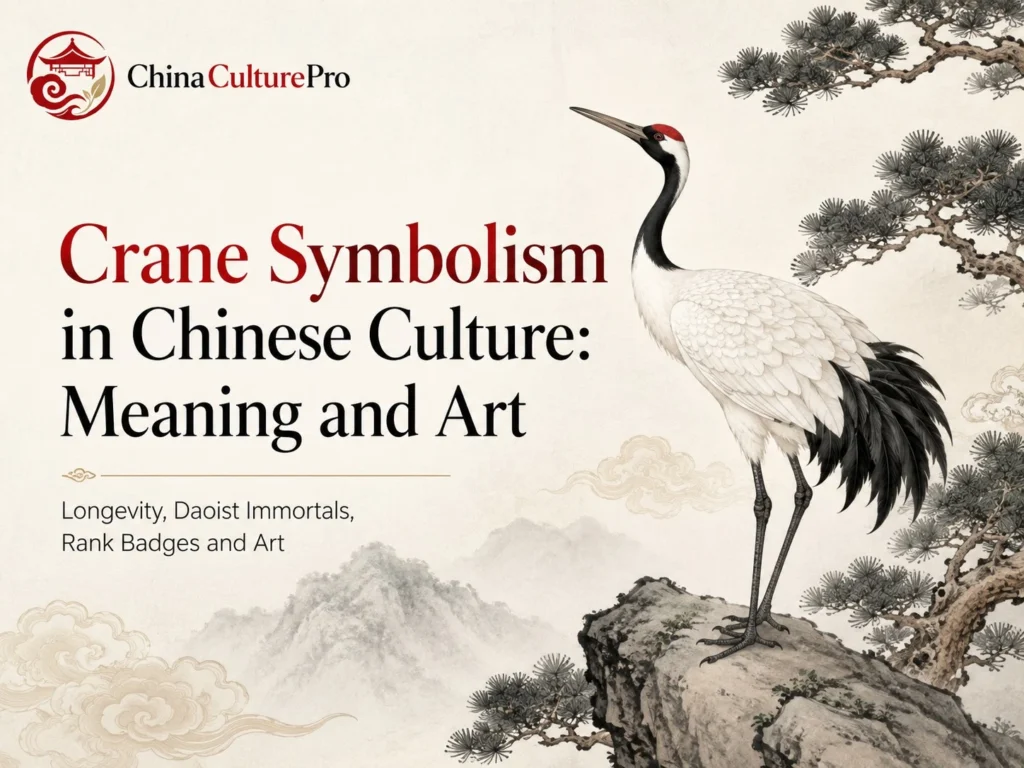

Quick Answer: What Does the Crane Symbolize in Chinese Culture?
The crane (鹤/鶴, hè) can symbolize longevity, immortality, imperial auspice, civil rank, or refined withdrawal in Chinese culture. No definition applies to every crane image; the period, object, institution, inscription, and companion motifs determine which meaning is active.
- Longevity: Cranes became familiar emblems in birthday art and long-life compositions, especially beside pine, rock, peach, or lingzhi.
- Immortality: In Daoist and immortal-themed art, a crane may carry an immortal or inhabit a transcendent landscape.
- Official rank: On Ming and Qing rank badges, the crane identifies a first-rank civil official.
- Imperial auspice: Court art could present unusual crane appearances as favorable responses linking Heaven and rulership.
- Literati character: Poetry and painting may associate cranes with distinction, solitude, freedom, or cultivated retirement.
These are cultural meanings, not supernatural properties. A crane design cannot extend life, improve health, secure promotion, or change fortune.
A crane in a natural painting, a crane carrying an immortal, and a crane embroidered on an official robe may share the same elegant silhouette while performing different cultural jobs. The first may be an observed bird or literary subject, the second belongs to an immortal narrative, and the third makes bureaucratic rank visible.
This context-first approach is essential to both Chinese animal symbolism and the wider study of Chinese symbols and meanings. Identify the carrier and historical system before translating the bird into a single abstract quality.
How Crane Symbolism Developed Across Chinese History
Chinese crane imagery did not move through a simple sequence in which one meaning replaced another. Ideas of exceptional lifespan, immortality, court auspice, official rank, birthday blessing, and literati character accumulated and overlapped. A later longevity design cannot automatically explain an earlier text, and a court badge should not be decoded as if it were a birthday painting.
Material and audience also changed what viewers were expected to notice. An emperor’s inscribed handscroll could interpret an event for a court audience. A badge made status legible during official ceremony. A birthday screen addressed a recipient and occasion, while a scholar’s painting could invite poetic reflection. The repeated bird created visual continuity, but it did not erase these differences in use.
Why the Crane Became a Symbol of Longevity and Immortality
The crane’s long neck and legs, pale plumage, measured movement, and ability to fly high made it visually suited to literary ideas of distance from ordinary life. Chinese writers then gave the bird an imagined lifespan far beyond biology. The Western Han text Huainanzi contrasts a crane said to live one thousand years with the mayfly that lives for a day. The passage is evidence of an early cultural association, not a zoological claim and not proof that every ancient crane image meant longevity.[1]
In later art, cranes became “immortal birds” (仙禽, xiānqín) and companions or conveyances of transcendent figures. A seventeenth-century ink cake, object 1942.233, depicts the legendary prince Wang Ziqiao riding a crane while playing a mouth organ. The molded scene turns the crane into part of a specific ascent-to-immortality story; the bird is a narrative vehicle rather than an independently worshipped deity.[3]
Museum studies of Chinese symbols for longevity note that cranes were associated with long life partly through their role as conveyances of immortals. White plumage could also recall the white hair of old age, while a pair of cranes could refer delicately to an elderly couple.[2] These associations explain why cranes appear in birthday art, but a lone crane in an uninscribed landscape may still be naturalistic, poetic, or decorative.
Cranes as Auspicious Omens in Imperial Art
Emperor Huizong’s Auspicious Cranes, painted in 1112 and now in the Liaoning Provincial Museum, shows cranes above a gate of the Northern Song capital. Huizong’s inscription frames the reported appearance as an auspicious response, or ruiying, connecting an unusual natural event with heavenly favor and rulership. The work is therefore not primarily a birthday wish. It participates in an imperial language in which signs in nature could support claims about moral government, dynastic order, and divine approval.[4]
The painting is an unusually well-documented case because image and imperial inscription interpret the event together. It should not be used to label every cloud-and-crane composition a political omen. A later ceramic, textile, or commercial design may use similar forms for longevity or beauty. In Chinese symbolism in art, title, inscription, patronage, and original setting can outweigh visual resemblance.
The Crane as a First-Rank Civil-Official Badge
Ming and Qing court dress used square rank badges (补子/補子, bǔzi) to display official grade. Birds identified civil officials and beasts identified military officials. Within that regulated system, a crane marked the first civil rank. Its primary meaning was institutional: it told viewers where the wearer stood in the bureaucracy.
A Qianlong-period badge dated 1736–95, object 1948.69, shows the Qing formula clearly. The central crane occupies a cosmic landscape and faces the sun. The museum explains the sun as the emperor and the orientation as an expression of the official’s loyalty. The badge belonged to a front-and-back set; the front badge was divided vertically to accommodate the robe opening. An official’s wife could wear badges corresponding to her husband’s rank.[5]
The crane’s familiar prestige made it appropriate for the highest civil grade, but the badge did not certify that a particular wearer was personally immortal, pure, or long-lived. Nor was it a general promise of promotion. Reading it correctly requires the dress rules explained in Chinese symbolism in clothing, including dynasty, badge construction, robe type, and the direction of the bird.
Ordinary Crane, Immortal Crane, Rank-Badge Crane, and Mythical Birds: What Is the Difference?
Long legs, white feathers, or flight do not establish one identity. Chinese artists idealized cranes and did not always document a modern biological species, so the complete composition is usually more reliable than one anatomical feature.
The red-crowned crane is the best-known visual model: artists often show a red crown, white body, dark flight feathers, long neck, and long legs. Yet embroidery, porcelain painting, monochrome ink, damage, or later restoration can obscure those clues. A museum title may also preserve an older identification that does not match a field guide exactly. Species recognition should therefore support interpretation rather than replace object history.
| Image type | Cultural system | Primary role | Typical clues | Do not assume |
|---|---|---|---|---|
| Naturalistic or poetic crane | Bird-and-flower or landscape art | Observed nature, season, solitude, or literary character | Wetland, reeds, open landscape, poem or artist inscription | Longevity and immortality are possible, not automatic. |
| Immortal crane | Daoist and immortal-themed narrative | Companion, conveyance, or sign of a transcendent realm | Immortal, magic fungus, peaks, grotto, or stylized clouds | The crane is not necessarily a god and is not an official rank emblem. |
| Longevity crane | Birthday and auspicious art | Expresses wishes for a long and flourishing life | Pine, rock, peach, lingzhi, shou character, birthday dedication | The image communicates a wish; it cannot lengthen life. |
| Rank-badge crane | Ming and Qing court dress | Identifies first-rank civil status | Square badge, sun, clouds, waves, cosmic landscape | It is not primarily a Daoist or birthday image. |
| Fenghuang or Vermilion Bird | Mythical-creature or directional systems | Performs roles unrelated to the crane’s identity | Composite plumage, flames, directional grouping, named inscription | Neither the Chinese Fenghuang nor the Vermilion Bird is a crane. |
| Heron, egret, or stork | Naturalistic and rebus imagery | Varies by species, wordplay, and composition | Bill, crown, neck posture, habitat, title, companion motifs | English translations such as “white bird” or “heron” should not be silently replaced with crane. |
The crane is a real-bird motif even when art gives it an immortal role. It is not thereby one of the Chinese mythical creatures. It also does not belong to the directional quartet described in the Four Symbols of Chinese mythology. A red crown does not make it the southern Vermilion Bird, just as white plumage does not make it a supernatural species.
The fastest test is functional. A square textile worn on an official robe signals rank; an immortal riding the bird signals narrative; a birthday inscription narrows the image toward long life. When those clues are absent, describe the work before choosing among several possible meanings.
Crane Motifs and Pairings in Chinese Art
Companion motifs work like visual grammar. They can narrow a crane’s broad associations, join several wishes, or place it in a story. Many familiar auspicious combinations became especially prominent in late imperial art, so they should not be projected unchanged onto every early object.
A documented title or dedication can be decisive. Pine and crane in an imperial birthday set supports a long-life reading; the same animals in an untitled mountain scene leave more possibilities open. Numbers matter too: one crane, a pair, or a flock can alter the composition, but number alone does not establish a fixed formula. Read the motifs as a sentence whose grammar comes from the whole object.
| Combination | Likely reading in a supported context | Documented example | Interpretation limit |
|---|---|---|---|
| Crane, pine, and rock | Long life, endurance, and a birthday wish | Chen Zhaofeng’s late nineteenth-century Crane, Pine, and Rock, object 2018.148, was made for an imperial birthday.[6] | A wetland or mountain scene containing the same forms may simply depict nature. |
| Crane, peach, and lingzhi | Layered references to longevity and immortality | An eighteenth-century work after Shen Quan, object 1975.268.81, combines cranes, peaches, lingzhi, bamboo, and China rose.[7] | These are cultural wishes, not a health treatment. |
| Crane, deer, and the Three Friends of Winter | Longevity joined with endurance and renewal | A Jiajing-period gourd bottle, object 65.56.2, places cranes and deer with pine, bamboo, and plum.[8] | Do not force a later named rebus when the object record does not support it. |
| Crane and immortal | Travel to or life within a transcendent realm | The Wang Ziqiao ink cake shows the immortal riding the crane.[3] | The bird serves the story; it is not independently granting immortality. |
| Crane, sun, and clouds | First civil rank and loyalty when used on a regulated badge | The Qianlong badge, object 1948.69, places the crane facing the imperial sun.[5] | Outside court dress, the same elements do not automatically mean office or promotion. |
| Paired cranes with pine | Long life and, on some objects, a wish for an enduring marriage | A Chinese hanging scroll dated around 1500, F1911.273, is catalogued as a marriage gift whose cranes and pine express longevity and marital wishes.[9] | Two cranes are not a universal Chinese love symbol. |
| Crane and tortoise | Two established long-life motifs may reinforce a longevity theme | The full object, inscription, and regional tradition must confirm the reading. | Do not import Japanese or Korean formulas into a Chinese object solely because both animals appear. |
The plant motifs have histories of their own. A pine tree may suggest endurance and long life, while pine, bamboo, and plum form the Three Friends of Winter. The tortoise also belongs to Chinese longevity imagery, but the presence of two long-life symbols does not produce one fixed title in every artwork.
What Does the Crane Mean in Chinese Idioms and Literature?
Chinese literature uses the crane for distinction, freedom, old age, reputation, and even panic. The range is wider than the positive language of birthday decoration.
| Expression | Literal image | Meaning in use | Tone |
|---|---|---|---|
| 鹤立鸡群 (hè lì jī qún) | A crane standing among chickens | A person whose appearance or ability stands far above the group | Positive |
| 闲云野鹤 (xián yún yě hè) | Idle clouds and a wild crane | A free, unencumbered life away from official or social constraint | Positive, reclusive |
| 鹤发童颜 (hè fà tóng yán) | Crane-white hair and a youthful face | An elderly person who appears vigorous and healthy | Complimentary |
| 风声鹤唳 (fēng shēng hè lì) | Wind sounds and crane calls | Extreme fear makes ordinary sounds seem threatening | Negative |
| 梅妻鹤子 (méi qī hè zǐ) | Plum as wife, crane as child | An allusion to Lin Bu and a life of cultivated reclusion | Admiring, literary |
| 鹤鸣九皋 (hè míng jiǔ gāo) | A crane calls from the deep marsh | Virtue or talent becomes known even from an obscure position | Positive, literary |
“A crane calls in the deep marsh; its voice is heard in the wilds” appears in the Book of Poetry and later supports readings about reputation traveling beyond one’s immediate position.[10] The historical anecdotes behind “crane among chickens” and “wind and crane calls” likewise use the bird in opposite emotional directions: unusual distinction in one, terrified misperception in the other.[11][12]
These phrases belong to language. A negative expression such as “wind and crane calls” does not turn an auspicious birthday painting into an image of panic, and “crane among chickens” does not make every crane artwork a promise of professional success.
How to Interpret or Use a Chinese Crane Symbol Correctly
- Identify the bird carefully: Distinguish a crane from a heron, egret, stork, Fenghuang, or Vermilion Bird. Use the title and object record when stylization makes species uncertain.
- Date the carrier: A Song imperial painting, Ming or Qing badge, birthday hanging scroll, religious ink cake, and modern logo follow different conventions.
- Name the cultural system: Decide whether the image belongs to naturalistic art, immortal narrative, court auspice, official dress, literati culture, or popular longevity design.
- Read the complete composition: Check inscriptions, patron, original use, sun, clouds, immortals, pine, rock, peach, lingzhi, deer, and other birds.
- Separate evidence from adaptation: State what the historical object documents, then label any modern personal meaning as a contemporary choice.
For a product or tattoo, a brief such as “a modern crane expressing resilience and long life” is clearer than “an ancient Chinese crane for luck.” If a design borrows a rank badge or religious scene, preserve the context instead of combining official and sacred elements only for visual prestige. The same caution applies to the designs discussed in Chinese tattoo symbols and meanings.
Prefer “can symbolize” to “always means.” A crane motif may communicate elegance, longevity, remembrance, independence, or cultural connection in modern design, but it cannot extend life, heal illness, secure office, or alter luck.
When presenting a historical reference, record its dynasty, date range, museum accession number, and original medium. That small evidence trail lets an artist or reader distinguish a faithful quotation from a loose adaptation. If the source is uncertain, describe the new work as “Chinese-inspired” rather than assigning it a specific traditional name that the evidence cannot support.
FAQs About Crane Symbolism in Chinese Culture
The two distinctions below depend on Japanese origami history and Korean longevity traditions rather than on Chinese crane imagery alone.[13][14]
Is the Paper Crane a Chinese Symbol?
Not in its familiar origami form. Crane imagery has a long Chinese history, but the folded paper crane belongs to Japanese origami tradition. Its modern global association with peace is strongly connected with the story of Sadako Sasaki after the Hiroshima bombing. A paper crane may share the broader East Asian crane theme, but it should not be presented as a traditional Chinese art form.
Do Crane Symbols Have the Same Meaning in China, Japan, and Korea?
No. Long life is a shared theme, but local visual systems differ. Chinese art developed Daoist immortal, imperial-omen, civil-rank, literati, and birthday uses. Japanese traditions include origami and distinct wedding or auspicious designs. Korean art places cranes within local court and Ten Longevity compositions. Interpret the country, period, and object rather than applying one universal “East Asian crane” definition.
Sources
[1] Chinese Text Project. Huainanzi: Shuo Lin Xun
[2] The Metropolitan Museum of Art. Longevity in Chinese Art
[3] Cleveland Museum of Art. Ink Cake with Wang Ziqiao
[4] The Metropolitan Museum of Art. Image as Word: A Study of Rebus Play in Song Painting
[5] Cleveland Museum of Art. Rank Badge (buzi), 1736–95
[6] The Metropolitan Museum of Art. Crane, Pine, and Rock
[7] The Metropolitan Museum of Art. Cranes, Peach Tree, and China Rose
[8] The Metropolitan Museum of Art. Gourd-Shaped Bottle with Deer and Crane in Landscape
[9] National Museum of Asian Art. Crane and Pine
[10] Chinese Text Project. Book of Poetry: He Ming
[11] Chinese Text Project. Dictionary Entry: 鹤立鸡群
[12] Chinese Text Project. Dictionary Entry: 风声鹤唳
[13] U.S. National Park Service. Origami Cranes
[14] Cleveland Museum of Art. Korea Focus: Korean Embroidery Arts