

Quick Answer: What Are the Chinese Symbols for Love?
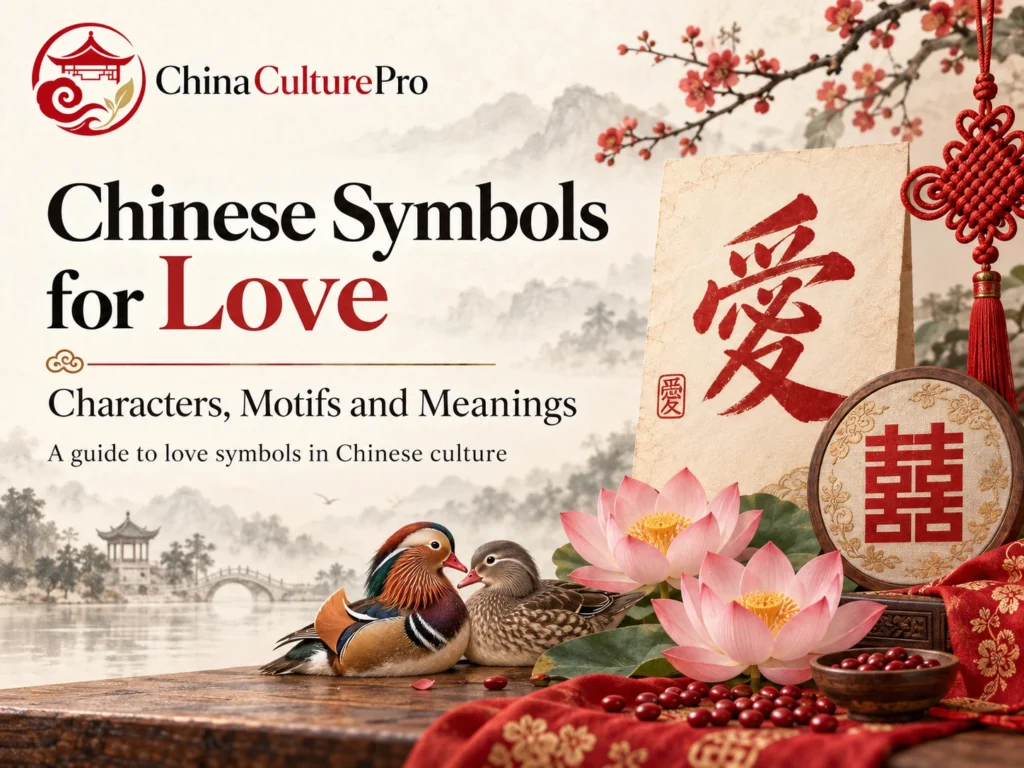
Love is written 爱 in simplified Chinese and 愛 in traditional Chinese, both pronounced ài. The word includes romantic love, family affection and care. Traditional images express more specific relationship themes.
- Affection: The character directly names love; a complete phrase makes the intended message clearer.
- Wedding joy: Double Happiness (囍; 双喜, shuāngxǐ) celebrates marriage.
- Lasting companionship: Twin lotuses (并蒂莲, bìngdìlián) express union and shared life.
- Longing and reunion: Red beans (红豆, hóngdòu) evoke remembrance; legendary images tell stories of reunion.
These are cultural expressions, not promises of a happy relationship or predetermined partner.
Choosing a Chinese love symbol begins with the relationship you want to describe. A wedding emblem, a declaration of affection and an image of missing someone carry different messages. The distinctions below help you choose a meaningful design and interpret an existing object.
Chinese Love Symbols at a Glance
Use this table to narrow your theme. The detailed sections explain the evidence and limits behind each association.
| Name | Type | Relationship meaning | Context or limit |
|---|---|---|---|
| Love: 爱/愛, ài | Written word | Affection, romantic love, care or cherishing | Suitable for broad emotional expression; the surrounding phrase identifies the relationship. |
| Double Happiness: 囍; 双喜, shuāngxǐ | Wedding emblem | Shared wedding joy and a harmonious marriage | Strongly associated with marriage; not the Chinese word for love. |
| Mandarin ducks: 鸳鸯, yuānyāng | Animal motif | Partnership and marital harmony | Usually paired in wedding decoration; fidelity is a cultural association. |
| Dragon and phoenix: 龙凤, lóngfèng | Mythical pair | Harmonious union in wedding settings | Courtly objects may instead emphasize status, authority or auspiciousness. |
| Twin lotuses: 并蒂莲, bìngdìlián; joined branches: 连理枝, liánlǐzhī | Plant images | Shared life and enduring attachment | The joined growth matters; ordinary flowers or crossing branches are not equivalent. |
| Red beans: 红豆, hóngdòu | Literary image | Longing for an absent person | Can express remembrance beyond romance; not a precise botanical identification. |
| Butterflies: 蝴蝶, húdié | Animal and narrative image | Devoted love in a famous tragic tale | A butterfly alone may represent spring, decoration or another theme. |
| Red thread: 红线, hóngxiàn | Folklore image | A destined marriage within a legend | Modern cord jewelry borrows the idea; its color alone does not establish meaning. |
| Tongxin knot: 同心结, tóngxīn jié | Knot and literary image | United hearts and mutual commitment | A named relationship image; not every red decorative knot means love. |
| Magpie Bridge: 鹊桥, quèqiáo | Legendary setting | Reunion across separation | Requires the lovers’ story or festival context; a magpie alone commonly signifies joy. |
How Is Love Written in Chinese?
The character ài has a falling fourth tone. Its meaning extends from affection toward people to liking something, cherishing it or showing benevolence. English “love” is similarly broad: loving a partner, a parent and a favorite activity involves different relationships.[1]
The simplified and traditional forms represent the same word. The traditional form visibly contains 心, meaning heart or mind, while the simplified form does not retain that component. This graphic difference does not make simplified Chinese emotionally weaker or change the word’s meaning. Choose the script appropriate to the recipient, surrounding text or calligraphic design, rather than treating one form as more loving.
Complete expressions often communicate more clearly than an isolated character:
- I love you: 我爱你, wǒ ài nǐ, a direct expression to a partner or another loved person.
- Romantic love: 爱情, àiqíng, names the kind of relationship rather than addressing someone.
- Love each other: 相爱, xiāng’ài, emphasizes mutual affection.
- Loving closeness: 恩爱, ēn’ài, commonly describes an affectionate couple.
- Loving attachment: 爱恋, àiliàn, expresses fondness and romantic attachment.
Related characters need their own context. 情, qíng, concerns feeling or emotion; 恋/戀, liàn, concerns attachment or longing; 心, xīn, names the heart or mind. None is an interchangeable translation for every use of “love.” For lettering, the broader guide to Chinese character symbols helps distinguish a written word from a cultural emblem.
Which Symbols Express Marriage and Marital Harmony?
Wedding imagery celebrates a couple’s union rather than every form of affection.
Double Happiness: Wedding Joy Rather Than the Word Love
Double Happiness joins two copies of 喜, “happiness” or “joy,” into 囍. It is a compound wedding emblem, not the traditional form of 喜 and not an alternative spelling of 爱. Its doubled structure gives visual form to shared celebration.[2]
It appears on invitations, paper cuttings, wedding clothing, furnishings and objects associated with a marriage. On a wedding card, it communicates congratulations without needing a literal declaration of love. On a gift for a friend or parent, however, it may suggest a wedding that the sender did not intend.
Choose it when the occasion is a marriage celebration or the design deliberately recalls one. A contemporary artist can borrow the form more freely, but that choice changes the context rather than erasing its recognizable wedding association. For a general message of affection, a personal sentence usually says more precisely what you mean.
Mandarin Ducks: A Cultural Image of Partnership
Paired mandarin ducks are a familiar image of marital companionship. Their symbolism developed around beliefs that the birds remained together faithfully; this is a cultural account of partnership, not proof that real birds form lifelong exclusive bonds.[3]
A Ming cloisonné dish, dated to the late fifteenth or early sixteenth century and held by the Metropolitan Museum of Art, depicts ducks with lotuses. Its accession number is 2011.111. The pairing supports a reading of conjugal harmony, but it does not identify the original owner or prove that this particular dish was commissioned for a wedding.[3]
When interpreting mandarin duck imagery, inspect the whole scene. Paired birds, lotus flowers, accompanying text and an object’s wedding use can reinforce the relationship theme. A naturalistic picture of waterbirds may simply show wildlife; even a pair should be read alongside the rest of the work.
Dragon and Phoenix: A Pair Whose Meaning Depends on Context
In wedding decoration, the dragon and phoenix can celebrate a harmonious, auspicious union. Their grand forms also lend a ceremonial feeling to clothing, cakes and gifts. The pair therefore carries a different tone from an intimate written message or a small literary reference.[4]
The same combination has courtly meanings. In imperial contexts, it can refer to the emperor and empress, high status or auspicious order. Those associations may overlap with marriage, but they prevent the pair from becoming a universal shorthand for romantic love.
Look at the object’s date, purpose, inscriptions and other decoration before assigning a relationship meaning. A palace object and a modern wedding garment can use similar creatures for different reasons. The dragon and phoenix should not be reduced to a fixed formula of male and female “energies”; the setting determines which association is useful.
Which Plant Motifs Express Union or Longing?
Joined growth offers a metaphor for shared life, while a remembered seed can evoke absence. This is different from flowers that primarily signify wealth or fruits associated with descendants: those wishes may accompany a marriage without directly meaning romantic love.
Twin Lotuses and Joined Branches
Twin lotuses describe the unusual growth of two flowers on one stem. Their shared support makes them an image of togetherness, and the associated blessing can wish a couple affection or good things in pairs. The name describes a growth form, not necessarily a separate botanical variety.[5]
Joined branches describe branches of two trees growing together, a plant image used figuratively for an affectionate couple. Bai Juyi’s poem Chang Hen Ge (长恨歌, Cháng Hèn Gē), often translated as “Song of Everlasting Sorrow,” gives a famous example: the lovers wish to become joined branches on earth. The poem illustrates the metaphor; it should not be treated as evidence that the poet invented it.[6]
The visual distinction matters in a design. Two separate lotus flowers do not necessarily constitute twin lotuses, and branches merely crossing in a composition do not establish joined growth. A title, inscription or clearly shared stem can clarify the intended union. Both images express an aspiration to remain together.
Red Beans and the Poetry of Longing
Red beans evoke xiangsi (相思, xiāngsī), longing for someone absent. Wang Wei’s poem “Xiangsi” associates gathering red seeds with remembrance, making them a compact literary image for affection felt across distance.[7]
The emotional focus is missing someone, rather than celebrating a wedding. That longing can concern a lover, friend or another important person; the accompanying words determine whom the message addresses. A reference to the poem on a keepsake may therefore communicate something more specific than a generic heart.
The literary label also does not reliably identify one plant species or an edible bean. For cultural interpretation, focus on the poem, inscription and intended feeling. For an anniversary design, red beans can work when remembrance is the chosen theme, even though they are not a standard wedding emblem.
How Do Legends Shape Chinese Love Symbols?
Three well-known stories emphasize devotion, destined marriage and reunion respectively.
Butterflies and the Butterfly Lovers
The Butterfly Lovers legend (梁祝传说, Liáng Zhù chuánshuō) centers on Liang Shanbo and Zhu Yingtai (梁山伯与祝英台, Liáng Shānbó yǔ Zhù Yīngtái), whose relationship faces separation and a tragic ending. In the familiar ending, they become butterflies and remain together. Butterfly imagery connected with the tale can therefore express devoted love extending beyond separation.[8]
The legend entered China’s first national intangible cultural heritage list in 2006, with multiple regional traditions represented. It has been retold through performance, music and other art forms; no single modern decorative pattern represents every version.[8]
Butterflies outside this narrative may suggest spring, beauty or other auspicious associations. Two butterflies alone do not prove a reference to the lovers. A title, recognizable story scene or accompanying text provides stronger evidence. When choosing the motif for a gift, consider whether the recipient appreciates its tragic story as well as its image of enduring companionship.
The Red Thread and Yue Lao
Yue Lao (月老, Yuèlǎo), the “Old Man Under the Moon,” is a marriage figure in folklore. His story is associated with the Tang tale “The Marriage Inn,” or Ding Hun Dian (定婚店, Dìng Hūn Diàn), attributed to Li Fuyan. A red cord joins the feet of people destined to marry, despite distance or differences in circumstance.[9]
Within the story, the thread represents a bond that ordinary obstacles cannot prevent. Modern red-string jewelry may borrow that romantic idea, but a red bracelet can also have other personal or cultural associations. It is not automatically a marriage token.
The story offers a poetic language of connection; it does not establish that a particular person is someone’s destined partner. A design can acknowledge the legend through a short explanation, while leaving the recipient free to understand it as a personal wish rather than a claim about fate.
The Magpie Bridge and Reunion at Qixi
The Magpie Bridge belongs to the Cowherd and Weaver Girl story. The separated lovers meet across a bridge made by magpies at Qixi (七夕, Qīxī), observed on the seventh day of the seventh lunar month. Its relationship theme is reunion across distance and obstacles.[10]
For someone missing a partner, the bridge can express the hope of meeting again. It is especially recognizable in Qixi festival imagery, where the lovers, stars or river-like Milky Way supply the narrative setting. The festival also has traditions beyond romance, so the story should not stand in for its entire history.
An isolated magpie usually offers a less specific message of joy or good news. A bird, bridge and identifiable lovers together give a much clearer reference to this reunion than a bird motif chosen solely from a generic symbol chart.
What Does a Chinese Love Knot Mean?
A Tongxin knot expresses united hearts: mutual attachment and a wish to remain of one mind. Historical descriptions refer to interlinked patterns made with decorative bands, and the image appears in early literature, including a poem by the Liang emperor Wu. This establishes a longstanding relationship metaphor, not one compulsory shape for every modern love knot.[11]
The phrase works well when a gift emphasizes commitment or shared intentions. Its meaning comes from the named image and its context, rather than from the cord being red. A label or accompanying message can clarify the intended connection when the knot itself is unfamiliar.
Chinese knotting (中国结, Zhōngguó jié) covers a broader craft tradition. The Buddhist Endless Knot (盘长, páncháng) has a distinct religious context and should not automatically be renamed “eternal love.” English labels such as “love knot,” “Chinese knot” and “endless knot” cover different ideas; check the actual design and explanation rather than treating those names as synonyms.
How to Choose a Chinese Love Symbol for a Gift or Design
- Name the feeling: Decide whether you mean affection, wedding congratulations, shared commitment or longing. A declaration suits the first; a wedding emblem suits the second. Choosing the emotional task first prevents an attractive motif from sending the wrong message.
- Match the occasion: Consider the recipient and relationship. A marriage-associated design may fit a wedding gift but confuse a birthday message to a parent. For a historical object, identify its original use before importing a modern romantic interpretation.
- Check the complete form: Verify characters, script consistency and orientation. For imagery, inspect the species, shared stem, paired arrangement, story elements and inscriptions. A mirrored character or an incomplete motif can change how a design is recognized; a cropped photograph may omit decisive evidence.
- Make the intention clear: Read the design alongside a short message and check it with a competent Chinese reader before permanent lettering or engraving. Explain a literary allusion if the recipient does not know it. For religious imagery, understand that tradition before adapting it for a romantic theme.
Modern hearts, roses and digital number messages can also express affection in Chinese-speaking settings. They belong to contemporary communication rather than one unchanged ancient symbol system. Combining an older image with a personal sentence is a valid modern choice, provided the design’s new meaning is distinguished from its historical associations.
FAQs About Chinese Symbols for Love
What Is the Chinese Character for Love?
It is 爱 in simplified Chinese and 愛 in traditional Chinese, pronounced ài with a falling fourth tone. The word can describe romantic affection, family love and care, depending on the phrase and relationship.
Do 爱 and 愛 Mean the Same Thing?
Yes. They are two script forms of the same word. Traditional 愛 contains the visible heart component 心; simplified 爱 changes the written structure. That difference does not remove love from the word’s meaning.
Does Double Happiness Mean Love?
It expresses wedding joy and wishes for a harmonious marriage. It is not a translation of “love.” Choose it for a marriage-related message; a direct phrase is usually clearer for affection toward family or friends.
Which Chinese Symbols Can Express Lasting Love?
Joined branches, twin lotuses, a Tongxin knot and paired mandarin ducks can express wishes for enduring companionship in appropriate contexts. Each emphasizes something different, and none promises that a relationship will remain happy or last forever.
Can Foreigners Use Chinese Love Symbols?
Yes. Match the symbol to the relationship and occasion, check the lettering and understand any literary or religious context. An unfamiliar motif is easier to appreciate when a short personal message explains why you chose it.
Sources
[1] Ministry of Education. 愛 — Concised Mandarin Chinese Dictionary
[2] Asian Art Museum. Hidden Meanings in Chinese Decorative Motifs
[3] The Metropolitan Museum of Art. Dish with Mandarin Ducks and Lotuses
[4] National Museum of Asian Art. A Selected Illustrated Guide to Common Chinese Symbols
[5] Ministry of Education. 蓮開並蒂 — Revised Mandarin Chinese Dictionary
[6] Ministry of Education. 連理枝 — Revised Mandarin Chinese Dictionary
[7] Wang Wei. 相思 — Classical Text
[8] China Intangible Cultural Heritage. 梁祝传说
[9] Ministry of Education. 月下老人 — Revised Mandarin Chinese Dictionary
[10] ChinaCulture.org. The Cowherd and the Weaver Girl
[11] Ministry of Education. 同心結 — Revised Mandarin Chinese Dictionary