
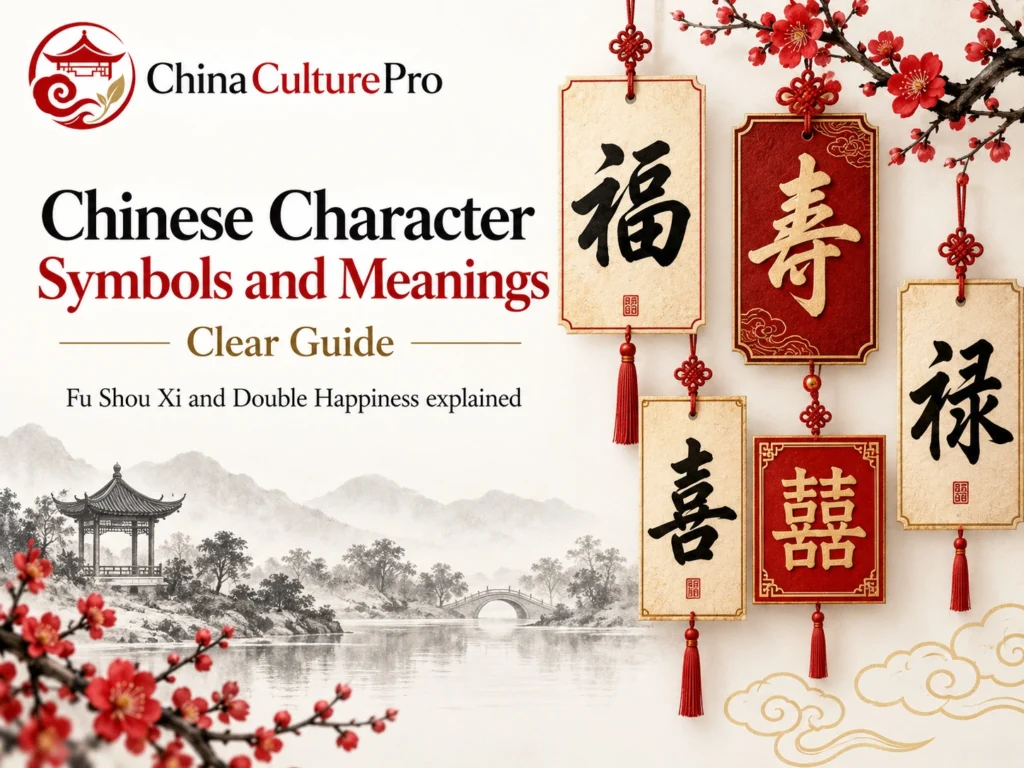

Quick Answer: What Are Chinese Character Symbols?
Chinese character symbols are written forms that also work as stand-alone decorative emblems. Chinese characters, or Hanzi (汉字, Hànzì), are first of all units of writing; only some have widely recognized symbolic roles in celebrations, gifts, art, and household decoration.
- Best-known emblems: Fu (福, fú) conveys blessing or good fortune; Shou (寿/壽, shòu) longevity; Lu (禄/祿, lù) emolument or career prosperity; and Xi (喜, xǐ) joy or a happy occasion.
- Special wedding form: Double Happiness (囍, shuāngxǐ) joins two 喜 forms into a wedding emblem.
- Context matters: Meaning depends on the word, occasion, script, object, placement, and surrounding images.
- Writing comes first: Most Hanzi are ordinary written characters, not ancient charms or mystical pictograms.
These emblems communicate wishes and values. Displaying one does not guarantee luck, wealth, love, longevity, or protection.
English-language lists often call every Chinese-looking mark a “Chinese symbol.” A written character, wedding ligature, blessing phrase, and picture of five bats may all carry auspicious meaning, but through different mechanisms.
This guide focuses on written emblems. For animals, plants, colors, numbers, and objects, begin with the parent guide to Chinese symbols and meanings. Here, the goal is to identify what a character says, understand its cultural use, and verify the form before using it in a gift or permanent design.
Chinese Characters, Symbols and Motifs: What Is the Difference?
A character does not stop being language when it becomes decorative. Its meaning is highlighted through size, color, placement, calligraphy, repetition, or ceremonial use. “Symbol” describes its function in a design, not a separate writing system.
| Category | Examples | What it is | How to interpret it |
|---|---|---|---|
| Ordinary Chinese character | 家, 山, 水 | A unit used in words and sentences | Start with its linguistic meaning; decorative use is possible but not automatic |
| Stand-alone character emblem | 福, 寿/壽, 喜 | A character deliberately enlarged or displayed as a blessing | Check the occasion, object, and normal lexical meaning |
| Ligature or decorative compound | 囍 | A combined graphic form used as one emblem | Read the complete construction and its established social setting |
| Multi-character blessing | 福禄寿喜, 吉祥如意 | A phrase or sequence made from several characters | Interpret the complete wording rather than assigning the whole message to one character |
| Pictorial motif | five bats, three auspicious fruits | A nonwritten image that gains meaning through sound, convention, number, or association | Identify every pictured element and read the composition as a whole |
A bat can suggest blessing because 蝠, the second character in “bat,” sounds like 福. The animal remains an image, not a character. Likewise, 家 may appear in modern family-themed art without becoming a traditional auspicious emblem in every context.
Common Chinese Character Symbols and Meanings
The following characters have recognizable independent decorative uses, although they do not all have the same history or frequency. English glosses are starting points rather than universal one-word translations. The traditional lexical range of 福 includes favorable fortune and a flourishing life, while 禄/祿 can specifically refer to an official salary or emolument rather than generic cash wealth.[1][2]
| Character | Pinyin | Core meaning | Common context | Important limit |
|---|---|---|---|---|
| 福 | fú | Blessing, good fortune, a favorable life | Lunar New Year displays, doors, paper cuts, gifts | Broader than money or a lucky accident |
| 寿/壽 | shòu | Longevity | Birthdays, gifts for elders, ceramics, textiles, calligraphy | Does not by itself include wealth or official rank |
| 禄/祿 | lù | Emolument, status, career prosperity | Fu-Lu-Shou groupings, congratulatory art, career wishes | Historically narrower than general wealth |
| 喜 | xǐ | Joy, a happy or celebratory occasion | Celebrations, festive decoration, congratulatory gifts | Not limited to marriage and not identical to long-term wellbeing |
| 囍 | shuāngxǐ | Double Happiness, marital joy | Weddings, invitations, bridal rooms, wedding goods | A special combined emblem, not an ordinary stand-alone word used in sentences |
| 财/財 | cái | Wealth, property, material resources | Business openings, New Year decoration, modern commercial design | More explicitly material than 福 |
| 吉 | jí | Auspicious, favorable | Gifts, festive inscriptions, compounds such as 吉祥 | Often appears in a phrase rather than alone |
| 安 | ān | Safety, settledness, peace | Travel wishes, home décor, gifts centered on wellbeing | May emphasize safety or stability rather than international “peace” |
| 和 | hé | Harmony, accord | Family décor, calligraphy, civic or organizational settings | Does not equal “peace” in every sentence |
| 爱/愛 | ài | Love, affection | Jewelry, contemporary décor, gifts, tattoos | Context determines romantic, familial, or general affection |
| 德 | dé | Virtue, moral character | Calligraphy, educational spaces, personal-value designs | An ethical value, not a device for attracting luck |
Do not use the table as a character vending machine. “Strength,” “freedom,” “peace,” and “family” can require different Chinese words according to the intended sense. A natural word or phrase may be more accurate than one isolated graph.
How Written Characters Become Decorative Emblems
Three changes commonly move a character from ordinary writing into an emblematic role: isolation, visual emphasis, and context. A large 福 centered on red paper still means what 福 means in language, but its scale, color, placement, and New Year setting turn it into a household blessing display. The design does not need a secret second definition.
Calligraphy adds another layer. A character can be rounded, elongated, repeated, fitted into a medallion, or rendered in an older script. Shou is especially flexible: a nineteenth-century Qing tapestry panel presents the longevity character in ten forms and may once have belonged to a set of one hundred displayed for a luxurious birthday celebration.[4] The variants express artistic range while continuing to point to longevity.
Material and location matter. A character woven into a robe, painted on porcelain, cut from paper, carved into wood, or engraved on jewelry reaches different audiences. Decorative treatment strengthens the message; it does not give writing supernatural power.
Pairs, Ligatures and Blessing Systems
Written blessings often expand beyond one character. The relationship among the parts determines whether the result is a ligature, a phrase, or a larger symbolic system.
- Double Happiness: 囍 places two 喜 forms side by side in a compact square. It is conventionally associated with love and marriage, which is why it appears on wedding invitations, decorations, and gifts.[8] Calling it “the Chinese word for happiness” is too broad; its strongest function is as a wedding emblem.
- Fu-Lu-Shou-Xi: 福禄寿喜 (fú lù shòu xǐ) brings together blessing, emolument or status, longevity, and joy. A late Qing wedding bowl places the four characters in separate roundels, each surrounded by bats and ruyi-shaped ornament, showing how writing and accompanying motifs can build one auspicious program.[5]
- Five Blessings: The Five Blessings (五福, wǔfú) are longevity, wealth, health and peace, love of virtue, and the natural completion of life.[3] They are not five copies of 福. Five bats can represent the set through the sound relationship between 五蝠 and 五福.[5] The mechanism is explained more fully in the guide to bat symbolism in Chinese culture.
- Three Abundances: The Three Abundances (三多, sānduō), also called the Three Plenties, wish for abundant blessings, longevity, and descendants. A common Qing decorative form uses Buddha’s hand citron, peach, and pomegranate to carry these three wishes.[6] The fruit system, including Buddha’s hand citron symbolism, is pictorial rather than a single written emblem.
These categories can overlap: a central character may identify the dominant wish while surrounding motifs make it more specific.
Simplified, Traditional and Calligraphic Forms
Simplified and traditional characters are standardized graphic forms, not competing levels of auspicious power. Choose between them according to the intended readers, region, object, and visual setting. Traditional forms remain common in Taiwan, Hong Kong, Macau, historic objects, and heritage-style calligraphy; simplified forms are familiar in mainland China and many contemporary settings.
| Simplified | Traditional | Practical note |
|---|---|---|
| 福 | 福 | Same modern form in both systems |
| 寿 | 壽 | Visually very different; 壽 is common in historical and calligraphic designs |
| 禄 | 祿 | Different right-hand structure |
| 喜 | 喜 | Same modern form in both systems |
| 财 | 財 | Different component form |
| 爱 | 愛 | Clearly different forms; both mean love |
Script style is a separate decision. Major calligraphic families include seal script (篆书, zhuànshū), clerical script (隶书, lìshū), regular script (楷书, kǎishū), running script (行书, xíngshū), and cursive script (草书, cǎoshū). These forms developed distinctive structures and degrees of abbreviation over the history of Chinese calligraphy.[7] Regular script is generally easiest for a learner to verify, while highly stylized seal or cursive forms may require specialist reading.
An old-looking form is not automatically more authentic for every project. A modern gift for mainland readers, a Hong Kong wedding design, and a museum-inspired reproduction may reasonably use different forms. Legibility and cultural fit matter more than a blanket rule that traditional characters are “better.”
Where and When Chinese Character Symbols Are Used
The same character can shift emphasis with the occasion. Use the setting to decide which part of its meaning is active.
| Occasion | Common choices | Typical carriers | What to check |
|---|---|---|---|
| Lunar New Year and household blessings | 福, 吉, 安, 财/財 | Door papers, paper cuts, couplets, red envelopes | Local placement practice and the complete New Year message |
| Birthdays and gifts for elders | 寿/壽, 福寿, Fu-Lu-Shou groupings | Ceramics, paintings, textiles, gift boxes | Whether the design clearly communicates longevity and respect |
| Weddings | 喜, 囍, 和 | Invitations, room decoration, paper cuts, tea sets | 囍 is strongly wedding-specific; 喜 is broader |
| Business and career | 财/財, 禄/祿, 吉, 昌 | Opening gifts, signs, office calligraphy | Wealth, career status, growth, and favorability are different wishes |
| Home and relationships | 安, 和, 福 | Plaques, hanging scrolls, modern wall art | Whether the intended idea is safety, harmony, or general blessing |
| Contemporary personal design | 爱/愛, 德, 和, 福 | Jewelry, clothing, logos, tattoos | Exact wording, script, orientation, and audience recognition |
Historical evidence does not make every modern use ancient. 爱/愛 works in contemporary design but lacks the same established auspicious-display history as 福 or 寿. A new use remains meaningful when described honestly as modern or personal.
How to Choose and Verify a Character for Art, Gifts or Tattoos
Use this five-step process before engraving, printing, painting, or tattooing a Chinese character:
- Define the intended meaning. Decide whether you mean blessing, longevity, romantic love, family harmony, safety, wealth, career status, or moral virtue. Do not begin with an English word and assume one graph will cover every sense.
- Check whether the character works independently. Some ideas are natural as single-character emblems; others require a two-character word, idiom, or complete phrase. Confirm that the proposed form sounds intentional rather than like a dictionary fragment.
- Choose the writing system and script. Select simplified or traditional form for the actual audience, then choose a readable calligraphic style. Do not mix components from different variants to create a hybrid glyph.
- Ask a fluent reader to review the final artwork. Verification should cover the complete wording, stroke structure, orientation, line order, and visual balance—not merely a typed source character.
- Inspect the production proof. Check for missing or added strokes, mirroring, accidental rotation, broken font substitution, and AI-generated pseudo-characters before approving any permanent work.
For a tattoo, logo, or architectural feature, review the exact final stencil or vector, not only the original text message sent to the artist. Personal reinterpretation is legitimate, but it should not be marketed as a fixed ancient tradition when it is a new design.
Common Misreadings and Design Mistakes
| Common claim or mistake | More accurate reading |
|---|---|
| Every Chinese character is an ancient pictogram | Hanzi form a full writing system; only some characters have established stand-alone decorative roles |
| Every English abstraction has one perfect Chinese symbol | Meaning often depends on a multi-character word, phrase, and social context |
| 囍 is the ordinary character for happiness | It is a combined Double Happiness wedding emblem; ordinary joy is written 喜 |
| Traditional characters are more auspicious than simplified ones | The systems use different standard forms; auspicious meaning does not have a script-based power ranking |
| Hard-to-read calligraphy is more authentic | Style can add artistic or historical associations, but illegibility increases the risk of error |
| 福 must always be upside down | Inversion can play on 倒, “upside down,” and 到, “arrive,” but upright 福 is also normal and placement customs vary |
| A character automatically attracts wealth, love, or protection | It communicates a wish or value; it cannot guarantee an outcome |
| An AI-generated “Chinese-style” mark is ready to use | Decorative generators can produce missing strokes, false structures, reflections, or shapes that are not characters |
The safest interpretive habit is simple: identify the exact written form, translate it in context, inspect the complete design, and separate documented convention from personal interpretation.
FAQs About Chinese Character Symbols
Is Every Chinese Character a Symbol?
No. Every Hanzi is part of a writing system, but only some characters have broadly recognized stand-alone roles in blessing, ceremonial, or decorative settings. Any character can be used artistically; that does not make it a traditional auspicious emblem.
Is 囍 a Normal Chinese Character?
囍 is an encoded Chinese ideograph and a familiar decorative form, but its main role is the Double Happiness wedding emblem made from two 喜 forms. It is not used like an ordinary everyday word in a sentence.
Should 福 Be Displayed Upside Down?
It can be, but it does not have to be. An inverted 福 can suggest “blessing has arrived” through the shared pronunciation dào in 倒, “inverted,” and 到, “arrive.” Upright 福 is equally valid, and local conventions and placement affect the choice.
Are Traditional Characters More Auspicious Than Simplified Characters?
No. Traditional and simplified forms do not carry different amounts of luck. Traditional forms may better suit a historic object, a particular region, or a calligraphic design; simplified forms may be clearer for another audience. Accuracy, readability, and context should decide.
Sources
[1] Ministry of Education, Taiwan. Revised Mandarin Chinese Dictionary: 福
[2] Ministry of Education, Taiwan. Revised Mandarin Chinese Dictionary: 祿
[3] Ministry of Education, Taiwan. Revised Mandarin Chinese Dictionary: 五福
[4] The Metropolitan Museum of Art. Panel with Longevity (Shou) Characters
[5] The Palace Museum. Bowl with the Characters Fu, Lu, Shou and Xi in Red Enamel on a Yellow Ground
[6] The Palace Museum. Three Abundances Pattern
[7] Smithsonian National Museum of Asian Art. Writing, Carving and Rubbing: China’s Calligraphic Arts
[8] The Unicode Consortium. Enclosed Ideographic Supplement