
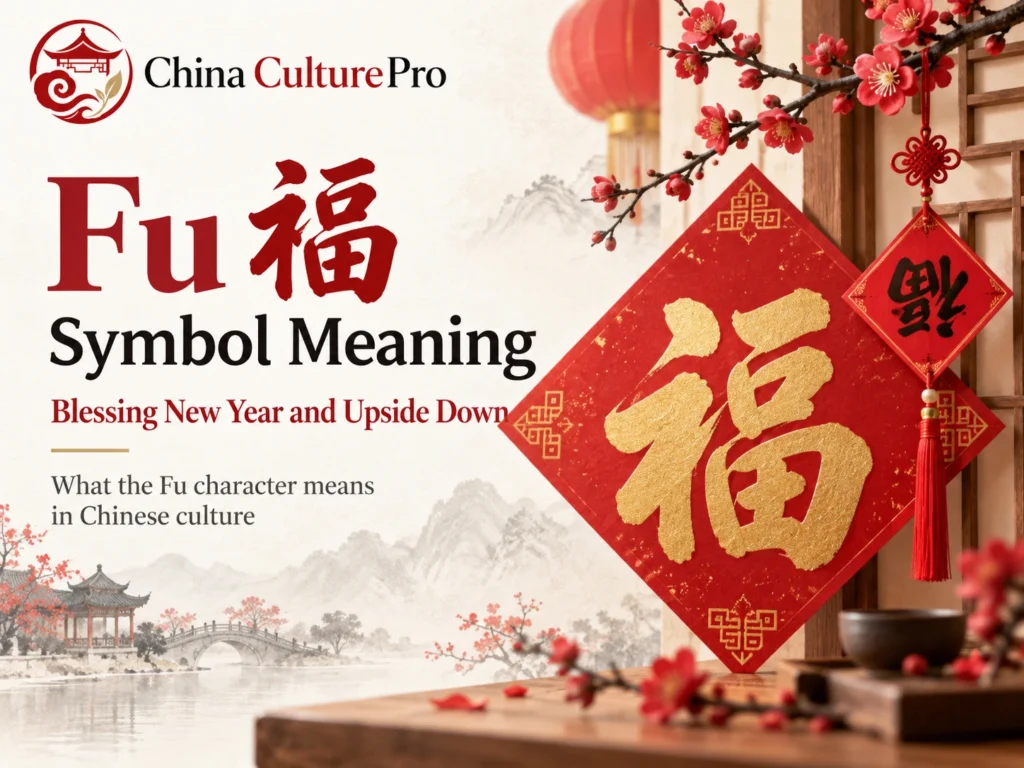

Quick Answer: What Does the Fu Symbol Mean?
Fu (福, fú) is one of the best-known auspicious Chinese characters. Its safest English meanings are “blessing” and “good fortune”: a broad wish for a favorable, well-lived life rather than money alone.[1]
- Pronunciation: Fú, with a rising second tone.
- Core meaning: Blessing, favorable fortune, and a life going well.
- Common settings: Chinese New Year decorations, paper cuts, calligraphy, gifts, red envelopes, and decorative objects.
- Upside-down form: An inverted Fu plays on dào, which can mean both “upside down” and “arrive,” suggesting that good fortune has arrived.[3]
Fu expresses a hope or blessing; it does not guarantee wealth, luck, health, or a change of fate.
Fu is both an ordinary Chinese character and, when enlarged or displayed alone, a decorative emblem. Its meaning still comes from language. The context—New Year paper, a porcelain jar, a gift, or a modern logo—determines how that broad blessing is being used.
This distinction matters when reading other Chinese symbols and meanings. Written characters, visual puns, festival customs, and later commercial designs may overlap, but they are not one universal symbolic code.
What Does Fu Mean in Chinese?
Fu has a wider meaning than the English word “luck” often suggests. It can describe blessings, favorable circumstances, or the condition of being fortunate over time. Traditional dictionary senses include auspicious or fortunate things and the combined idea of wealth, status, and long life.[1] The best translation therefore depends on the sentence or object.
| Chinese term | Pinyin | Core meaning | Important distinction |
|---|---|---|---|
| 福 | fú | blessing, good fortune, fortunate life | Broadest term; not limited to money or chance |
| 富 | fù | rich, wealthy, abundant | Describes material wealth more directly |
| 财/財 | cái | money, property, wealth | Narrowly financial or material |
| 幸福 | xìngfú | happiness, well-being | Usually describes a happy or fulfilling state |
| 好运/好運 | hǎoyùn | good luck | More closely connected with favorable chance |
Calling Fu a “wealth symbol” is therefore incomplete. Prosperity may be part of the wish, but family well-being, peace, longevity, opportunity, and general favorable fortune may also fit the context.
How Is the Character Fu Formed and Written?
Traditional lexicography analyzes 福 as “from 示, with 畐 providing the sound” (从示,畐声). The left element is associated with ritual and blessing, while 畐 functions as the phonetic component.[2] This is a historical character analysis, not a license to turn every modern stroke into a separate secret message.
A popular folk breakdown reads parts of the modern form as “one,” “mouth,” and “field,” then constructs a story about every family possessing land. That can work as a mnemonic, but it is not the standard etymology and should not be presented as the character’s proven origin.
福 is used in both simplified and traditional Chinese. Regional typefaces may render the left side differently, and calligraphic scripts can make the character look dramatically different. Seal, clerical, regular, running, and cursive forms preserve the same central idea. Decorative collections such as “Hundred Fu” and “Thousand Fu” designs gather many calligraphic versions rather than many different meanings.[3]
Why Is Fu Displayed at Chinese New Year?
During Chinese New Year, Fu is commonly written or printed on red paper and displayed on doors, windows, walls, red envelopes, paper cuts, and gifts. The display turns a familiar word into a visible household wish: may blessings enter, and may the coming year go well.[3]
An upright Fu is fully traditional and correct. One commonly stated convention keeps the character upright on the main entrance to represent welcoming good fortune through the door. Inverted displays also occur, but family and regional practices vary. There is no need to turn every Fu decoration upside down for it to be culturally meaningful.
Why Is the Fu Character Sometimes Upside Down?
The inverted Fu works through a Mandarin homophone. “Upside down” is dào (倒), while “to arrive” is also dào (到). Saying “Fu is upside down” can therefore sound like “Fu has arrived,” turning the physical position of the character into the festive phrase “good fortune has arrived.”[3]
The wordplay explains the custom more securely than any single origin story. Popular tales connect the practice with the Ming founder Zhu Yuanzhang, Empress Ma, or later princely households, but these stories circulate in different versions and should be identified as folklore rather than established history.
Placement rules also vary. Some households invert Fu on interior doors, cabinets, containers, or windows while keeping the main-door character upright; others follow different family habits. When the audience or setting is unclear—especially in a permanent design—an upright, legible Fu is the safest choice.
How Does Fu Relate to Bats and the Five Blessings?
The written character, the bat motif, and the Five Blessings (五福, wǔfú) belong to connected but distinct symbolic systems.
| Form | Cultural mechanism | Usual reading | Interpretation limit |
|---|---|---|---|
| 福 | Written meaning | A direct wish for blessing or good fortune | One character does not automatically specify five blessings |
| 蝠, bat | Sound-based visual pun | The word for bat, fú, sounds like 福 | The image must still be read with its number and companion motifs |
| Five Blessings (五福, wǔfú) | Named five-part ideal | Longevity, wealth, health and peace, love of virtue, and a natural completion of life | It is a particular traditional framework, not five generic kinds of luck |
Five bats can visualize the Five Blessings because 五蝠 and 五福 are pronounced alike. A single bat usually gives a broader blessing reference, while five recognizable bats support the complete numbered reading.[5][6] The Chinese symbolism of bats becomes more specific when bats appear with peaches, a longevity character, clouds, or other motifs.
How Should You Use or Interpret the Fu Symbol?
Read Fu from its setting rather than treating it as a free-floating charm.
- New Year decoration: Interpret it as a household or festival wish for blessings in the coming year. Upright and inverted versions can both be meaningful.
- Gift, red envelope, or household object: It usually conveys a broad wish for the recipient’s well-being and favorable fortune, not a promise of money.
- Historical artwork: Check the date, object type, other characters, and companion motifs. A late-sixteenth-century porcelain jar, for example, combines Fu with characters for longevity, peace, and health, creating a larger auspicious message.[4]
- Logo, jewelry, or contemporary design: Fu can communicate a modern connection with Chinese blessing culture, but the design should not be marketed as an ancient formula with guaranteed effects.
- Tattoo or permanent installation: Verify the character, orientation, calligraphic style, and image direction with a competent Chinese reader or calligrapher. Avoid mirrored, malformed, or AI-invented strokes.
Common Misreadings of the Fu Symbol
| Common misreading | More accurate interpretation |
|---|---|
| Fu means only wealth | It is a broad blessing; wealth is only one possible part of a fortunate life. |
| Fu is identical to random luck | “Blessing” or “good fortune” usually captures its wider and more enduring sense. |
| The strokes literally encode “one mouth and a field” | That is a modern folk mnemonic, not the standard character analysis. |
| Fu must be upside down | Upright Fu is equally valid; inversion is an optional festive pun. |
| One imperial legend proves the custom’s origin | Several folklore versions exist, but none should be treated as a settled historical origin. |
| One Fu represents the complete Five Blessings | The Five Blessings are a named five-part framework; one character remains a broad blessing. |
| Fu is a device that produces good luck | It communicates a cultural wish and has no demonstrated power to change outcomes. |
FAQs About the Fu Symbol
Does Fu Mean Luck, Happiness or Blessing?
“Blessing” or “good fortune” is usually the safest translation. “Happiness” can fit some contexts, while “luck” may sound too random and “wealth” is too narrow to represent the full meaning of Fu.
Is Fu the Same in Simplified and Traditional Chinese?
Yes. Both systems use 福. Regional fonts and calligraphic scripts may change its stroke shapes or visual style, but they do not turn it into a different character or give it a different core meaning.
Does an Upside-Down Fu Bring Bad Luck?
There is no single nationwide rule that treats an inverted Fu as bad luck. It is widely understood as the “fortune has arrived” pun, although placement preferences vary. If the cultural setting is uncertain, displaying Fu upright is the least ambiguous choice.
Is Fu a Feng Shui Symbol?
Fu is primarily a Chinese word, festive emblem, and decorative blessing. Modern feng shui products may use it, but that does not make every historical Fu inscription a feng shui device or prove that the character changes a building’s fortune.
Sources
[1] Ministry of Education, Taiwan. 福: Revised Mandarin Chinese Dictionary
[2] Ministry of Education, Taiwan. 福: Dictionary of Chinese Character Variants
[3] Travel China. The Character “Fu”—Decoding the Cultural Symbols for Spring Festival
[4] The Metropolitan Museum of Art. Jar Decorated with Auspicious Characters amid Plants
[5] Asian Art Museum. Hidden Meanings in Chinese Decorative Motifs
[6] Ministry of Education, Taiwan. 五福: Revised Mandarin Chinese Dictionary