
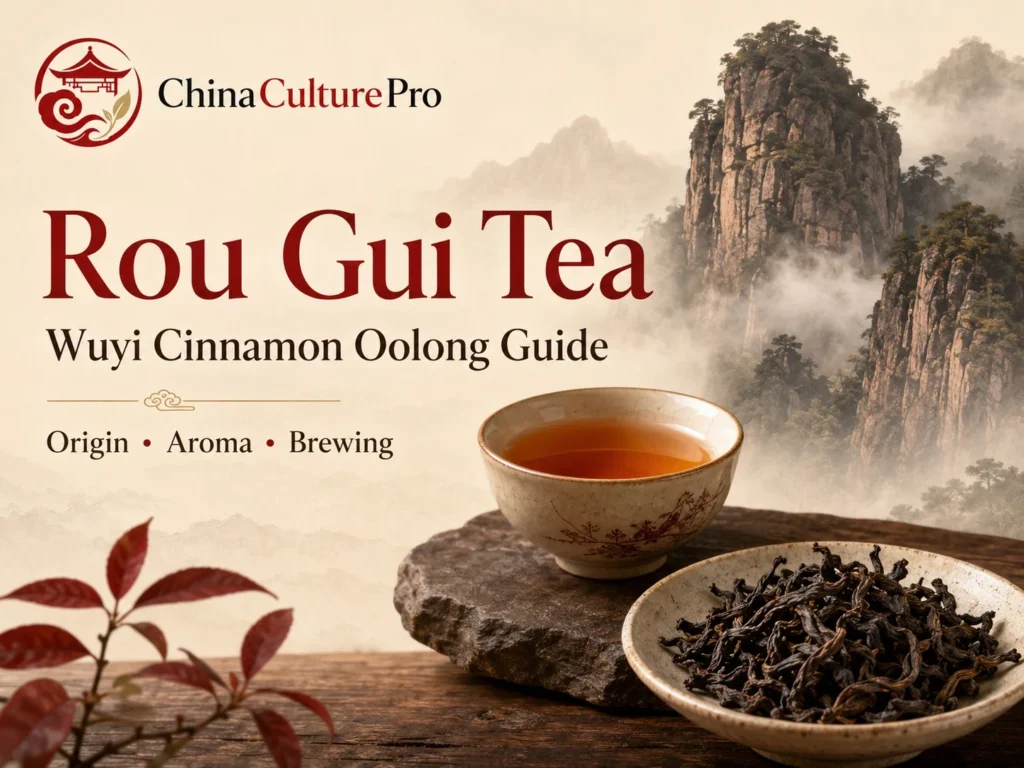

Quick Answer: What Is Rou Gui Tea?
Rou Gui Tea, also written as Rougui Tea or Wuyi Rou Gui, is a famous Chinese oolong tea from Wuyi Mountain in Fujian Province. It belongs to Wuyi Rock Tea, or Wuyi Yancha, a roasted oolong tradition known for mineral depth, strong body, layered aroma, and yan yun, often translated as rock rhyme.
Rou Gui means cinnamon or cassia, but Rou Gui Tea is not cinnamon-flavored tea. Its natural cinnamon-like aroma comes from the Rou Gui tea cultivar, Wuyi Mountain terroir, oolong processing, and roasting—not cinnamon powder, added spice, or artificial flavor.
Its basic identity is clear:
-
Tea Type: Chinese oolong tea.
-
Chinese Name: 肉桂.
-
Common English Name: Rou Gui Tea / Wuyi Cinnamon Oolong.
-
Core Region: Wuyi Mountain, Wuyishan, northern Fujian.
-
Tea System: Wuyi Rock Tea / Wuyi Yancha.
-
Not The Same As: herbal cinnamon tea, flavored cinnamon tea, black tea, green tea, or Pu-erh.
-
Core Aroma: natural cinnamon-like aroma, cassia bark, orchid, floral notes, ripe fruit, roast, and woody warmth.
-
Core Taste: strong but smooth, spicy but not harsh, full-bodied, mineral, and long-lasting.
-
Key Quality: yan yun, or rock rhyme.
-
Brewing: best brewed gongfu style with hot water and short repeated infusions.
A simple way to place it within Wuyi Rock Tea: Da Hong Pao is the famous representative name, Rou Gui is the high-aroma and powerful cultivar, and Shui Xian is the fuller, softer, more woody and orchid-like style.
Chinese tea drinkers often say, “香不过肉桂,醇不过水仙” — no aroma surpasses Rou Gui, no mellowness surpasses Shui Xian. This is not an absolute ranking. It means good Rou Gui is valued for natural cinnamon-like aroma, aromatic force, strong but smooth body, long hui gan, and yan yun—not just spice, heavy roast, or a famous label.
To understand oolong as a category, read our [Chinese Oolong Tea] guide.
Name, Tea Type, and Basic Identity
The name Rou Gui means cinnamon or cassia in Chinese. In tea, however, Rou Gui is a tea cultivar name and a tea name, not an ingredient name.
| Identity Point | What It Means |
|---|---|
| Chinese Name | 肉桂 |
| Pinyin | Rou Gui |
| Common English Rendering | Rou Gui Tea, Rougui Tea, Wuyi Cinnamon Oolong |
| Tea Type | Chinese oolong tea |
| Tea System | Wuyi Rock Tea / Wuyi Yancha |
| Origin | Wuyi Mountain, Fujian |
| Processing Style | partially oxidized and roasted oolong |
| Not The Same As | cinnamon-flavored tea, herbal cinnamon tea, black tea, green tea, or Pu-erh |
| Core Quality | natural cinnamon-like aroma, clean roast, strong body, mineral depth, hui gan, yan yun |
The most important point is this: Rou Gui Tea is not flavored with cinnamon. It is not made with cinnamon bark, cinnamon powder, spice blends, or sweet dessert-style flavoring. It is real tea from the Camellia sinensis plant: a partially oxidized Wuyi rock oolong shaped through oolong processing and finished with roasting.
Its “cinnamon” character is a natural tea aroma created by cultivar, mountain site, leaf maturity, zuo qing, roasting, and storage. This makes Rou Gui very different from Western-style herbal cinnamon tea.
To compare major Chinese tea categories, read our Chinese Tea Types guide.
Origin: Wuyi Mountain and Rock Tea Terroir
Rou Gui comes from the Wuyi Mountain tea region in northern Fujian. This is the home of Wuyi Rock Tea, a group of roasted oolong teas shaped by rocky valleys, cliffs, ravines, streams, mist, and weathered stone soils.
| Origin / Area | Chinese | What To Know |
|---|---|---|
| Wuyi Mountain | 武夷山 | core region of Wuyi Rock Tea and Rou Gui in northern Fujian |
| Wuyishan | 武夷山市 | administrative area associated with Wuyi tea production |
| Zhengyan Area | 正岩产区 | core rock area, often prized for stronger yan yun and deeper site character |
| Ban Yan / Banyan Area | 半岩产区 | semi-rock areas around the core scenic region; can still produce good Rou Gui |
| Zhoucha Area | 洲茶产区 | flatter areas near streams or lower terrain; generally larger production and less prized |
| San Keng Liang Jian | 三坑两涧 | classic Zhengyan site language, including Huiyuan Keng, Niulan Keng, Daoshui Keng, Liuxiang Jian, and Wuyuan Jian |
| Niu Lan Keng Rou Gui | 牛栏坑肉桂 | often shortened by Chinese tea drinkers as “Niu Rou”; known for depth, refinement, and strong rock character |
| Ma Tou Yan Rou Gui | 马头岩肉桂 | often shortened as “Ma Rou”; often discussed for high aroma and sharper aromatic force |
| Hui Yuan Keng Rou Gui | 慧苑坑肉桂 | Zhengyan site expression often associated with steadier body and depth |
| Jiu Long Ke Rou Gui | 九龙窠肉桂 | Rou Gui from the Jiulongke area, a famous Wuyi site also known for the Da Hong Pao mother-tree story |
The Chinese nicknames “Niu Rou” and “Ma Rou” are tea-drinker shorthand. They do not mean beef or horse meat. Niu Rou means Niu Lan Keng Rou Gui, and Ma Rou means Ma Tou Yan Rou Gui.
Mountain site can shape aroma, sharpness, soup texture, mineral depth, and aftertaste. Zhengyan Rou Gui is often highly valued, but a famous site name does not guarantee quality. Good Ban Yan Rou Gui can still be enjoyable, and weak tea from a famous label is still weak tea.
The useful standard is clear origin, good raw material, skilled processing, clean roasting, proper storage, and a cup that proves itself.
Rou Gui in Wuyi Rock Tea
Rou Gui is one important cultivar tea within Wuyi Rock Tea. It is not the whole Wuyi Rock Tea category, and it is not a side note under Da Hong Pao. It has its own strong identity.
| Wuyi Rock Tea | Chinese | Main Character |
|---|---|---|
| Da Hong Pao | 大红袍 | representative name, cultural identity, cultivar or blend context, broad market recognition |
| Rou Gui | 肉桂 | high aroma, natural cinnamon-like spice, sharp aromatic power, strong tea body |
| Shui Xian | 水仙 | fuller body, orchid-like depth, woody warmth, softer and more mellow style |
| Tie Luo Han | 铁罗汉 | deeper, steadier, often more traditional and heavy-toned |
| Bai Ji Guan | 白鸡冠 | lighter, unusual, sometimes herbal and delicate |
| Shui Jin Gui | 水金龟 | distinctive fragrance and clearer style |
Rou Gui’s role in Wuyi Rock Tea can be summed up as aromatic force with structure. The phrase “香不过肉桂,醇不过水仙” does not mean every Rou Gui is more fragrant than every other tea. It means Rou Gui’s cultivar style is especially known for high, penetrating aroma, while Shui Xian is known for mellowness and body. Good Rou Gui still needs mineral depth, returning sweetness, and a finish that stays in the mouth and throat.
To explore the full rock tea system, read our Chinese Oolong Tea guide.
What Does Rou Gui Tea Taste Like?
Good Rou Gui is known for natural cinnamon-like aroma, spicy warmth, strong body, clean roast, mineral rock character, long hui gan, and yan yun. The best examples are powerful but not rough, spicy but not harsh, and roasted but not burnt.
| Tasting Point | Good Rou Gui Tea |
|---|---|
| Dry Leaf | tight twisted strips, dark brown or green-brown, often with a slight oily sheen |
| Dry Aroma | clean roast, natural cinnamon-like aroma, floral notes, ripe fruit, woody warmth |
| Main Aroma | cassia bark, orchid, flower, ripe fruit, honey-like sweetness, roasted nuts, cocoa, caramel |
| Liquor | golden, orange-yellow, orange-red, or amber; clear and bright |
| Taste | strong, smooth, structured, spicy-warm, mineral, sweet after swallowing |
| Mouthfeel | powerful but not coarse, full but not heavy, sharpness that can transform |
| Aftertaste | long hui gan, returning sweetness, lingering aroma |
| Rock Character | mineral depth, throat feel, structured soup texture, lasting finish |
| Leaf Base | soft, bright, red-edged, not charred black |
The “cinnamon” aroma in Rou Gui is closer to natural cassia bark warmth than sweet cinnamon dessert. It should rise from the tea liquor naturally. If it smells like cinnamon candy, artificial spice, or perfume, it is not the clean Rou Gui character serious tea drinkers look for.
Different roast levels create different Rou Gui expressions:
| Roast Level | Chinese | Flavor Profile | Best For |
|---|---|---|---|
| Light Roast | 轻火 | brighter cinnamon-like aroma, clearer floral notes, lighter roast, cleaner sharpness | drinkers who like high aroma and aromatic lift |
| Medium Roast | 中火 | balance of cinnamon-like aroma, floral-fruity depth, roast warmth, body, and sweetness | many Wuyi rock tea drinkers |
| Heavy Roast | 足火 / 高火 | deeper roast, steadier spice, thicker body, more storage potential | drinkers who like deeper and more settled tea |
| Charcoal Roast | 炭焙 | traditional roast depth, smoother warmth, longer finish when well made | drinkers who value classic Wuyi roasting craft |
Good Rou Gui is not simply “the spiciest tea.” If the sharpness cannot transform into sweetness, it becomes rough. If the roast covers the cultivar aroma, it becomes empty fire. If the liquor is dark but has no body, it is not depth.
The best Rou Gui has force and balance: cinnamon-like aroma, floral-fruity depth, clean roast, mineral structure, and a sweet finish that returns after swallowing.
How Rou Gui Tea Is Made
Rou Gui is made as a Wuyi rock oolong, not black tea, green tea, or flavored tea. Its natural cinnamon-like aroma is shaped through cultivar character, leaf maturity, oolong processing, and roasting.
The process usually follows this sequence:
- Plucking / 采摘 Rou Gui is usually picked at a more mature stage than delicate green tea. Wuyi rock tea often uses open-face plucking, where the leaves have enough maturity to support aroma, body, and roasting.
- Withering / 萎凋 Fresh leaves lose moisture and soften. This prepares the leaves for shaking, resting, and partial oxidation.
- Shaking And Zuo Qing / 做青、摇青 Leaves are shaken and rested repeatedly. The leaf edges are lightly bruised, allowing partial oxidation. For Rou Gui, this step is crucial because it helps form cinnamon-like aroma, floral-fruity depth, and tea body.
- Kill-Green / Sha Qing / 杀青 Heat stops enzymatic oxidation and fixes the result of zuo qing. This keeps the tea from continuing to oxidize like black tea.
- Rolling / 揉捻 The leaves are rolled into twisted strips. This shapes the dry tea and helps the flavor release during brewing.
- Initial Drying / 初烘 Moisture is reduced and the tea becomes stable enough for roasting.
- Roasting, Re-Roasting, Or Charcoal Roasting / 焙火、复焙、炭焙 Roasting refines aroma, body, sweetness, and storage potential. In Rou Gui, roasting should support the cinnamon-like aroma and tea structure, not cover them.
Two steps define Rou Gui most clearly: zuo qing and roasting. Zuo qing builds the oolong aroma and body; roasting makes that aroma clearer, deeper, and more stable as Wuyi Rock Tea.
Newly roasted Rou Gui may taste fiery. After resting, the fire settles and the natural cinnamon-like aroma, floral-fruity depth, mineral character, and sweet finish become easier to feel.
Yan Yun, Roast, and Rock Character
In Rou Gui, yan yun is not just mineral taste. It includes mineral depth, strong tea body, structured soup texture, throat comfort, hui gan, and lingering aroma.
| Element | What It Means In Rou Gui |
|---|---|
| Mineral Depth | a clean rocky impression in the liquor |
| Strong Tea Body | a tea soup with force and structure, not thinness |
| Soup Texture | weight and shape in the mouth |
| Hui Gan | sweetness that returns after swallowing |
| Throat Feel | comfort and lingering sensation after the tea goes down |
| Lingering Aroma | fragrance that stays in the cup, mouth, and throat |
Several mistakes should be avoided: roast flavor is not yan yun, cinnamon-like spice is not yan yun by itself, bitterness is not strength, dark liquor is not quality, and a famous site name is not the cup. The tea still has to smell clean, taste smooth, and return sweetness.
Chinese tea drinkers often judge Rou Gui by a practical standard: 有力但不粗,有辛香但不刺,有火功但不焦. In English, that means powerful but not rough, spicy but not harsh, roasted but not burnt.
How to Taste Rou Gui Like a Tea Drinker
Tasting Rou Gui is not just looking for “cinnamon smell.” The real question is whether aroma, strength, body, roast, sweetness, and yan yun work together.
- Look At The Dry Tea The dry leaves should be tight, twisted, and reasonably even. The color may be dark brown, green-brown, or roasted brown, often with a slight oily sheen. Avoid excessive dust, broken fragments, mold marks, or dead black leaves.
- Smell The Dry Aroma Good Rou Gui may show natural cinnamon-like aroma, clean roast, flower, ripe fruit, nuts, cocoa, or woody warmth. Avoid artificial spice, burnt, moldy, sour, smoky, or stale smells.
- Check The Liquor The liquor should be golden, orange-yellow, orange-red, or amber, depending on roast and age. It should be clear and bright. Cloudiness is a warning sign.
- Smell The Wet Leaves The wet aroma should feel natural and layered. Cinnamon-like spice should seem to rise from the tea itself, not sit on top like added flavoring.
- Taste The Liquor Good Rou Gui should feel strong but smooth, spicy but not harsh, full but not coarse. It may have some grip, but the grip should transform into sweetness.
- Feel The Yan Yun Look for mineral depth, throat comfort, returning sweetness, lingering aroma, and structure in the tea soup. If the tea has only fire but no tea character, or only spice but no sweetness, it is not good Rou Gui.
- Look At The Leaf Base The brewed leaves should be soft and bright, often with red edges from oolong processing. Avoid leaves that are charred black, stiff, rotten-looking, or broken into lifeless fragments.
The best Rou Gui leaves an impression after swallowing: the mouth feels comfortable, sweetness returns, and the cinnamon-like aroma becomes calmer and deeper instead of disappearing immediately.
For aroma, mouthfeel, hui gan, and aftertaste, read our Chinese Tea Tasting guide.
How to Brew Rou Gui Tea
Rou Gui is best brewed with gongfu style because short infusions show its changing aroma, spice, roast, body, and rock character.
| Brewing Method | Teaware | Water Temperature | Leaf Amount | Steeping Time | Notes |
|---|---|---|---|---|---|
| Gongfu Brewing | porcelain gaiwan or Yixing pot | 95–100°C / 203–212°F | 5–8g / 100–120ml | quick rinse optional, then 8–15 seconds to start | best for cinnamon-like aroma, body, and yan yun |
| Western Brewing | teapot or mug | around 95°C / 203°F | 3g / 250ml | 2–3 minutes | easier for daily drinking, less layered |
| Grandpa Style | glass or mug | around 95°C / 203°F | small amount of leaf | drink slowly and add hot water repeatedly | use less leaf to avoid rough bitterness |
Brewing tips:
- Use hot water: Rou Gui needs enough heat to release aroma, spice, and structure.
- Use short infusions: long steeping can make Rou Gui rough or overly sharp.
- Use a gaiwan for aroma clarity: porcelain helps show cinnamon-like aroma and roast changes.
- Use Yixing for medium or heavier roast Rou Gui: clay can soften the liquor and hold heat well.
- Use an optional quick rinse: a fast rinse can wake the leaves, especially for tighter or heavier-roast tea.
- Let new roast rest: newly roasted Rou Gui may need weeks or months for the fire to settle.
- Enjoy it plain: milk and sugar cover the natural spice, roast, mineral depth, and aftertaste.
The core method is high heat, quick pour, many infusions: hot water brings out Rou Gui’s aromatic force, quick pouring prevents roughness, and repeated infusions show how the cinnamon-like aroma moves from sharp to settled.
To learn practical brewing methods, read our How to Brew Chinese Tea guide.
For gaiwans, Yixing pots, teapots, and cups, read our Chinese Teaware guide.
Rou Gui vs Da Hong Pao vs Shui Xian
Rou Gui, Da Hong Pao, and Shui Xian are three of the most important names for understanding Wuyi Rock Tea. They are not better or worse by default; they show different Wuyi oolong aesthetics.
| Tea | Chinese | Role In Wuyi Rock Tea | Aroma | Body | Best For |
|---|---|---|---|---|---|
| Rou Gui | 肉桂 | high-aroma cultivar tea | natural cinnamon-like spice, floral, fruit, roast | strong, structured, powerful | drinkers who want aromatic force and spicy warmth |
| Da Hong Pao | 大红袍 | representative cultural and market name | roast, orchid, fruit, mineral, complex style depending on source | balanced, layered, often broad | drinkers who want a classic Wuyi name and broad rock tea profile |
| Shui Xian | 水仙 | classic tree-style oolong | orchid-like aroma, woody warmth, deeper mellow notes | full, soft, rounded | drinkers who want mellowness, body, and softness |
A practical way to choose: pick Rou Gui for power and natural cinnamon-like spice, Da Hong Pao for a representative Wuyi Rock Tea name and broader style, and Shui Xian for body, softness, woody warmth, and mellow depth.
To compare another famous Wuyi oolong, read our Da Hong Pao Tea guide. To compare the classic Wuyi tree-style oolong, read our Shui Xian Tea guide.
How to Choose Good Rou Gui Tea
Rou Gui is a famous Wuyi tea, so labels can be confusing. A good name is useful, but the tea must prove itself in aroma, liquor, taste, aftertaste, and leaf base.
| Checkpoint | What To Look For | Warning Signs |
|---|---|---|
| Origin | Wuyi Mountain, Zhengyan, Ban Yan, Zhoucha, or a credible site name | vague “Wuyi” label with no detail |
| Name Clarity | Rou Gui, Wuyi Rou Gui, Zhengyan Rou Gui, Niu Lan Keng Rou Gui, Ma Tou Yan Rou Gui, charcoal roasted Rou Gui | only “rock tea” or “oolong tea” with no cultivar |
| Aroma | natural cinnamon-like aroma, clean roast, floral or fruity depth | artificial spice smell, burnt smell, sourness, mold, heavy smoke |
| Taste | strong but smooth, spicy but not harsh, full but not coarse | rough bitterness, empty fire taste, spice with no sweetness |
| Liquor | clear golden, orange, orange-red, or amber | cloudy, muddy, or dull liquor |
| Aftertaste | long hui gan, returning sweetness, lingering aroma | no sweetness, short finish, drying roughness |
| Leaf Base | soft, bright, red-edged, not charred | blackened, stiff, burnt, broken, lifeless |
Watch for “cinnamon flavored tea” sold as Rou Gui, artificial spice aroma, burnt roast sold as “strong Rou Gui,” very cheap “Niu Lan Keng Rou Gui,” vague Wuyi labels, very dark tea with no aroma or sweetness, spice without hui gan, and fire without tea character.
Five buying rules matter most: clear origin, clear cultivar name, natural cinnamon-like aroma, strong but smooth body, and long returning sweetness. If these are missing, the story is not enough.
Storage, Roast Resting, and Aging
Rou Gui’s storage depends partly on roast level. Light roast is more aroma-forward and usually best enjoyed earlier. Medium roast is often the easiest balance. Heavy roast and charcoal roast can have more body and storage potential when the raw material and roasting are good.
Newly roasted Rou Gui can taste fiery. This does not always mean the tea is bad; it may need time for the fire to settle. After resting, the natural cinnamon-like aroma, floral-fruity depth, mineral character, and smoothness become clearer.
Storage rules are simple:
- Seal It Well: use a sealed pouch, tin, or clean jar.
- Keep It Dry: moisture makes Rou Gui dull, sour, or moldy.
- Avoid Light: light weakens aroma.
- Keep It Cool: normal cool room temperature is enough.
- Avoid Odors: keep it away from spices, coffee, smoke, incense, and strong-smelling teas.
- Do Not Refrigerate: refrigerators often have moisture and food odors.
- Do Not Confuse Aging With Staling: aged Rou Gui should be clean, deeper, and smoother; stale Rou Gui is flat, sour, dusty, or warehouse-like.
The storage principle is clean and stable. For Rou Gui, clean storage matters more than a high year number.
Benefits and Caffeine
Rou Gui contains caffeine. Strong gongfu brewing can feel more concentrated than loose Western-style brewing, and a roasted taste does not mean the tea is caffeine-free.
Rou Gui also contains common tea compounds such as tea polyphenols, amino acids, and aromatic compounds. Many drinkers describe roasted Wuyi rock tea as warming or comforting, but this is a drinking experience, not a medical claim.
Important cautions:
- Rou Gui contains caffeine.
- Strong brewing increases concentration.
- Avoid drinking large amounts before sleep.
- People sensitive to caffeine should drink moderately.
- People with stomach sensitivity should adjust strength and amount.
- Pregnant people, people taking medication, or people with medical concerns should ask a qualified professional.
- Do not treat Rou Gui as medicine.
Do not use Rou Gui as a promise for weight loss, detox, blood sugar control, blood pressure control, cancer prevention, or disease treatment. It is tea; its best value is aroma, taste, culture, texture, and the experience of Wuyi rock oolong.
Final Thoughts
Rou Gui Tea is not cinnamon-flavored tea and not Western-style herbal cinnamon tea. It is one of the most representative Wuyi rock oolong cultivars from Wuyi Mountain in Fujian.
Its value comes from Wuyi terroir, the Rou Gui cultivar, zuo qing, roasting, resting, and yan yun. A good Rou Gui should show clean roast, natural cinnamon-like aroma, floral or fruity depth, mineral rock character, strong but smooth body, long hui gan, and a finish that stays after swallowing.
Good Rou Gui is powerful but not rough, spicy but not harsh, roasted but not burnt. Its quality should not be judged only by famous site names, heavy fire, strong spice, high price, or packaging stories.
FAQs About Rou Gui Tea
What is Rou Gui Tea?
Rou Gui Tea is a famous Wuyi rock oolong from Wuyi Mountain in Fujian, China. It is known for natural cinnamon-like aroma, strong body, mineral depth, long hui gan, and yan yun.
Is Rou Gui Tea flavored with cinnamon?
No. Rou Gui Tea is not flavored with cinnamon. It contains no cinnamon powder, spice blend, or added flavoring. Its cinnamon-like aroma is a natural tea aroma.
What does Rou Gui mean?
Rou Gui means cinnamon or cassia in Chinese. In tea, it refers to a Wuyi rock tea cultivar and finished oolong tea, not an ingredient.
Is Rou Gui black tea or oolong tea?
Rou Gui is oolong tea. It is a partially oxidized and roasted Wuyi rock oolong, not black tea, green tea, Pu-erh, or herbal tea.
What does Rou Gui taste like?
Rou Gui often tastes strong, smooth, spicy-warm, floral, fruity, roasted, mineral, and sweet after swallowing. Good Rou Gui may show cassia bark aroma, orchid, ripe fruit, woody warmth, and long hui gan.
What is yan yun in Rou Gui Tea?
Yan yun, or rock rhyme, is the core Wuyi rock tea quality. In Rou Gui, it includes mineral depth, structured body, throat feel, returning sweetness, lingering aroma, and lasting finish.
How do you brew Rou Gui Tea?
Use gongfu brewing when possible: 5–8g leaf in a 100–120ml gaiwan or Yixing pot, 95–100°C water, and short repeated infusions. Start around 8–15 seconds and extend gradually.
What is the difference between Rou Gui and Da Hong Pao?
Rou Gui is usually sharper, more aromatic, and more cinnamon-like. Da Hong Pao is a broader representative Wuyi Rock Tea name with cultural, cultivar, blend, and commercial layers.
What is the difference between Rou Gui and Shui Xian?
Rou Gui is known for high aroma, cinnamon-like spice, and strong body. Shui Xian is usually fuller, softer, woodier, and more mellow, often with orchid-like depth.
How do I choose good Rou Gui Tea?
Look for clear origin, clear cultivar name, natural cinnamon-like aroma, clean roast, clear liquor, strong but smooth body, long hui gan, and no artificial spice smell.
Does Rou Gui Tea have caffeine?
Yes. Rou Gui contains caffeine. Strong gongfu brewing can feel concentrated, so avoid drinking large amounts at night if you are caffeine-sensitive.