
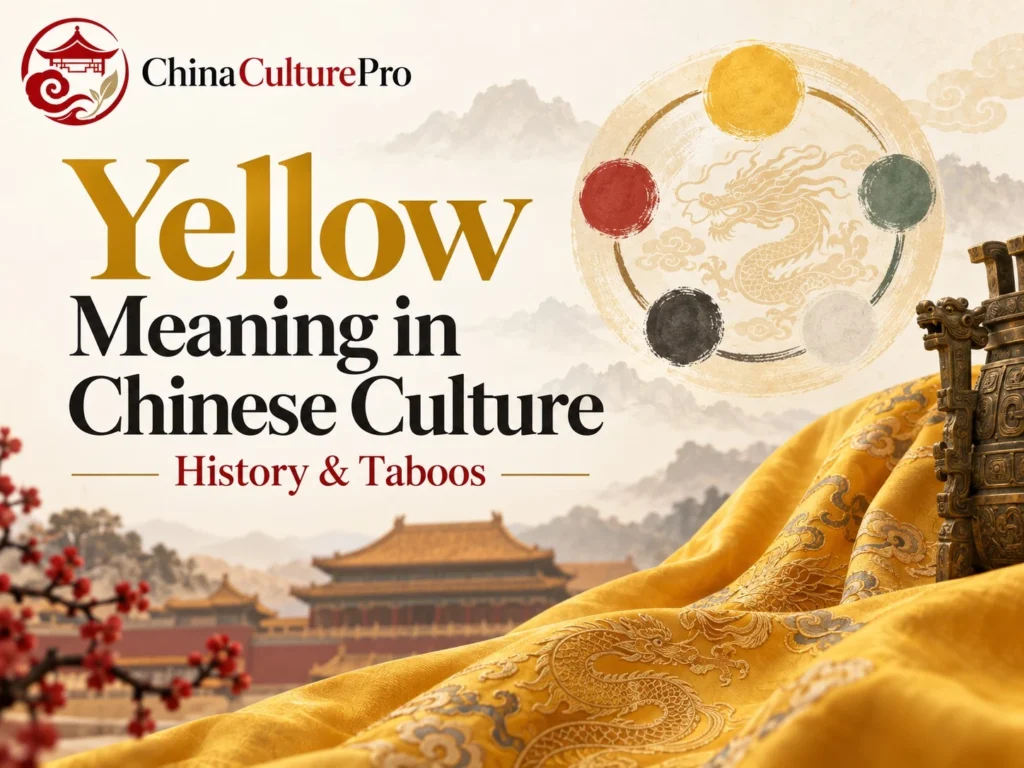

Quick Answer: What Does Yellow Symbolize in Chinese Culture?
Yellow (黄, huáng) has no single meaning across Chinese history. Its significance depends on the period, shade, material, object, wearer, and setting. The most important associations are:
- Earth and the center: In the traditional Five Colors (五色, wǔsè) system, yellow corresponds to Earth and the central direction, expressing an ordered cosmos rather than personal luck.
- Imperial authority: Particular yellow grounds became powerful rank markers in late imperial court dress and architecture, especially under the Qing dynasty. Not every yellow object was imperial.
- Land and stability: Earthy yellows can evoke soil, territory, agriculture, and groundedness, although these are broad cultural associations rather than fixed messages.
- Ritual use: Yellow appears in some Buddhist and Daoist clothing, papers, and objects, but it is not a universal Chinese religious color.
- Modern adult-content language: In modern Chinese, “yellow” can label pornographic or obscene media. This lexical meaning does not apply automatically to yellow clothing, art, or architecture.
Yellow is therefore neither a universal lucky color nor an inherently negative one. A reliable interpretation begins with context, not the hue alone.
Few Chinese colors are as recognizable—or as easily oversimplified—as yellow. English-language summaries often reduce it to “the emperor’s color,” wealth, or good fortune. Each description captures only part of the record. Yellow acquired different meanings through early cosmological classification, changing dress regulations, costly court materials, religious practice, and modern language. The same hue can mark imperial status on a Qing robe, serve as an ordinary glaze on utilitarian pottery, or carry a completely different meaning in a phrase about media content. This guide uses period, material, carrier, and setting to separate those meanings.
Huang Is Not One Fixed Historical Color
The historical category huang was broader and less mechanically standardized than a modern digital swatch. Early Chinese color words often referred to qualities embodied in substances and objects, not abstract coordinates on a screen. Silk dyed yellow, an earthen wall, a mineral pigment, a ceramic glaze, and a metallic thread could all differ in hue, saturation, texture, and brilliance while still being described within a yellow range.[1] This is why an ancient or imperial yellow should not be assigned one universal RGB, HEX, or Pantone value.
| Term | Useful historical reading | Interpretive limit |
|---|---|---|
| Bright yellow (明黄, mínghuáng) | A vivid court color closely regulated in Qing imperial dress | Not a timeless name for every “Chinese imperial yellow” |
| Apricot yellow (杏黄, xìnghuáng) | A warmer yellow category used in Qing court ranking, including dress assigned to the heir apparent | Not a modern standardized apricot swatch |
| Golden yellow (金黄, jīnhuáng) | A deeper yellow category used for other imperial-family ranks in Qing dress | Does not necessarily mean that an object is made of gold |
| Earthy yellow | A descriptive range resembling soil, ochre, or muted yellow-brown materials | Not one official court grade and not automatically low status |
These labels become meaningful only when joined to a dated regulation or an identified object. A museum may determine a robe’s status from its ground color, weave, cut, motifs, and documented function. A contemporary designer using a visually similar shade does not inherit the robe’s legal rank.
Yellow in the Five Colors and Wuxing System
The Five Colors—qing, red, yellow, white, and black—became part of a larger classificatory system linking color to directions, seasons, ritual activity, and the Wuxing (五行, wǔxíng), often translated as the Five Phases. Within the best-known correspondence, yellow aligns with Earth and the center. This “center” is a relational position surrounded by the four cardinal directions, not simply a claim that yellow is visually superior to every other color.[1][2]
| Category | Yellow correspondence | What it means |
|---|---|---|
| Wuxing phase | Earth | A category in a dynamic system of natural and ritual relationships |
| Direction | Center | The organizing position in a five-direction model |
| Seasonal scheme | Often late summer or a transitional central period | A developed correspondence that is not identical in every text |
| Broad imagery | Soil, cultivation, stability, and ordered territory | Cultural associations, not guaranteed meanings for every yellow object |
The system helped classify ritual vessels, sacrificial practices, spaces, and courtly order. It was not designed as a personalized formula for choosing a lucky wallet, wedding color, or business logo. Modern Five Elements advice may reuse the old chart, but that does not turn its historical correspondences into measurable ways to alter fortune. Readers who need the larger system can compare this color framework with the site’s explanation of the Five Elements in Chinese culture.
How Yellow Became an Imperial Color
Yellow Before the Ming and Qing
Yellow’s connection with rulership developed over time. Early ritual systems associated it with Earth and the center, but early sovereign dress was not uniformly yellow. Classical ceremonial ensembles could use dark upper garments, reddish lower garments, and rank-defining emblems. Color choice also changed as courts invoked different cosmological and dynastic precedents.
Restrictions appeared before the Ming and Qing. Tang rulers adopted yellow or ochre-yellow garments as an imperial marker, and regulations increasingly limited subjects’ use of closely associated shades. That development matters because it corrects two opposite errors: yellow was not reserved to emperors from the beginning of Chinese history, but imperial control also did not suddenly start only in the last two dynasties. The scope and enforcement of restrictions varied by period, garment, wearer, and shade.
By the late imperial period, yellow had become much more visibly embedded in court hierarchy. Ming and especially Qing institutions used regulated colors together with insignia and object type to make status legible. The safest historical summary is therefore that yellow moved from an important cosmological and ritual category toward an increasingly codified imperial color—it did not possess one unchanged political meaning for three thousand years.
Qing Court Dress: Shade, Rank and Motif
Qing dress offers the clearest evidence for a highly differentiated yellow hierarchy. Bright yellow was closely identified with the emperor and empress at the top of the system, while related yellow categories could mark an heir, imperial sons, consorts, or specially authorized wearers. The exact entitlement depended on garment class and the regulations in force; it cannot be reconstructed from an isolated color sample.
Motifs must also be read with care. Five-clawed dragons were associated with the imperial house and high privilege, but they were not, in every context, exclusive to the emperor alone. The Twelve Symbols of Sovereignty, placement and number of dragons, the robe’s cut, and its ceremonial function could narrow the identification further. A bright-yellow Qing festive robe with the prescribed imperial dragons and insignia carries a much stronger claim than an undated yellow robe bearing a generic dragon design.
One Qing emperor’s robe in the Asian Art Museum combines a bright-yellow ground with a fully regulated program of five-clawed dragons. Its museum interpretation identifies the combination—not yellow in isolation—as restricted to the emperor.[3] The same object also contains gold couching, colored clouds, bats, longevity roundels, rocks, and waves. Each material and motif performs a different visual job.
- Check the ground color: Is it bright yellow, apricot yellow, golden yellow, another color, or a faded textile?
- Identify the garment: Court, ceremonial, festive, official, theatrical, and later reproduction robes follow different rules.
- Read the insignia: Dragon claws are useful, but the Twelve Symbols, dragon placement, and accompanying motifs may be more decisive.
- Confirm the date and wearer: Regulations changed, exceptions could be granted, and late practice did not always match an ideal rulebook.
Yellow Glazed Roof Tiles and Architectural Exceptions
Yellow-glazed roof tiles make the imperial association monumental. Across the Forbidden City, yellow roofs dominate major halls and visually unify the palace as a seat of Ming and Qing rule. Their brilliance depended on ceramic materials and firing technology as well as symbolic choice. Here yellow communicates court rank and central authority through an architectural system, not a free-floating promise of luck.
The system includes meaningful exceptions. The Wenyuan Pavilion, an imperial library, uses black-glazed roof tiles; within the Five Phases logic, black’s association with Water offered a fitting symbolic response to the danger of fire. Green tiles also appeared in spaces historically associated with an heir and with growth. Such cases show why “all Chinese palaces have yellow roofs” is inaccurate. Building function, occupant, institutional status, and reconstruction history matter alongside color.
Yellow roofs also did not make every structure an emperor’s residence. Temples and other privileged buildings could receive glazed tiles under particular patronage or regulations. Conversely, an imperial ritual complex might emphasize another color: the blue roofs of the Temple of Heaven direct attention to Heaven rather than copying the palace palette. Architectural color should be read building by building.
Yellow Across Art, Clothing and Religious Contexts
A yellow surface changes meaning when its material and function change. Court porcelain, ordinary pottery, silk, a religious paper, and a painted halo may look related in a photograph while belonging to different systems.
| Carrier | Possible function | What not to assume |
|---|---|---|
| Monochrome yellow porcelain | Imperial ritual, court dining, display, or ordinary ceramic use depending on date, mark, glaze, and provenance | Every yellow-glazed vessel was made for an emperor |
| Court textile | Rank and occasion communicated through shade, weave, cut, and insignia | Yellow alone identifies the wearer |
| Vernacular cloth or pottery | Available dye, clay, glaze, or practical decoration | An earthy yellow carries imperial authority |
| Buddhist robe or image | Renunciation, institutional distinction, ritual splendor, or regional convention | All Chinese Buddhist robes are yellow |
| Daoist paper or vestment | A ritual medium whose role depends on the rite and tradition | The color itself performs scientifically demonstrable protection |
Chinese Buddhist monastic colors varied by period and region; historical sources record red, dark, gray-black, blue, yellow, and other robes rather than one universal uniform.[4] Gold and yellow in Buddhist images may create visual splendor or distinguish sacred figures, but the religious meaning belongs to the whole iconographic setting. Daoist ritual likewise cannot be reduced to “yellow equals sacred.” Yellow paper and garments have specific liturgical uses, while commercial claims that they automatically repel harm or change fortune move beyond cultural interpretation.
The Yellow Emperor, Yellow River and Cultural Naming
The Yellow Emperor (黄帝, Huángdì) and Yellow River (黄河, Huáng Hé) contain the same color word but do not derive their meanings from Qing imperial dress.
Huangdi is a legendary sovereign and culture hero, not a ruler whose biography can be treated as fully verified political history. His cult and narratives took shape over time. In the late Warring States period he was incorporated into a Five Phases scheme in which yellow, Earth, and the center corresponded.[5] Later traditions credited him with numerous cultural inventions and made him an ancestral figure. These are important histories of mythology and identity, not evidence that one historical “first emperor” created China’s yellow color code.
The Yellow River’s name is grounded more directly in physical geography. Fine loess carried through the river system gives much of the water its muddy yellow-brown appearance, especially where erosion and sediment loads are high.[6] Later descriptions of the river as a cradle of Chinese civilization add cultural and national significance, but they should not be converted into a claim that yellow itself universally means Chinese identity—or that one river basin was the sole origin of every Chinese civilization.
Is Yellow Lucky in Festivals, Gifts and Everyday Life?
Yellow is not China’s all-purpose lucky color. Red has a much clearer role in many Lunar New Year and Han Chinese wedding settings, while gold contributes material brilliance and wealth associations. Yellow may appear beside them, but visual proximity does not make the three colors interchangeable.
In a modern gift, package, or garment, yellow can feel warm, bright, seasonal, fashionable, or institutionally formal without communicating an inherited blessing. A yellow imperial-style design may evoke court aesthetics, but its meaning comes from deliberate reference to a historical palette. Yellow chrysanthemums used in contemporary memorial displays illustrate the reverse problem: the flower, arrangement, region, and occasion create the mourning association; the hue does not make every yellow object funerary.
For etiquette, judge the entire occasion. Yellow is usually acceptable in everyday clothing and design. Avoid presenting it as an emperor-only color in modern life, and do not promise that a yellow item attracts money, improves health, or changes personal fortune. Those claims confuse historical symbolism with causal power.
Why “Yellow” Can Mean Obscene Content in Modern Chinese
Modern Chinese gives huang a specialized meaning in compounds such as “yellow publications,” “yellow films,” and “yellow content”: pornographic, obscene, or sexually explicit material. The expression sao huang (扫黄, sǎo huáng), literally “sweep away yellow,” refers to campaigns or enforcement against pornographic material; in the combined phrase “sao huang da fei,” it is paired with action against illegal publications.[7]
This is a lexical convention, not a verdict on the color. A yellow coat, flower, roof, ceramic, or painting does not become obscene. Context usually makes the distinction immediate: “yellow content” invokes the modern secondary sense, whereas “yellow glazed tiles” describes a material color.
Popular explanations often attribute the usage to one foreign newspaper, book cover, or Western “yellow journalism” tradition. The proposed origins are inconsistent, and yellow journalism primarily concerns sensational reporting rather than pornography. Without stronger evidence, the responsible conclusion is that the modern sexual meaning is established but its single point of origin is uncertain.
Yellow vs Gold in Chinese Culture
Yellow and gold overlap visually, but their cultural logic differs. Treating them as synonyms transfers gold’s material value to a color that may be produced with inexpensive earth, glaze, or dye.
| Dimension | Yellow | Gold |
|---|---|---|
| Basic nature | A hue category appearing in dyes, paints, glazes, soils, and light | A precious metal or a metallic visual effect made with gold, gilding, or imitation materials |
| Main source of prestige | Cosmological position and regulated court use in specific periods | Rarity, cost, luster, durability, and religious or court craftsmanship |
| Wealth association | Not automatic | Much more direct when real gold or costly gilding is involved |
| Imperial regulation | Specific shades and carriers could be restricted | Use depended on object, expenditure, rank, and sumptuary rules; gold decoration was not one emperor-only color code |
| How to identify it | Examine hue, pigment, dye, glaze, and historical label | Examine material, metallic reflection, gilding technique, and documentation |
A Qing robe can therefore have a yellow silk ground and gold-thread dragons at the same time. The yellow ground helps communicate court rank; the gold thread supplies precious material, luminosity, and patterned detail. Calling both features “gold” erases the object’s design logic, while calling both “yellow” erases its material value.
Chinese and Western Yellow: What Not to Transfer
Neither China nor “the West” has one permanent yellow psychology. Still, several contrasts help prevent careless translation.
| Context | Common Chinese association | Common Western association |
|---|---|---|
| Historical order | Earth, center, and late-imperial rank | No equivalent Five Colors court system |
| Modern public signs | Visibility and warning may follow international design conventions | Caution, visibility, and hazard marking are widespread |
| Figurative language | Obscene or pornographic content in specific compounds | Cowardice, sensational journalism, jealousy, or sickness in particular expressions |
| Positive design | Brightness, warmth, seasonality, or historical court reference depending on context | Sunshine, cheerfulness, warmth, or energy in many modern design systems |
These are usage patterns, not universal emotional reactions. A museum object should be interpreted through its own culture and period; a contemporary campaign should be tested with its actual audience rather than justified by a generic color-psychology chart.
How to Interpret Yellow Correctly
- Identify the color and material. Ask whether the surface is dyed silk, ceramic glaze, mineral pigment, painted wood, metallic thread, gold leaf, or a modern digital color.
- Date the object or usage. Separate early ritual classification, Tang and Song regulation, Ming-Qing court systems, modern cultural practice, and contemporary branding.
- Determine the carrier and user. A robe, roof, bowl, religious paper, flower arrangement, and media label belong to different interpretive systems.
- Read the complete visual program. On dress, examine shade, dragon type, insignia, cut, and occasion. In architecture, examine building function and institutional rank. In art, read inscriptions and museum cataloging.
- Choose the narrowest supported meaning. Distinguish cosmological classification, legal status, aesthetic color, religious use, and modern vocabulary. If evidence is missing, describe the material or appearance instead of inventing symbolism.
This method follows the broader rule used throughout Chinese symbols and meanings: a motif or color becomes interpretable through its complete context, not through a universal dictionary label.
Common Misreadings of Yellow Symbolism
- Misreading: “Yellow was always reserved for the emperor.” Its political status developed over time, with restrictions appearing before the Qing and becoming especially detailed in late imperial court systems.
- Misreading: “Every yellow dragon robe belonged to an emperor.” Shade, garment type, date, wearer, dragon program, and other insignia must be assessed together.
- Misreading: “A five-clawed dragon always proves the wearer was the emperor.” Five-clawed dragons could extend within the imperial house and to privileged ranks; the complete regulated ensemble provides the stronger identification.
- Misreading: “Yellow and gold both mean wealth.” Gold’s value comes mainly from precious material and metallic craft. Yellow can be made from many ordinary materials and has no automatic wealth meaning.
- Misreading: “Yellow is a universal Chinese lucky color.” It is not the default color for all festivals, weddings, gifts, or good-fortune designs.
- Misreading: “Yellow is the sacred color of Chinese Buddhism and Daoism.” Religious colors vary by institution, region, period, object, and ritual.
- Misreading: “The modern adult-content meaning makes yellow unlucky.” That meaning belongs to particular words about media, not to yellow physical objects.
- Misreading: “The Five Colors chart can select a personal success color.” The historical system classified ritual and cosmological relationships; it does not demonstrate control over individual outcomes.
FAQs About Yellow Meaning in Chinese Culture
What does yellow symbolize in Chinese culture?
Yellow can represent Earth and the center in the Five Colors system, imperial rank in specific late-imperial settings, or soil and territory in broader imagery. It also has a modern secondary meaning in phrases referring to pornographic content. The relevant meaning depends on period, material, object, and wording.
Was yellow reserved only for the Chinese emperor?
No universal rule covered every dynasty, shade, and object. Yellow restrictions developed gradually, while Qing court dress assigned particular shades and motifs to different members of the imperial hierarchy. Bright yellow in a fully regulated imperial ensemble is much more specific than an ordinary yellow surface.
Is yellow a lucky color in China?
Not in every setting. Yellow has prestigious and positive associations in some cosmological and court contexts, but it is not the universal main color of Chinese weddings, festivals, or good-luck gifts. It has no demonstrated power to attract money, health, or success.
Why does yellow mean pornography in modern Chinese?
Modern Chinese uses “yellow” in established compounds for pornographic or obscene media, and sǎo huáng for action against such material. The precise historical origin is disputed. This lexical usage does not alter the meaning of yellow clothing, ceramics, buildings, or flowers.
Are yellow and gold the same in Chinese culture?
No. Yellow is a hue; gold is a precious metal or metallic effect. Yellow’s imperial prestige came from historical regulation and cosmological associations, while gold’s wealth and status associations derive more directly from rarity, cost, and craftsmanship.
Sources
[1] Victoria Bogushevskaya. Chinese Color Language
[2] Jun Wenren. Ancient Chinese Encyclopaedia of Technology: Translation and Annotation of the Kaogong Ji
[3] Asian Art Museum. Emperor’s Dragon Robe
[4] John Kieschnick. The Symbolism of the Monk’s Robe in China
[5] Encyclopaedia Britannica. Huangdi
[6] Encyclopaedia Britannica. Yellow River
[7] National Office Against Pornography and Illegal Publications. Official “Sao Huang Da Fei” Website