
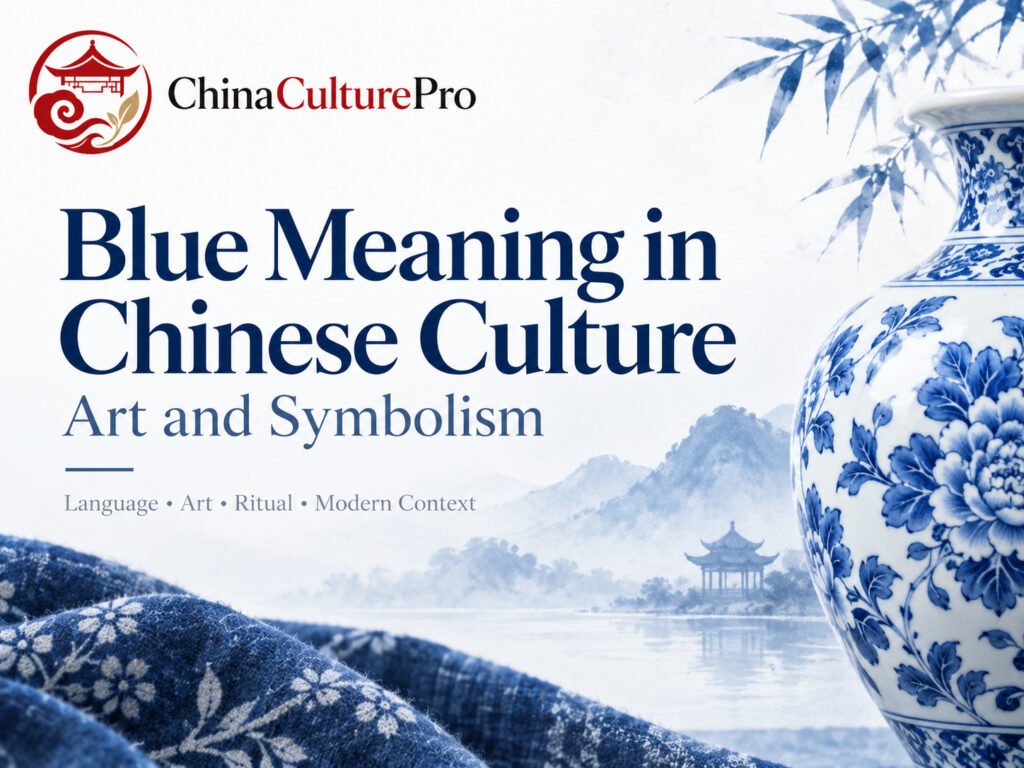

Quick Answer: What Does Blue Symbolize in Chinese Culture?
Blue (蓝色, lánsè) has no single, timeless meaning in Chinese culture. Its interpretation depends on the word used, the material that creates the color, the object, the period, and the setting.
- Language: Modern blue differs from qing (青, qīng), a historical category that can include blue, green, blue-gray, and dark tones.
- Nature: Blue or qing skies and still water can suggest clarity, distance, or quiet, but these are contextual aesthetic associations.
- Art and craft: Indigo textiles, mineral pigments, and cobalt-blue porcelain are valued chiefly through materials, technique, and motif.
- Imperial ritual: In specific Ming–Qing state rites, blue referred to Heaven; it was not a universal imperial color.
- Modern design: Calm, trust, and professionalism are contemporary design associations, not fixed meanings inherited from classical China.
Blue is neither a universal lucky color nor an unlucky one in China. It has no established power to attract wealth, heal, protect, or change fate, and its ordinary use carries no nationwide taboo.
Blue (蓝色, lánsè) is a familiar modern color term, but it is not a neat key to all blue-looking things in Chinese history. Classical texts more often organize part of this visual territory under qing (青, qīng), while dyers, painters, potters, and ritual specialists name the material or process that produced a particular hue. A blue robe, an indigo cloth, an azurite mountain, and a cobalt-painted vase therefore do not automatically communicate the same message.
This guide treats context as the deciding evidence. It separates language from pigment, hue from motif, state ritual from ordinary life, and modern branding from inherited cultural convention. That method prevents two common errors: treating blue as a fixed Chinese symbol of trust or wisdom, and forcing modern blue into the ancient Five Colors (五色, wǔsè).
Blue Is Not One Historical Color: Lan, Qing, Dianlan and Shiqing
Historical Chinese color vocabulary is material and object-sensitive. Modern English “blue” may translate several terms, but those terms are not interchangeable. Scholarship on Chinese color language stresses that qing can name different regions of today’s blue–green–dark spectrum according to the object and period.[1][2]
| Term | Basic meaning | Typical carrier | Interpretation limit |
|---|---|---|---|
| Blue, 蓝色 (lánsè) | The modern general term for a recognizable blue hue | Clothing, products, signs, digital design | A modern category, not an ancient ritual color class |
| Qing, 青 (qīng) | A broad historical color category spanning blue, green, blue-gray, and sometimes dark tones | Classical texts, ritual classification, ceramics, landscapes | Must be translated from context, not automatically as blue or green |
| Indigo blue, 靛蓝 (diànlán) | Deep blue produced through plant-based indigo dyeing | Printed cotton, batik, regional dress | Specific meanings normally come from motif and community use, not hue alone |
| Azurite blue, 石青 (shíqīng) | Mineral blue pigment made from azurite | Blue-green landscapes, murals, decorative painting | An artistic material, not a Five Colors category |
| Flower blue, 花青 (huāqīng) | A transparent plant-derived painting color | Ink-and-color painting and washes | A technical painters’ term without a fixed auspicious meaning |
The character 蓝 originally referred primarily to plants from which dye could be obtained. Only later did it become the ordinary name of a color. Qing did much of the broader color-category work in early and imperial texts. Neither term maps reliably onto one RGB or HEX value: fibers, minerals, glaze chemistry, firing, aging, and lighting all change what viewers see.
This distinction matters whenever an English museum label says “blue.” The translator may be describing appearance, while the Chinese title identifies qing, indigo, azurite, cobalt, or another material tradition. The cultural meaning should follow the more precise evidence.
Is Blue One of the Five Traditional Chinese Colors?
No. Modern blue is not one of the traditional Five Colors (五色, wǔsè). The standard set is qing, red, yellow, white, and black. In the correlative Five Phases (五行, wǔxíng) system, qing is linked with Wood, the east, and spring, while black corresponds to Water and the north. Blue does not have an independent, fixed position in that scheme.[1]
The associated eastern emblem is the Azure Dragon (青龙, Qīnglóng), not a “green dragon” or a modern “blue dragon.” The word qing in its name carries the historical category and its cosmological setting. Readers interested in the full creature symbolism can compare the site’s guide to the Azure Dragon.
The Five Colors were a framework for classifying directions, seasons, rites, and cosmic order. They were not a personal palette for luck, fashion, or fate. Assigning modern blue to Water because oceans look blue is a later visual guess, not the historical correspondence.
From Indigo Plant to Blue Dye: The Classical Language of Lan
What “Qing Comes from Lan” Originally Means
The best-known classical sentence involving lan appears in the “Encouraging Learning” chapter of the Xunzi: “Qing is taken from lan, yet is bluer than lan.” In the original material comparison, lan is the dye-producing plant and qing is the processed color that can emerge deeper than the source plant.[3]
The line became a metaphor for learning: disciplined transformation allows a student or later generation to surpass a teacher or predecessor. It does not establish blue as the Chinese color of intelligence, progress, or academic success. The force of the passage comes from improvement through a process, not from an inherent psychological property of blue.
The sentence also exposes a translation trap. Rendering both words as modern color labels erases the relation between raw plant and finished dye. In cultural interpretation, the most faithful English explanation often needs to preserve the terms lan and qing before supplying a smooth translation.
Indigo-Dyed Cloth and Regional Textile Traditions
Plant indigo became one of China’s most important practical dye systems. Leaves were fermented and processed into a dye vat; fabric emerged greenish and developed a deeper blue as the dye oxidized. Indigo was durable, repeatable, and suitable for cotton as well as other fibers. China National Silk Museum materials document the long history of plant dyes and the expansion of patterned and dyed textiles.[4]
Regional traditions matter more than a supposed national “blue meaning.” Nantong blue calico uses resist paste to create crisp blue-and-white floral, animal, and geometric designs. Miao and other southwestern textile traditions use indigo with wax-resist, embroidery, pleating, and locally meaningful pattern systems. In either case, a motif may express fertility, continuity, protection in folk belief, or family identity—but only when the specific design and community context support that reading.
Indigo itself is therefore best understood as a material tradition: practical, labor-intensive, and aesthetically associated with everyday cloth and regional craft. Calling it a “peasant color” is too reductive, while calling every indigo textile auspicious ignores what the pattern actually says.
Blue-and-White Porcelain: Color, Technique and Motif
Blue-and-white porcelain (青花瓷, qīnghuācí) separates the color-producing material from the painted image. Potters painted cobalt pigment onto a pale ceramic body, covered it with transparent glaze, and fired it at high temperature. The blue is an underglaze effect; it is not an independent good-luck symbol.
The technique reached mature large-scale production in the Yuan dynasty and became especially important under the Ming. Cobalt sources and recipes varied. Some celebrated fourteenth- and fifteenth-century wares used imported West Asian cobalt, while Chinese cobalt also became important in later production. The National Museum of Asian Art emphasizes both cobalt’s material role and the international demand for Chinese blue-and-white porcelain.[5]
Meaning comes primarily from the painted subject and the vessel’s function. A dragon, lotus, peony, phoenix, wave border, inscription, or narrative scene must be interpreted on its own evidence. A dragon may mark imperial authority in a regulated court context; a lotus may carry Buddhist or decorative associations; a landscape may simply create visual pleasure. The cobalt blue does not turn every motif into a blessing.
This is also why Chinese blue-and-white ware should not be read through the British Blue Willow story. That romantic tale belongs to a later European chinoiserie pattern, not to the symbolic system of Chinese porcelain.
Blue-Green Painting and Mineral Pigments
Blue-green landscape painting (青绿山水, qīnglǜ shānshuǐ) is not a purely blue genre. It combines mineral blues—especially azurite—with mineral greens such as malachite, often alongside ink, outlines, and layered washes. Particle size, preparation, binder, and application affect the final hue and luminosity.[5]
The mode was established by the Tang dynasty. In later periods, artists could use it to evoke an antique style, richly imagined mountains, or paradisiacal and idealized realms; Princeton University Art Museum describes these historical and otherworldly associations while also showing how varied the mode became.[6]
Those associations belong to a pictorial tradition, not to “blue” by itself. A particular work may feel tranquil or transcendent, but the conclusion should come from composition, subject, inscription, patronage, and historical style. Blue-green pigment does not automatically promise healing, longevity, spiritual purity, or good fortune.
Blue, Heaven and Imperial Ritual
Blue did acquire a clear institutional meaning in some Ming–Qing state rites: it could identify Heaven. This is a narrow but well-documented use, not a universal rule for Chinese culture.
At Qing ritual altars, ceramic offering vessels were color-coded by destination. A dark-blue-glazed dou in The Met’s collection belonged to the rites for Heaven; comparable systems used yellow for Earth, red for the Sun, and white for the Moon.[7] The famous blue-glazed roofs at Beijing’s Temple of Heaven work within the same celestial ritual environment.
Dress followed similarly specific rules. The Palace Museum identifies a Qianlong-period blue satin court robe as clothing for the emperor during major ceremonies including the winter-solstice sacrifice at the Circular Mound Altar, prayers for grain, and prayers for rain.[8] The robe’s meaning came from its ritual use, imperial rank, dragon and Twelve Symbols decoration, and prescribed color together.
Blue was therefore not the emperor’s universal color. Yellow remained central to many Qing court garments and spaces, while common people used indigo and other blues in ordinary textiles. A blue object becomes “heavenly” or imperial only when date, regulation, imagery, and function support that conclusion.
What Does a Blue Face Mean in Chinese Opera?
In Peking opera, facial makeup (脸谱, liǎnpǔ) uses bold colors as stage codes. A blue face often marks a forceful, resolute, unruly, or stubborn character; in some repertories, blue and green identify grassroots heroes or figures outside conventional authority. The well-known outlaw Dou Erdun is frequently shown with blue makeup.
This is not a single psychological dictionary. Meaning varies with role type, play, regional genre, line pattern, and the other colors on the face. Official introductions to Peking opera describe blue and green as colors used for grassroots heroes, while other performance references emphasize stubbornness or fierceness.[9]
Opera coding applies only to performance. It should not be used to judge a real person wearing blue, interpret a porcelain motif, or define blue in Chinese culture as “brave.”
Does Blue Mean Calm, Trust, Wisdom or Healing?
The most familiar online descriptions of blue usually come from modern global design and Western color psychology. They may be useful for a contemporary interface or brand, but they are not reliable summaries of classical Chinese symbolism.
| Popular label | Traditional status | Safer interpretation |
|---|---|---|
| Calm or serenity | No fixed classical rule | A possible response to sky, water, or a restrained blue composition |
| Trust, reliability, professionalism | Modern design convention | Common in contemporary corporate and public communication, not inherited ritual symbolism |
| Wisdom or learning | Often misread from “qing comes from lan” | The Xunzi passage praises learning and transformation, not the hue blue |
| Healing, health, or longevity | No established traditional basis | A marketing or personal association unless a separate motif supplies the meaning |
| Sadness or melancholy | Not a traditional Chinese blue meaning | “Feeling blue” is an English idiom and should not be projected onto Chinese objects |
Modern Chinese audiences participate in global visual culture, so a bank logo may use blue for reliability and a wellness brand may use it for calm. Those readings are real contemporary conventions. They simply answer a different question from what blue meant in a Qing ritual, a Yuan porcelain workshop, or a classical text.
Is Blue Lucky, Unlucky or Taboo in China?
For ordinary contemporary use, blue is generally neutral. China has no nationwide custom declaring all blue lucky or unlucky, and there is no blue equivalent of the narrow “green hat” taboo. Etiquette still depends on the event and the people involved.
| Setting | Practical reading | Boundary |
|---|---|---|
| Everyday clothing | Normal and widely used | No standard national taboo |
| Gifts and packaging | Usually safe and neutral | Meaning comes from the gift, text, and motif more than the color |
| Lunar New Year | Acceptable as an accent | Red and warm metallic tones are more conventional festive choices |
| Weddings | Appropriate for guests and modern design | Not the principal traditional bridal color; family preferences vary |
| Funerals | Dark blue can be suitably restrained today | Traditional Chinese mourning centered on undyed or white garments, not blue |
Calling blue “safe” does not make it auspicious. A navy suit can be respectful, a blue gift box can be elegant, and a cobalt vase can be valuable without any of them promising luck. Likewise, a somber blue may suit a funeral because of modern dress convention, not because blue traditionally symbolizes death.
How to Interpret Blue Correctly in Chinese Art and Design
- Identify the term and material: Decide whether the evidence points to modern blue, historical qing, indigo dye, azurite pigment, cobalt underglaze, or another blue-producing material. This prevents a modern color label from replacing a historical category.
- Identify the carrier: Ask whether the blue appears on textile, porcelain, painting, architecture, court dress, opera makeup, packaging, or a digital screen. Each medium has its own conventions.
- Date and locate the object: Separate ancient ritual classification, Tang painting, Yuan–Ming ceramic technology, Qing court regulation, regional folk craft, and modern design. A meaning from one period cannot be assumed in another.
- Read motifs and text: Inspect dragons, flowers, inscriptions, border patterns, titles, seals, and museum labels. These often carry more semantic weight than the hue.
- Use the narrowest supported meaning: If documentation proves only that cobalt, indigo, or azurite was used, describe the material and aesthetic effect. Add luck, rank, religion, or emotion only when the object’s context supports it.
This process also applies beyond blue. The site’s broader guide to Chinese symbols and meanings uses the same context-first principle for animals, plants, colors, characters, and decorative motifs.
Common Misreadings of Blue Symbolism
- Misreading: Blue is one of the ancient Five Colors. Correction: qing is the historical category; modern blue is not an independent member.
- Misreading: Blue belongs to Water in Wuxing. Correction: Water corresponds to black, while qing corresponds to Wood.
- Misreading: Qing always means blue. Correction: its translation can be blue, green, blue-gray, or dark depending on object and period.
- Misreading: “Qing comes from lan” makes blue a symbol of wisdom. Correction: lan is the source plant and the saying praises learning through transformation.
- Misreading: Blue-and-white porcelain is lucky because it is blue. Correction: cobalt supplies color; motifs, inscriptions, use, and patronage supply specific meanings.
- Misreading: Blue-green landscapes are inherently calming or healing. Correction: tranquility may be an aesthetic response, not a fixed traditional symbol.
- Misreading: Blue was an imperial color throughout Chinese history. Correction: its court significance was regulated and occasion-specific, especially in rites to Heaven.
- Misreading: Blue opera makeup defines a real personality type. Correction: it is a theatrical code that varies by role and repertory.
- Misreading: Blue attracts luck, protects the wearer, or changes fate. Correction: no accepted historical system gives ordinary blue objects those powers.
FAQs About Blue Meaning in Chinese Culture
What does blue symbolize in Chinese culture?
Blue has no single traditional meaning. Historical texts often use qing rather than modern blue; indigo, azurite, and cobalt belong to different craft traditions; blue can signify Heaven in prescribed imperial rites; and contemporary design may associate it with calm or professionalism. The object and setting determine the interpretation.
Is blue a lucky color in China?
Blue is generally neutral rather than a standard lucky or unlucky color. It is acceptable in clothing, gifts, weddings, and most public settings, but it is not a principal traditional color for Lunar New Year blessings. A blue object becomes auspicious only if its motif, wording, or ceremonial context supplies that meaning.
Is blue one of the Five Traditional Chinese Colors?
No. The Five Colors are qing, red, yellow, white, and black. Qing covers part of what modern viewers call blue and green, but it is a historical category with its own ritual associations. Water corresponds to black, not blue.
What is the difference between blue and qing in Chinese?
Modern blue is lánsè, a relatively narrow hue category. Qing is an older, broader term that may describe blue sky, green vegetation, blue-gray ceramics, or dark tones. Its English translation must follow the period and object; it cannot always be rendered as either blue or green.
What does blue mean in Chinese porcelain and opera?
In blue-and-white porcelain, cobalt is the coloring material; the painted motif and vessel context carry specific symbolism. In opera, blue facial makeup often marks a forceful, stubborn, or unconventional hero, but the code varies by role and remains strictly theatrical.
Sources
[1] Victoria Bogushevskaya. Chinese Color Language
[2] Victoria Bogushevskaya. Chinese qīng: When and Why It Means Green, Blue or Dark
[3] Chinese Text Project. Xunzi: Encouraging Learning
[4] China National Silk Museum. English Exhibition Guide
[5] National Museum of Asian Art. Blue
[6] Princeton University Art Museum. Blue-Green Realms in Chinese Painting
[7] The Metropolitan Museum of Art. Vessel for Ritual Offering (Dou)
[8] Palace Museum. Blue Satin Court Robe Embroidered with Dragons amid Clouds
[9] State Council Information Office of the People’s Republic of China. Peking Opera