
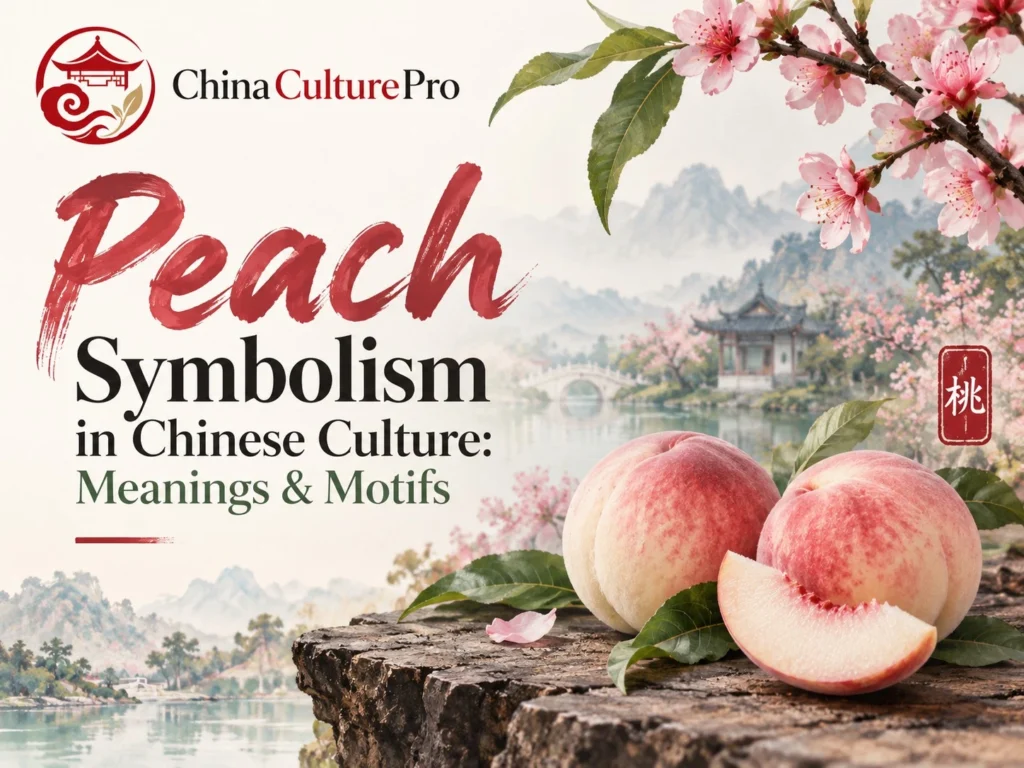

Quick Answer: What Does the Peach Symbolize in Chinese Culture?
Peach (桃, táo) has several distinct meanings in Chinese art and literature. Fruit, flowers, ritual wood, literary landscapes, and compound designs do not form one interchangeable symbolic code.
- Peach fruit (桃果, táoguǒ): longevity and wishes for a long life, especially in birthday art shaped by Xiwangmu (西王母, Xīwángmǔ).
- Peach blossom (桃花, táohuā): spring, youth, and—in an appropriate poetic or wedding context—marriage or romantic feeling.
- Peach Blossom Spring (桃花源, Táohuā Yuán): Tao Yuanming’s hidden, peaceful community and the ideal of withdrawal from a troubled world.
- Peachwood and peachwood charms (桃符, táofú): traditional door rituals in which peachwood was believed to repel harmful forces.
- Compound motifs: peaches with bats, Shoulao, Magu, longevity characters, or other emblems create specific birthday wishes.
Family continuity is a secondary reading in some marriage imagery, not a universal peach meaning. All of these are cultural metaphors, literary ideas, ritual beliefs, or artistic wishes. A peach image cannot lengthen life, attract a partner, improve fertility, repel danger, or change fortune.
A nineteenth-century jadeite peach (桃, táo)-shaped cup in the Metropolitan Museum of Art carries a tiny bat among its branches. Together they make a birthday image of longevity and blessing. Zhang Hong’s 1638 handscroll Peach Blossom Spring (桃花源, Táohuā Yuán), named for peach blossom (桃花, táohuā), instead follows Tao Yuanming’s story of a hidden community beyond a flowering grove. Its subject is withdrawal from disorder, not long life or romance.
The shared plant does not produce a shared meaning. In Chinese art, peach fruit (桃果, táoguǒ), peach blossom (桃花, táohuā), wood, and grove belong to different traditions. Date, medium, inscription, narrative, and companion motifs decide which reading fits. This contextual method also governs the wider system of Chinese symbols and meanings.
Peach Fruit, Peach Blossom, Peach Wood, and Peach Blossom Spring: What Is the Difference?
English “peach” can conceal several Chinese categories. The botanical plant is Prunus persica. Kew treats it as an accepted species and describes its native range as a cultigen from north-central China.[1] Cultural interpretation, however, begins with the represented part or story rather than taxonomy alone.
| Subject | Recognition clues | Leading meaning | Do not assume |
|---|---|---|---|
| Peach fruit | Ripe fruit; birthday vessel; immortals, bats, or longevity characters | Longevity or immortality imagery | Romance or marriage |
| Peach blossom | Flowering branch, spring landscape, wedding poem or inscription | Spring and youth; marriage or love only with supporting context | Every blossom means peach-blossom luck (桃花运, táohuā yùn) |
| Peach tree or grove | Whole trees or a flowering grove in landscape painting | Spring scenery or a named narrative setting | Every grove is Peach Blossom Spring |
| Peachwood or taofu | Door plaque, carved board, door-god name, New Year ritual context | Historical apotropaic belief at the doorway | Modern peachwood jewelry provides protection |
| Peach Blossom Spring | Fisherman, boat, stream, cave, isolated village, or a “Peach Spring” title | A hidden ideal community and withdrawal from disorder | A romantic paradise |
| Peachbloom glaze | Mottled red Qing ceramic glaze without fruit or flowers | A ceramic color and technique | Peach symbolism merely because of the English name |
The table is a diagnostic guide, not a replacement for an object record. Museum titles, inscriptions, and documented use should outrank visual guessing.
Two objects can also look “peach-like” for entirely different reasons. A vessel may copy the fruit’s rounded form, a painter may record a flowering branch, and a potter may use a mottled red glaze later called peachbloom in English. Only the first two actually depict peach material, and even they do not share one message. This negative test improves identification: before assigning a symbolic meaning, ask whether the object represents a plant at all, whether the name is modern or historical, and whether an inscription or museum record connects the form to a recognized story or occasion.
How Peach Symbolism Developed Across Chinese History
Peach meanings accumulated rather than replacing one another. Early marriage poetry, ritual beliefs about wood, immortality mythology, literary utopia, and later birthday decoration developed on different tracks.
Early Peach Blossoms, Marriage Poetry, and Ritual Wood
The Book of Poetry song Tao Yao is the central early text for peach blossom and marriage. It begins with a young, brilliantly flowering peach and turns toward a bride joining a household: “The peach tree beams so red; how brilliant are its flowers.” Later stanzas move from blossoms to abundant fruit and luxuriant leaves, repeatedly wishing that the bride will fit harmoniously within her home.[2]
The poem supports a marriage and household reading, not the modern idea that any blossom predicts romantic luck. Peachwood followed another path: early and medieval traditions associated it with rites intended to restrain harmful spirits, while later New Year practice placed inscribed taofu at doors. This history does not transfer to flowers or fruit.
Xiwangmu and the Peaches of Immortality
In Han and later religious and mythic imagery, Xiwangmu (西王母, Xīwángmǔ), the Queen Mother of the West, became closely connected with the Peaches of Immortality (蟠桃, pántáo). The divine fruit in her distant realm promised immortality within myth. Artists later depicted her orchard, banquets, immortals carrying peaches, and human seekers hoping to share the fruit’s power.
Texts and pictures do not preserve one uniform ripening schedule. Popular retellings often say three thousand years, but versions vary. As the motif moved into secular birthday art, immortality became a human wish for longevity. A cup, vase, embroidery, or painting translated myth into ceremonial good wishes.[3]
Tao Yuanming and the Peach Blossom Spring
Tao Yuanming’s fifth-century Record of Peach Blossom Spring tells of a fisherman who follows a stream through a flowering grove, passes a narrow opening, and finds an isolated farming community. Its people say their ancestors escaped the upheaval of the Qin period and thereafter lost contact with outside dynasties. The fisherman leaves, marks the route, and cannot find the settlement again.[4]
Peach trees are the threshold, not a romantic subject. The failed return makes the peaceful ideal unreachable. Zhang Hong’s 1638 handscroll translates this literary geography into mountains, water, paths, figures, and a secluded village.[5] It is too simple to label every such image a Daoist immortal realm, and wrong to call the story a love affair.
Ming–Qing Birthday Art and Auspicious Decoration
During the Ming and Qing periods, peach fruit became especially visible on court and domestic birthday objects. Painters and artisans combined it with bats, the Star God of Longevity, Magu, cranes, deer, lingzhi, rocks, and longevity characters. Each companion narrowed the message, producing wishes for long life, blessings, or an auspicious birthday.
Naturalistic peach-blossom painting and Peach Blossom Spring landscapes continued at the same time. This coexistence matters: “Qing peach” is not a single symbolic category. A flowering branch on an album leaf may mark spring; a nine-peach vase may serve a longevity context; a handscroll may narrate Tao Yuanming. Period alone never settles the meaning.
Why Does the Peach Fruit Symbolize Longevity and Immortality?
The longevity association proceeds through three stages. First, myth gives the divine peach the power to confer immortality. Second, Xiwangmu’s orchard and gatherings turn the fruit into a recognizable narrative attribute. Third, birthday art adapts that impossible divine immortality into a human wish for a long, healthy life.
That distinction separates immortality from longevity. Immortality belongs inside stories of deities and transcendents. Longevity is the ceremonial wish expressed by a gift or image. A longevity peach (寿桃, shòutáo)—whether a depicted fruit, peach-shaped object, or celebratory food—is a cultural sign of the wish, not a mechanism for achieving it.
Several figures identify the setting:
- Xiwangmu: appears as the divine owner of the immortality peaches and host of otherworldly gatherings.
- Shoulao: the Star God of Longevity, is often shown with a peach, staff, deer, or other age-related attributes.
- Magu: appears in later birthday imagery as an immortal woman presenting longevity gifts.
- Dongfang Shuo: appears in humorous or legendary scenes about stealing peaches from Xiwangmu’s orchard.
The Met’s jadeite cup 02.18.433a,b takes the shape of a peach and includes a bat, combining longevity with blessing.[3] A botanical blossom study lacks those cues.
What Do Peach Blossoms Mean in Love, Marriage, and Spring?
Peach blossom has three overlapping but separable histories.
First, it is a seasonal sign. In a landscape or bird-and-flower album, spring may be the entire subject. Peach blossoms with swallows can intensify that reading; as the guide to swallow symbolism explains, paired birds do not by themselves prove marriage.
Second, Tao Yao gives blossom, fruit, and leaves a marriage framework. The song praises a bride and wishes harmony for the household she joins. A wedding textile, inscription, or painting that invokes the poem may therefore use peach blossom as part of a marriage blessing. That is different from treating peach as China’s universal “flower of love.” Butterfly-and-peach imagery can also acquire a courtship or wedding sense, but only when the wider context supports the reading; see the discussion of butterfly symbolism.
Third, later poetry expanded peach blossom toward beauty, encounter, and desire. Cui Hu contrasts a remembered face with returning blossoms, creating an image of meeting, absence, and longing. Later astrological terminology and modern speech use peach-blossom luck (桃花运, táohuā yùn) for romantic attention. The phrase should not be projected onto an early poem or unsigned spring painting.
Fertility is also conditional. In Tao Yao, abundant fruit and foliage support a household-flourishing reading. A single flower branch without a wedding text, fruit, or family setting does not promise children.
What Does Peach Blossom Spring Actually Symbolize?
Peach Blossom Spring is best understood as an imagined community outside ordinary political time. Its inhabitants farm, maintain households, and live without knowledge of later dynastic change. Their separation began in flight from warfare. The story can therefore suggest refuge, social harmony, agrarian sufficiency, withdrawal, and a critical alternative to a disordered world.
The visitor leaves and tries to return, but the route disappears. The ideal cannot become an ordinary mapped destination.
Look for several narrative clues together:
- a fisherman or small boat moving along a stream;
- a flowering grove and a narrow mountain opening;
- an enclosed village with fields, paths, and residents;
- a title or inscription containing “Peach Spring” or “Peach Blossom Spring.”
Zhang Hong’s dated Met handscroll is explicitly titled Peach Blossom Spring, so its narrative is secure.[5] A grove without figures, cave, village, or title may simply be spring scenery. The tale is neither a historical travel report nor primarily a romance, and it is not automatically a Daoist immortal paradise.
What Did Peach Wood and Taofu Mean in Traditional Rituals?
Peachwood belongs to a material and ritual tradition distinct from peach fruit and flowers. Historical belief linked the wood with powers that could restrain or repel harmful beings. Door traditions told of Shentu and Yulei, figures associated with guarding a supernatural passage beneath a great peach tree. Their names or images could be placed on peachwood boards at an entrance.
Taofu became part of New Year door practice and are often discussed as predecessors to written Spring Festival couplets. Wang Anshi’s line about exchanging “new peachwood charms for the old” links the changing year, doorway, and renewal. A museum overview likewise traces couplets to boards bearing the guardians’ names.[6]
The correct language is conditional: peachwood was believed to repel harmful forces, and taofu were used in protective rites. A modern bracelet, blossom, or fruit does not become protective by sharing the word “peach,” and this history supplies no placement rules.
Common Peach Motifs and Their Meanings in Chinese Art
The smallest meaningful unit is usually the complete composition. The table offers leading readings while retaining the need to check title, use, and date.
| Motif | How it works | Leading contextual meaning | Limit |
|---|---|---|---|
| Single peach fruit | Fruit recalls the immortality peach; a birthday function strengthens the reading | Long-life wish | Not romance; a natural still life may remain open |
| Peach and bat | Peach supplies longevity; bat, fú, sounds like blessing, fú | Blessing and longevity together | Neither element supplies the other’s meaning alone |
| Peach with Xiwangmu, Shoulao, or Magu | Mythic or divine figures identify a birthday and immortality narrative | Immortality story or longevity wish | Not a factual promise of endless life |
| Peach with crane, deer, lingzhi, or longevity character | Several longevity motifs reinforce one another | Formal birthday blessing | Meaning belongs to the ensemble and occasion |
| Nine peaches | Fruit plus a courtly group of nine; jiǔ, “nine,” sounds like jiǔ, “long-lasting” | Extended longevity in Qing birthday art | No universal lucky-count rule |
| Peach, pomegranate, and Buddha’s-hand citron | Three fruits assemble the Three Abundances | Longevity, descendants, and blessings | Each fruit has a different role; no real-world guarantee |
| Peach-blossom branch | Seasonal flower, perhaps with poetic or wedding cues | Spring and youth; conditional marriage meaning | Not automatic romantic luck |
| Peach Blossom Spring landscape | Fisherman, stream, cave, village, or title | Hidden ideal community and withdrawal | Not a love garden |
Peaches and Bats: Blessings and Longevity
Peach and bat demonstrate compound visual grammar. The peach contributes longevity through Xiwangmu’s immortality fruit. Bat (蝠, fú) is a full Mandarin homophone of blessing (福, fú). When both appear on a birthday dish, cup, textile, or carving, the design can wish its recipient both blessing and long life.
The Met’s Yongzheng-period dish 1997.1.11 is catalogued with peaches and bats.[7] A peach alone does not mean “blessing,” and a bat alone does not mean “longevity.” The guide to bat symbolism in Chinese culture explains the homophone.
A crane can strengthen a birthday composition, but a bird beside a blossom may be naturalistic; see crane symbolism.
Nine Peaches and Birthday Ceramics
Nine-peach designs are strongly associated with Qing court ceramics. In an appropriate birthday context, the fruit supplies longevity and nine (九, jiǔ) can reinforce duration through its exact Mandarin homophone long-lasting (久, jiǔ). The Met’s Qianlong-mark vase 17.120.194 bears nine peaches, while the museum’s longevity materials place the work within this auspicious tradition.[3][8]
This is a situated composition, not permission to turn every count into fortune telling. Nine becomes reliable evidence only when period, object type, inscription, museum documentation, or declared intent supports the longevity reading.
What Do Peach Expressions Mean in Chinese Language and Literature?
Language creates meanings that may have no independent existence in an uninscribed object. A phrase must therefore be recognized as a textual allusion before it is used to explain an image.
| Expression | Practical English rendering | Source or context | Meaning and boundary |
|---|---|---|---|
| 桃之夭夭, táo zhī yāoyāo | “The peach tree in full bloom” | Book of Poetry, Tao Yao | A marriage and household blessing, not generic dating luck |
| 桃花源 / 世外桃源, Táohuā Yuán / shìwài táoyuán | Peach Blossom Spring / an earthly haven | Tao Yuanming | A secluded ideal community outside worldly disorder |
| 桃花运, táohuā yùn | Peach-blossom luck | Later astrology and modern speech | Romantic attention or opportunity; do not apply automatically to old paintings |
| 人面桃花, rénmiàn táohuā | Human face and peach blossoms | Cui Hu’s poem | A remembered encounter, absence, and changed circumstances |
| 投桃报李, tóu táo bào lǐ | Give a peach and return a plum | Book of Poetry allusion | Reciprocity and returning kindness |
| 桃李满天下, táolǐ mǎn tiānxià | Peaches and plums throughout the world | Later literary and educational idiom | A teacher with many students; “peach and plum” functions as a metaphor for pupils |
These expressions cannot be extracted word by word. The peach in “peaches and plums throughout the world” does not make a peach painting an education symbol; peach-blossom luck is not a permanent property of painted petals.
What a Chinese Peach Symbol Does Not Automatically Mean
| Common claim | More accurate interpretation |
|---|---|
| Every peach element means longevity | Peach fruit carries the strongest longevity association in birthday and immortality contexts; blossom, wood, and Peach Blossom Spring have different histories |
| Peach blossom and peach fruit mean the same thing | Blossom usually begins with spring and youth; fruit leads toward immortality and long-life wishes |
| Every peach blossom means romance or peach-blossom luck | Marriage poetry, a wedding function, inscription, or later romantic narrative is needed; ordinary spring imagery may be nonromantic |
| Peach Blossom Spring is a love story | Tao Yuanming describes an isolated community formed by people fleeing warfare, not a romantic couple |
| Peachwood jewelry protects its wearer | Peachwood had a place in historical protective belief; no object has proven supernatural power |
| Nine peaches are a universal feng shui formula | Nine-peach longevity imagery is especially meaningful in documented Qing birthday art, not as an all-purpose counting rule |
| Peachbloom glaze carries peach symbolism | The term names a ceramic color effect; without peach imagery or inscription, it does not invoke blossom, fruit, or peach mythology |
| Color, fruit count, or branch direction predicts fortune | No unified rule covers Chinese art across periods, regions, and media |
| Peach designs attract partners, fertility, health, or long life | They express stories and wishes; they do not cause those outcomes |
| Japanese peach customs explain Chinese objects | Related plants can enter different cultural systems; one tradition cannot substitute for evidence from another |
This rejects universal claims, not documented local customs or modern personal associations.
How to Interpret or Use a Chinese Peach Symbol Correctly
Use this six-step method for a museum object, antique-style design, tattoo, wedding graphic, or logo:
- Identify the subject. Decide whether you see blossom, fruit, a whole tree, peachwood, Peach Blossom Spring, or merely a peach-colored glaze.
- Establish the date. Separate early poetry and ritual, Han and later immortality mythology, medieval literary painting, Ming–Qing auspicious art, and modern design.
- Identify the medium and function. A birthday vase, handscroll, door board, wedding textile, and contemporary tattoo require different starting assumptions.
- Read the complete composition. Check for immortals, bats, cranes, children, boats, caves, villages, characters, and inscriptions. Do not isolate one attractive detail.
- Choose the relevant system. Classify the work as spring imagery, marriage poetry, immortality or birthday art, literary narrative, ritual belief, naturalistic study, or modern adaptation.
- Separate history from new intent. A designer may create a new meaning, but should label it as contemporary rather than claiming an ancient universal rule.
In a museum, begin with the catalogue: a painted peach is not enough to prove a birthday function. For a wedding, peach blossom can cite Tao Yao when framed as a household blessing. In a tattoo, fruit may reference longevity, blossom spring or youth, and a fisherman entering a grove Peach Blossom Spring. No ancient tattoo canon fixes colors, counts, or directions. A logo may simplify these images, but should state which tradition it adapts.
FAQs About Peach Symbolism in Chinese Culture
Does the Peach Always Symbolize Longevity in China?
No. Peach fruit has a strong longevity association in birthday art and Xiwangmu mythology. Blossom, peachwood, a grove, and Peach Blossom Spring belong to other systems. Even fruit should be checked against the object’s function and companion motifs.
What Is the Difference Between Peach Fruit and Peach Blossom Symbolism?
Peach fruit enters immortality mythology and wishes for long life. Peach blossom begins with spring, youth, and seasonal beauty; in Tao Yao or a documented wedding setting, it can support a household blessing. Their cultural histories are not interchangeable.
Do Peach Blossoms Symbolize Love or Marriage?
Only in context. Tao Yao connects flowering peach, a bride, and a harmonious household; later poetry adds beauty, encounter, or longing. A plain spring landscape does not automatically mean love, marriage, or peach-blossom luck.
Is Peach Blossom Spring a Love Story?
No. Tao Yuanming describes a hidden farming community whose ancestors withdrew from war. The fisherman discovers it and cannot return. The work concerns refuge, social harmony, seclusion, and an unattainable ideal—not romantic love.
What Does a Chinese Peach Tattoo Mean?
A modern tattoo may use fruit for longevity, blossom for spring or youth, Tao Yao for marriage, or a grove and fisherman for Peach Blossom Spring. Meaning depends on imagery and intent. There is no ancient peach-tattoo canon, fixed lucky color or count, or supernatural effect.
Sources
[1] Royal Botanic Gardens, Kew. Prunus persica
[2] Chinese Text Project. Book of Poetry — Tao Yao
[3] The Metropolitan Museum of Art. Longevity in Chinese Art
[4] Chinese Text Project. Tao Yuanming, Record of Peach Blossom Spring
[5] The Metropolitan Museum of Art. Zhang Hong, Peach Blossom Spring
[6] Bowers Museum. Happy Spring Festival!
[7] The Metropolitan Museum of Art. Dish with Peaches and Bats
[8] The Metropolitan Museum of Art. Vase with Nine Peaches