

Quick Answer: What Are Traditional Chinese Desserts?
Traditional Chinese desserts include sweet cakes, rice-based foods, soups, puddings, pastries and small confections. Three broad groups help with recognition:
- Cakes and rice sweets: Steamed, pressed or cooked foods with soft, crumbly or chewy textures, including tangyuan (汤圆, tāngyuán), or sweet rice balls.
- Sweet soups and puddings: Spoonable desserts made with beans, seeds, fungi, milk or other ingredients, such as black sesame soup (芝麻糊, zhīmahú).
- Pastries and small sweets: Baked, fried or sugar-coated treats, including taosu (桃酥, táosū), a crumbly cookie.
These are reading aids, not an official nationwide classification. Ingredients and sweetness vary, and sweet foods can be snacks, tea accompaniments or festival dishes as well as a final course.
A flaky pastry from a neighborhood bakery, a slice of rice cake beside tea, and a warm bowl of sweet soup all belong to the world of traditional Chinese desserts. They need not wait until dinner is over. Their appeal lies in contrasting textures, familiar ingredients and local eating habits, from everyday snacks to foods shared at family festivals.
Cakes, Sweet Soups and Pastries: The Main Types
Gao (糕, gāo), often translated as “cake,” does not identify one flour or one sponge-like texture. Rice, bean and other starch-based cakes may be steamed or pressed into shape. Water chestnut provides a different starch source from rice or beans. A compact, crumbly bean cake and a springy, translucent cake can therefore share the broad English label without resembling each other.[1]
Tong sui (糖水; Mandarin: tángshuǐ) is the Cantonese name commonly used for sweet soups and related desserts. The category ranges from thin sweet liquids to thick pastes and softly set puddings. Red bean soup (红豆沙, hóngdòushā) may be served with softened beans or a smoother consistency; sweet tofu pudding (豆腐花, dòufuhuā) offers silky bean curd with syrup. The same tofu base can also appear in savory regional preparations, so the topping matters.[2]
Flaky pastries (酥饼, sūbǐng) contrast a layered crust with a softer filling.[14] A cookie such as taosu crumbles too, but does not necessarily have laminated layers or a filled center. Other small sweets use different structures: sesame balls (煎堆, jiānduī) have a fried, chewy rice-flour shell, while tanghulu (糖葫芦, tánghúlu) pairs fruit with a brittle sugar coating. Sweetness links these foods, while their structures remain quite different.
Traditional Chinese Desserts to Recognize
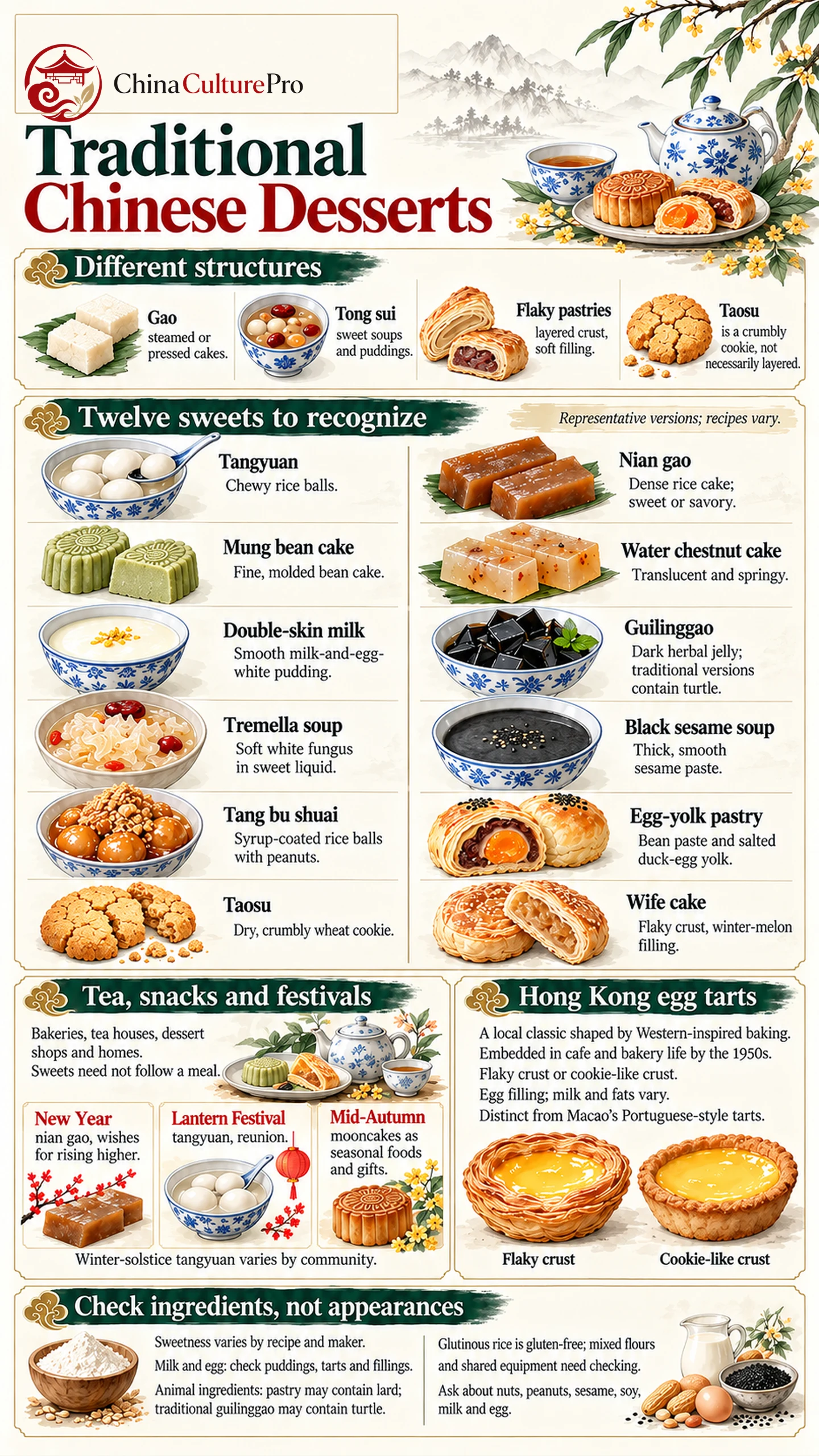
The following twelve examples emphasize the foods’ shape, texture and regional associations. They are a useful selection, not a popularity ranking or a fixed menu for every household. Recipes within one name can differ, so the descriptions identify representative versions rather than universal formulas.
| Dessert and Chinese name | Regional association | Main ingredients, form and texture |
|---|---|---|
| Tangyuan — 汤圆, tāngyuán | Many regions, with varied local serving traditions | Cooked glutinous-rice balls, either plain or enclosing a filling such as black sesame or peanut. The wrapper is soft and chewy; a filled version adds a rich center. This guide focuses on sweet preparations. The separate tangyuan and yuanxiao comparison explains their different preparation traditions.[3] |
| Nian gao — 年糕, niángāo | Many regional styles, including Jiangnan | Rice cakes made from glutinous rice, ordinary rice or a combination, depending on the style. Sweet versions can be dense, sticky and elastic. Shape, color and texture vary; the name also covers rice cakes used in savory meals rather than desserts.[3] |
| Mung bean cake — 绿豆糕, lǜdòugāo | Regional bakery traditions, including Jiangnan and northern China | A common form uses cooked mung-bean flour or a smooth bean mixture, sweetened and pressed into molds. Its texture is fine and compact, ranging from dry and crumbly to richer and softer when more fat is used. This molded bean cake is different from a flaky pastry containing mung-bean filling.[4] |
| Water chestnut cake — 马蹄糕, mǎtígāo | Cantonese tea food, especially associated with Guangzhou | A steamed cake based on water-chestnut starch and sweetened liquid, sometimes with crisp water-chestnut pieces. The cake is translucent and springy rather than fluffy. Some versions have distinct pale and golden-brown layers.[5] |
| Double-skin milk pudding — 双皮奶, shuāngpínǎi | Shunde and the wider Pearl River Delta | A delicate milk pudding known for its surface skins and smooth interior. Traditional preparations combine milk, often buffalo milk, with egg white and sugar. It has a clear dairy character and may be served plain or with toppings; it is not a plant-based pudding.[6] |
| Guilinggao — 龟苓膏, guīlínggāo | Lingnan, with a documented Wuzhou tradition | A dark, set jelly with an herbal flavor, often eaten with a sweet topping. Traditional Wuzhou preparations include turtle-derived material and smilax rhizome among their ingredients. Formulas differ, and the dark jelly should not be assumed vegetarian or confused automatically with grass jelly.[7] |
| Tremella sweet soup — 银耳羹, yín’ěrgēng | Home-style sweet soups in many regions | White fungus cooked in sweet liquid, often with ingredients such as red dates or lotus seeds. The softened, ruffled pieces remain recognizable within a thick, slippery soup. It is eaten with a spoon, with soft pieces suspended in the liquid rather than one uniformly set pudding. |
| Black sesame soup — 芝麻糊, zhīmahú | Cantonese dessert shops and other regional traditions | A dark, smooth, thick sweet soup or paste with a pronounced sesame aroma. Some versions include rice or another thickener. It is a spoonable sweet rather than the savory sesame sauce used in other dishes; consistency and serving temperature vary.[2] |
| Tang bu shuai — 糖不甩, tángbùshuǎi | Pearl River Delta, including Dongkeng in Dongguan | Chewy glutinous-rice balls coated in sweet syrup, commonly with crushed roasted peanuts. Some local versions add strips of cooked egg. The appeal is the contrast between the soft rice balls, clinging syrup and nutty topping, rather than a liquid soup surrounding the balls.[8] |
| Egg-yolk pastry — 蛋黄酥, dànhuángsū | Especially associated with Taiwanese baking; also widely sold elsewhere | A rounded pastry with a layered wheat crust, sweet bean paste and a salted duck-egg yolk at its center. A cut piece shows the flaky shell, smooth filling and rich yolk as distinct layers. The yolk adds a salty contrast to the sweet paste.[9] |
| Taosu — 桃酥, táosū | A widely sold bakery cookie with regional versions | A baked wheat-flour cookie with a dry, crumbly bite, often marked by surface cracks. Oil or other fat contributes to its texture; some versions include nuts or sesame. It usually has no soft filled center and should not be confused with a laminated, filled pastry. |
| Wife cake — 老婆饼, lǎopobǐng | Cantonese and related southern pastry traditions | A thin, flaky crust surrounding a soft filling, commonly based on sweetened winter melon. Sesame or other additions vary by recipe. The contrast is between the crust’s loose layers and the denser, yielding center; the name does not establish one fixed filling or an agreed origin story.[10] |
When and Where Chinese Sweets Are Eaten
The setting helps explain how these foods fit into a day. A bakery may sell pieces to take home or share with visitors. A tea house can offer sweet and savory dim sum together. A Cantonese dessert shop makes a bowl of tong sui a reason to sit down in its own right, with hot and chilled options rather than a requirement to order a full meal first.[2][14]
Home eating is equally flexible. A sweet soup can be a separate snack, while a cake may accompany tea or be served when relatives visit. These are possible settings, not a national timetable.
On a menu, look beyond the broad word “cake.” A slice of water chestnut cake offers a springy bite; mung bean cake is finer and more crumbly. A bowl of sesame soup provides a smooth paste, whereas tremella soup retains soft pieces. These texture differences are often more useful for choosing than an English dessert label.
Festivals add another layer of meaning:
- Lunar New Year: Nian gao carries an auspicious association with rising higher from year to year. It is one example within the wider range of Chinese New Year foods; ordinary rice cakes also have everyday uses.[3]
- Lantern Festival and winter solstice: Tangyuan’s round form is associated with reunion. Winter-solstice eating differs by community, as the Dongzhi food traditions show; it should not be presented as one rule for every family.[3]
- Mid-Autumn Festival: Mooncakes (月饼, yuèbǐng) are especially prominent as seasonal foods and gifts. Sweet and savory styles both exist; the mooncake guide covers crusts, fillings and regional differences. Their festival connection does not mean they can only be eaten on that date.
Traditional Desserts and Newer Local Classics
Egg tarts (蛋挞, dàntà) show why “traditional” need not mean unchanged since antiquity. Western custard tarts were adapted within Guangzhou’s food culture, and versions reached Hong Kong through its connections with Cantonese tea-house dining. By the 1950s, egg tarts were becoming embedded in the city’s expanding cafe and bakery scene.[11]
Hong Kong versions commonly offer a choice between a layered, flaky crust and a shorter, cookie-like crust. The first emphasizes loose pastry layers; the second gives a more compact, crumbly bite. Egg is central to the filling, while milk and the choice of fat depend on the recipe. The result is a locally established classic, with a history of adaptation still visible in its crusts and filling. Hong Kong egg tarts and Macao’s Portuguese-style tarts also have distinct local forms; one name should not make their recipes interchangeable.[2][11]
Sweetness, Ingredients and Dietary Needs
Traditional Chinese desserts have no uniform sweetness level. A dish that tastes delicate or comes in a small bowl may still have a sweetened base. Judge the particular recipe and portion rather than treating “Chinese” as a low-sugar label. A finished pastry cannot usually be made less sweet after baking; some soups allow adjustment, but premixed bases may not.
- Milk and egg: Double-skin milk pudding contains dairy and egg white; egg-yolk pastries contain egg. Egg tarts and other fillings may also contain milk, butter or milk powder. Confirm the actual recipe rather than assuming all three sweets have identical ingredients.[6]
- Animal-derived ingredients: Lard can be used in pastry, while other recipes use butter or vegetable fats. Traditional guilinggao can contain turtle-derived ingredients. A brown crust or a dark jelly is not evidence that a food is vegetarian or vegan.[7][14]
- Flour, fillings and shared equipment: Wheat-based pastries contain gluten. Nuts, peanuts, sesame, soy, milk and egg may appear in fillings or toppings. Ask about ingredients and preparation equipment when managing an allergy; a photograph cannot establish suitability.[13]
Glutinous rice itself is naturally gluten-free, but a finished sweet may include wheat-based ingredients or encounter allergens during preparation. Ingredient choice and handling are separate checks.[12][13]
FAQs About Traditional Chinese Desserts
Do Chinese people eat dessert after every meal?
No. There is no nationwide requirement for a separate sweet course. Cakes, pastries and sweet soups can appear as snacks, tea foods or festive dishes. Some meals end with something sweet, while others do not; household and restaurant practices differ.
Are traditional Chinese desserts always less sweet?
No. Sweetness varies by recipe, filling, portion and maker. A mildly flavored pudding and a syrup-coated rice sweet can taste very different. A dessert’s gentle flavor or traditional name does not establish that it is low in sugar.
Is nian gao always a sweet dessert?
No. Sweetened rice cakes are one part of the category. Other nian gao is used in savory dishes with vegetables, meat or soup. The rice cake’s name alone does not tell you whether the finished dish will be sweet.[3]
Does glutinous rice contain gluten?
No. In this name, “glutinous” means sticky; it does not refer to gluten. Plain glutinous rice is naturally gluten-free. For a prepared dessert, check mixed flours, fillings and shared-equipment risks rather than relying solely on the rice ingredient.[12][13]
Sources
[1] Nanjing Local Chronicles Office. 志说南京:金陵小吃江湖之糕点
[2] Hong Kong Tourism Board. 6 Must-Try Traditional Hong Kong Desserts
[3] Shanghai Municipal Government. A taste of Shanghai: Traditional New Year foods and their hidden meanings
[4] China.org.cn. 端午临近 徽味传统手工绿豆糕走俏
[5] Guangzhou Local Chronicles Office. 十大小吃之“泮塘马蹄糕”
[6] Guangdong Local Chronicles Office. 广东印记:双皮奶制作技艺
[7] China Intangible Cultural Heritage Network. 龟苓膏配制技艺
[8] Dongguan Municipal Government. 东坑糖不甩
[9] Jiu Zhen Nan. 蛋黃酥與廣式月餅有何不同?烏豆沙和紅豆餡一樣嗎?一次看懂中秋名餅的食材與工藝
[10] Guangdong Overseas Chinese Affairs Office. 饼中潮汕中秋月
[11] Siu Yan Ho, Chinese Cultural Heritage Research Centre. Pastry Egg Tarts
[12] Gluten Intolerance Group. What is glutinous rice and is it safe to include in a gluten-free diet?
[13] Food Standards Agency. Eating out or ordering food when you have an allergy
[14] Shanghai Information Office. Cakes to puff pastry: a panoply of desserts